

Today’s post is brought to you by my sponsor, Mechanize. They’re hiring junior software engineers at $300K/year base salary.
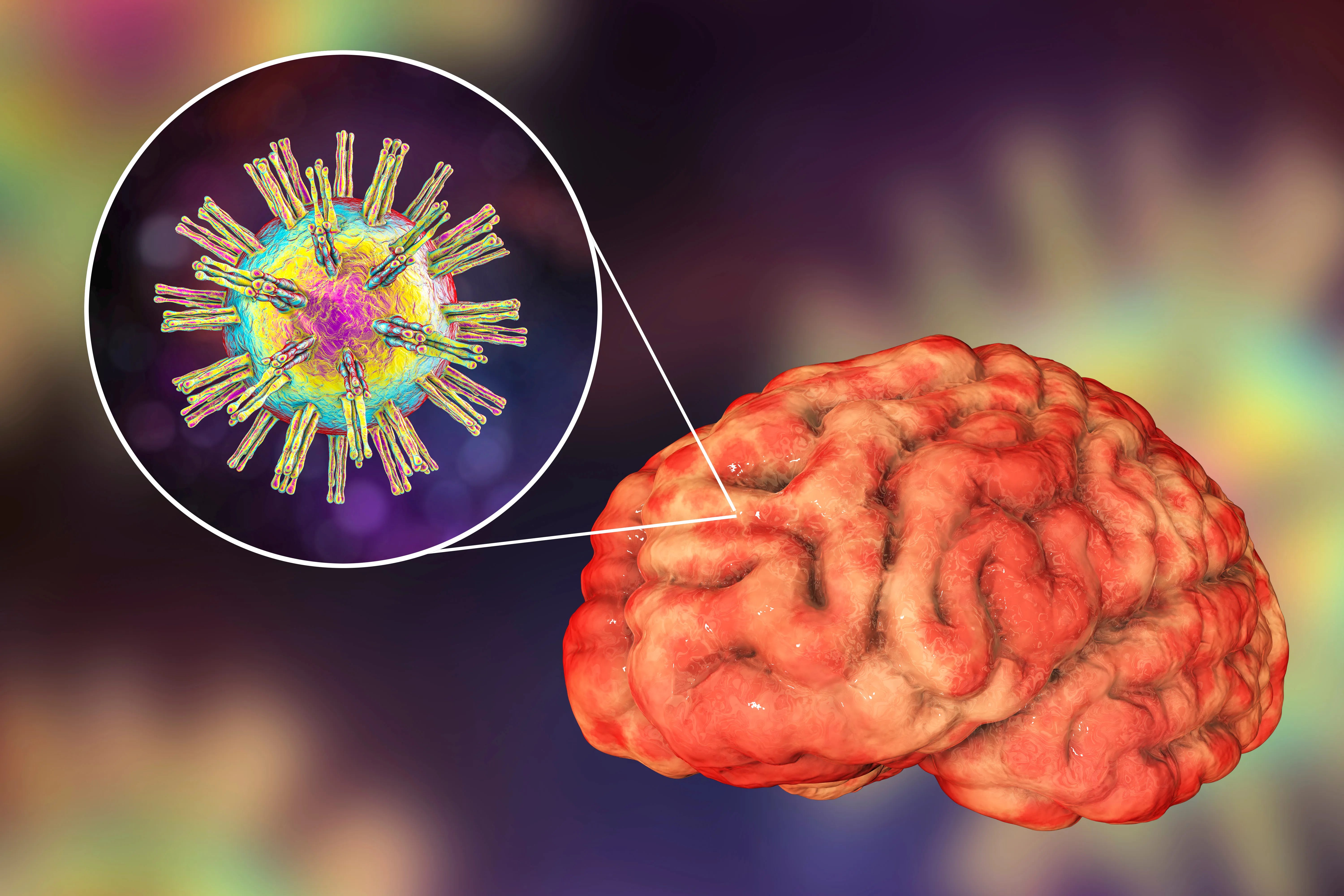
Chanda Chisala’s essay in Aporia, proposes that herpes simplex virus type 1 (HSV-1) spread to Black Americans after the Civil War through “a specific sub-subgroup of white Americans whose members were derisively called ‘white trash,’” and that its effects were significantly amplified for Black Americans by an inflammation-prone immune system, which in turn explains much of the Black–White IQ gap. In the article, he is very clear about what the theory depends on:
My hypothesis stands or falls on a prediction of much stronger vulnerability in Blacks to the full effects of HSV on IQ, health and behavior.
Thankfully, this is a falsifiable claim that can quite easily be tested. Chisala cites Tarter et al. (2014) as an example of the cognitive effects attributable to HSV-1. This study used the third National Health and Nutrition Examination Survey (NHANES III, 1988–94), and it tested 12–16-year-olds for HSV-1 antibodies along with administering the WISC-R Block Design and Digit Span plus WRAT-R Arithmetic and Reading subtests (WISC-R and WRAT-R are the Wechsler Intelligence Scale for Children–Revised and the Wide Range Achievement Test–Revised respectively). Both of these tests are psychometrically sound and not biased against any racial group, as they have equal predictive validity (Reynolds & Hartlage, 1979) and the same factor structure across races (Gutkin & Reynolds, 1981).
The Arithmetic Chisala’s Hypothesis Must Satisfy
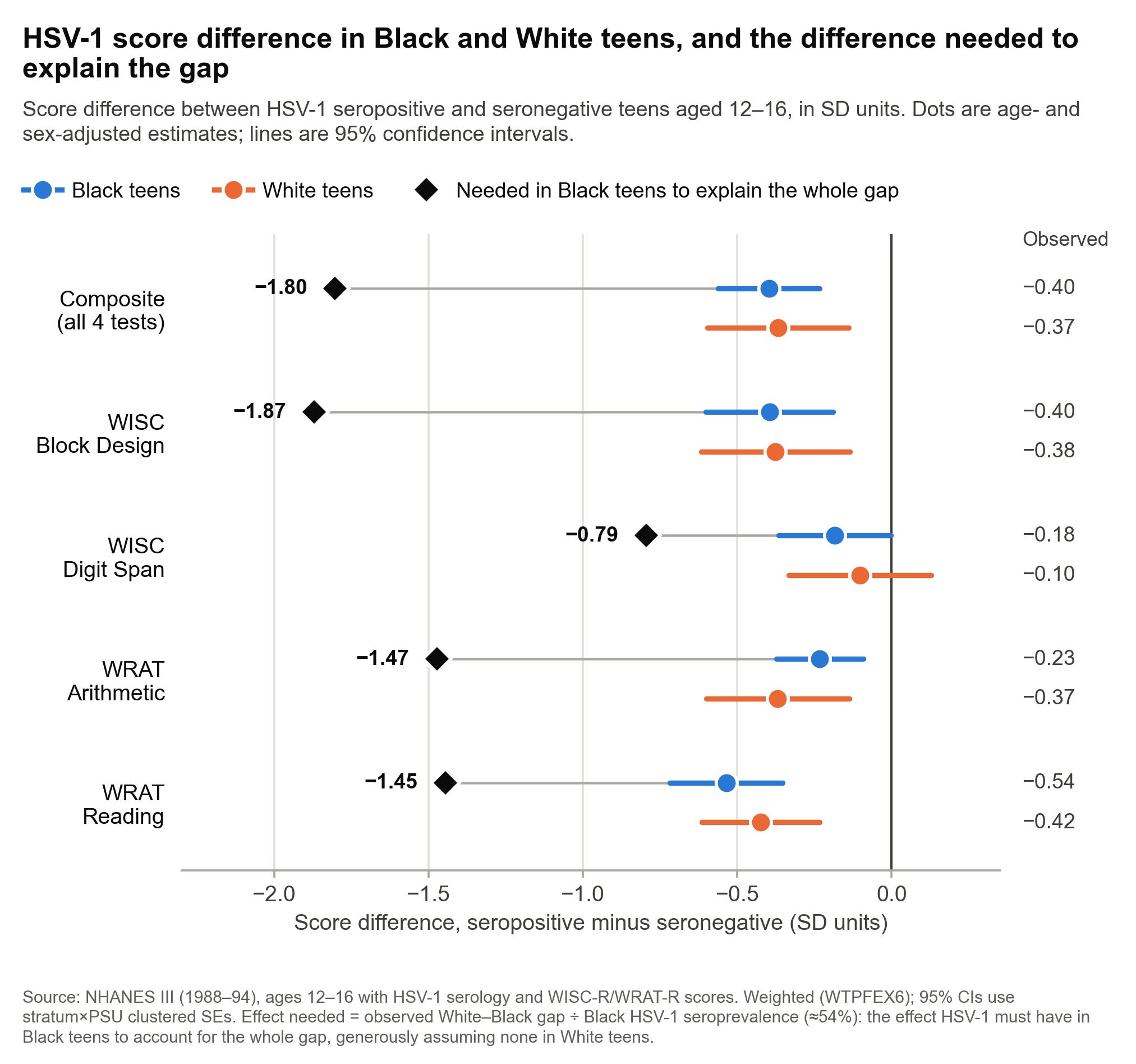
In the NHANES III sample used, the Black–White gap across all four of the subtests administered is 0.97 SD (14.5 IQ points), and around 54% of Black teens tested HSV-1 seropositive. If Chisala’s claims are true and HSV-1 does in fact explain the gap, being infected must cost Black children about 0.97 ÷ 0.54 ≈ 1.8 SD (27 IQ points). Even that figure is quite generous, as it assumes HSV-1 does no harm at all to White children, an obvious impossibility. The actual observed difference in the data between seronegative and seropositive teens is 0.40 SD for Blacks and 0.37 SD for Whites, meaning the required effect to satisfy Chisala’s claims is more than four times what we see, and this pattern holds across every subtest.
The Deciding Parameter
Chisala’s purported mechanism is a difference in vulnerability to HSV-1 infections between Blacks and Whites, meaning the same infection should hurt Black children’s cognitive ability much more than it does White children, and the statistic required to test this is the HSV-1 × race interaction. In other words, how much larger is the HSV-1 penalty in Black children than in White children? According to Chisala, it must be quite large. In reality, though, it is −0.03 SD (p = 0.82) on the composite, definitely not the roughly −1.4 SD required to satisfy his hypothesis, and none of the five outcomes (four subtests + composite) even come close to reaching the needed effect size with or without socioeconomic controls.
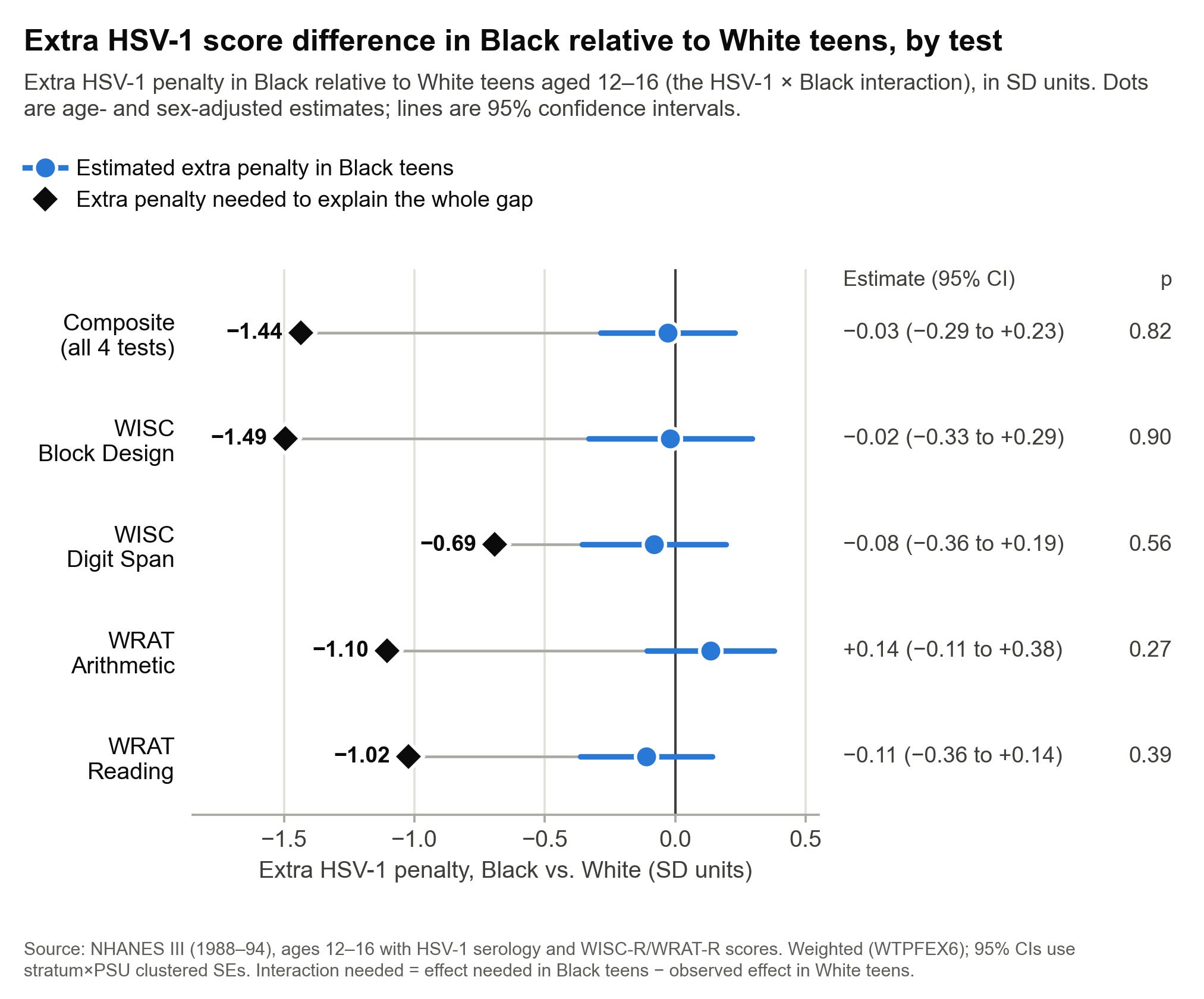
By Chisala’s own standard, his hypothesis fails.
Even Being Excessively Generous, HSV-1 Doesn’t Account For Much
If we suppose every observed association is 100% causal, the actual share of the Black–White gap that HSV-1 can account for can be represented by (Black prevalence × Black effect − White prevalence × White effect) ÷ gap, which on the composite is 9%.
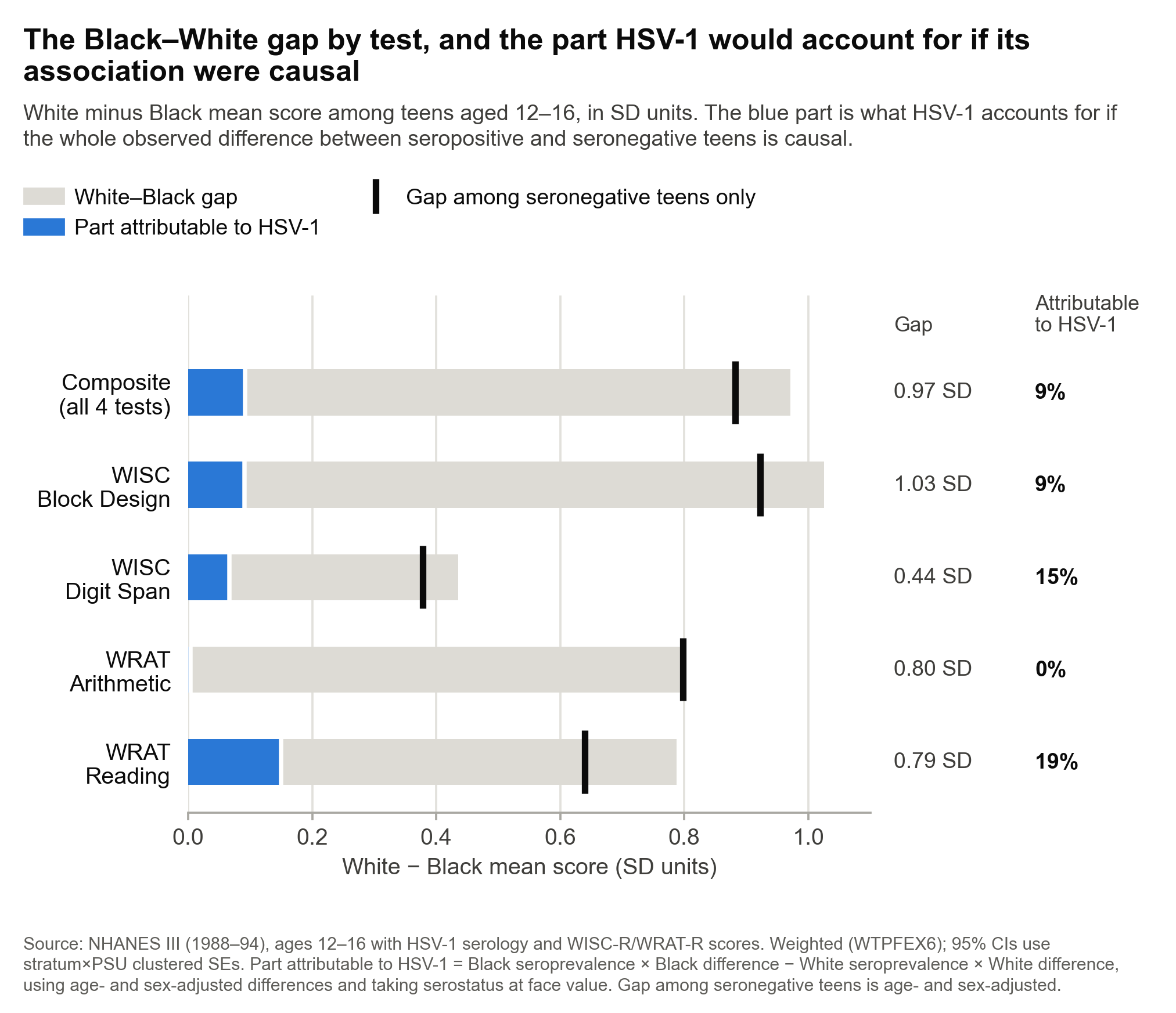
Another useful direct check is to simply look at children who have never been infected. If HSV-1 were truly a significant driver of the Black–White IQ gap, the gap should largely disappear among seronegative children. Of course, it doesn’t: the gap among seronegative teens is 0.88 SD on the composite and 0.92 SD on Block Design. Chisala presents Block Design as a “visuospatial puzzle” that HSV-1 explains, yet uninfected Black children show essentially the full Block Design gap! (It seems Chisala has forgotten to apply Spearman’s hypothesis, a much more parsimonious explanation for this “puzzle”; Block Design’s g loading in the WISC-R is .627 to .686; Naglieri & Jensen, 1987) This also resolves the objection that herpes reactivation frequency is what really matters, as reactivation can obviously only happen in people who are infected.
“The Test Misses Infections”
The only defense left to raise would be that seronegative children are secretly infected, or were exposed to the virus prenatally. Some degree of serologic misclassification is real (Kaufman et al., 2005, found HSV-1 DNA in 98% of healthy adults but antibodies in only 74%), but how much hidden infection would rescue the theory?
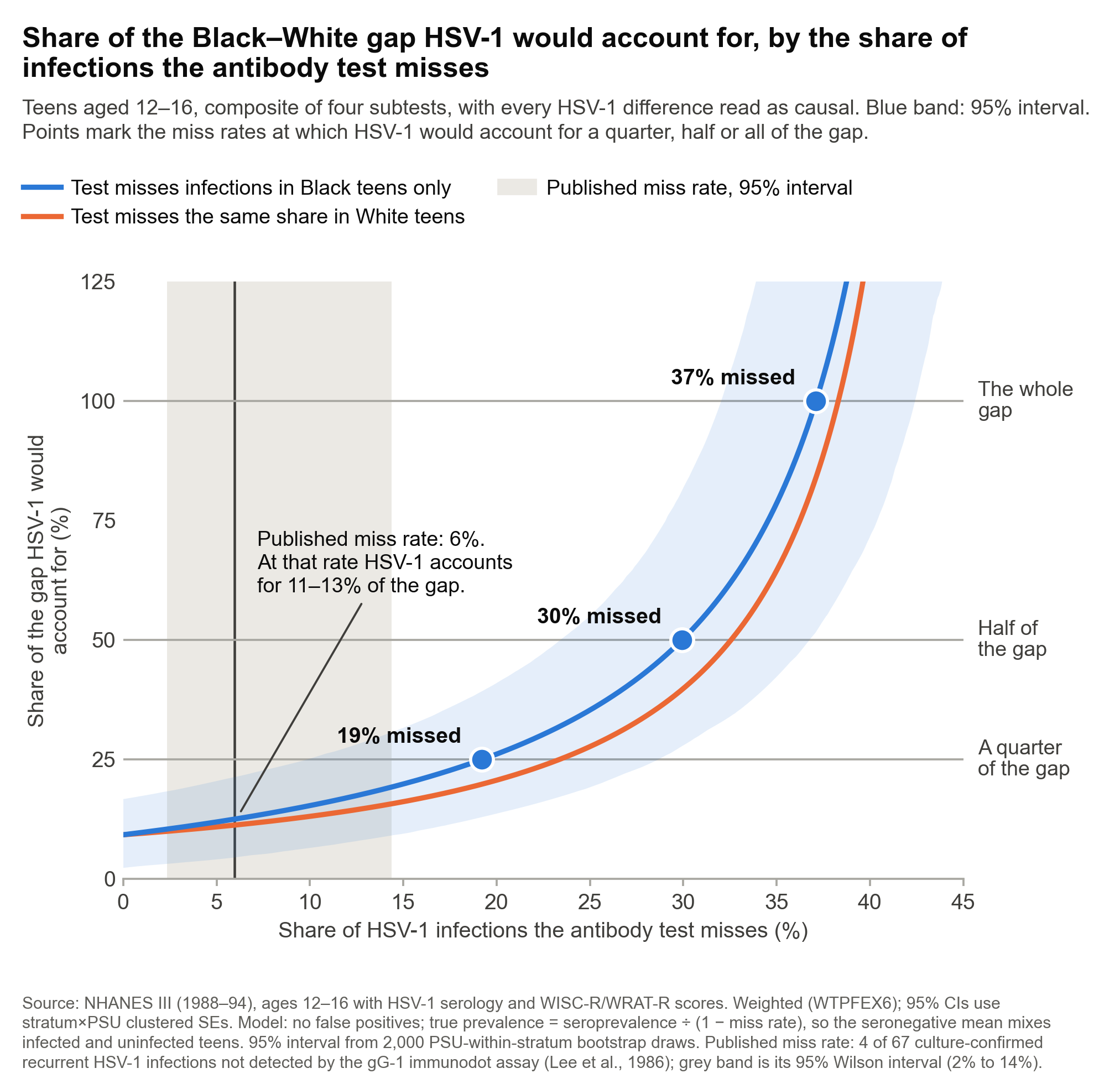
Two things:
If only Black children’s infections are missed, the theory is saved only if 70% of seronegative Black teens are actually infected (which means the test misses 37% of their infections) and it costs 1.28 SD (19 IQ points) per infection, an effect much larger than any reported in the literature. Using Kaufman’s numbers, truly uninfected Black children would have to score 1.3 to 3.9 SD above White children, with a per-infection cost of 2.6 to 5.2 SD!
If infections are missed equally in both groups, the gap among the truly uninfected closes only when the test misses 38% of infections in each race. At that point 73% of seronegative Black teens and 31% of seronegative White teens would be infected, and infection would have to cost 1.45 SD (22 IQ points) in Black children against 0.54 SD in White children. This is more than six times the test’s observed miss rate.
The prenatal version of the theory doesn’t rescue the theory either. NHANES III records each household’s reference person, so children can sometimes be linked to a female reference person (usually their mother), who also has an HSV-1 result recorded. Using this, we see that Black children ages 6–16 whose reference person is seronegative still trail White children by about 0.6 SD (95% CI 0.16–1.03; n = 83). Maternal HSV-1 is associated with lower scores for Black children, but this effect shrinks by a third with socioeconomic controls, and the Black–White difference in that association is not significant (p = 0.10), as the theory requires.
What Can We Conclude?
Chisala’s hypothesis rests atop a central quantitative prediction: HSV-1 negatively impacts the cognitive ability of Black Americans significantly more than it does White Americans. The data his own sources rely on clearly shows that this prediction is wrong. Chisala should have taken the 30 minutes required to run the direct test he mentions in his article.
The cognitive penalty of HSV-1 is essentially the same for Black and White children: it explains under a tenth of the Black–White IQ gap even under the most generous of readings and it leaves the gap almost intact among children who were never infected. In order to save his theory, we must assume that most children who test seronegative are secretly infected far beyond the rates of misclassification reported in the literature, and that the infection does damage far beyond the realm of possibility.
A message from my sponsor, Mechanize:
We’re hiring software engineers to build environments and evals that frontier AI labs use to train coding agents.
To get a better sense of the work we do, you can check out GBA Eval, where we had models build Game Boy Advance emulators from scratch and scored their performance.
Base pay starts at $300K/year for junior software engineers, with more for senior roles, plus equity and performance bonuses. Apply here.

