

Today’s post is brought to you by my sponsor, Mechanize. They’re hiring junior software engineers at $300K/year base salary.
If you talk to a member of the public about data centers, chances are, they’re opposed. The most common arguments in opposition also generally have a left-wing character, focused on the environment or the displacement of our precious farmlands and natural resources. For a quick overview, see my plot of Gallup’s latest polling:


The other common arguments are usually uninformed or silly, but also nonpolitical: opposition to noisy buildings, disdain for having to pay higher taxes, a fear of AI replacing human workers, and so on. Few of the arguments are solidly right-wing by any measure. But one argument did recently come across my feed, and while I don’t think it’s going to become a nationally prominent one, I think it could become prominent online, and from there, it would generate headaches and acrimony for everyone involved in the discourse: the claim is that data centers “attract a segment of the tech workforce that is overwhelmingly foreign, mostly Indian.”
This is an interesting theory, because it’s very obviously untrue if you’ve ever been in a data center. Data centers employ few people (~50 for a 250,000 square-foot data center is normal), about half of the employees are contractors, and basically none of them are H-1B workers. In fact, if we look at Census data on the demographics of the people working in data centers, the whole idea looks preposterous:1
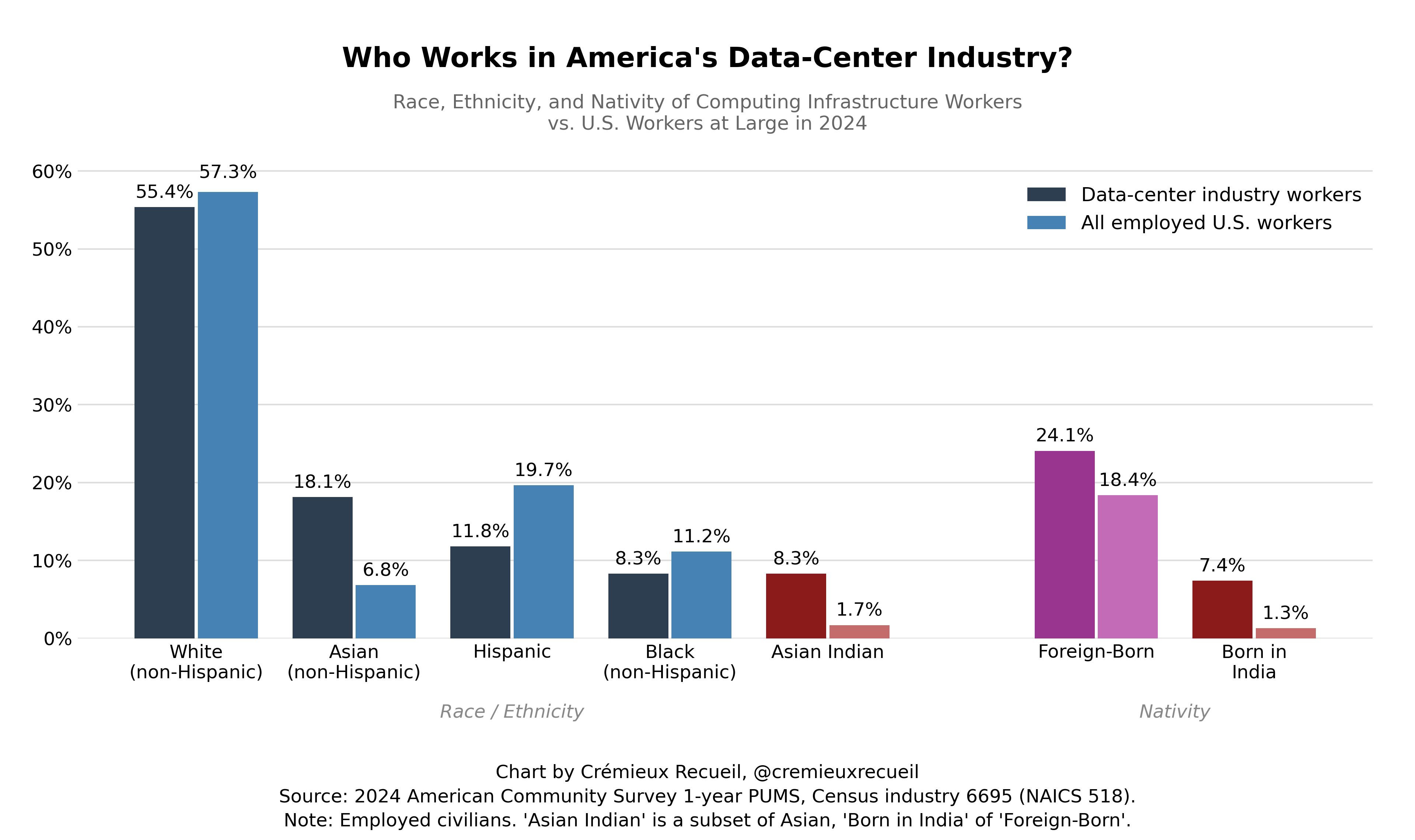
For most people, this is probably enough evidence to conclude that the claim about data centers attracting “a segment of the tech workforce that is overwhelmingly foreign, mostly Indian” is false, but there’s a way to defend the claim. One could argue that the alleged influx of Indians is due to the emergence of “the secondary ecosystem of cloud architects, IT engineers, consultants, and tech vendors that crop up in data center clusters.”
The evidence I’ve presented so far isn’t inconsistent with that idea per se, but if you know about the history of “data center clusters”, you’ll know that this claim is also false. If you understand data centers and thus that they do not create said secondary ecosystem, you’ll also realize the error in this idea. What’s more, we can rigorously demonstrate its inaccuracy with more data from the Census.
The Ecosystem Story
Does the construction of data centers spawn a secondary ecosystem composed of cloud architects, IT engineers, consultants, and tech vendors in the local area?
The first way to look at this is to treat any data center opening as the trigger, and the second is to look at places with >1 data center opening, so that the thing we’re looking at is definitely a “cluster” of data centers. The choice of operationalization doesn’t matter, however, because either one (and at any scale, hyper or not) fails to support the idea that these things cause a tech cluster—Indian-filled or otherwise—nearby.
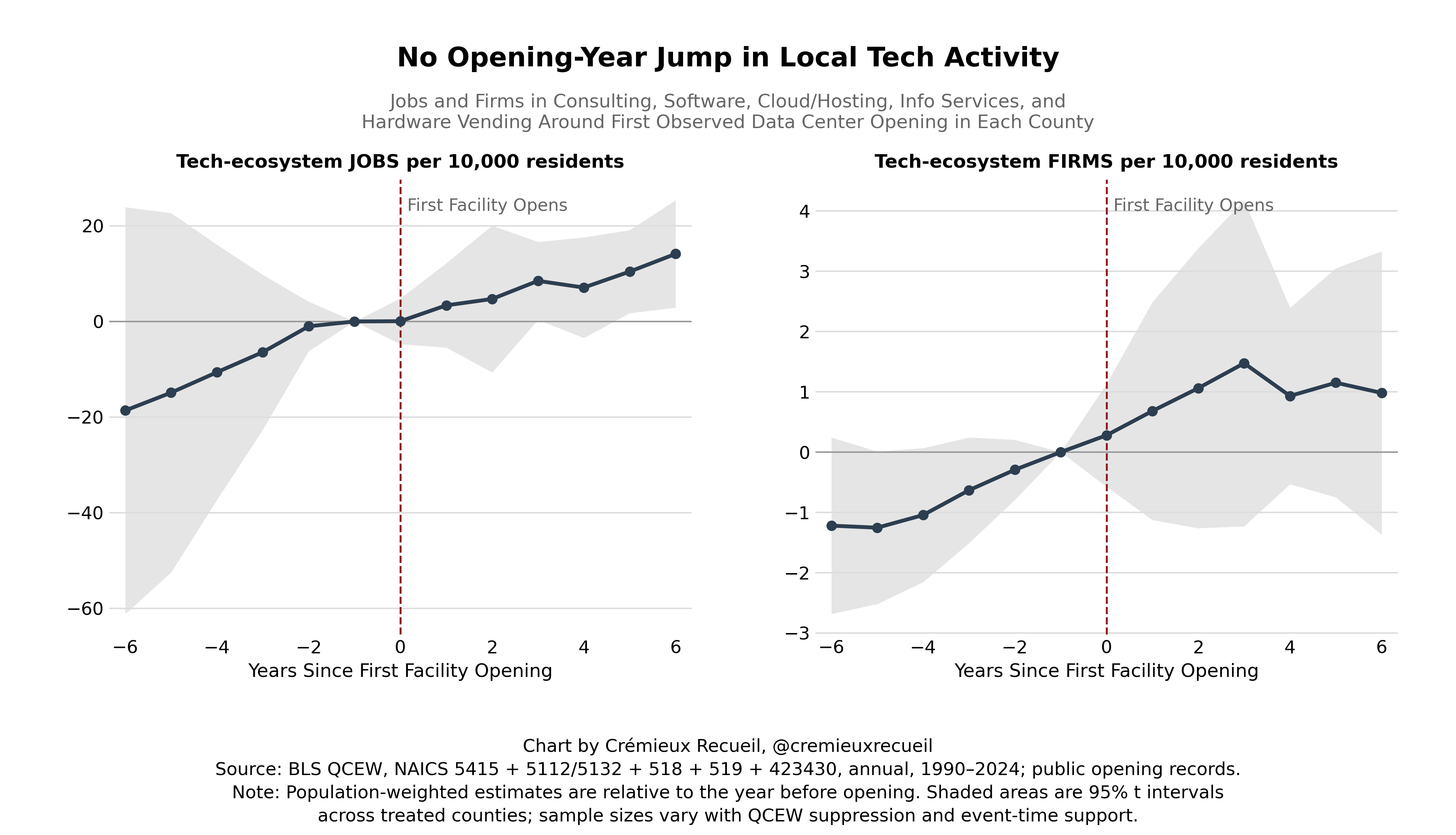
That claim can be considered debunked.2
The Indians and Foreigners Story
Now, the whole idea that data centers attract “cloud architects, IT engineers, consultants, and tech vendors” would seem to contradict the idea that they also attract bunches of Indians. Unless we focus in on IT engineers—which Indians are quite overrepresented among—, then we’re at a loss with how to make this story about Indians, because Indians are not massively overrepresented among the other listed occupations. But, let’s test the claim anyway by looking at data center establishment effects on numbers of Indians.
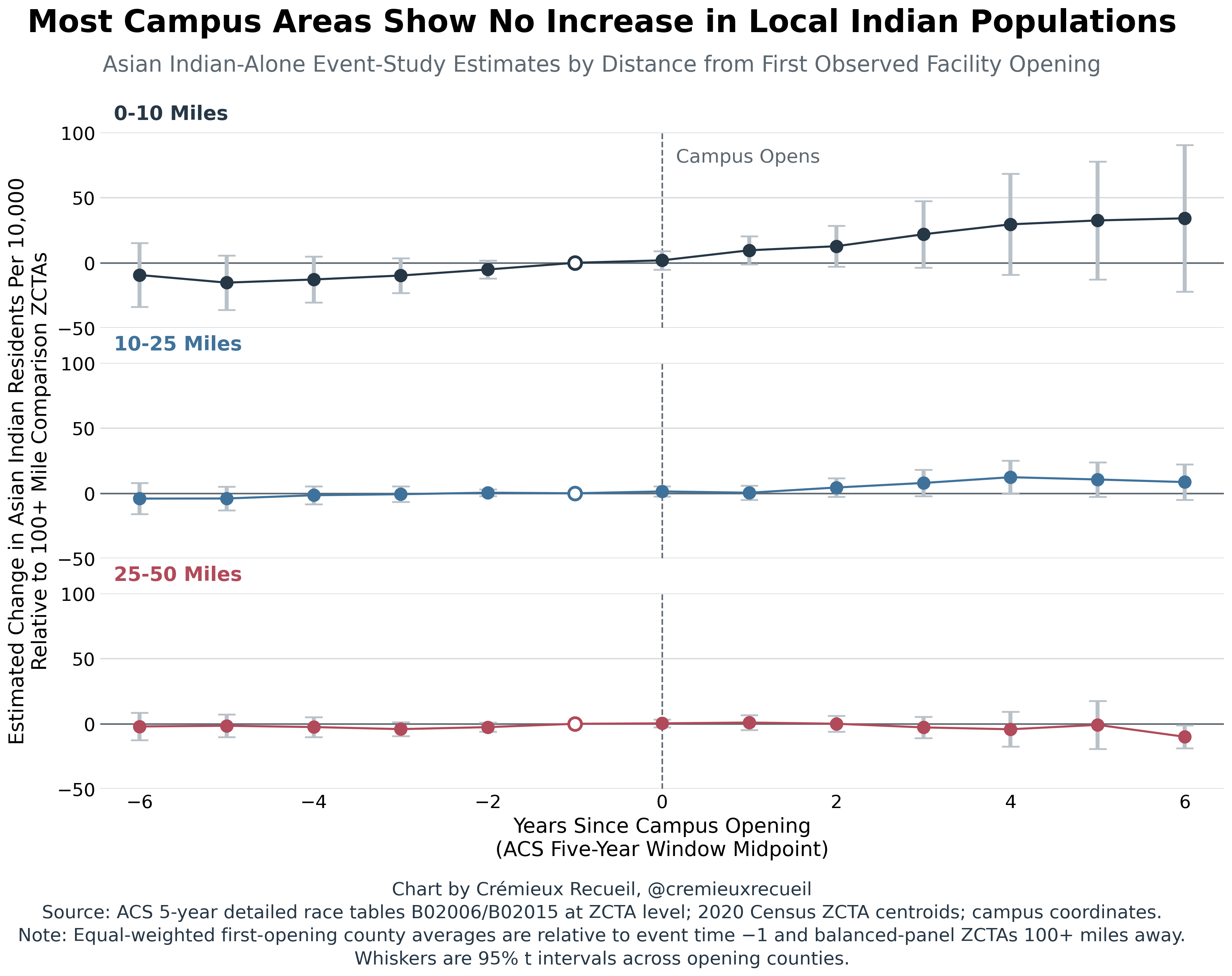
This claim can be considered debunked.3
Indians do not show up in meaningful numbers in the areas around data centers. In fact, they tend to show up further away from them, within tech metro exurbs. The more plausible theory, with real evidence behind it, is that Indian tech professionals go where there are suitable jobs, where there’s demand and the possibility for people to fill tech jobs, as professionals of any race or ethnic background tend to do.
Who Cares, Anyway?
Well, for one, many people within the current Trump administration. There’s a lot of anti-Indian sentiment right now among appointees and pundits, and this mostly has to do with H-1B employment being seen as a means of taking away American jobs. H-1Bs don’t do that in aggregate, and in fact they stimulate employment and innovation in America, but I digress. The point I want to make is that the people against Indians are the people who care, and some of them have the power to turn this disdain into an actual cudgel against data centers, even if they might like data centers in the abstract.4
So let’s reassure those people: there’s no merit to this, one of the few right-wing anti-data center arguments. It can only be supported through ignorance of what data centers are and who works in and around them, and ultimately, it is simply false.
You can find everything needed to reproduce my results and more5 in this zip. Happy coding!
A message from my sponsor, Mechanize:
We’re hiring software engineers to build environments and evals that frontier AI labs use to train coding agents.
To get a better sense of the work we do, you can check out GBA Eval, where we had models build Game Boy Advance emulators from scratch and scored their performance.
Base pay starts at $300K/year for junior software engineers, with more for senior roles, plus equity and performance bonuses. Apply here.
Note: This chart shows people described as “Asian alone”, not “Asian alone or in combination”, and people who describe as “Asian Indian alone” rather than “Asian Indian alone or in part”. The shares for partials were 20.5% (8.2% of all employed) and 8.5% (1.8% of all employed)—not much different for Indians, and a bit more different for Asians generally.
I have explored this in more depth than I’ve shown here and you can go see that in the replication materials.
I have explored this in more depth than I’ve shown here and you can go see that in the replication materials.
I thought about including a bit about how Indians make for some of the best immigrants in America right now and this argument against data centers would be silly regardless, but ultimately elected not to because it seemed superfluous and boring. I debunked a false story about Indians and I think that’s sufficient content for the article.
But a word of warning: I would not invite people to play the game of arguing that the right-wing anti-data center argument I’ve debunked here is a positive story and if it were true, it would represent a point in favor of data centers. Playing into the idea of ethnic replacement in general and in specific industries in particular feeds into resent. It’s best to reduce mentions of this sort of thing to the extent we can. Animosity is not beneficial.
I ran so many robustness and sensitivity tests and so many different permutations of these event-studies, and my results were robust. I’d be surprised if anyone can find a plausible, justifiable specification that provides anything more than very weak support for the original idea. And, chances are, if you imagine a viable specification that tests this theory, I already ran it.
CCP coming up with new talking points everyday, you have to give them credit for the creativity