

Today’s post is brought to you by my sponsor, Mechanize. They’re hiring junior software engineers at $300K/year base salary.

A new paper in the Proceedings of the National Academy of Sciences (preprint here) seems to show that people who experienced lower access to sugar when they were kids are less likely to have cancer when they’re old and gray. The authors’ proposed mechanisms for this relationship are two-fold, one behavioral, one biological:
“Rationed cohorts consume less sugar, eat smaller quantities, and maintain healthier, more diverse diets five decades later, consistent with persistent taste preferences shaped during a critical developmental window.”
“Rationed cohorts exhibit longer leukocyte telomere length (0.05 SD, approximately 2.2 fewer years of biological aging) and lower Granzyme B, indicating reduced chronic immune activation.”
But this doesn’t sound very strong to me. I need to see a lot better evidence before I’m willing to believe something in a domain as amply studied as oncology.
I am seriously disposed against this paper’s conclusions for a few reasons. The first of them is that it’s just not a clean test. The way the authors got their result was by leveraging the U.K.’s WWII-era sugar rationing.
The big issue is that sugar wasn’t the only thing being rationed at the time: tea, sweets and chocolates, eggs, cream, bacon, butter, margarine, cooking fats, cheese, and various meats were all also rationed to different degrees, with rationing ending around the same time. Changes also continued, giving us more exploitable variation in consumption the authors didn’t use. But when I use it? I get a bunch of nothing:
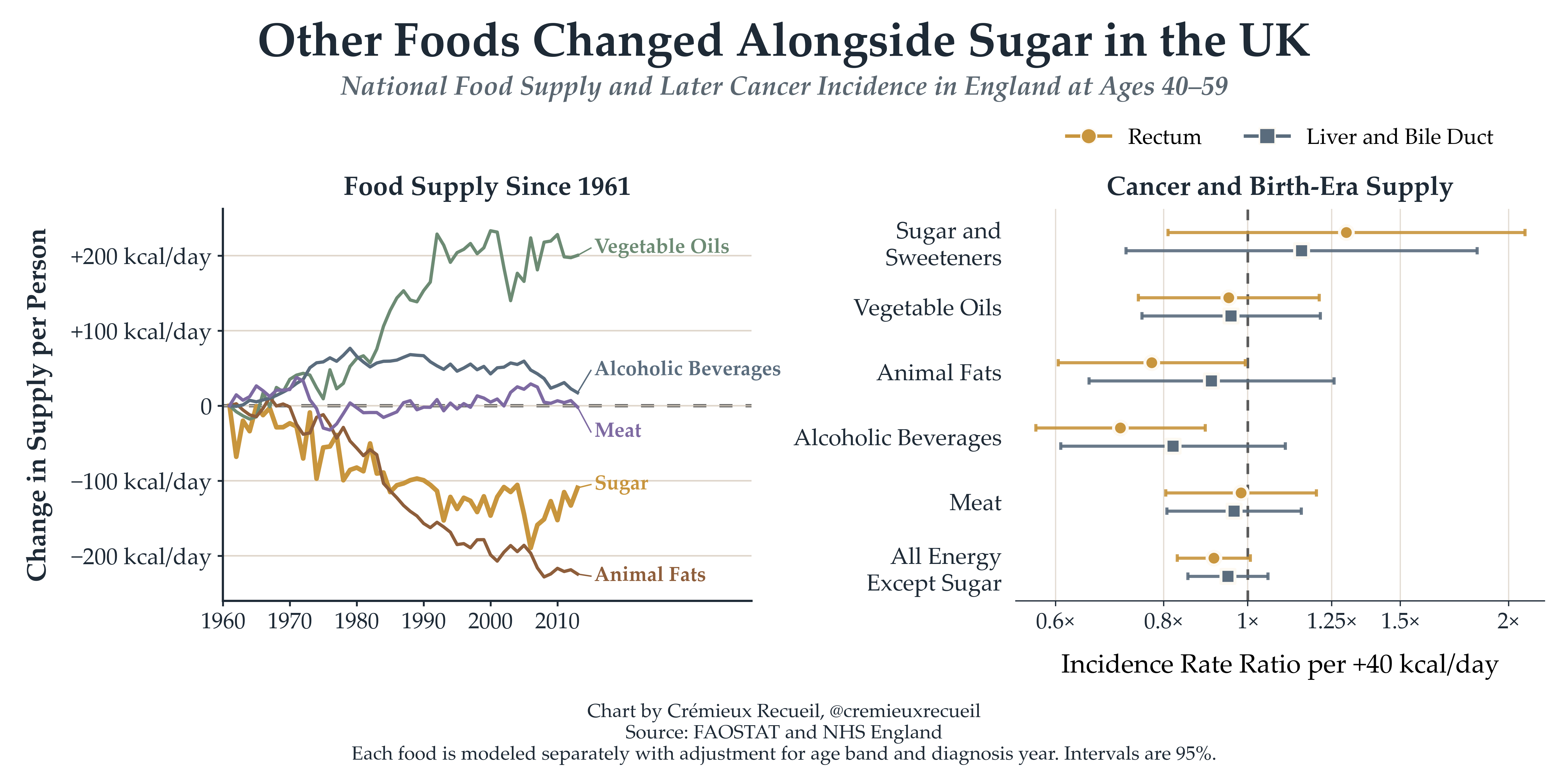
On the less substantial and more statistical side of things, the authors made a number of decisions that weren’t sensible or consistent. Their models? Hard to verify.1 Their bias tests? Not reassuring.2 The proposed dietary mechanism? Selectively presented.3 And the results just aren’t robust to shifting the cutoff for the assumed end of rationing—this is important because it wasn’t a discrete event—4, plus the results don’t replicate! They don’t replicate within the U.K. or in other countries either.5
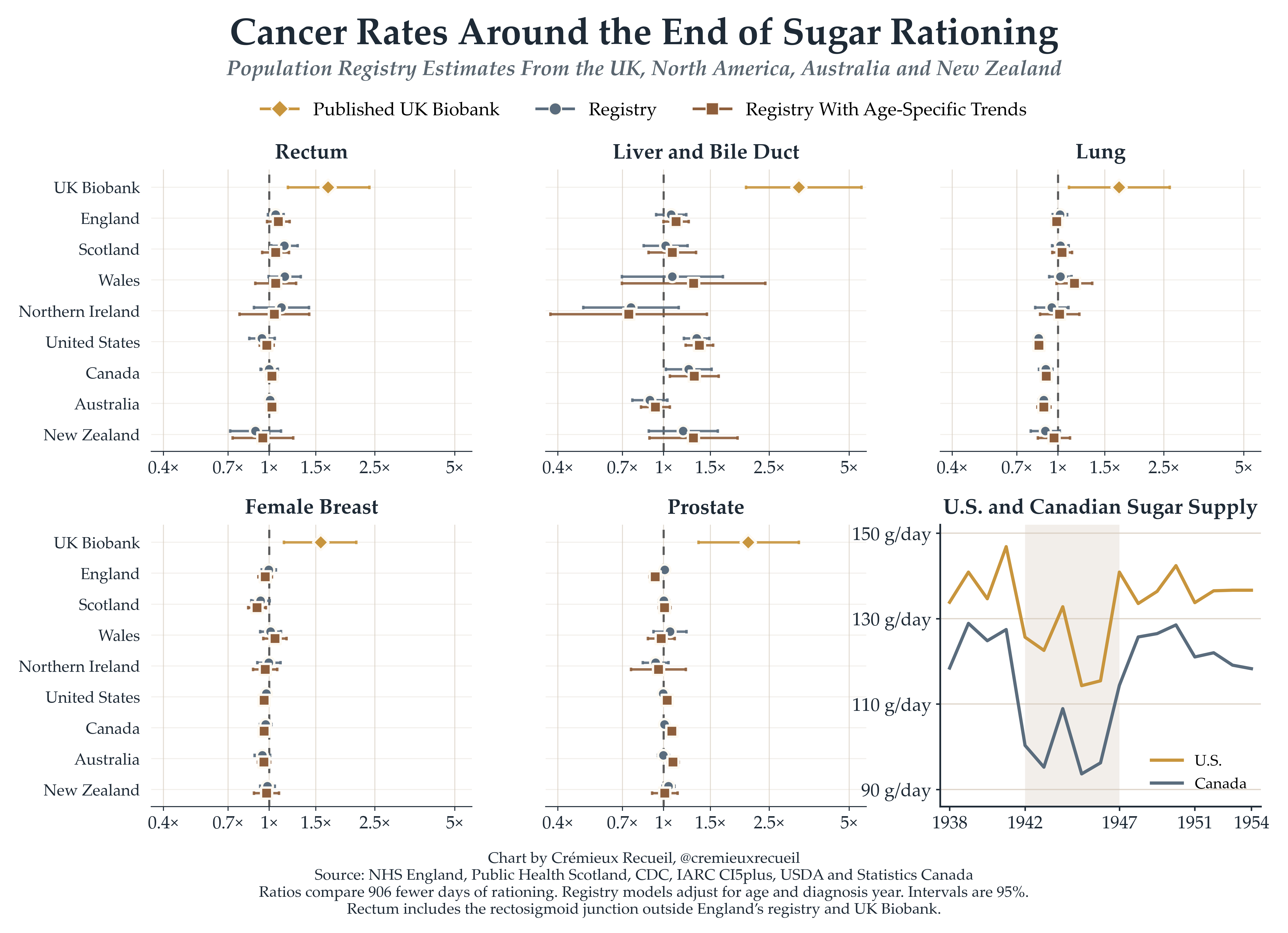
Using registry data from the U.K., we should be able to exactly reproduce the U.K. Biobank-based result from the paper (and the other recent paper on this topic), but it doesn’t show up: not in England, nor in Scotland, Wales, or Northern Ireland, and for other rationing programs, there’s also no signal across the rest of the Anglosphere.
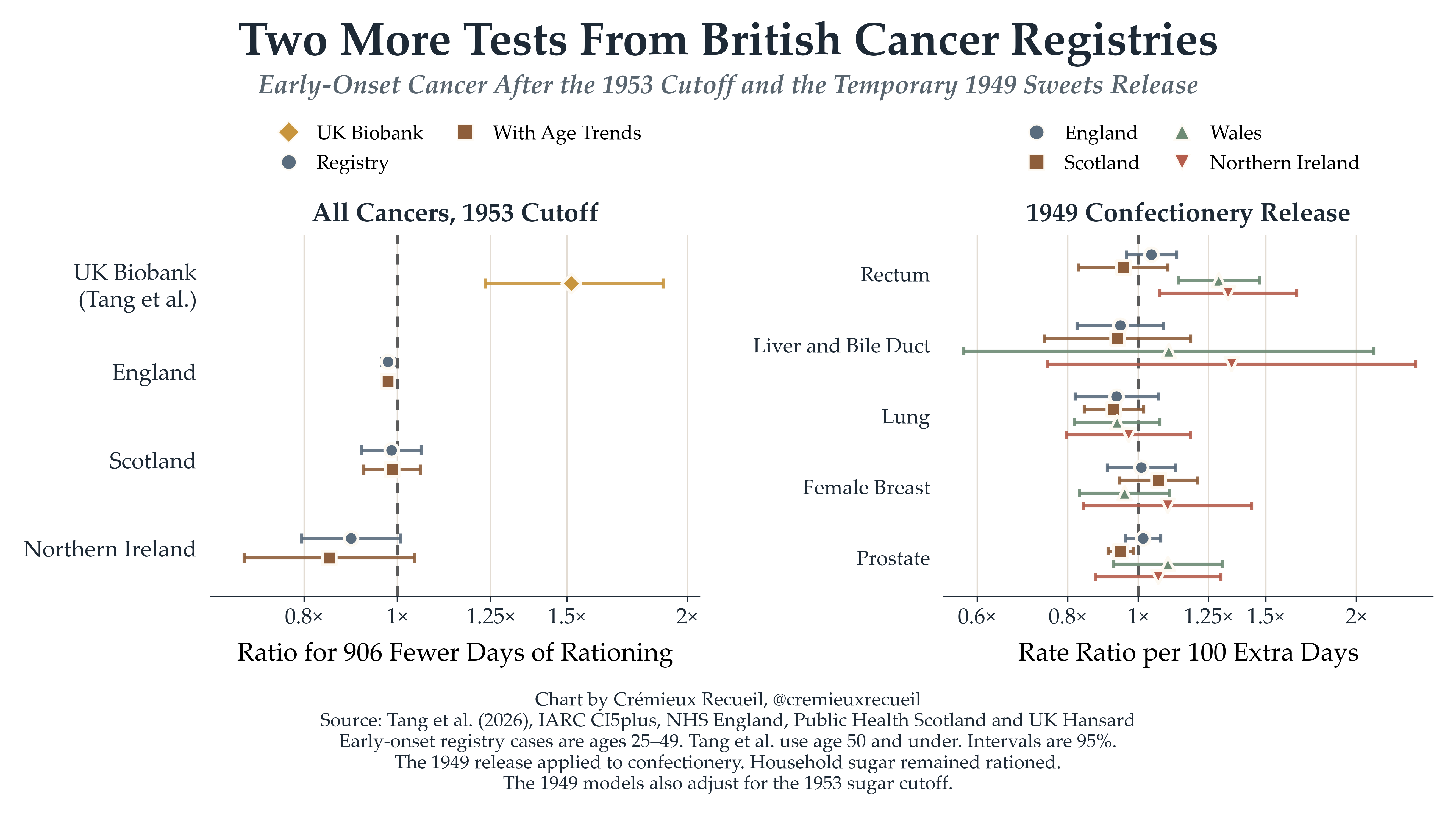
We can run more tests beyond the ‘sugar rationing’ test that the authors invoked, too. For example, we can look at effects on all cancers—not just a select few—around the 1953 cutoff, or we can leverage the temporary 1949 release of sweets rationing. Neither shows any signal that’s consistent, large, or robust.
If we leverage data from the U.S., we can compare what the study implies to what that shows and see that the implied effect just doesn’t show up for Americans. But do we really think Americans are so different from the British? Hardly.
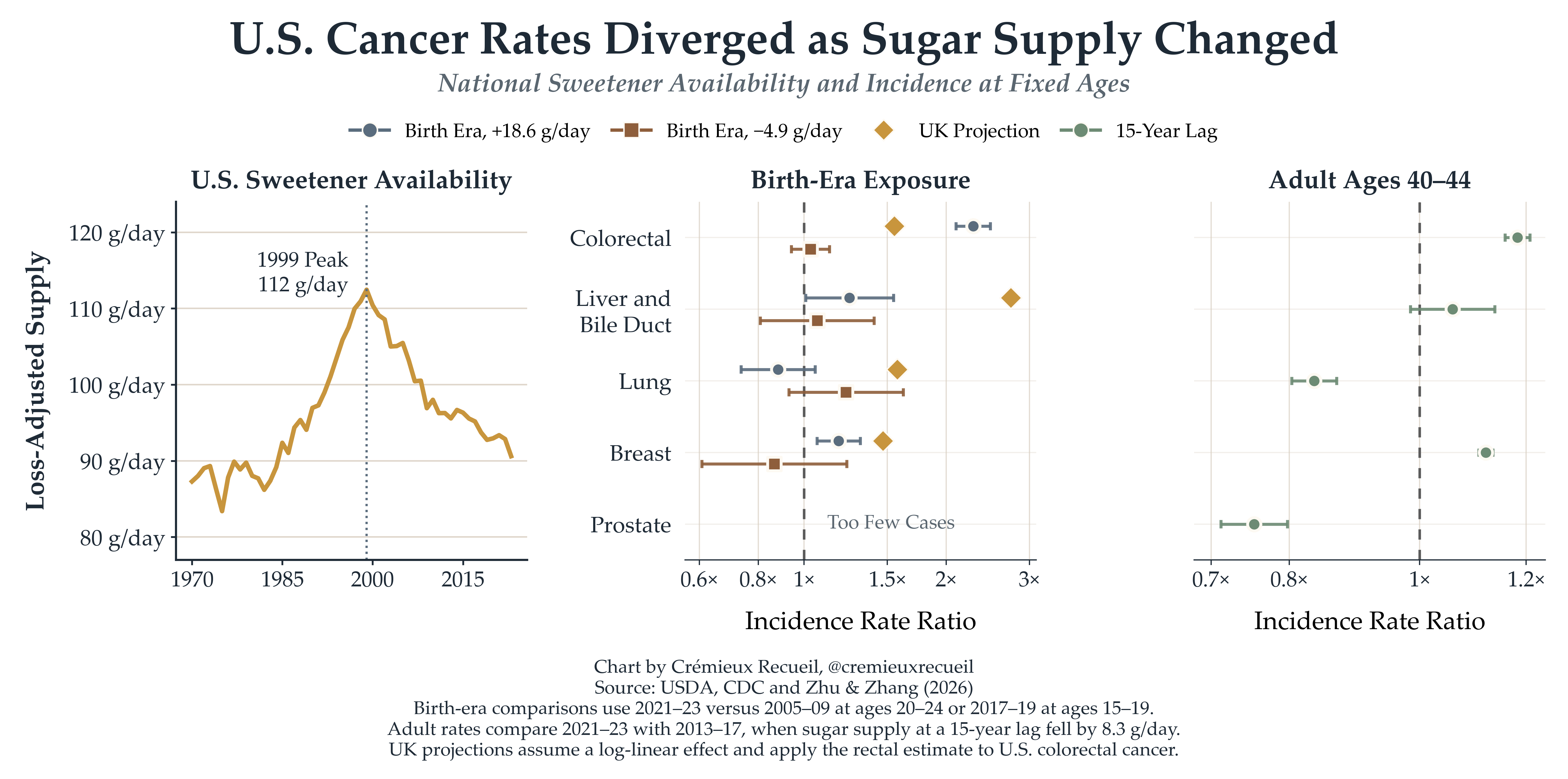
What if we want to check the basic assumption of the paper, that you can use rationing eras as proxies for sugar consumption? We can do this with American data because America rationed too, and we can see if cohorts exposed to less of it in their early life, more of it in their early life compared as expected based on measured consumption data from the USDA. This test doesn’t work:
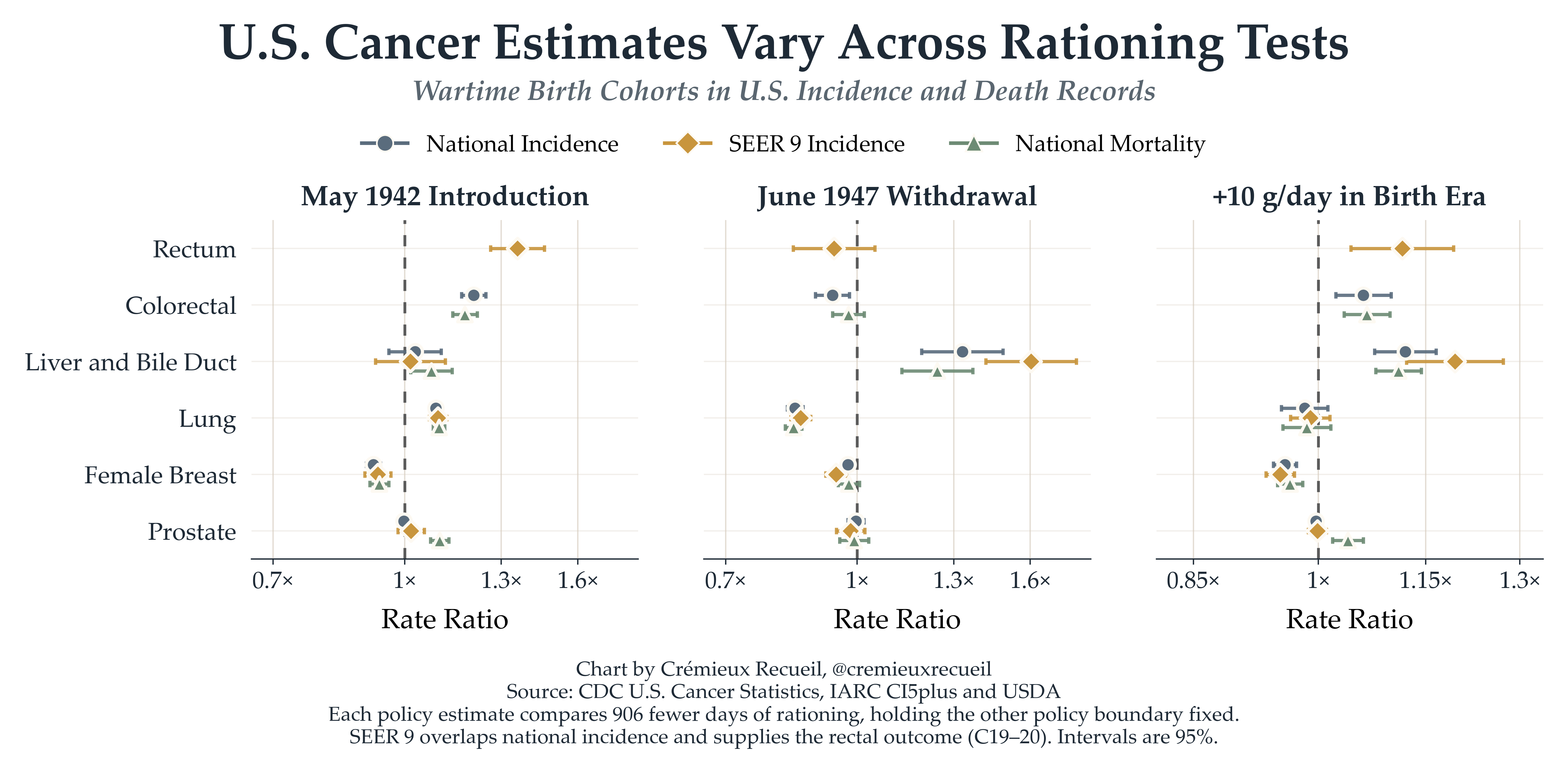
Let me wrap this up. The short and simple thing that I’m saying is that I just don’t believe these papers claiming that limited early access to sugar drives down cancer rates later on. They’re not supported by strong mechanisms, behavioral or otherwise. They’re also plausibly explained by selection:
In Tang et al. at least 99.2% of U.K. Biobank participants had already turned 50 before enrollment. Older cohorts had more time after diagnosis to die or become ill to enroll. So, with identical underlying cancer incidence, one model produces an odds ratio of 0.75 versus the observed 0.67 from the paper. A different model with the same five-year survival produces a null 0.91.
In Zhu and Zhang, their checks aren’t reassuring about who survived and volunteered into the study, and the public replication package leaves the follow-up rules unverifiable. Estimates flipped based on small differences in which births were compared, and data that should’ve delivered the same results didn’t.
Just ask yourself: What’s more likely? That cancer causes massive amounts of cancer with a fifty-plus year lag, or that the incorrectly-described and inconsistently-documented methods to reach that conclusion weren’t that good? I know what I think.
A message from my sponsor, Mechanize:
We’re hiring software engineers to build environments and evals that frontier AI labs use to train coding agents.
To get a better sense of the work we do, you can check out GBA Eval, where we had models build Game Boy Advance emulators from scratch and scored their performance.
Base pay starts at $300K/year for junior software engineers, with more for senior roles, plus equity and performance bonuses. Apply here.
