

Genetic evidence and trials suggest seed oils are not harmful: they don’t make people fat, they don’t cause inflammation, they don’t cause cardiovascular disease, and so on.
Given all of that, why are people worried about seed oils? Not for any good reasons. Most of the anti-seed oil hype has to do with feelings that they’re unnatural, that they’re prepared in bad or disgusting ways, and so on—not on the basis of any meaningful, clinically acceptable evidence. The best arguments are based on mechanistic reasoning, but mechanistic reasoning sets up a game of ‘he said, she said’ because proponents of replacing saturated fat with mono- and polyunsaturated fats, seed oils, whatever, also have their own technical, mechanistic arguments and the bulk of the causal evidence.
The usual outcome when the trials and genetic evidence are pointed to is that opponents of seed oils will make some sort of excuse. They seem fully capable of always finding a way to say that seed oil intake was mismeasured or some obscure control variable was needed and not present. These excuses reek; I have never seen one that’s principled or which seed oil opponents will reliably stick to. In one moment, a study will be deficient because it used the wrong measure, and in the next, when that measure seems to correlate with something bad, they’ll accept it once more.
Let’s establish a baseline. Everyone says ‘correlation isn’t causation’, so let’s just check what the correlations between seed oil intake and various health variables are.
For this analysis, we’ll be using the CDC’s nationally-representative National Health and Nutrition Examination Survey (NHANES) dataset. For all analyses, we’ll be controlling for age with natural cubic splines with four degrees of freedom, survey weights,1 normalized weights for logistic regression,2 and robust standard errors for the weighted least squares regressions.3
To measure seed oil intake, I will be using dietary and plasma linoleic acid and, to supplement, I’ll also be using dietary and plasma n-6:n-3 ratios. All of these has been used and apparently been suitable for seed oil bashing by opponents of seed oils. Thus, they must be valid generally, and the only objection will have to do with the measurements in the NHANES. But, the measurements in the NHANES have also been used to note increasing seed oil intake and to attack seed oils, so again, opponents will have to denounce their evidence if they want to attack these results.
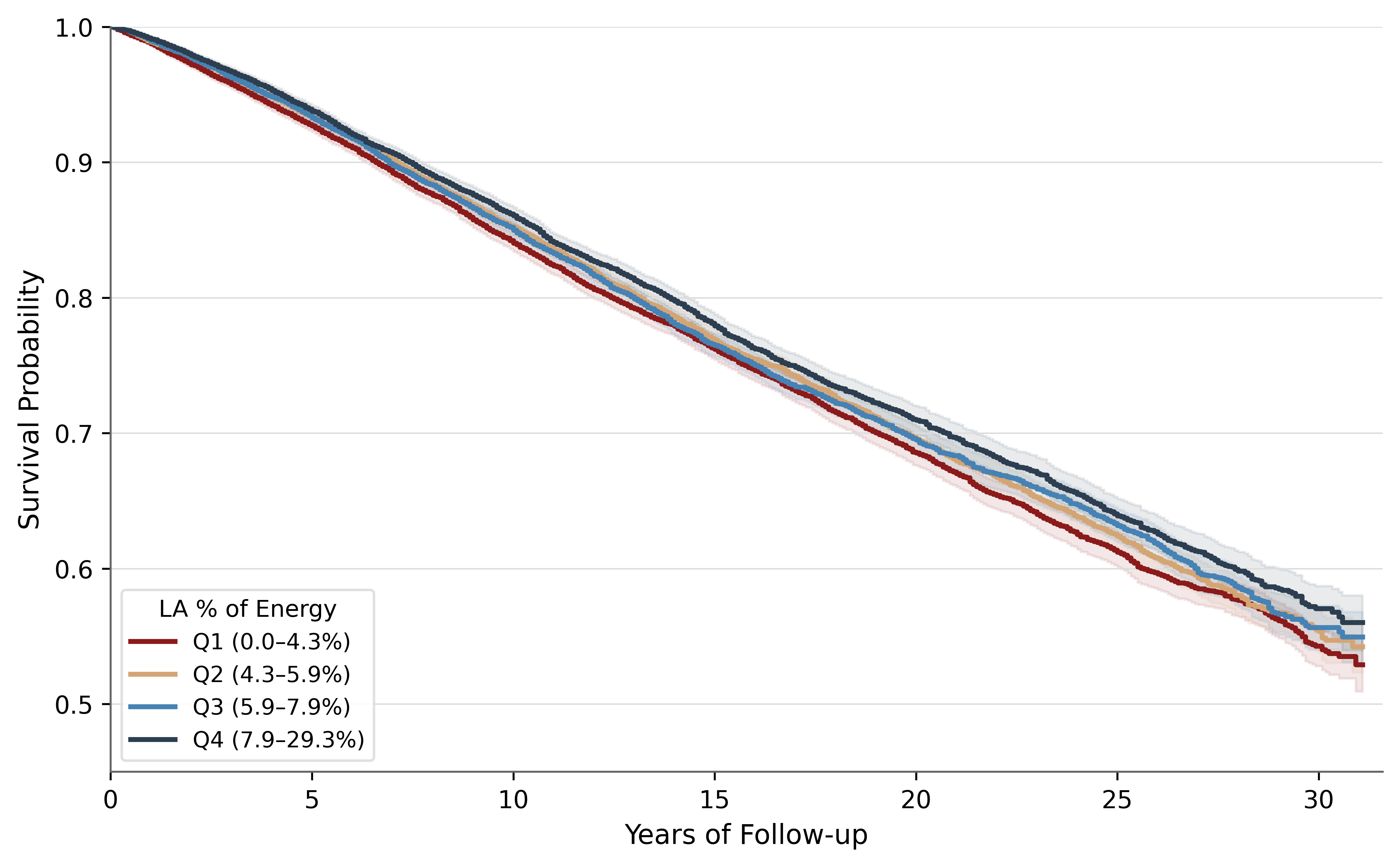
Seed oils aren’t even correlated with bad outcomes. Nor is canola oil intake or the n-6:n-3 ratio. But saturated fat is, in case you were wondering. Here’s a revealing big-picture graph: people who got the largest share of their diets from linoleic acid have the lowest risk of dying over just over 30 years of follow-up.
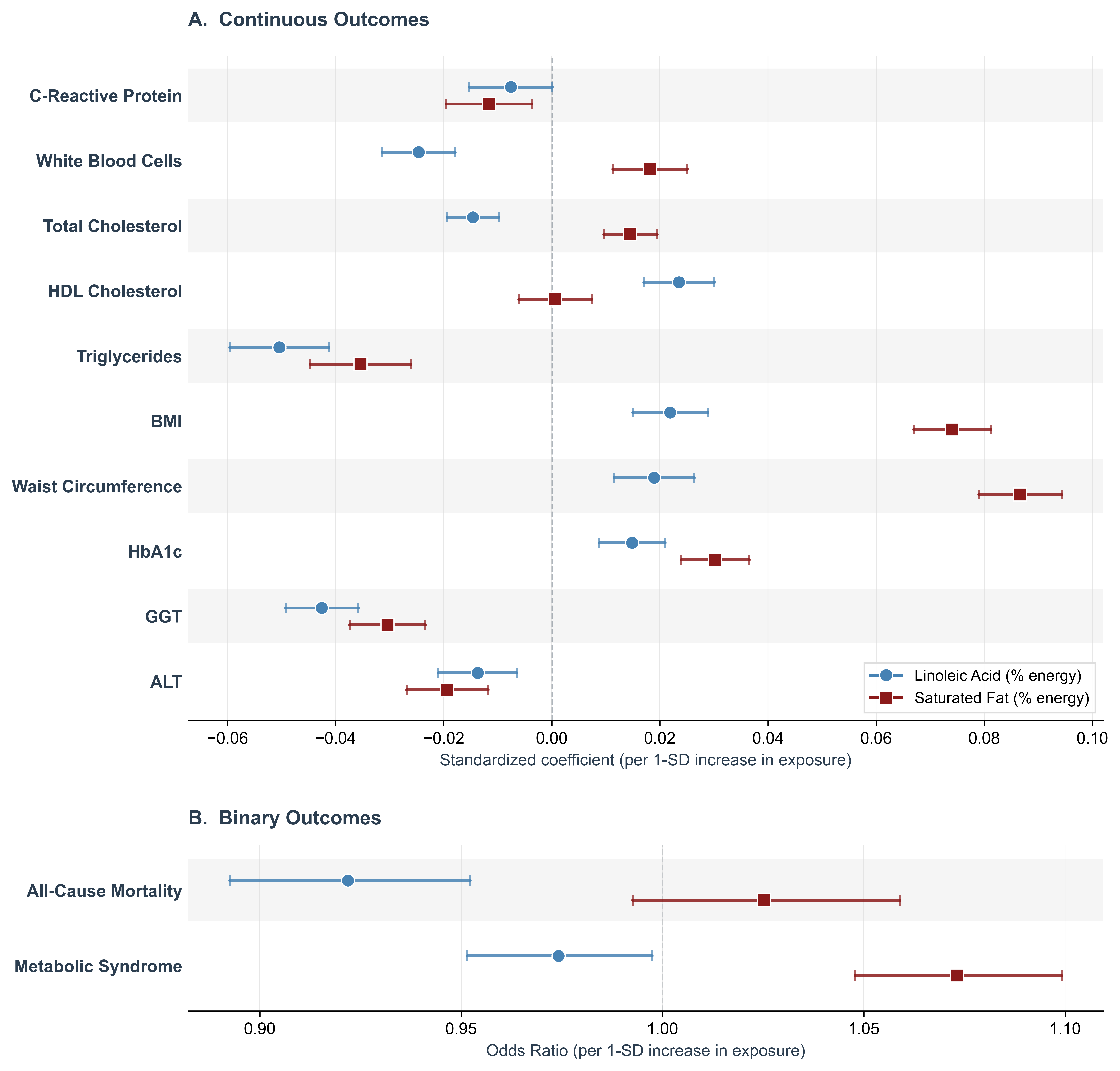
Cross-sectionally, linoleic acid was associated with lower inflammation, cholesterol, and triglycerides, with more worrying positive associations with HbA1c, which are the same or worse for saturated fat.
The bad associations for linoleic acid are driven by dietary confounding—more linoleic acid just means eating more. This is easily corrected, just switch to plasma measures of linoleic acid. With those, the bad associations fall away, the good associations remain, and saturated fat looks worse. Adding in propensity score-matching, most associations diminish; going further with doubly-robust estimation, they decline even more, but some signals remain. Here’s the summary:
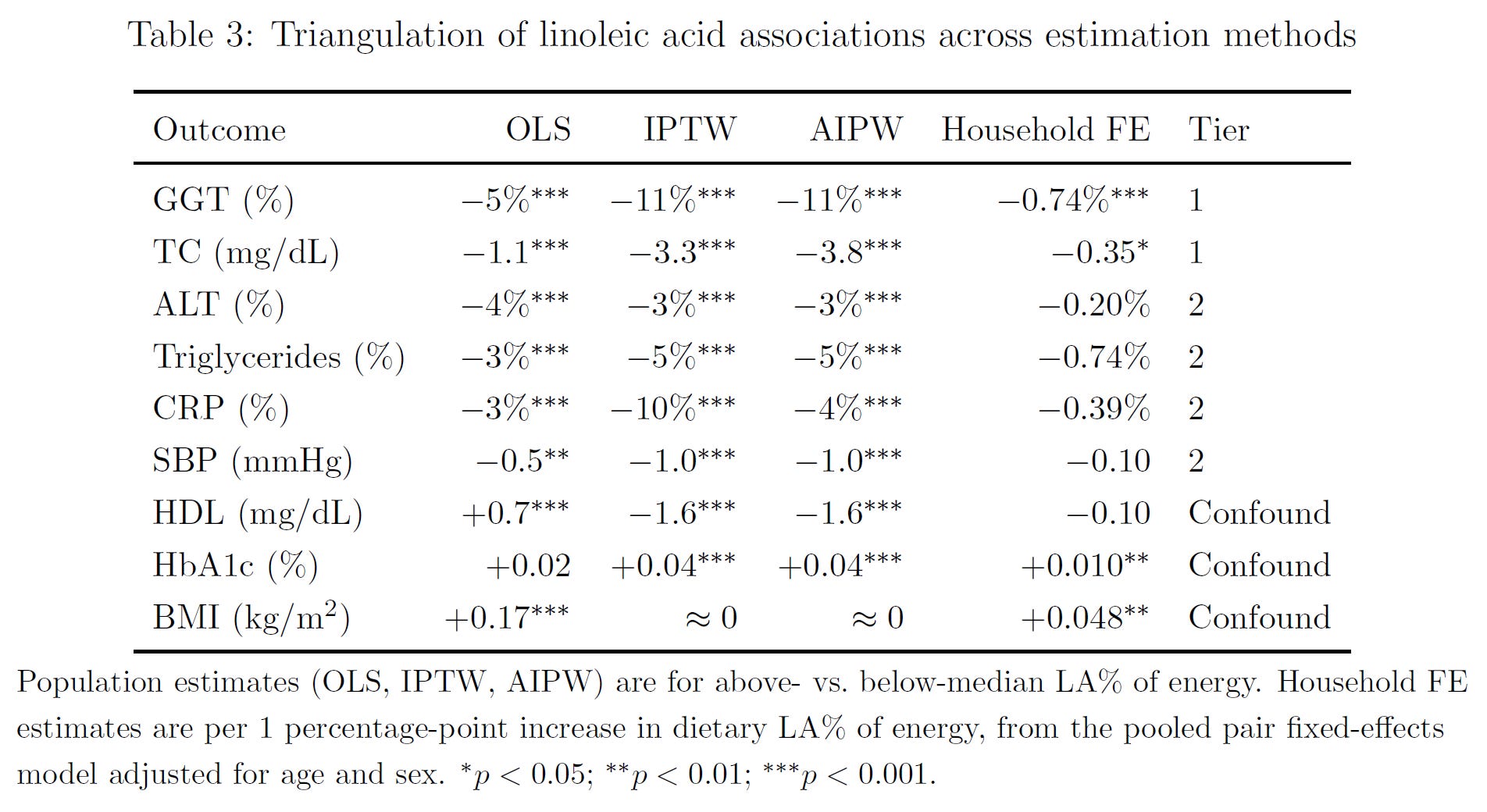
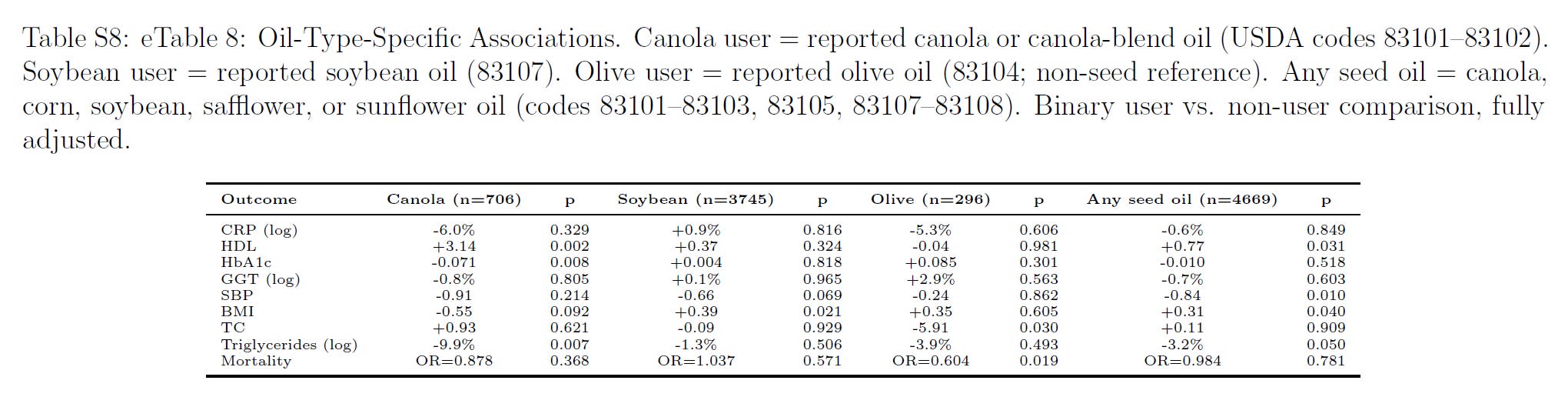
After all’s said and done, in the matching analyses, linoleic acid is associated with lower inflammation, higher HDL, lower HbA1c, and not a lot else. And if you’re not satisfied by that, well, there are several supplementary analyses I ran, which include just looking at reported seed oil intake effects directly. For those, there’s not a lot there either!
I also went further and tested the mechanistic claims made by seed oil critics. I found that linoleic acid was not associated with arachidonic acid; it didn’t relate to higher atherogenic particle risk; it didn’t seem related to thyroid suppression or autoimmunity; there was no evidence of vitamin E depletion or oxidative damage; even cooking oils specifically didn’t seem to matter; and there was bupkes for clotting.
Consistent with the causal evidence and the best observational evidence from humans—including, for example, a massive analysis of the Nurses’ Health Study/II/Health Professionals Follow-up Study, the latest meta-analysis of prospective cohort studies, the National Institutes of Health AARP Diet and Health Study, and an analysis of the U.K. Biobank—seed oils not only don’t seem to be harmful, they appear to be healthful. This analysis is not causally informative, but there’s not even any confounded evidence for harm here. The cliché is that correlation isn’t causation, but seed oils don’t even have correlation-level evidence that they’re bad.
I end with a quote:
Seed oils people do what people often do when attempting to build up a losing case. They rely on a broad panoply of weak, circumstantial, points—mechanistic research in rodents, bs studies—along with plenty of winks and nudges, to give off a strong impression that their argument is correct beyond a doubt. It’s then left to others to show that each one of their points is specious, one by one, and that what they’ve built up is, in reality, a false impression based on a lot of garbage/irrelevant studies and unjustified assumptions. Even if some of the peculiarities they manage to find can’t fully be ruled out, the case overall is far less impressive than [they’ve] made it out to seem.
