

Today’s post is brought to you by my sponsor, Mechanize. They’re hiring junior software engineers at $300K/year base salary.

Countries with more billionaires are undoubtedly better places to live. Places with a greater number of billionaires per capita have higher standards of living: their populations consume more and live longer; they have fewer people struggling to survive and more people achieving their dreams; their crime rates are lower and their politicians are less corrupt; satisfaction with life itself is greater.
But why?
Consider this plot: virtually every national outcome is better in places with more billionaires per capita. But, virtually every improved outcome goes null once GDP per capita is controlled.
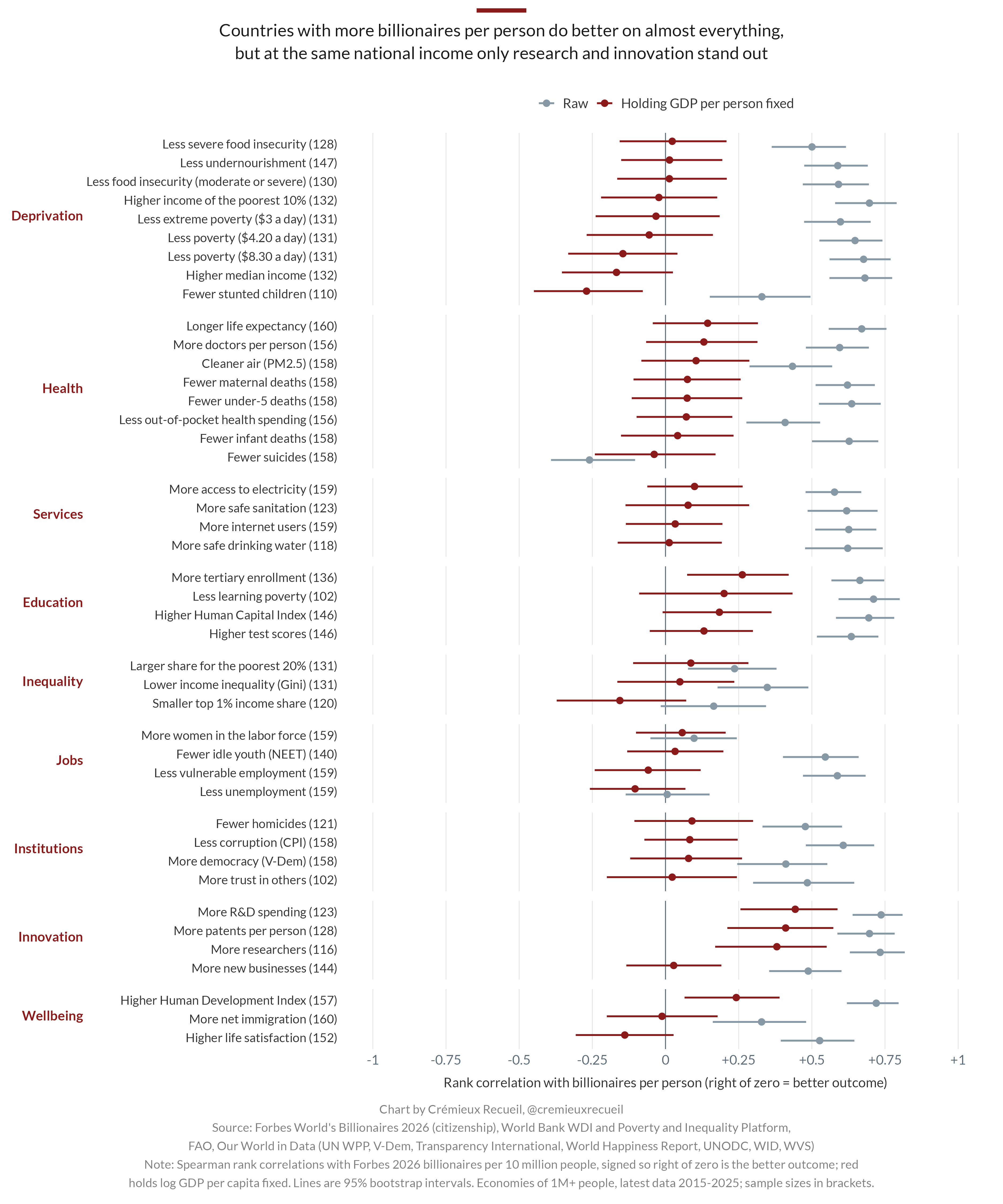
What this plot indicates is pretty obvious: billionaires largely reflect national wealth. In other words, places that are richer also tend to have a more filled-out right-tail of the wealth distribution. The correlation between per capita billionaire numbers and GDP is a substantial ρ = 0.70.
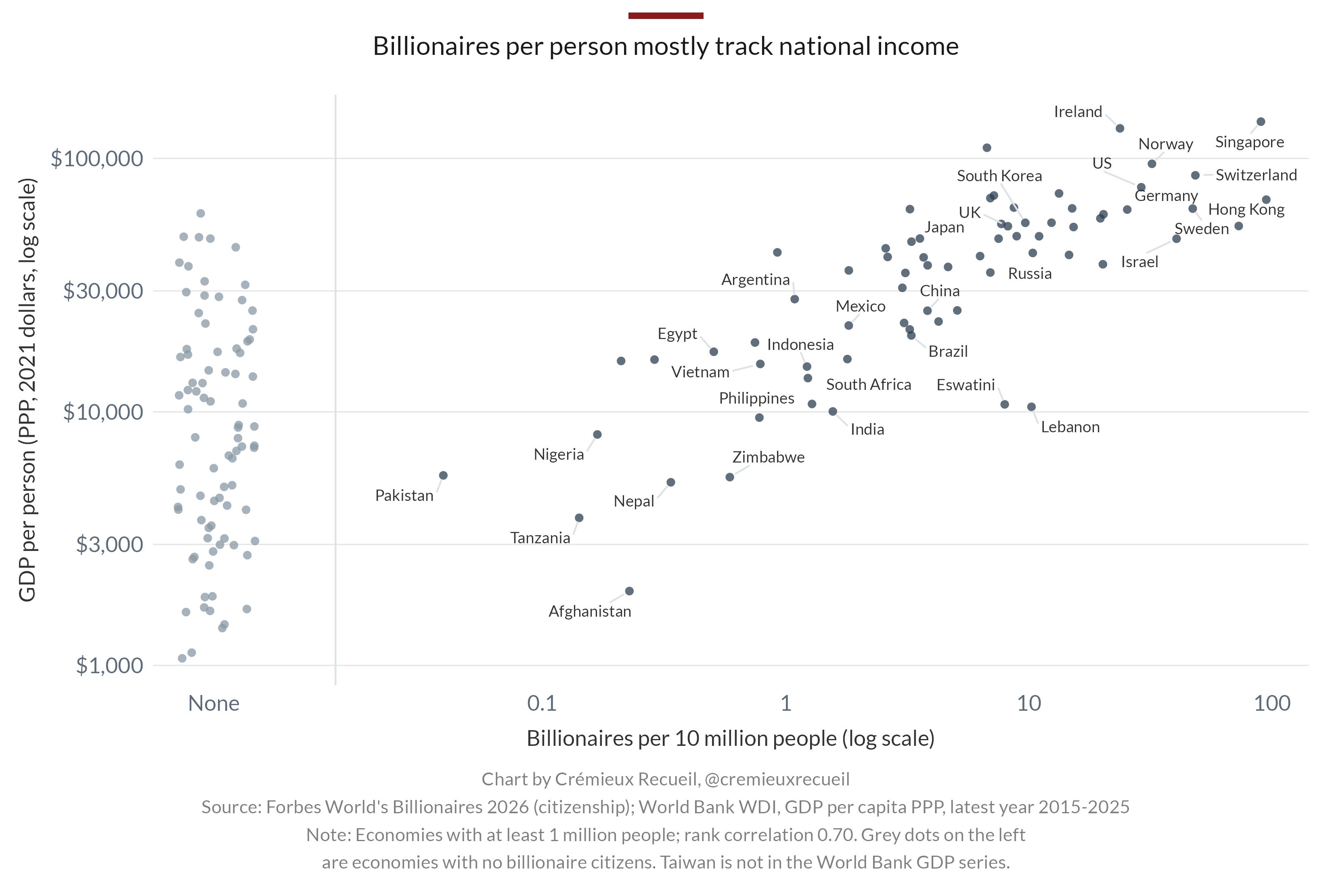
Once we’ve acknowledged this, it becomes apparent that the best way forward is to try to understand what predicts billionaires per capita above and beyond GDP. The relationship being ρ = 0.70, GDP per capita only explains about half of the variance, so there’s plenty left to explain.
One of the biggest factors predicting billionaire numbers beyond GDP is research and development spending: places that do more R&D have more billionaires, even at the same levels of national wealth. The same is true for the natural product of R&D, patenting.
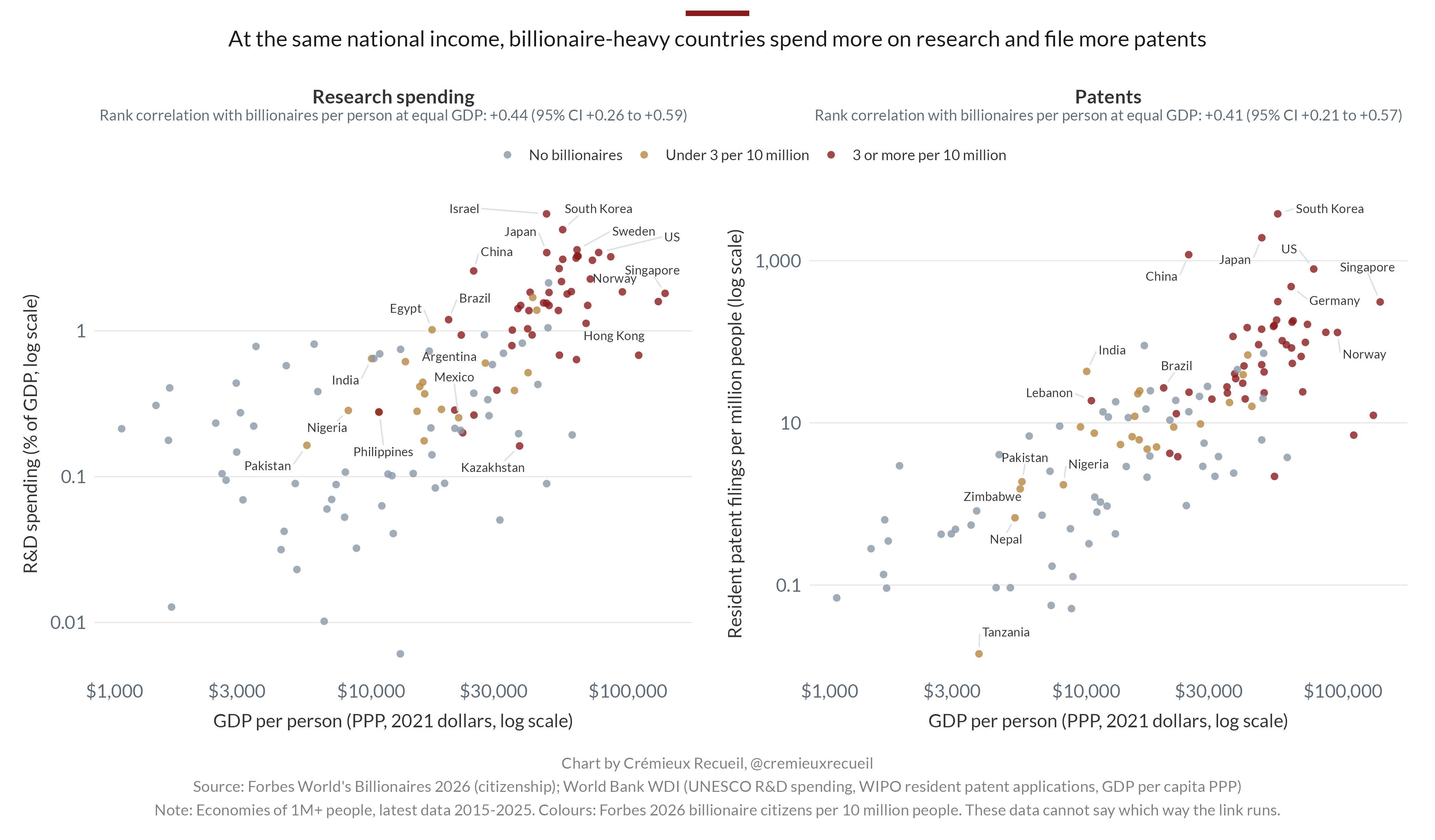
I see pictures like these and conclude that it’s reasonable to believe that innovation produces billionaires. It also makes sense, because innovation can create a niche from which billionaires can generate wealth they then capture with little competition. But, is this what happens? We actually cannot answer that question with this data, because this data is cross-sectional—it all comes from one point in time. We need to see how things develop, we need to know if more R&D spending in one year produces more billionaires in subsequent years. Does it?
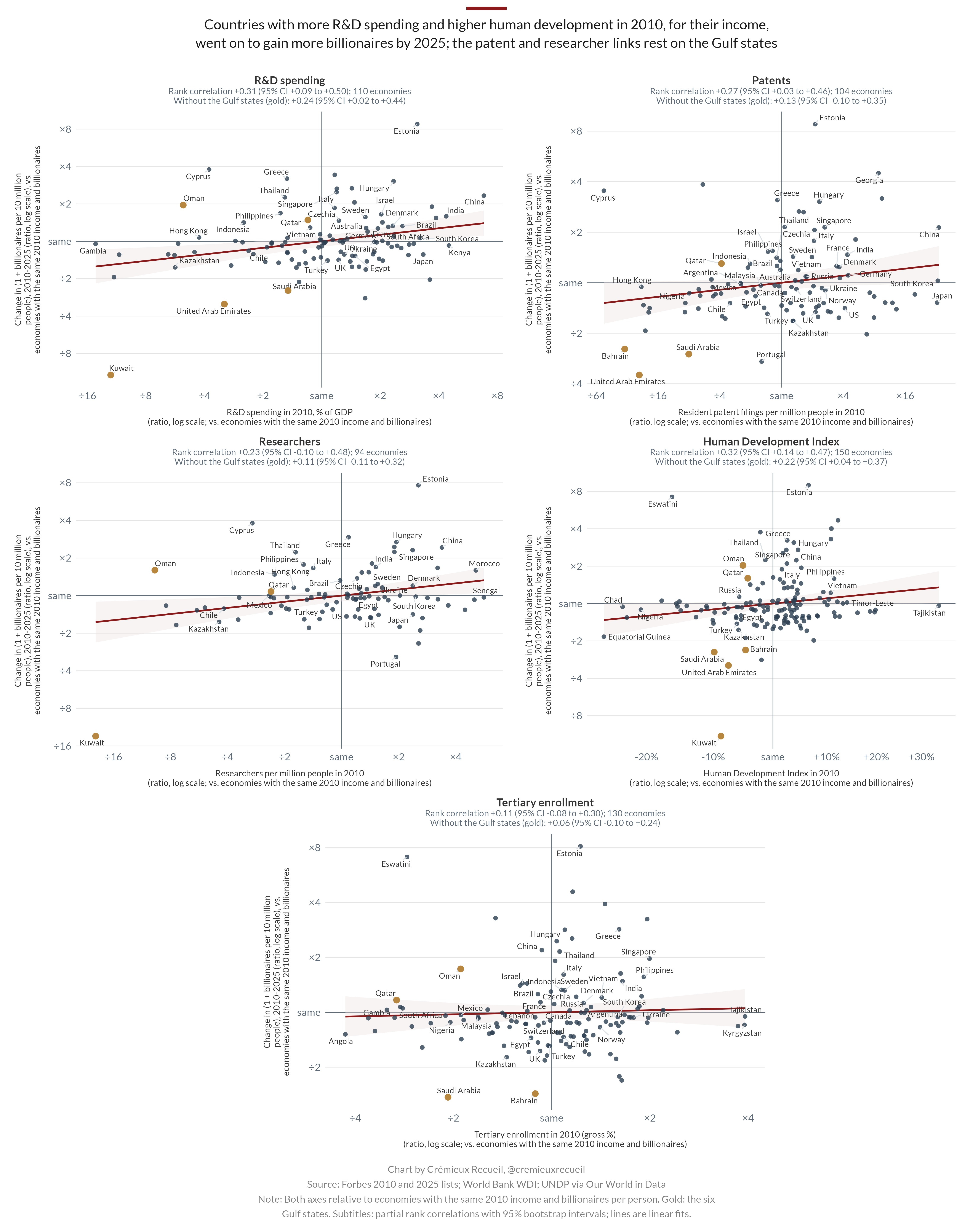
More R&D spending indeed leads to more billionaires, even controlling for GDP. But here’s something curious: gaining billionaires is not related to gains in R&D spending. Billionaire numbers are strongly related to R&D cross-sectionally, and R&D spending predicts the development of more billionaires, but billionaires do not themselves seem to be related to R&D going up after they’re around.
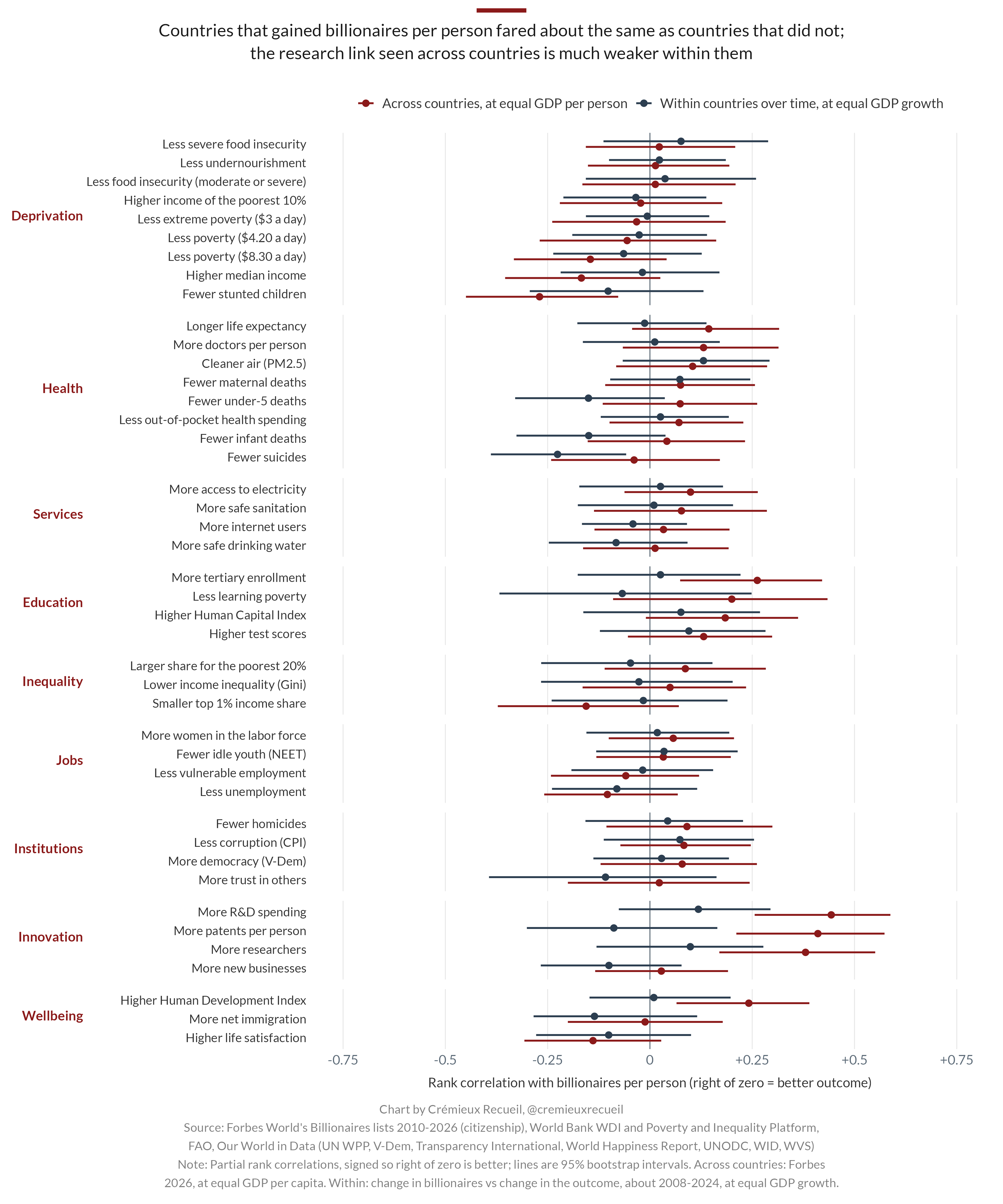
This finding is based on assessing changes in different variables over time. It’s closer to being causal than cross-sectional correlations are, but it’s still not really causal per se.
To get causal conclusions, what I did is I noted that each country’s billionaire wealth is concentrated in particular industries, and those industries boom and bust for reasons largely unrelated to a country’s own policies. Accordingly, I exploited these changes to assess how much billionaire wealth growth—not billionaire number growth per se—affected the various outcomes I’ve shown throughout this piece. Take a look:
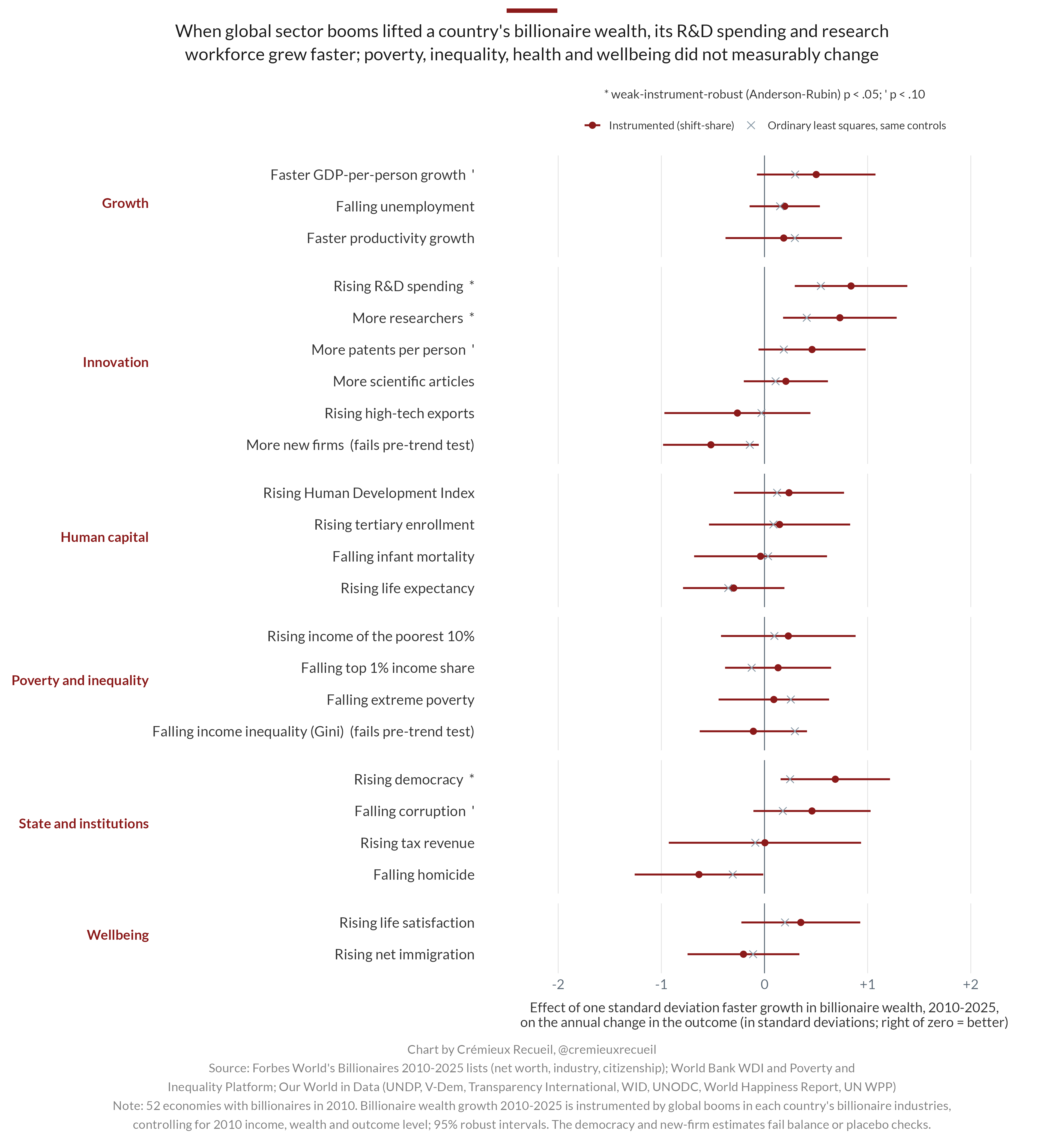
There are three strong results here;1 more billionaire wealth means:
More R&D spending;
More researchers;
Fewer new companies.
I think all of this makes sense. Think about it: people with billions of dollars want to invest and deploy their money. They can afford to allocate exceptionally large sums towards major projects that could not be funded otherwise, and people consume relatively less of each dollar at extreme income levels, so a larger share gets invested. Thus, more R&D. Billionaires also have the ability to hire or otherwise stimulate hiring for these things, so they do. And, they—and new, innovative industries more generally—pay well, so why found a new company when you can instead go work for people paying big bucks? I could elaborate on these things, but hopefully my pithy explanations are sufficient to get the gist.
What really stands out is what billionaire wealth does not change. Most outcomes don’t move, good or bad. Most effects are directionally positive, but they’re not statistically significant, and they’re mostly not meaningful in size. I think this might reflect something about the muddle inherent in talking about ‘billionaires’: many billionaires got there meritocratically; but, others got there through corruption. I recently made a post about this:


The way I conceptualized this issue was to split billionaires by how they got their wealth: did they get it from an industry that largely exists due to the state? Did they inherit their billionaire status or get there by growing their wealth?
The best billionaires, I think most will agree, are those who earn their money themselves rather than inheriting it, and who do so in a competitive industry with little state involvement and economic rents. To validate these categories, I went down the list of billionaires and categorized people by whether they made their money through markets or through the state, and found that the categorizations held up: billionaires in industries with ample rents were generally state-made.
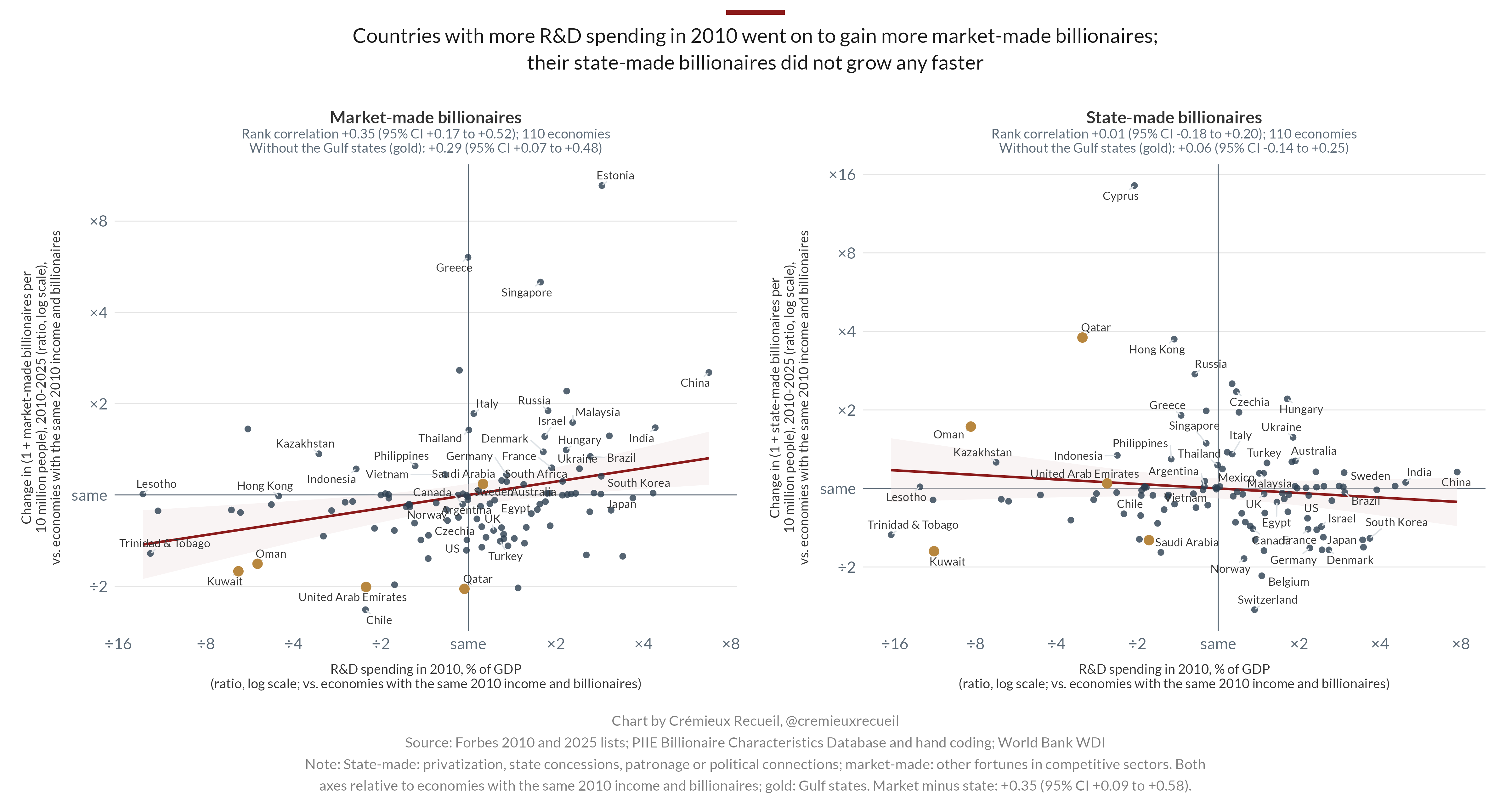
More interestingly, I found that R&D predicted only market-made billionaires, not the billionaires whose livelihoods were borrowed from the state.
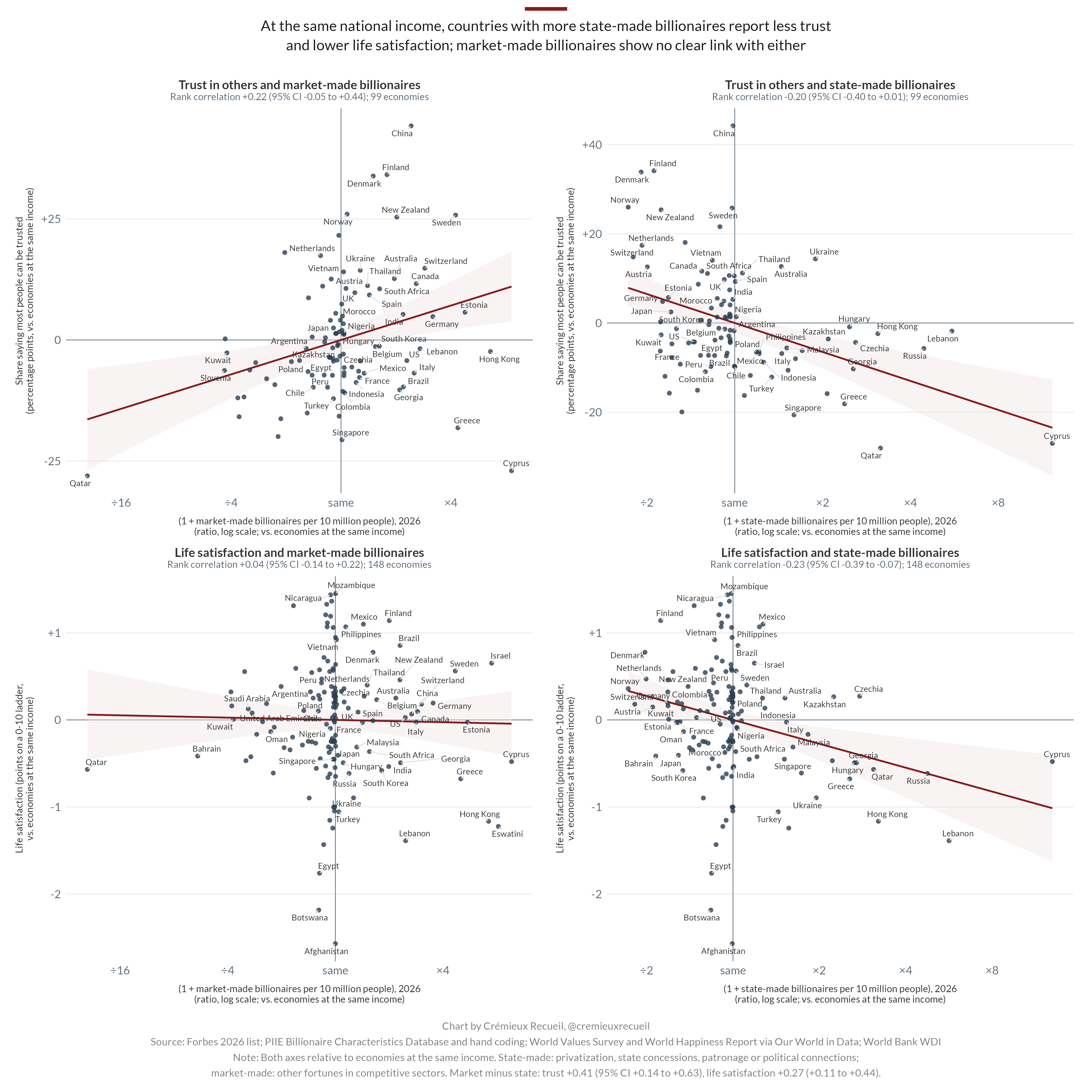
The correlates of these billionaire types also vary considerably. For example, countries with more market-made billionaires tend to have more trusting populations, whereas ones with more state-made billionaires tend to be less trusting.2 State-made billionaire numbers also correlate with lower life satisfaction among the populace, but the reverse is not true, as market-made billionaire numbers are unrelated to life satisfaction.
We unfortunately cannot re-run the instrumental variable strategy along the lines of these splits because if we do that, we lack statistical power. Perhaps in the future, that will change, but for now, there are too few billionaires for our purposes. In any case, here’s the big picture: billionaires look to be more good than bad, but in most cases, they’re neutral, not good or bad for real outcomes.

A message from my sponsor, Mechanize:
We’re hiring software engineers to build environments and evals that frontier AI labs use to train coding agents.
To get a better sense of the work we do, you can check out GBA Eval, where we had models build Game Boy Advance emulators from scratch and scored their performance.
Base pay starts at $300K/year for junior software engineers, with more for senior roles, plus equity and performance bonuses. Apply here.
