

Today’s post is brought to you by my sponsor, Mechanize. They’re hiring junior software engineers at $300K/year base salary.
Zach Goldberg’s most famous graph depicts the strange phenomenon whereby every racial group in America likes themselves, except for White liberals, who like other groups more than they like Whites.
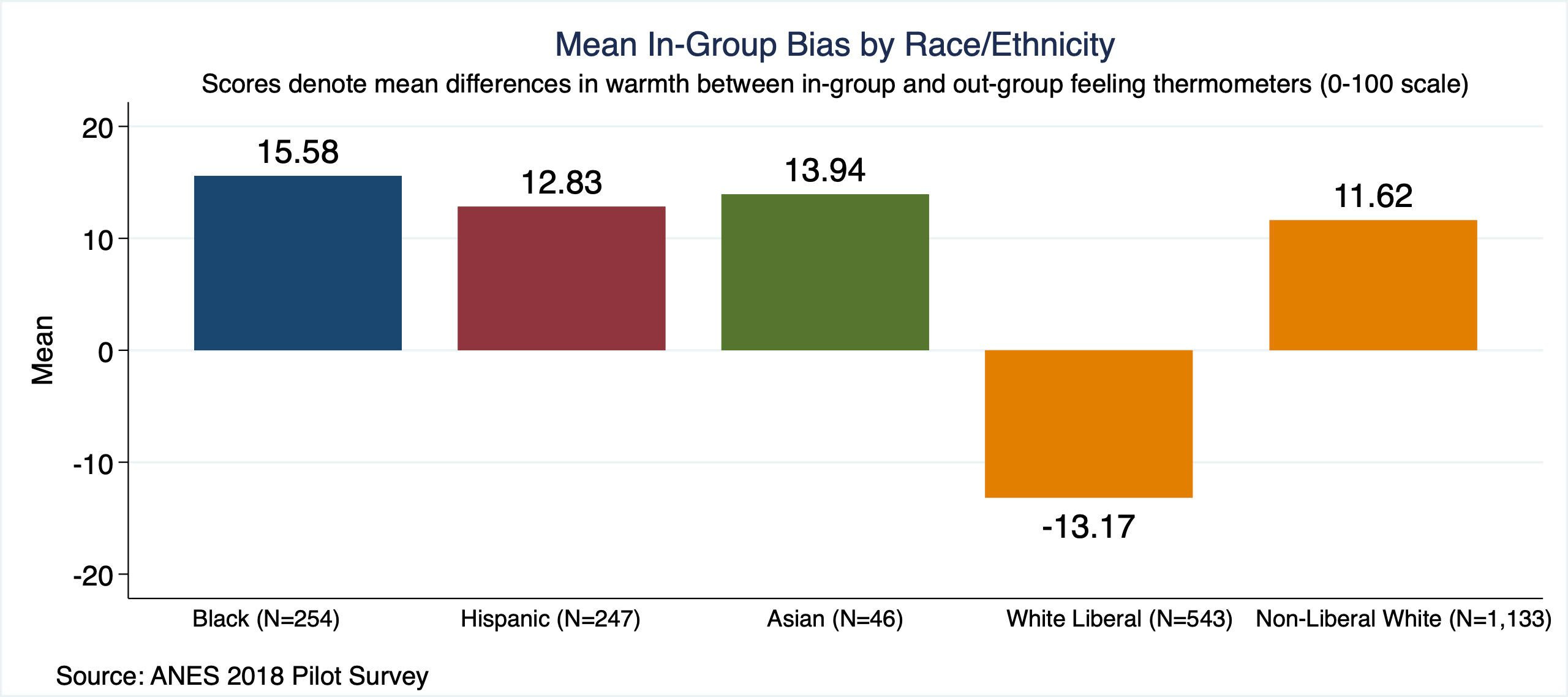
I’ve seen this graph enough times that I got curious about how well it replicated, and what else we could learn from this sort of data. So, I grabbed the data and set about answering some questions.
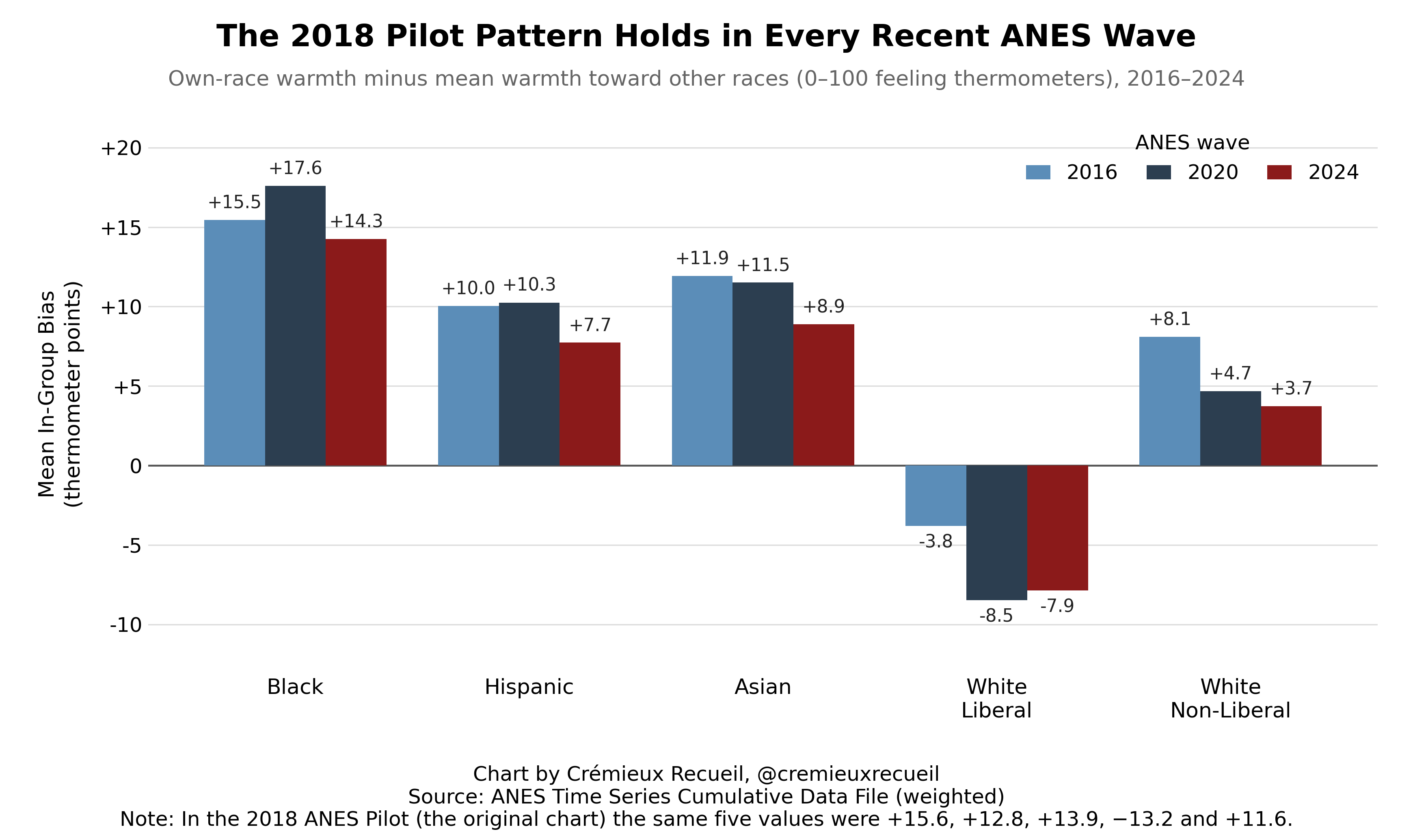
#1: Does it replicate? Yes. The plot itself holds up in adjacent waves of the same survey.
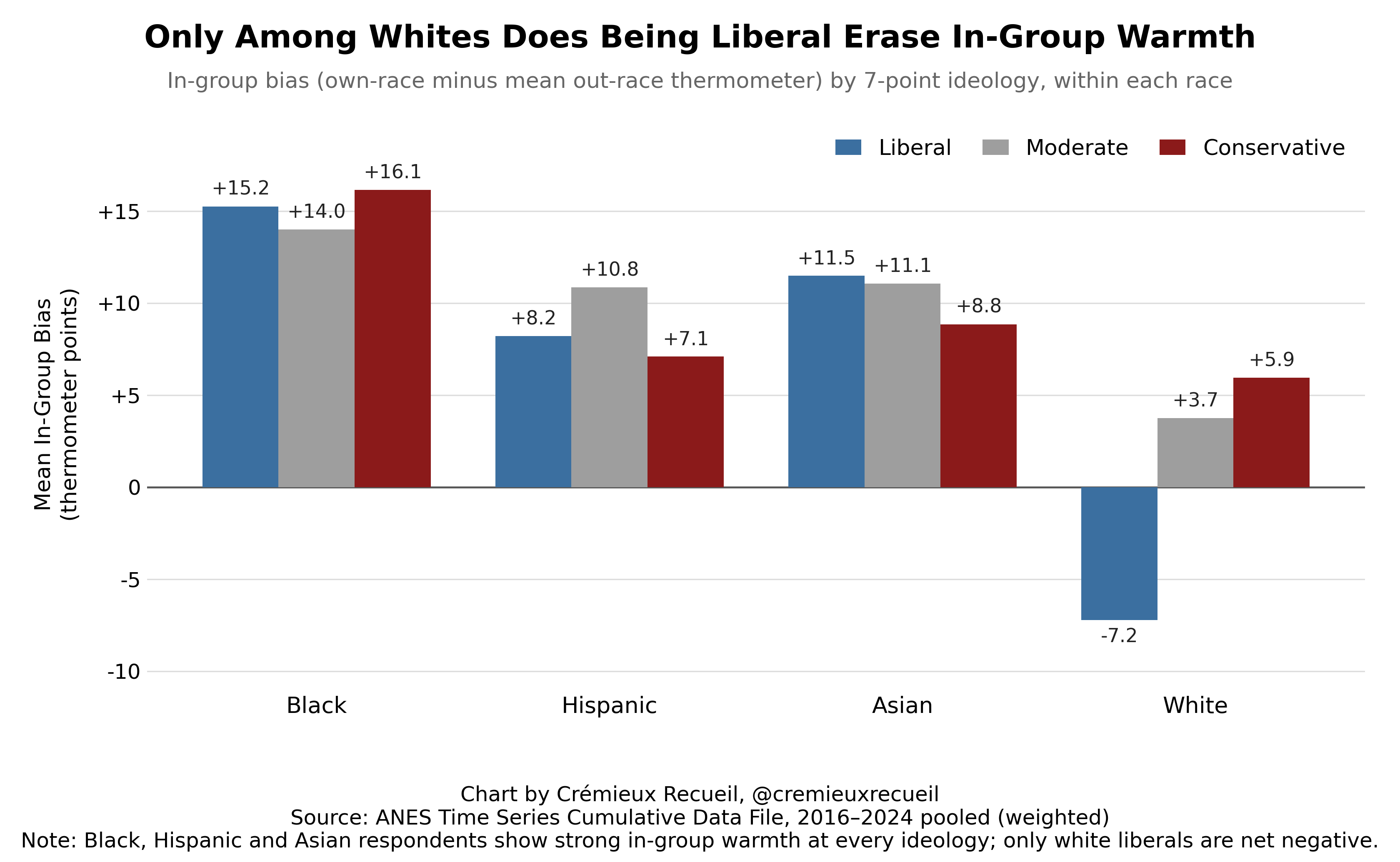
#2: Does a self-derogating split across ideological lines extend to other races? No. Other races consistently like themselves, regardless of their politics. It’s just White liberals.
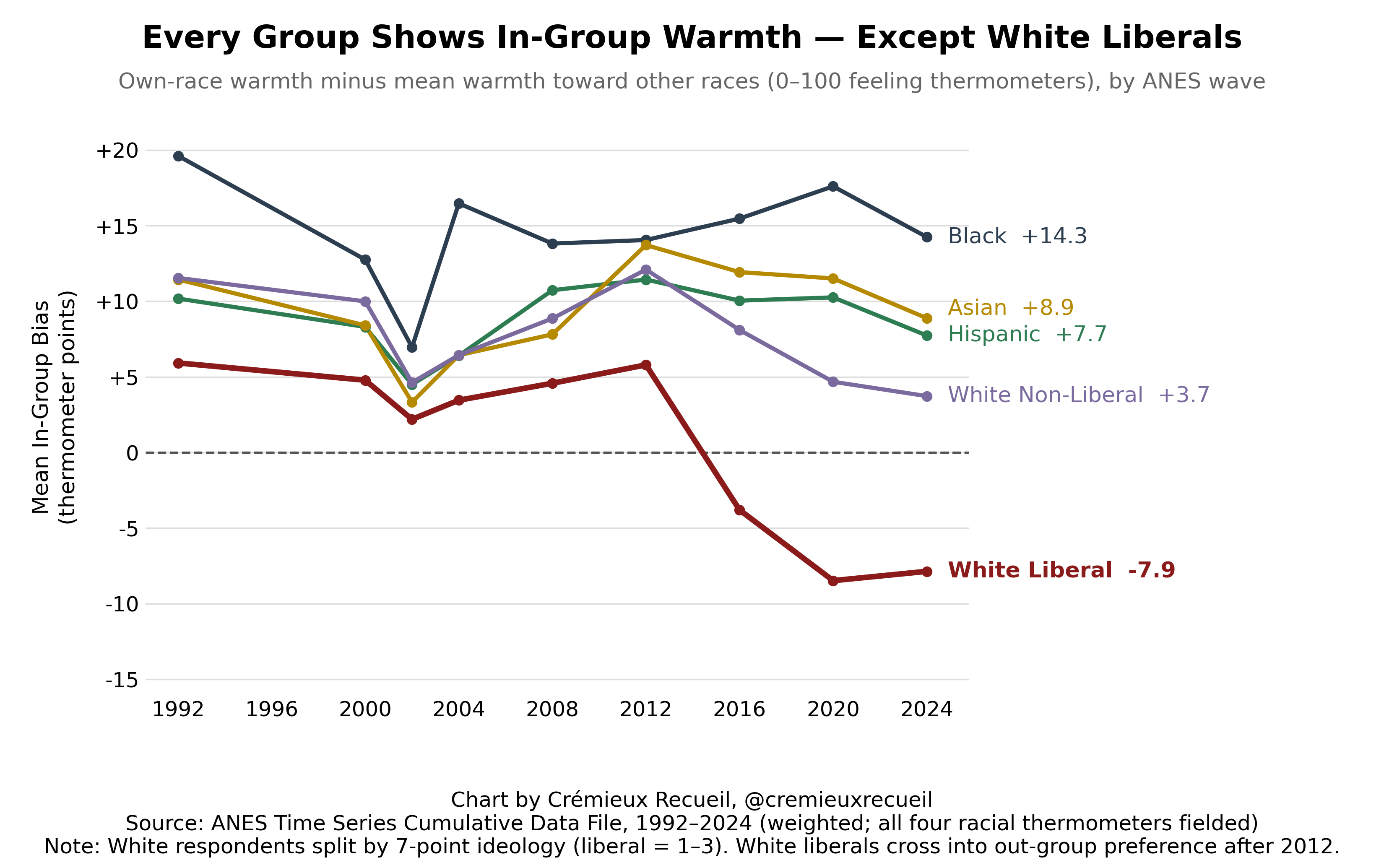
#3: Has it always been this way? No. White liberal self-derogation is a recent phenomenon, timed after the so-called ‘Great Awokening’ that came with Obama’s re-election and fomenting of race relations.
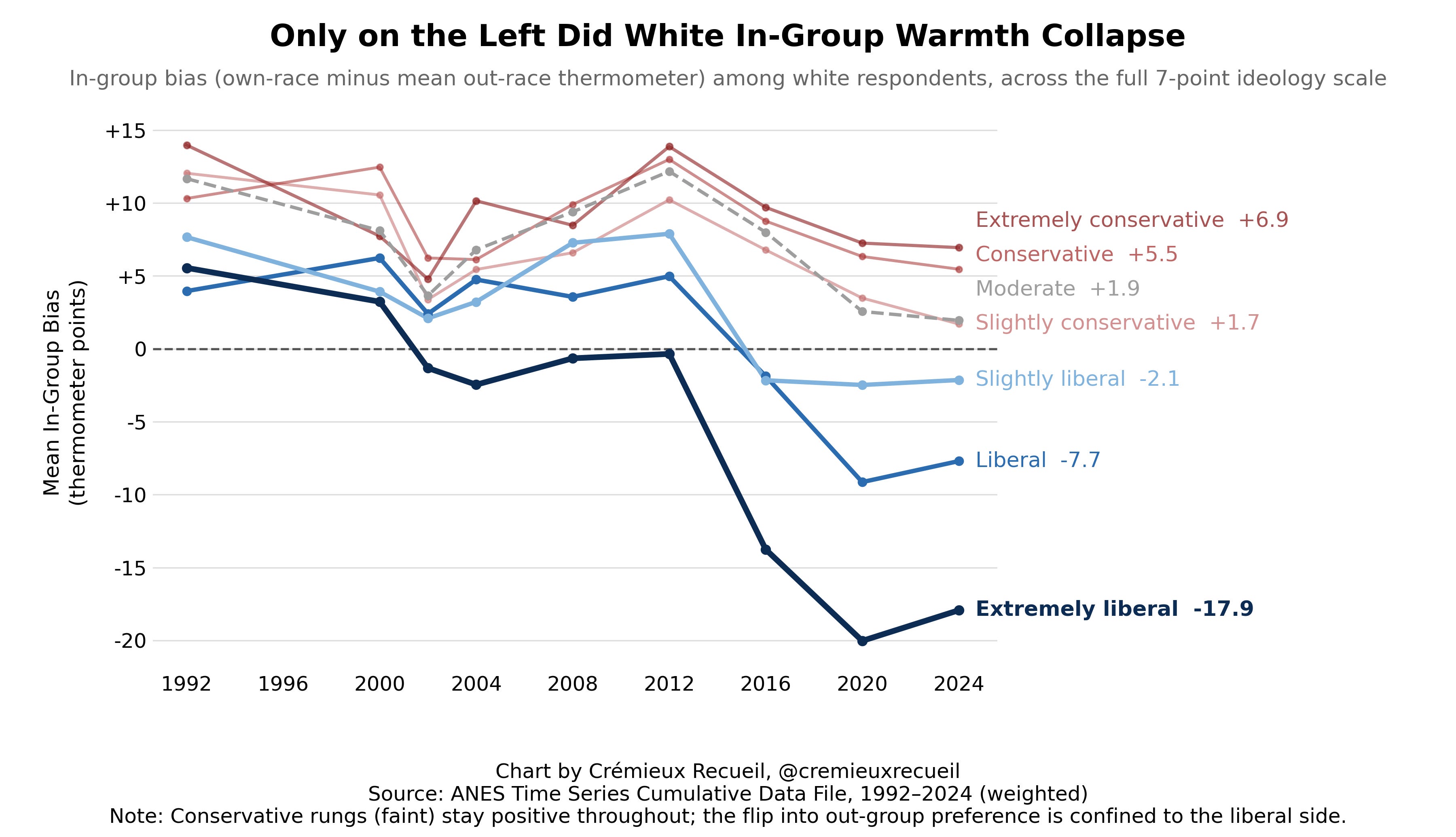
#4: Do White conservatives show an opposing trajectory shift? No. White conservatives are about as distinct from one another as they’ve always been. They even seem to have started going in the direction of their liberal counterparts, with weak evidence that such a shift has been larger for the less conservative among them.
#5: Do White liberals show a dose-response? Yes. More liberal Whites show greater racial outgroup preference.
#6: Do the results for ideology transfer to party? Yes and no. The more liberal party does show the same trajectory as liberals more generally.
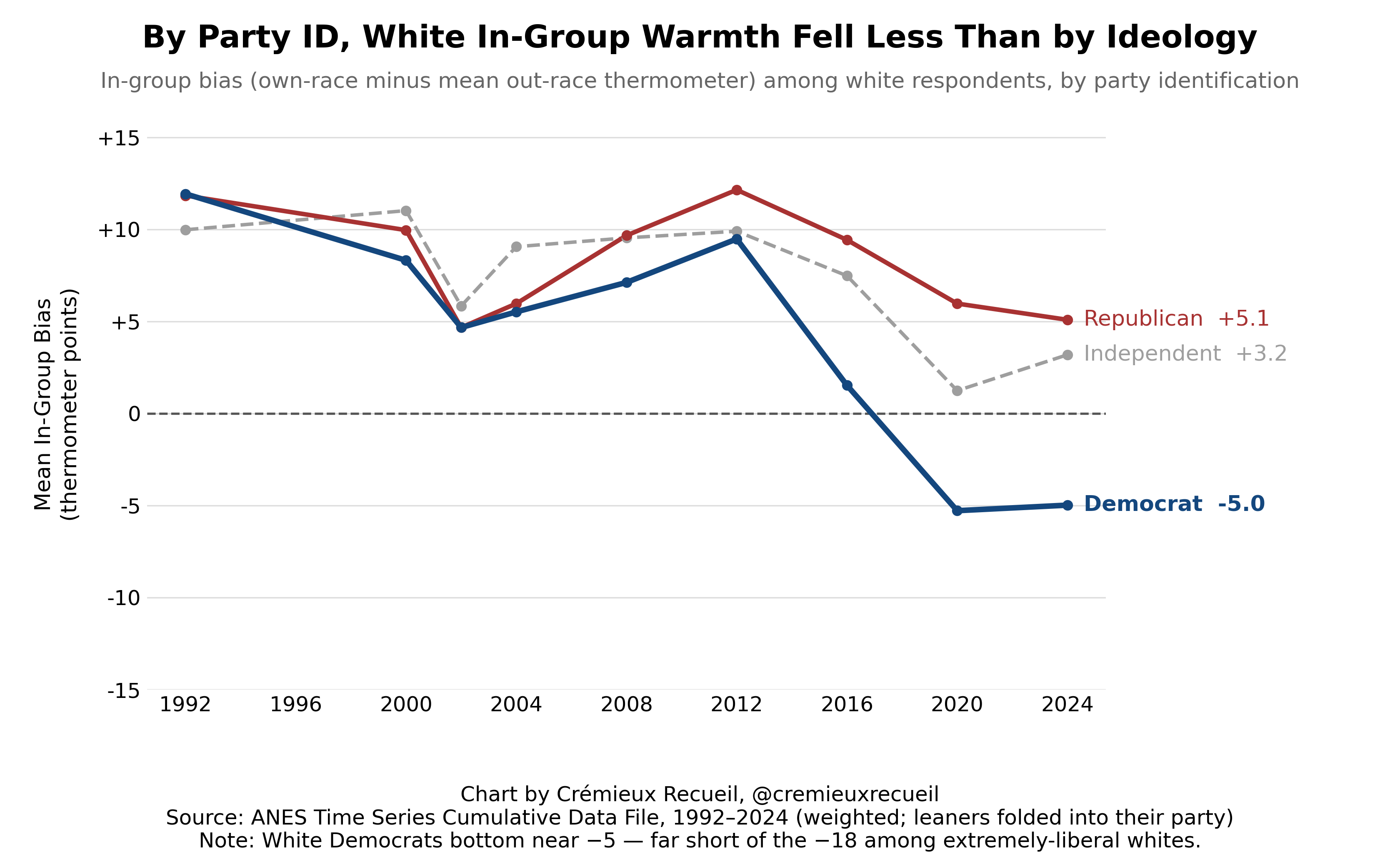
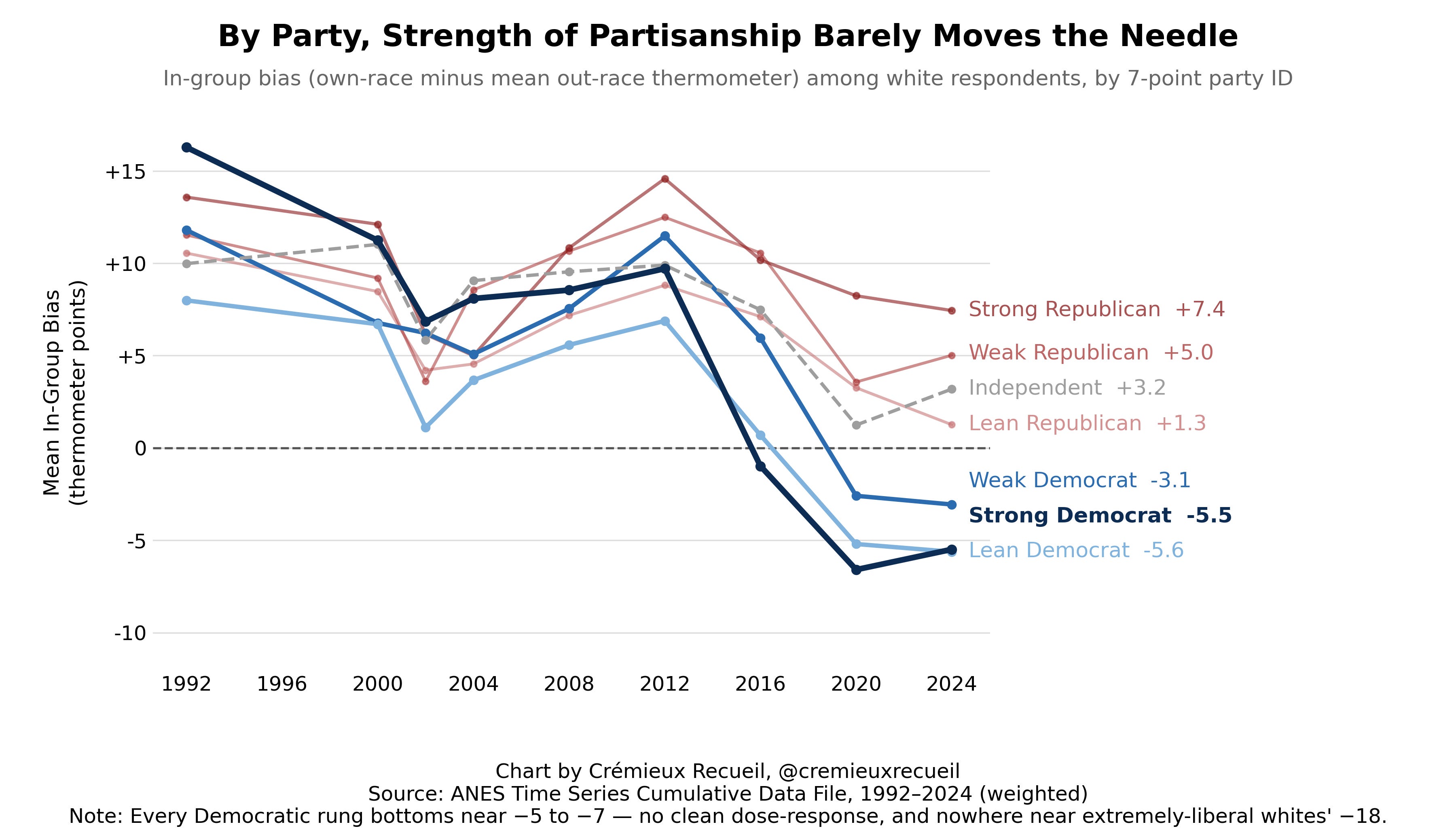
The ‘No’ has to do with the dose-response: the split among Democrats is about ideology, not party attachment, and party attachment and ideology are only weakly correlated (r = ). As a result, we get this quite different-looking graph:
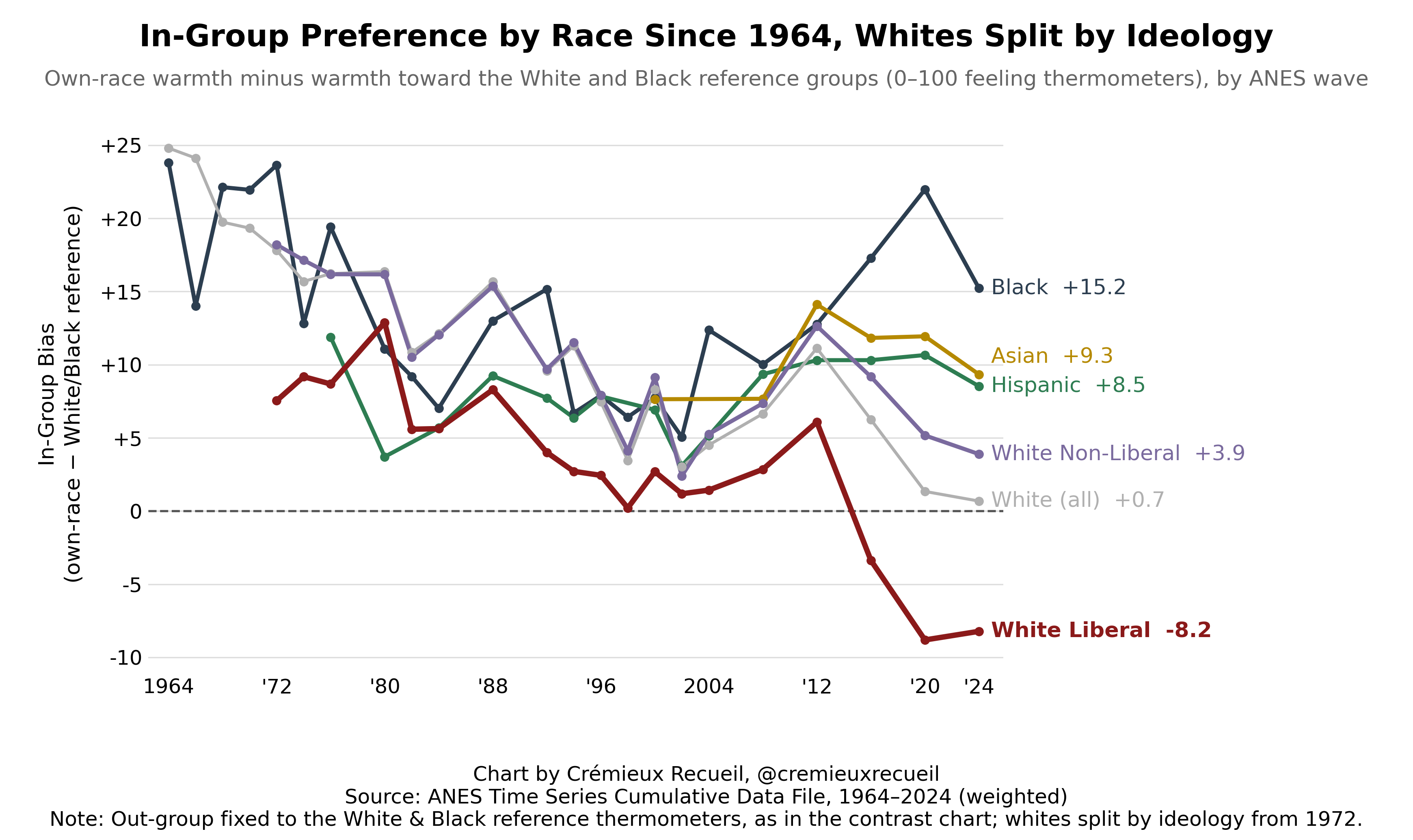
#7: Has this happened before? Not in recorded data. If we use the older ANES data going back to 1964, we don’t see this happen any other time. We also see that Blacks have reverted from the trajectory other groups were on, where they were heading towards having less ingroup bias over time. They are back to 1960s levels.1
#8: Is this because White liberals began liking Whites less or liking non-Whites more? Both.
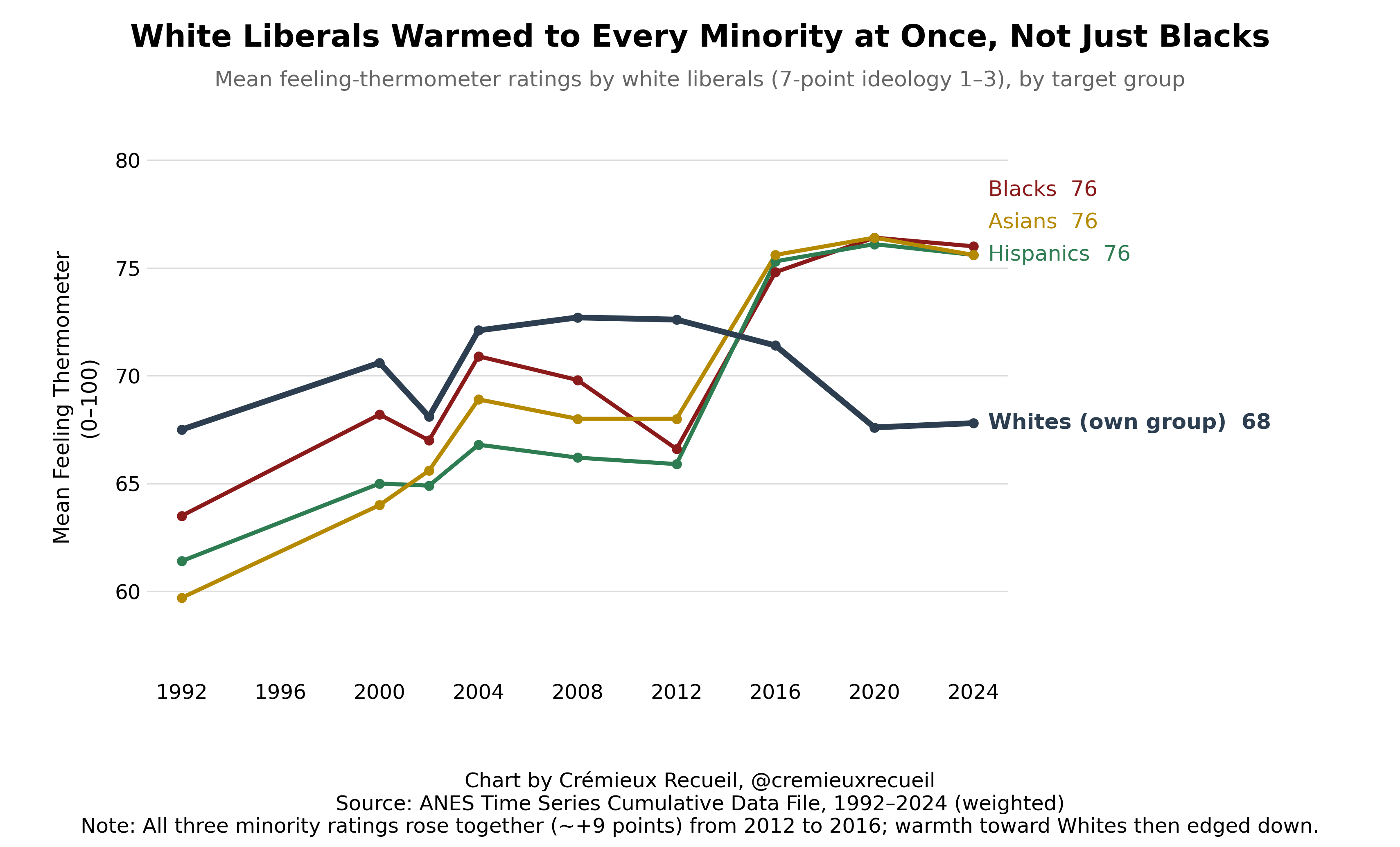
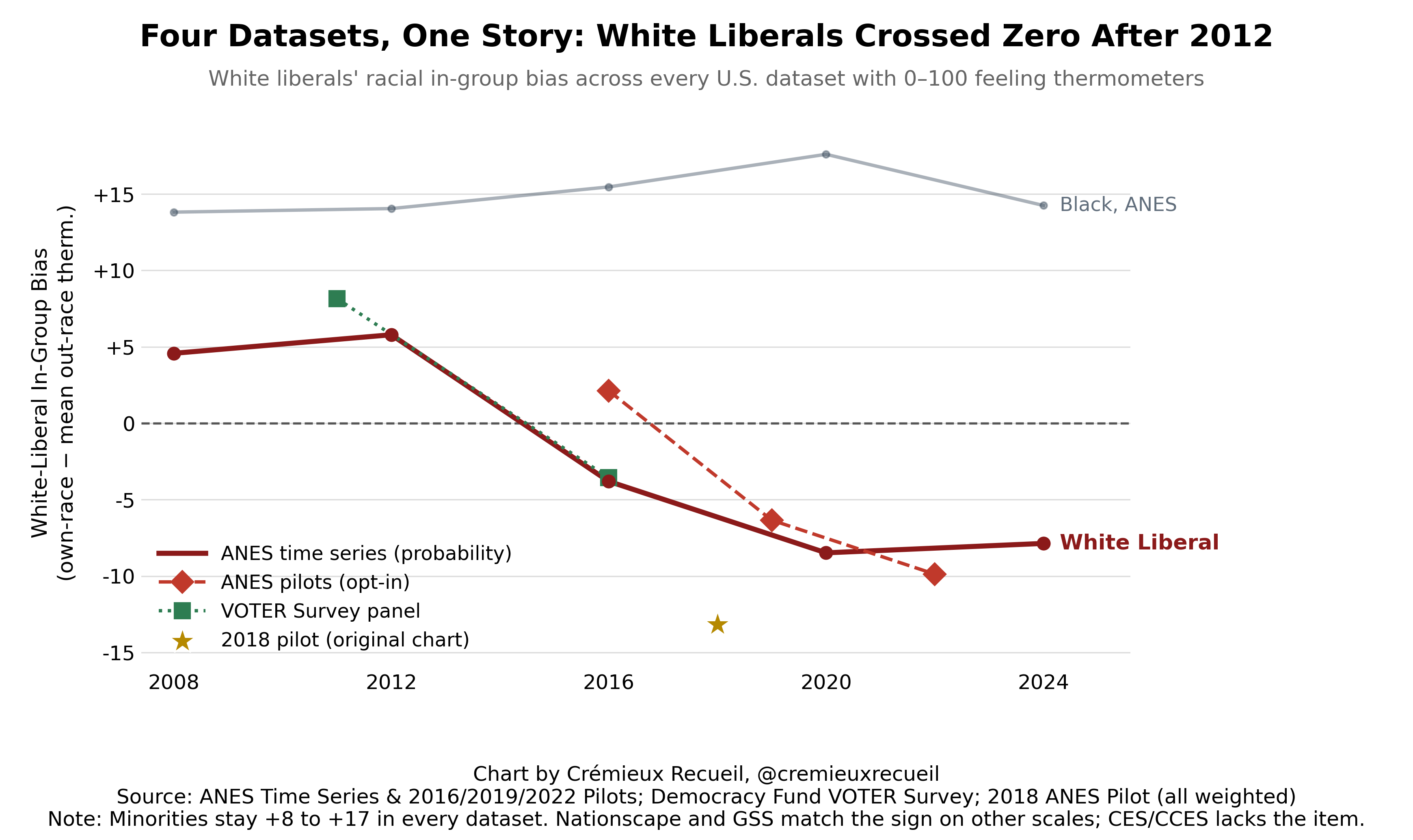
#9: Does this replicate in other U.S. datasets? Yes. This seems to replicate whenever we have representatively-sampled data from the U.S., in which participants are asked a substantially similar question. For example, here’s alternative ANES results, the VOTER survey, and mention of two additional sources and one dead-end.2
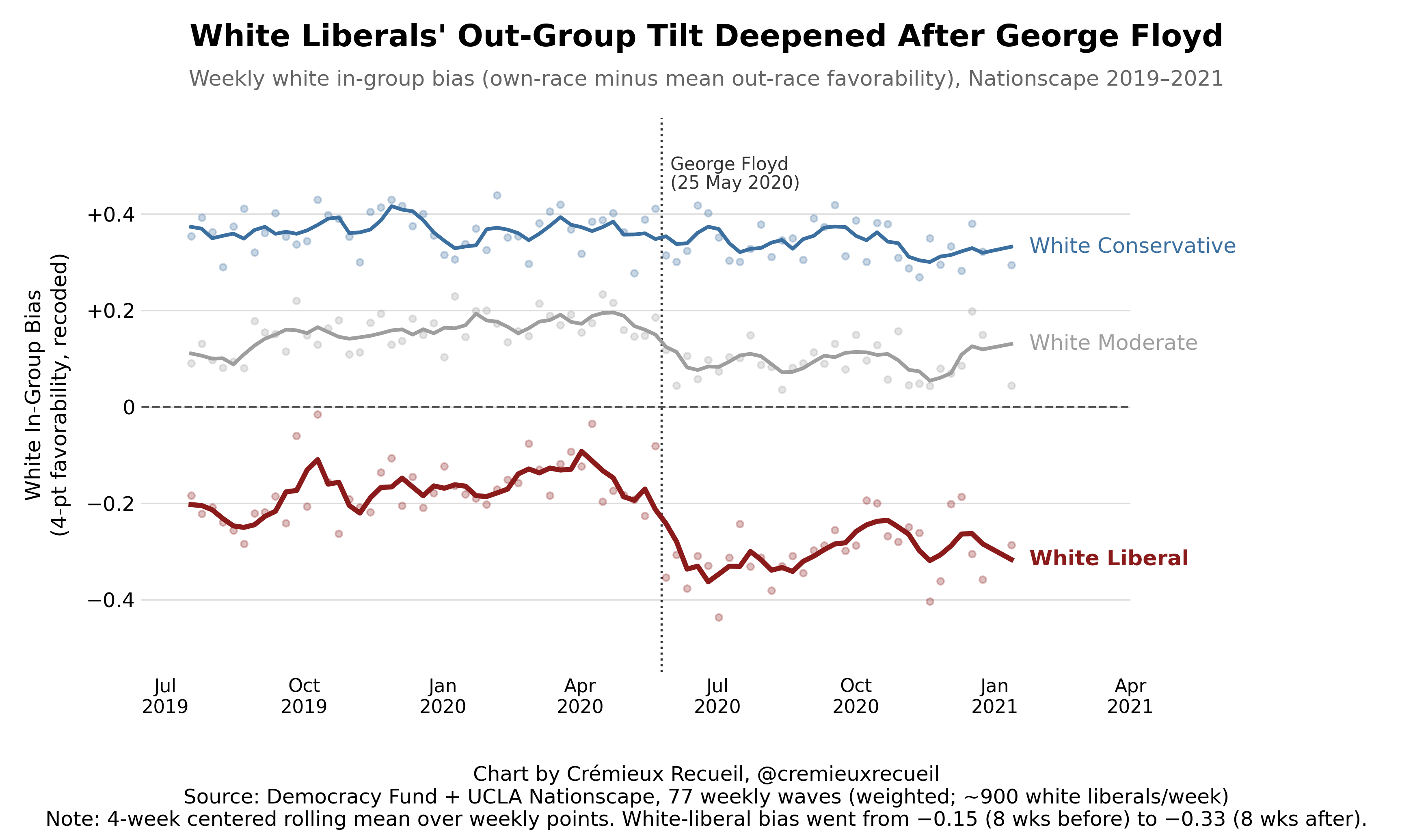
#10: Is this responsive to events? Yes. We generally do not have granular enough data to see whether particular events drive this reporting, but we do for one event: George Floyd’s death. We have weekly polling from the time, and right after it happened, White liberals’ anti-ingroup bias doubled. White moderates were affected in the same way to a smaller extent, whereas conservatives were unaffected.
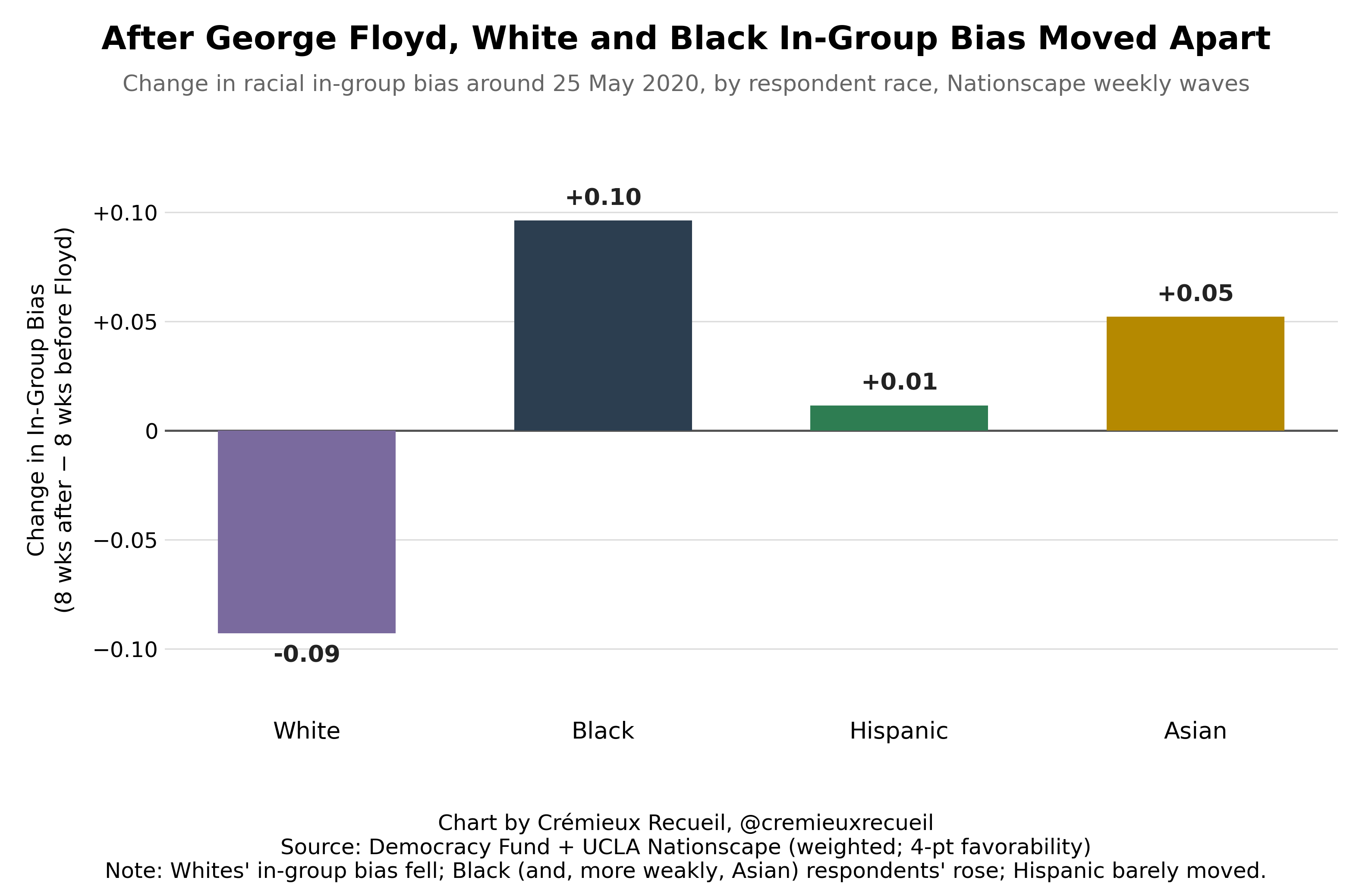
#11: Did the Floyd effect on warmth affect members of other races? Yes. From the same dataset:
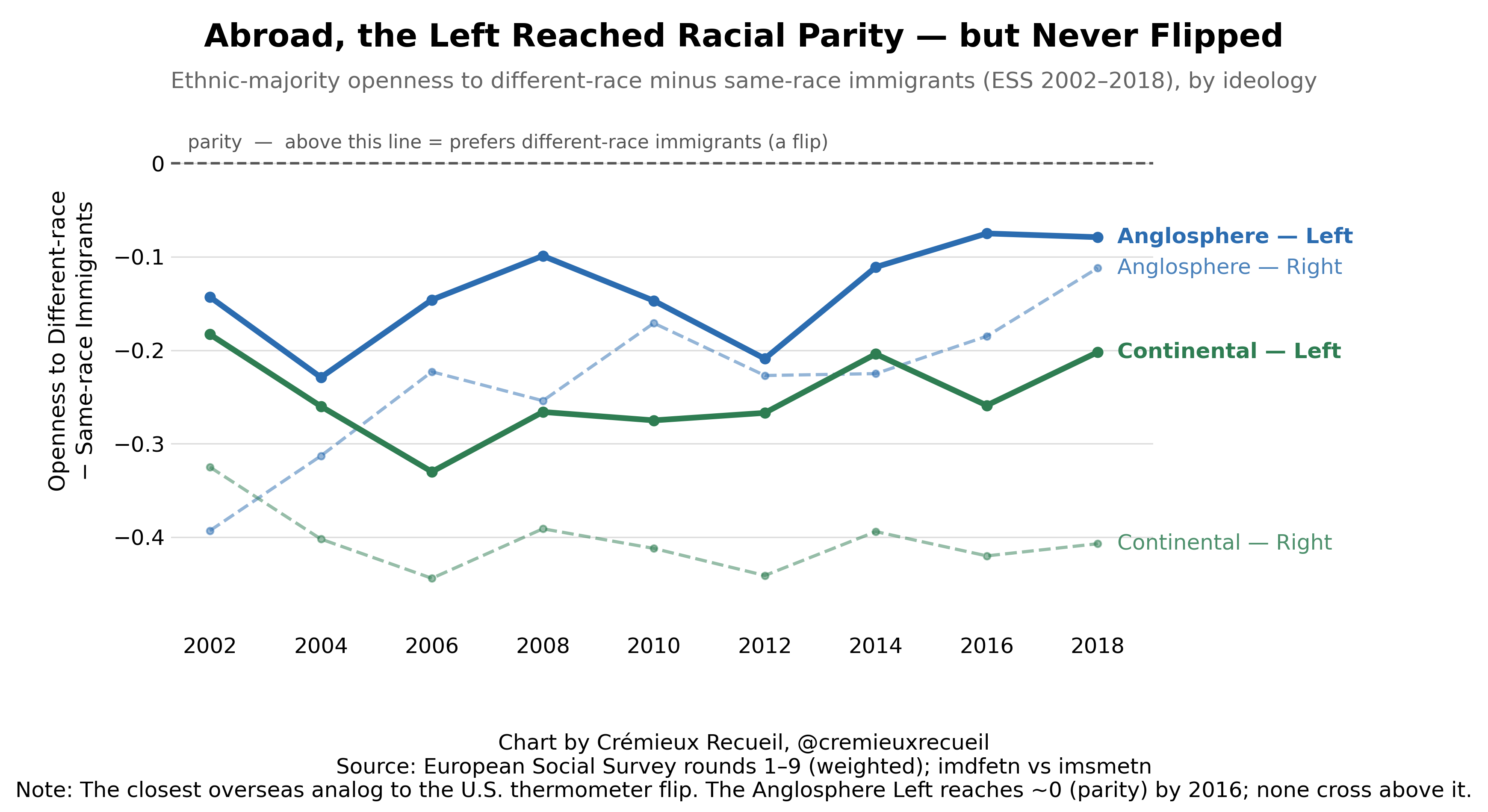
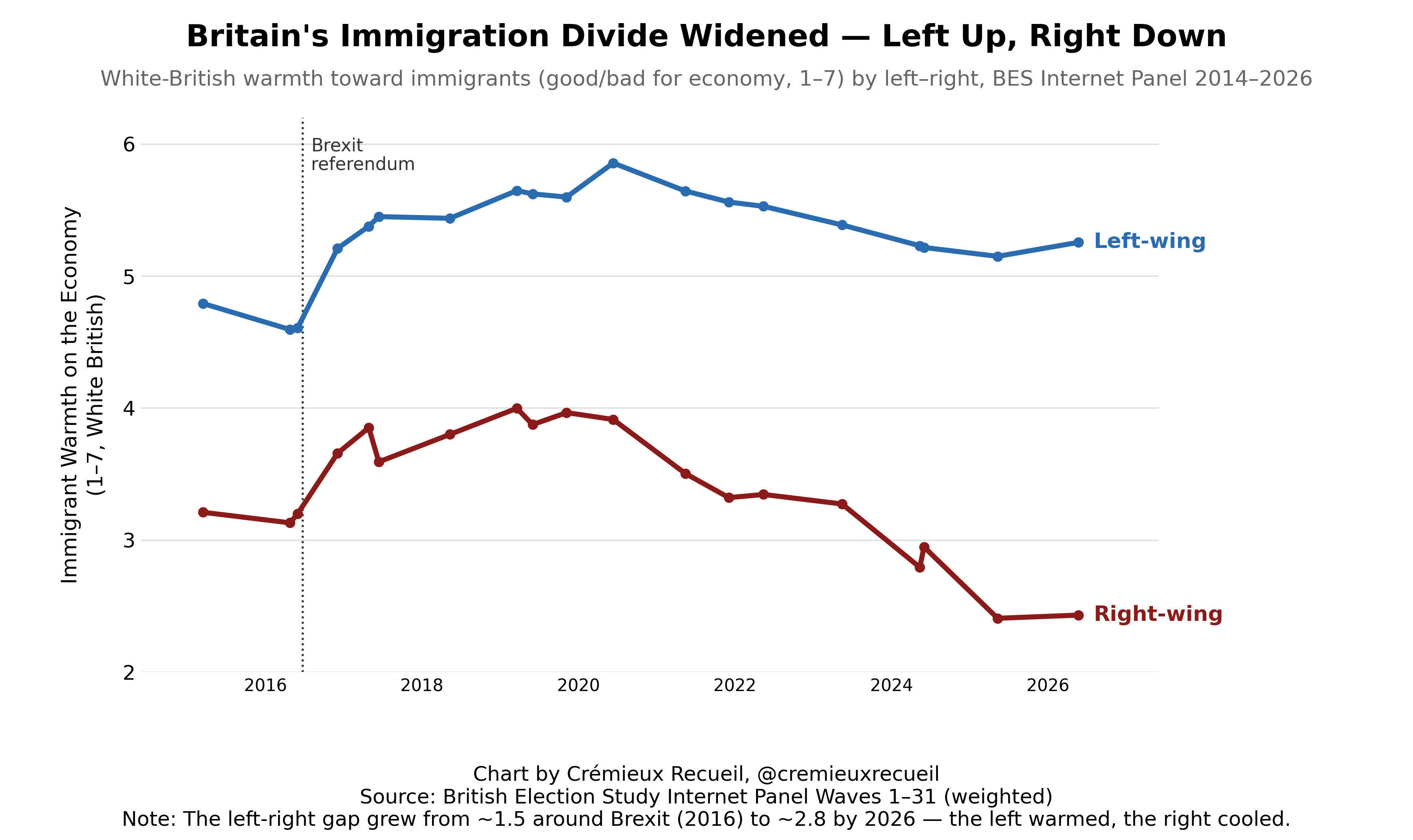
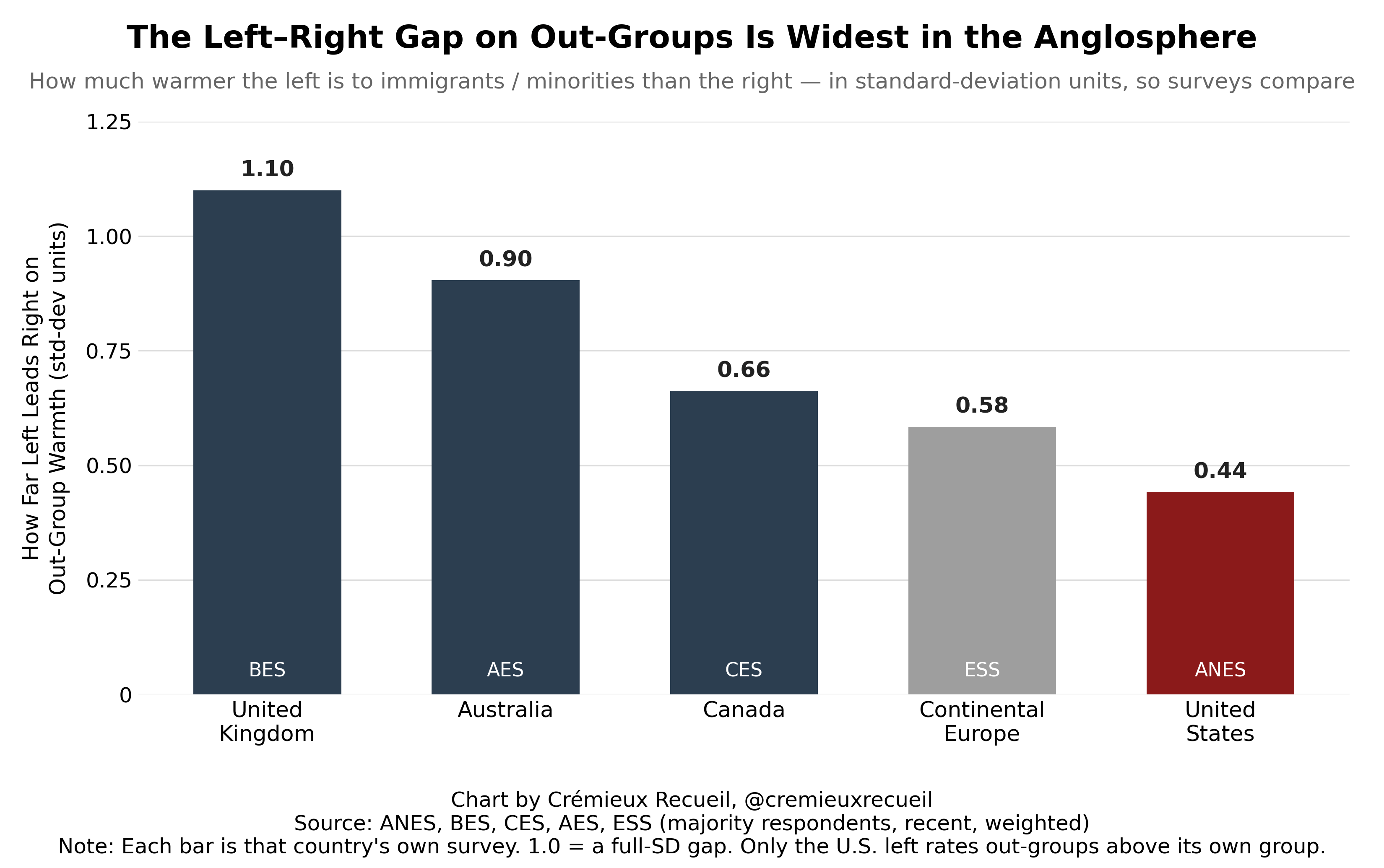
#12: Does White liberal outgroup preference replicate in international datasets? No. Across Europe, Australia, Canada, etc., attitudes have trended in the same direction, but they have not become as severe as in America: on net, Whites abroad still tend to prefer their own national and racial ingroups, even if said Whites lean left. We see this replicate in the European Social Survey, Australian Election Study, the British Election Study, and so on. I’ll show two charts to make some points.
First, compare the European Anglosphere to the Continent in terms of views on other-race versus same-race immigrants. The preference for own-race immigrants is smaller in the Anglosphere:
Second, in Britain, the post-Brexit trajectories on immigrant attitudes are curious:
And I’ll toss in a third chart to make a contrary point: where America, Europe, and the rest of the Anglosphere differ: the various in-group attitude measures are most differentiated by politics in the non-U.S. Anglosphere, despite how different the patterns look.
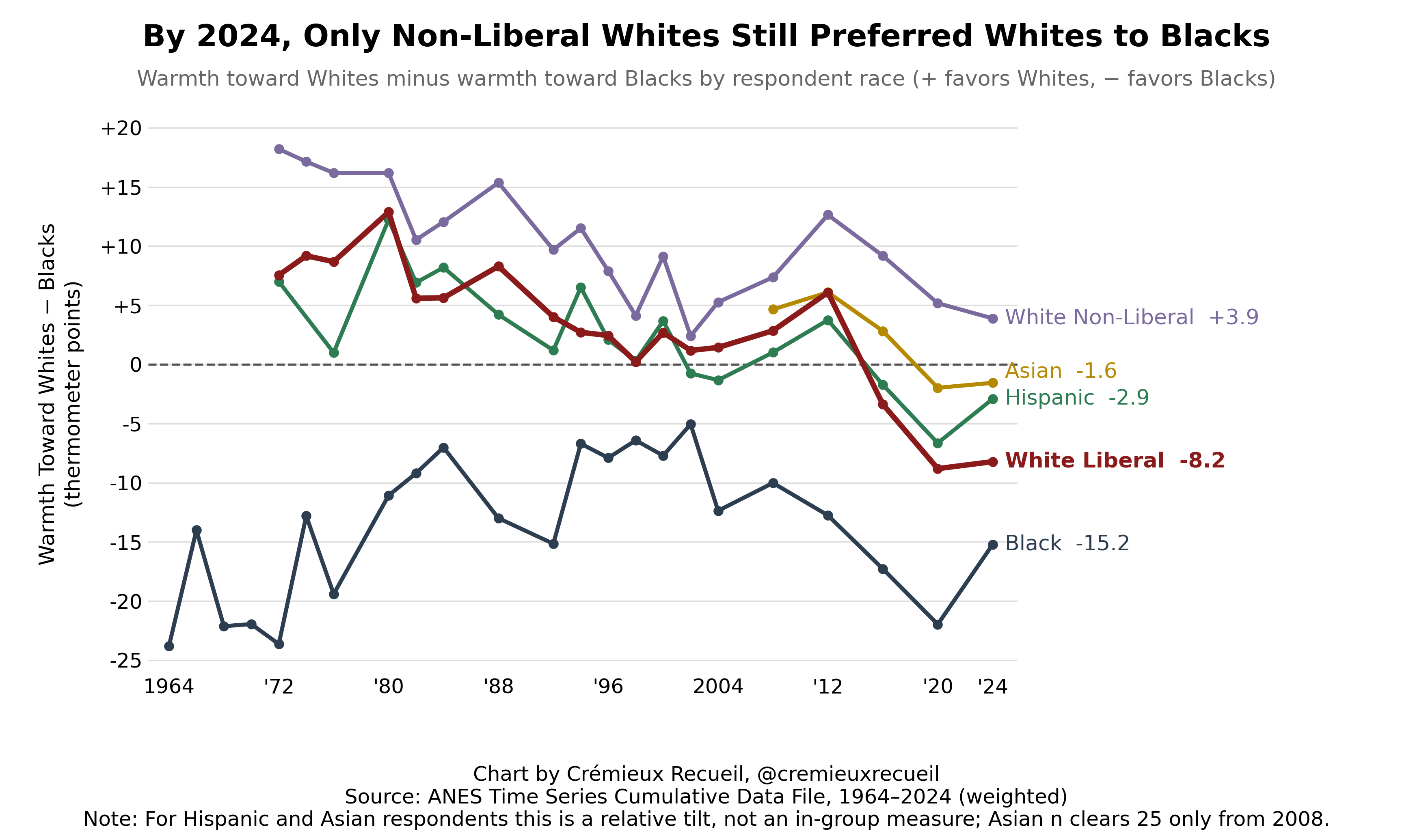
Bonus: The Great Awokening had a lot of focus on Black-White relations. How do different groups feel about Whites relative to Blacks? Outside of non-liberal Whites, everyone now prefers Blacks, at least in polling.3
This was a timed post. The way these work is that if it takes me more than an hour to complete the post, an applet that I made deletes everything I’ve written so far and I abandon the post. You can find my previous timed post here.
A message from my sponsor, Mechanize:
We’re hiring software engineers to build environments and evals that frontier AI labs use to train coding agents.
To get a better sense of the work we do, you can check out GBA Eval, where we had models build Game Boy Advance emulators from scratch and scored their performance.
Base pay starts at $300K/year for junior software engineers, with more for senior roles, plus equity and performance bonuses. Apply here.
Note that the results for Hispanics and Asians are harder to interpret here because the questions are not the same until more recent waves.
The GSS supports the trend, but not the sign reversal, but it uses the alternative measure ‘rated in-group closeness’.
P.S. I wanted to check if this result replicated for non-White racial majorities like Japanese in Japan, Koreans in Korea, etc., but there are no such applicable datasets as far as I know.
Interesting that so much hinges on 2012. What happened in 2012? Obama was already president, it wasn’t his first election. Trump, brexit, merkel’s millions were nowhere on the scene yet. I remember noticing the extent of woke madness seeping into the public sphere outside of academia and college campuses around 2012, but I am surprised it extended so far that it is seen this much in attitudes across white liberals. Was there some media source or social media platform that was becoming very active around that time? There was HuffPost, slate, daily kos…were such things enough to have such an impact on white attitudes about other whites?
Would be interesting to relate this data to studies of jury bias, though I'm not sure the latter have as much data longitudinally. If I recall, the general finding is that blacks have large in-group bias on juries, consistent with what you show here, while white jurors have essentially no in-group bias, but no anti-in-group bias, either ... though I'm not sure if anyone has broken out the specifically liberal white segment in the jury context.