

Today’s post is brought to you by my sponsor, Mechanize. They’re hiring junior software engineers at $300K/year base salary.

It sucks having a cold. For me, the worst part is the stuffed nose. When I have colds, I often reach for the one nasal spray that always works: Afrin, active ingredient, oxymetazoline.1 One puff per nostril and I’m clear for hours, saving me a lot of grief and making it possible to go about my day pretty much normally.
Afrin works, but I can’t recommend it. If your cold drags on for more than a couple of days, Afrin’s benefits turn to downsides. Oxymetazoline starts off by stimulating alpha-adrenergic receptors in the blood vessels in your nose, causing vasoconstriction: blood vessels tighten up and the blood flowing into your nose’s lining is pushed away and swelling goes down. That’s how Afrin opens your nose up, but after prolonged use, your nose adapts to this vasoconstrictor effect.
After a few days with Afrin, the nasal lining shifts to a more inflamed, leaky, and swollen state with local ischemia from repeated vasoconstriction causing reactive edema, increased vascular permeability, and chronic inflammatory changes.1 As a result, using Afrin can actually leave you more congested and you can become addicted; you can develop rhinitis medicamentosa, otherwise known as rebound congestion.
Suddenly, you need Afrin to be clear at all.
Hundreds of thousands and perhaps low millions of people come down with this condition every year by overusing Afrin and similar nasal sprays.2 There are whole online communities dedicated to quitting it. Those places are filled to the brim with people cycling in and out of addiction because they’re unable to put down the Afrin when it gets hard to breathe.
This isn’t some benign thing where the only cost is having to keep a spray bottle nearby. For one, a bottle of Afrin usually runs $10 to $20, and people who are severely addicted can run through a bottle every 2-3 days. Over a year, that adds up to about $1,200 to $3,700 in annual spend on a drug that should only be used when you’re sick.
Even if cost is no object, living with rebound congestion isn’t convenient. If you read the anecdotes on the various Afrin quitting forums, you’ll find stories about waking up every 2-3 hours at night, having to carry conspicuous bottles to use at functions, not to mention headaches, nervousness, dryness, sneezing, nasal discharge, dry mouth, mouth breathing, snoring, burning, stinging, and rarer side effects like turbinate hyperplasia and atrophic rhinitis to boot! Some people have even had their addiction result in high blood pressure, insomnia, and eventually surgeries.
Millions of people have turned a temporary stuffy nose cure into a self-sustaining chronic nasal disease, that brings with it poor sleep and generalized low quality of life.
Given how many people are affected by overuse of Afrin and Afrin-like drugs, you’d think there would be a standardized, high-quality protocol to get off it. Unfortunately, despite recognition by the medical profession, no one has gone through the effort to make that happen. So, to that end, I leveraged my subscribers for some testing.
I randomized convenience-sampled subscribers, Discord users, and friends to different strategies in groups of 20. Two strategies involved continued use of Afrin and the others involved either mechanical nasal dilation or the use of different nasal sprays. Here’s what we did:
Single-Nostril Comedown: This group was tasked with stopping their wholesale use of Afrin and instead just using it in one nostril, until they felt they could breathe in the other one, whereafter they would try to stop using Afrin entirely. 19 completed the trial.
Saline Wean: This group was to keep using Afrin, but was instructed to refill the bottle to the top with saline every night. That way, they would end up using a more and more diluted product over time. 16 completed the trial.
Saline Rinsing: This group was asked to rinse their nostrils as-needed with saline. They were also able to use a standard saline nasal spray. 32 of 39 completed the trial and I treat this as a sort of baseline or placebo group for everything else.
Flonase: This group used a nasal spray containing the corticosteroid fluticasone propionate every day. 20 completed the trial.
Flonase+: This group used as nasal spray containing the corticosteroid fluticasone furoate every day. 19 completed the trial.
TCA: This group used a nasal spray containing the corticosteroid triamcinolone acetonide every day. 14 completed the trial.
Nasonex: This group used a nasal spray containing the corticosteroid mometasone furoate every day. 15 completed the trial.
Xylitol: This group used a xylitol nasal spray every day. 16 completed the trial.
Xylitol+: This group used a xylitol and capsaicin nasal spray every day. 11 completed the trial.
Azelastine: This group used a nasal spray containing azelastine HCL every day. 13 completed the trial.
PO: This group used a nasal spray with 0.6% or 1% povidone iodine every day. 19 completed the trial.
IC: This group used a nasal spray with iota carrageenan every day. 17 completed the trial.
Intra-Nose: This group was asked to use an Air Max brand in-nose nasal dilator and, if they needed it, saline. 14 completed the trial.
On-Nose: This group was asked to use an Intake brand magnetic nasal strip and, if they needed it, saline. This group started and ended with 18.
Everyone was told to use standard dosing but was able to do more if they needed, they just had to use the correct compound and avoid failing to Afrin.
What Worked?
Here’s the main result in one picture. This is affirmative responses to ‘Are you now able to breathe clearly unassisted?’ Volunteers were asked if they were able to wake up and go throughout their day without using nasal sprays or mechanical assistance.
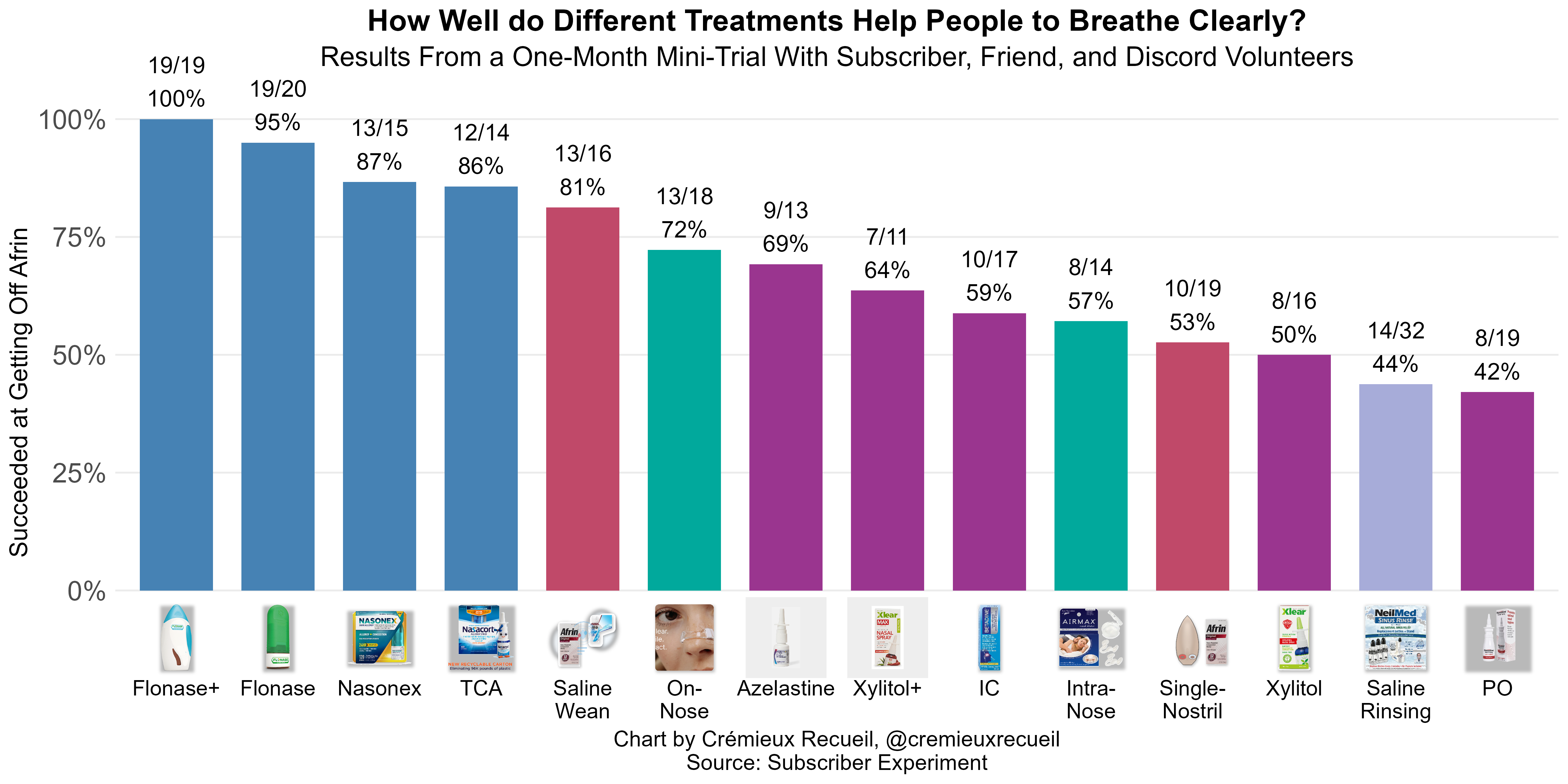
The bar coloring has to do with steroids (blue) vs. Afrin strategies (red) vs. mechanical methods (teal) vs. the rest (purple) vs. the placebo (soft periwinkle). This is because these are similar enough and I wanted to get statistically meaningful results so I had to group different interventions together. Given the variation within these groupings, you can probably tell that I mainly did that to get at the least varied and most successful group: the steroids.
Relative to the ‘placebo’ saline-only group, steroid spray-using completers were 48.9 percentage points (pp) more likely to end up with a clear nose at the end of a month. Assuming the people who didn’t make it to follow-up or who told me they couldn’t make it were all failures, then steroids had a success delta of 42.9pp, with 78.7% succeeding vs. 35.9% of those in the placebo group. This is the most robust result:
If you want to get off Afrin, use a steroid nasal spray if you can.
The other results are much less clear—for now (see below). For example, Xylitol+ is a xylitol nasal spray with capsicum oleoresin (capsaicin) plus aloe and grapefruit seed extract. It stings a little bit for some people and it achieved a success rate of 64%. But, it also had the highest attrition rate. If you assume the non-completers were failures, then Xylitol+ actually looks slightly—nonsignificantly—worse than basic Xylitol.
Anyway, the correlation among completers between rated feelings of clearness and rated feelings of comfort was a modest but statistically significant ρ = 0.57.
What’s the Catch?
In my opinion, there’s one catch, but it might not even be real: If you use everything as directed, the costs of these different treatments are nominally a bit higher than the costs of Afrin.3
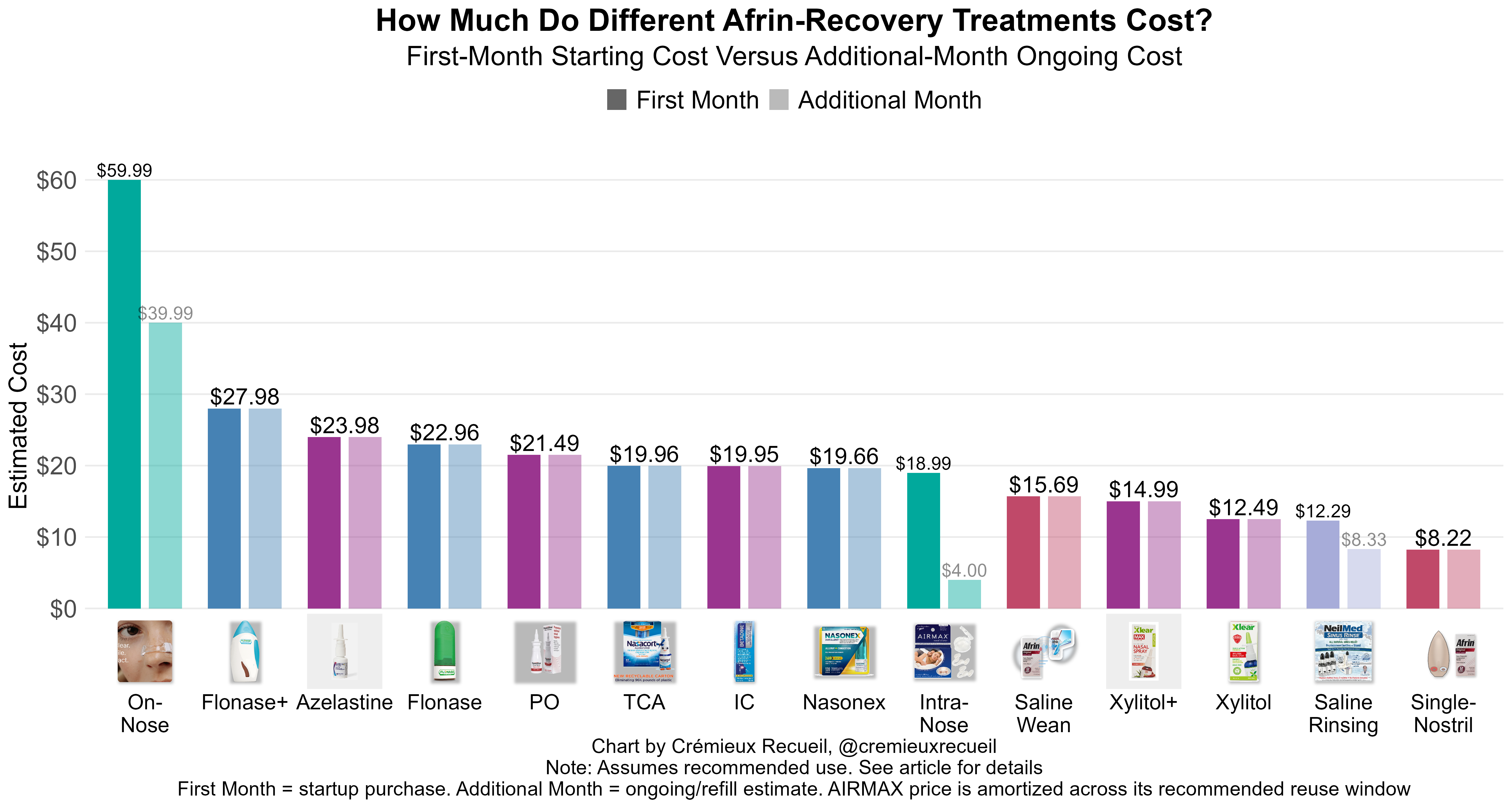
In general, the treatments for Afrin are more expensive than using Afrin 1-2 times a day. But that comparison is biased in favor of Afrin.
For that graphic, I used name-brand prices, but you can get off-brand prices that are much lower for several of these options. Additionally, people who are addicted to Afrin frequently use more than they should, so this understates Afrin-related spend. Plus, if you break an Afrin addiction, you don’t have to keep using the alternatives, you can just stop using them altogether after recovery. And, the cost of Afrin is not just measured in dollars! Rhinitis medicamentosa is a real medical condition that is no fun to have and it comes with tons of common side effects.
The way I’d think about the Afrin alternative side effects is like this:
Saline rinsing, plain xylitol, iota-carrageenan, and the mechanical devices have rare, mild, and local side effects—temporary burning, maybe causing a minor nose bleed if you use them really incorrectly, and possibly some ear fullness if your sinuses are particularly messed up. Saline is also just obviously safe and in the broader literature, both xylitol and iota-carrageenan are well-tolerated to the point where it’s hard to take side effect worries seriously.
The intranasal steroids can cause some local irritation: nosebleeds, burning, headache, sore throat, cough, and other nuisance effects that will mainly affect you if you’re using the products incorrectly, if you’re particularly messed up, or if you’re new to the products and having a reaction because you’re one of the minority of people who needs to get used to them. The most serious concerns for this intervention class mostly exist on their labels—eye effects, infection risk, systemic steroid effects, etc.—but not in the real world with typical or even double or triple the recommended OTC nasal use.
Azelastine has moderate costs. It helps with symptoms, but compared with intranasal steroids or saline-like approaches, it has a more noticeable tolerability ‘tax’ in the form of its bitter and unusual taste—which you can avoid by using the kids’ product, which has the same dose and efficacy, but tastes better—, nasal discomfort, fatigue, and sleepiness. But azelastine is still quite safe.
Xylitol with capsaicin may have moderate-to-high costs in the form of discomfort. Capsaicin has plausible therapeutic properties, some data to back them up, and it feels good to me and most of my friends, but if you’re not used to spice, you might find your nose burning, you might end up sneezing and coughing, and possibly feeling some short-term irritation. I love this stuff and some people I know hate it. It definitely produced the most polarizing reactions among people I talked to, but it is quite safe.
Povidone iodine has very formulation-dependent effects. Low-concentration products can be reasonably well-tolerated with mild transient nasopharyngeal discomfort as a common side effect, while higher concentration intranasal formulations frequently cause temporary burning and nasal pain. It’s basically more painful saline and I don’t think it’s up to the task for helping people get off Afrin, so maybe ignore it as an option (but research its other benefits!).
Compare all of these things to Afrin and there’s just no question! Quitting wins!
Afrin addiction—rhinitis medicamentosa—is a serious, self-imposed chronic disease; it means prolonged congestion, dependence, and risk of other nasal diseases far beyond anything these alternatives cause. The alternatives sometimes cause transient, localized annoyance, but they don’t generate dependence, they don’t lead to other serious medical conditions, and they don’t leave you with the incessant worries that being stuck on Afrin usually does.
What’s really remarkable is that to the extent people get off Afrin, they seemed to agree. General side effect reports correlated at ρ = -0.89 with success: as much as one of these options helped to get people off of Afrin, they felt it had lower side effects.4 This doesn’t match up with the literature on these drugs’ effects in normal use, but fixing Afrin addiction is decidedly not normal use, so I think this finding makes sense:
Afrin withdrawal is so bad that whatever side effects alternative drugs had, the relief from being able to come off Afrin was so great that effective treatments were experienced as having fewer side effects overall.
The Extended Writeup
I plan to keep updating this article as more data comes out, and that includes putting future trial results down below, too. To keep up to date with it and to see everything else that I’ve written on this subject, keep scrolling!
Untested Possibilities and Things I Didn’t Have Big Enough Groups For
Can We Design an Effective Mechanical Dilator?
Smelling Sticks?
Reddit
Amazon Reviews
