

Today’s post is brought to you by my sponsor, Mechanize. They’re hiring junior software engineers at $300K/year base salary.
This was a timed post. The way these work is that if it takes me more than one hour to complete the post, an applet that I made deletes everything I’ve written so far and I abandon the post. You can find my previous timed post here.


If you’re reading this, you’ve probably seen some permutation of the meme that ‘I didn’t move right, society moved left’. In the above cartoon, the idea is that today’s ‘far right’ are the normal people of yesteryear. But, is that true? Does it matter?
To figure out the answers to my questions, I opened up the General Social Survey and had a look around. To get started, I defined a few sets of political views: Institutional Confidence, Criminal Justice & Guns, Political Tolerance, Economic/Pro-Government, Racial Liberalism/Civil Rights, Gender-Role Egalitarianism, and Sexual & Moral Liberalism, and then I outlined a set of important social views. We’ll go in order.
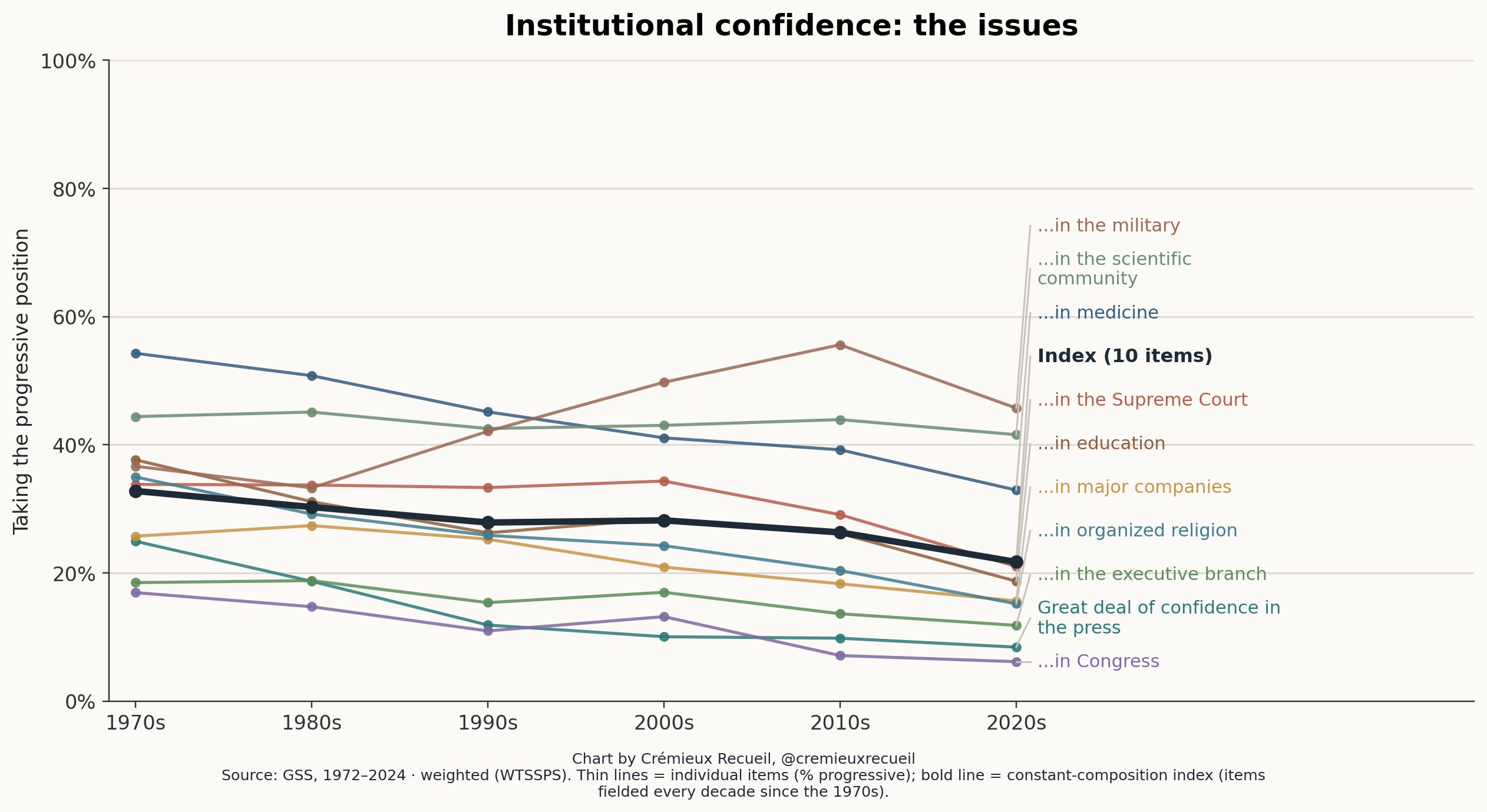
People have become less confident in America’s institutions over time.
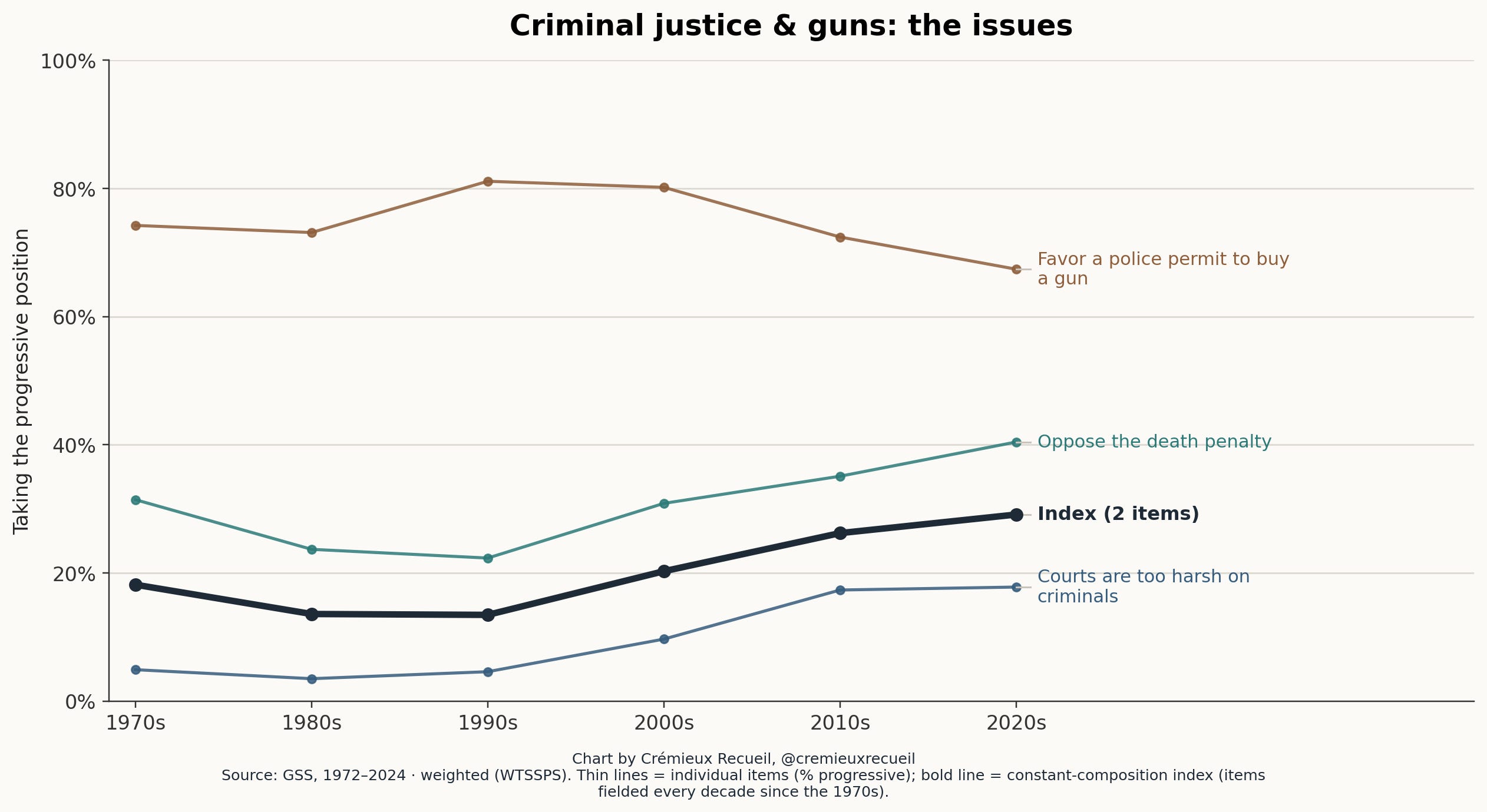
When it comes to criminal justice and firearms, more people think courts are too harsh on criminals, more people oppose the death penalty, and fewer people think we ought to requires permits to buy guns. The last of these didn’t change that much.
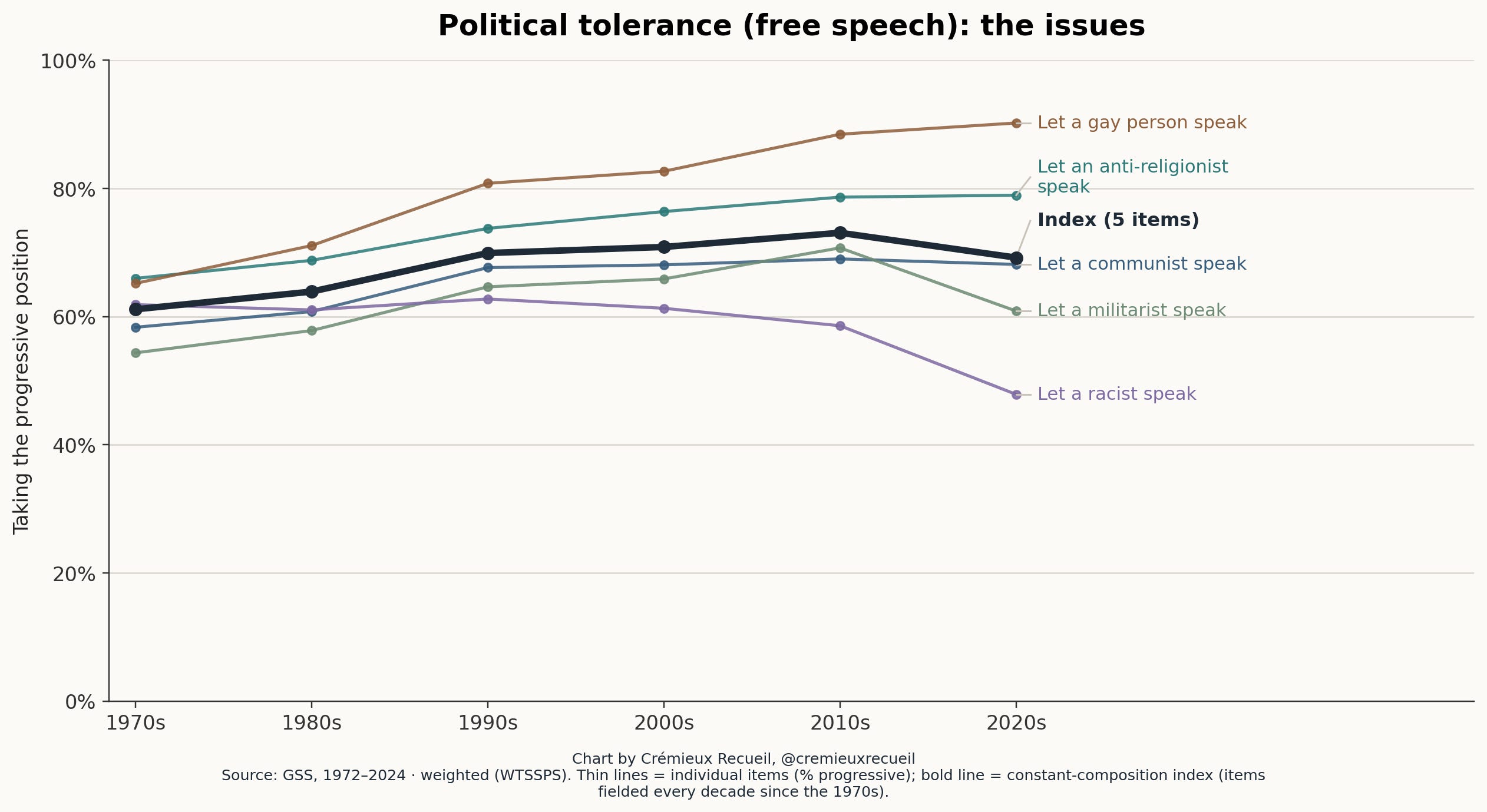
Political tolerance has somewhat increased since the 1970s, but it’s somewhat down since the 1990s. This general trend masks something interesting: more acceptance of gays and atheists, less acceptance of racists and militarists.
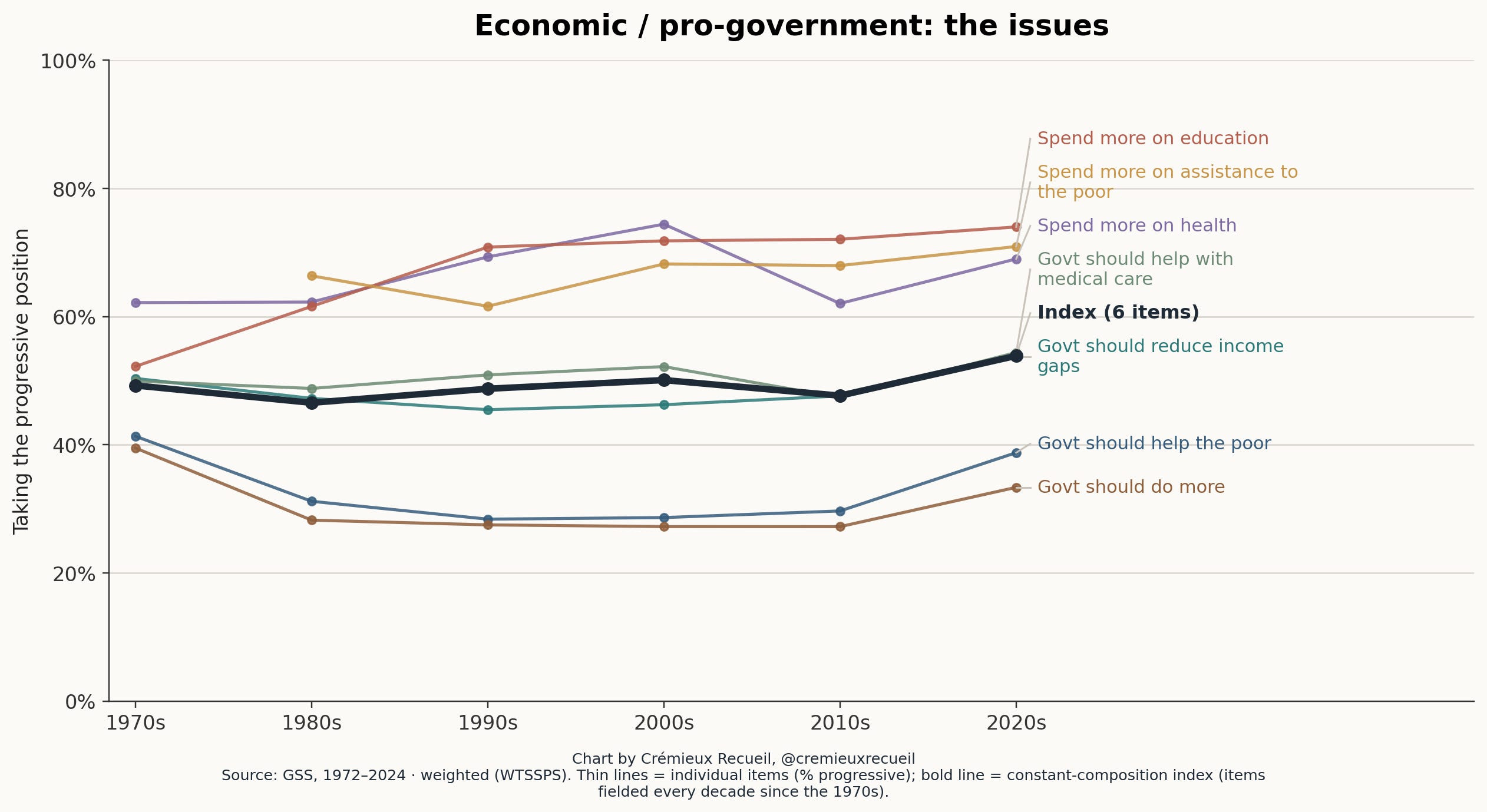
Movement on economically left-wing views has been generally pretty flat, which is roughly what we also see for economically right-wing views.
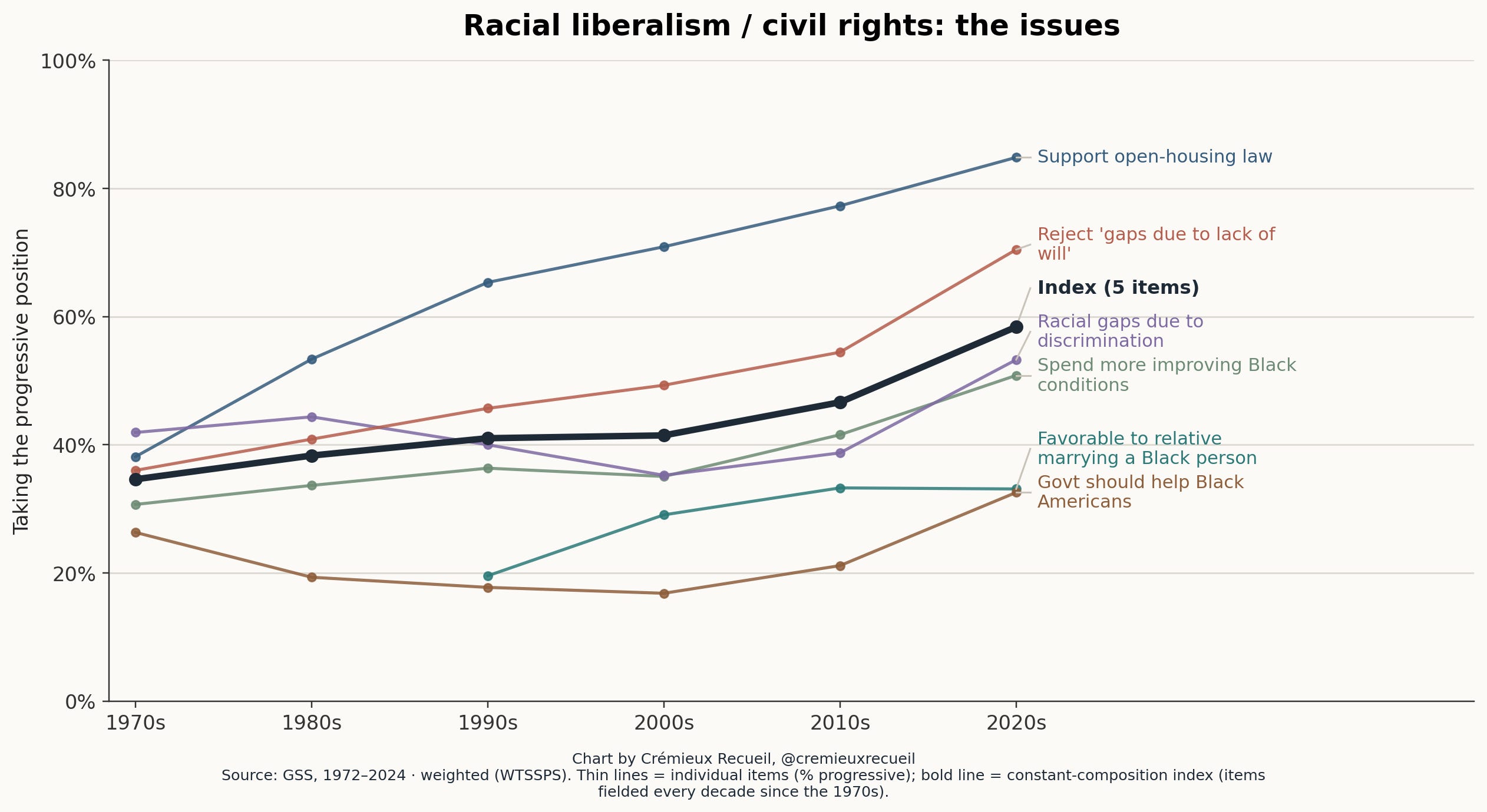
When it comes to racial liberalism, people have shifted far to the left. People have become more likely to ascribe Black-White gaps to discrimination and less to a lack of effort, among other things.
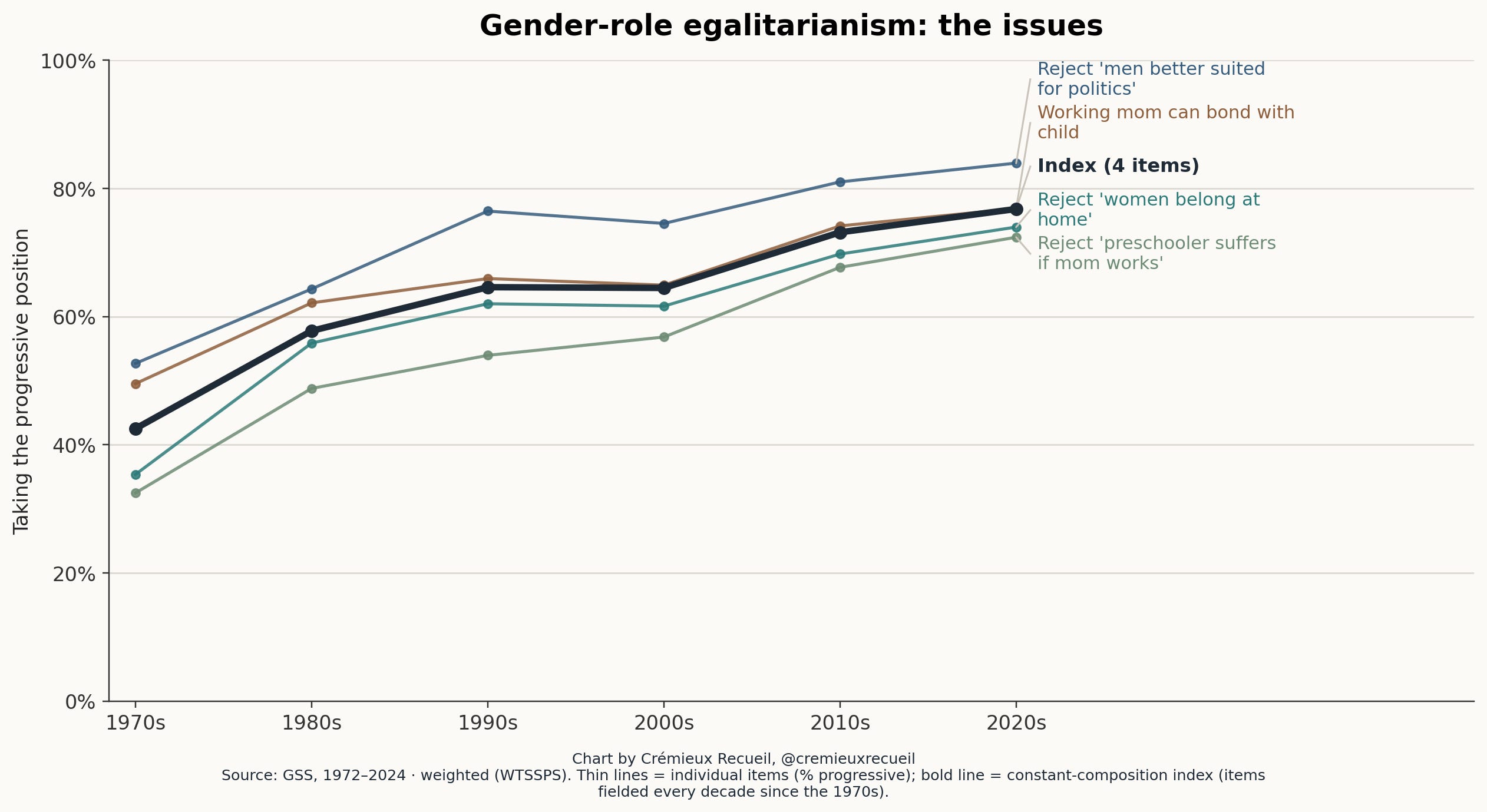
When it comes to gender roles, egalitarianism has greatly increased.
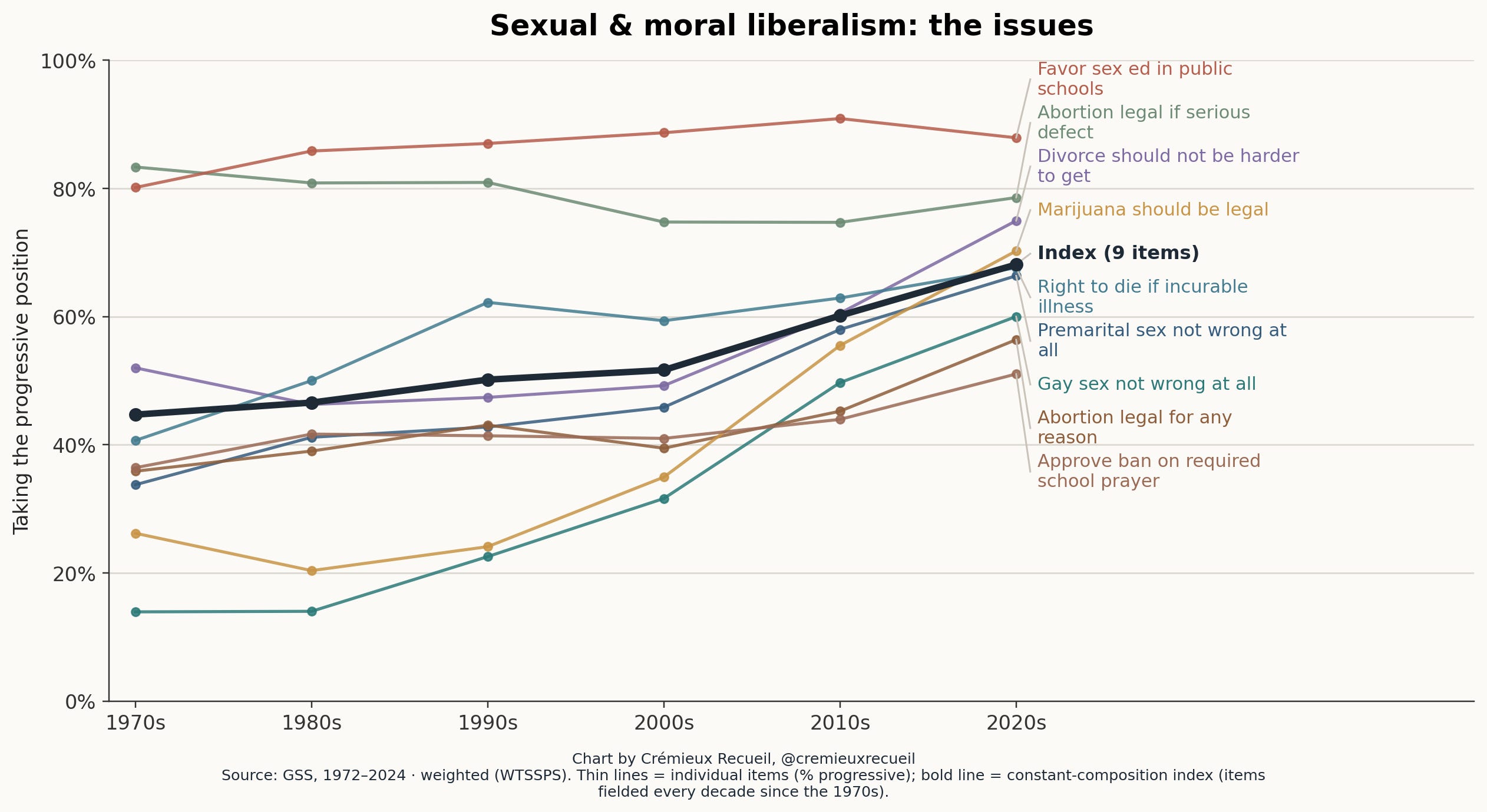
Finally, when it comes to sexual and moral liberalism, views on sex education, divorce, marijuana legality, and so on have, in some cases, quite radically shifted towards left-ward positions. Abortion legality for serious defects is the only exception among the bunch.
All of this sums up to saying that the nation has moved considerably, but not overwhelmingly, to the left.
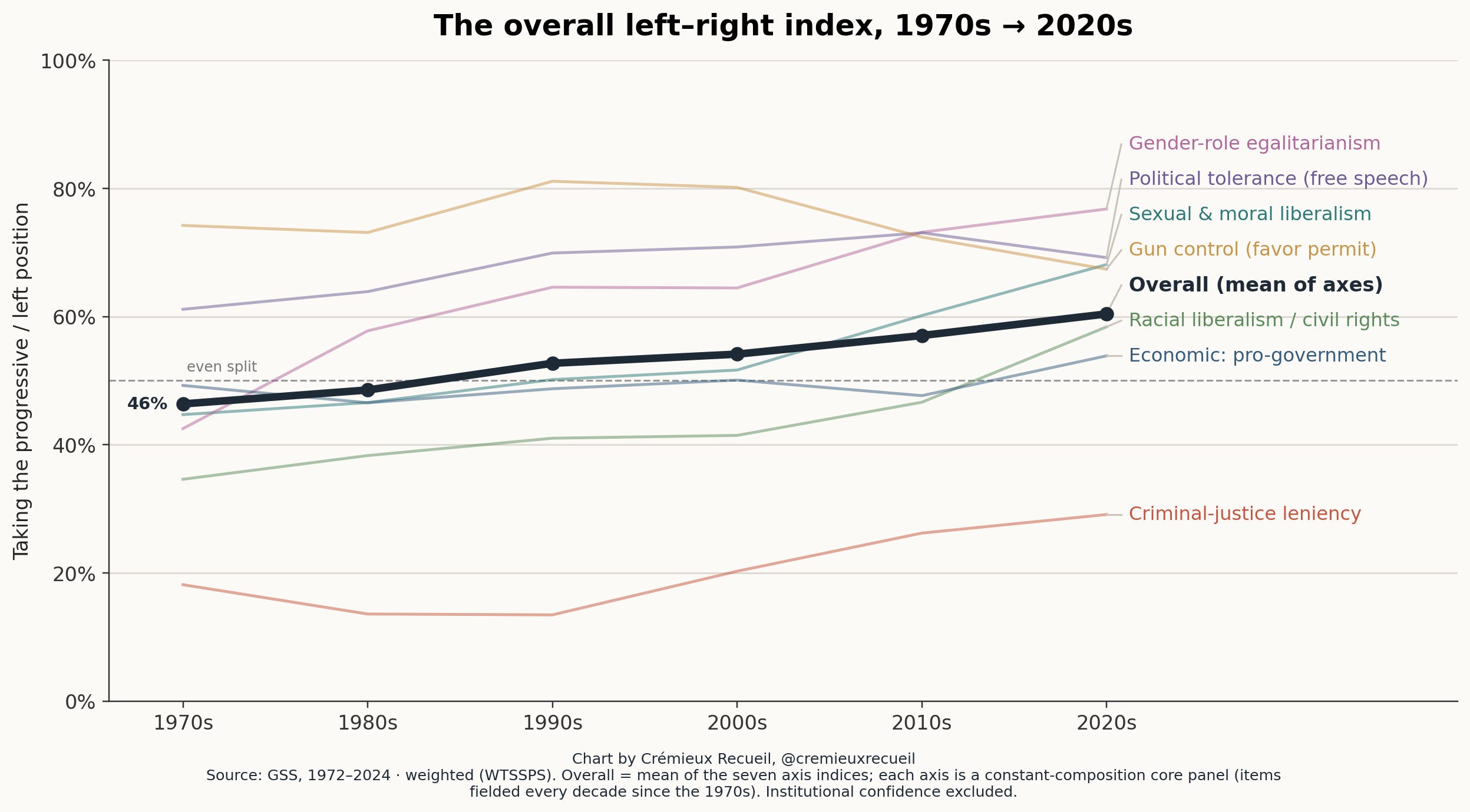
Does this support the thesis that a normal person from 30 years ago would be far-right today? Not on its own. Many of the views that society has shifted decisively on remain well within the Overton Window and are certainly not so generally proscribed that they’re rejected out of hand.1 The sort of position that is nowadays rejected firmly is like what the average person from a little over 30 years ago believed on interracial marriage: they didn’t approve.
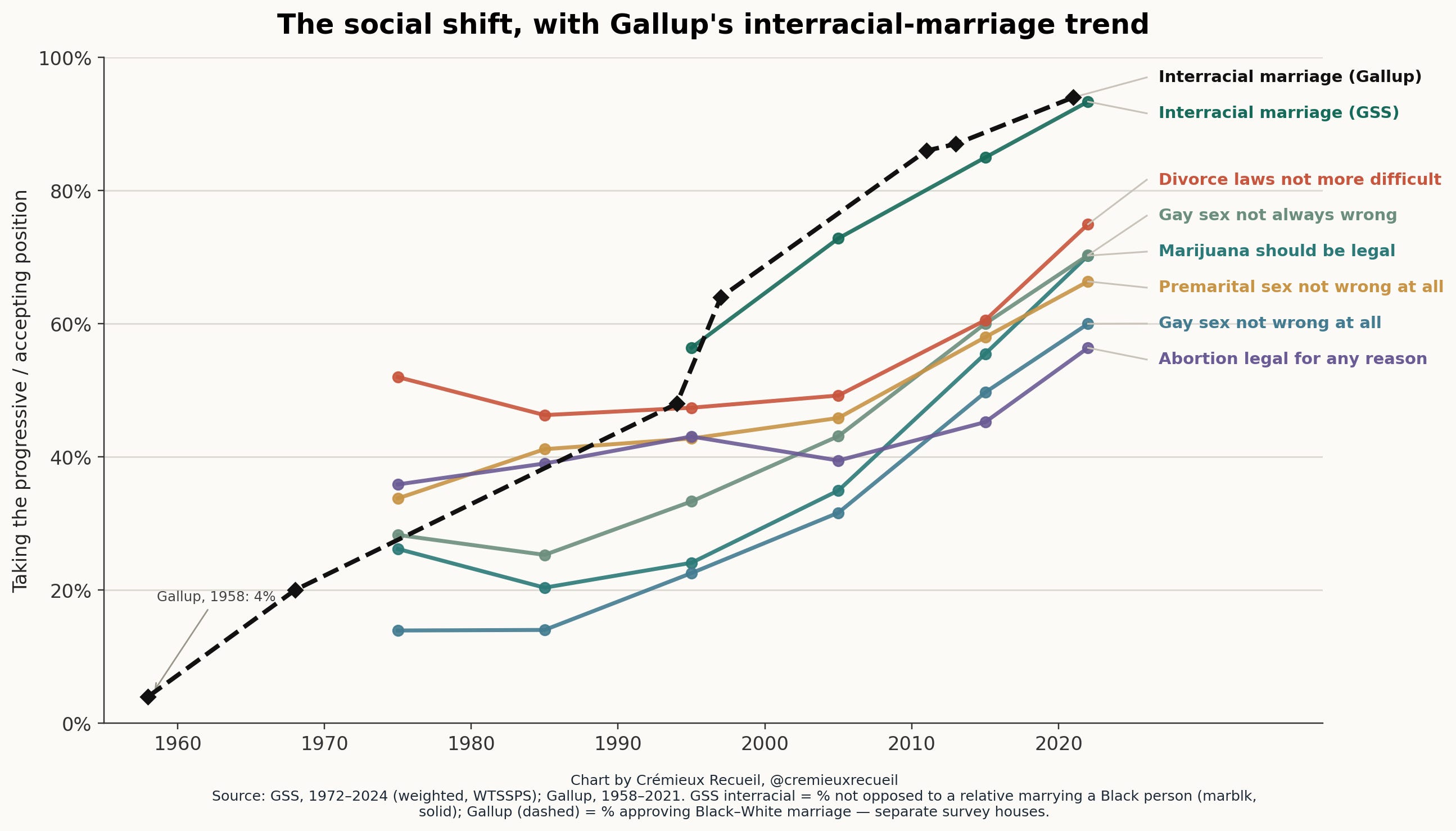
What can we say about the normal person from 1995? In many ways, he was much like us. In other ways, he was what most people would now regard as kind of a dick. He didn’t like interracial marriage and he wasn’t too keen on gays either. These social views aren’t alone: plenty of things now considered taboo were, at the time, wholly acceptable, even in polite society, and sometimes these were the majority view.
Right or wrong, I don’t think appealing to normal people in the world 30 years ago is likely to make many friends after realizing the sorts of things people used to believe.
A message from my sponsor, Mechanize:
We’re hiring software engineers to build environments and evals that frontier AI labs use to train coding agents.
To get a better sense of the work we do, you can check out GBA Eval, where we had models build Game Boy Advance emulators from scratch and scored their performance.
Base pay starts at $300K/year for junior software engineers, with more for senior roles, plus equity and performance bonuses. Apply here.
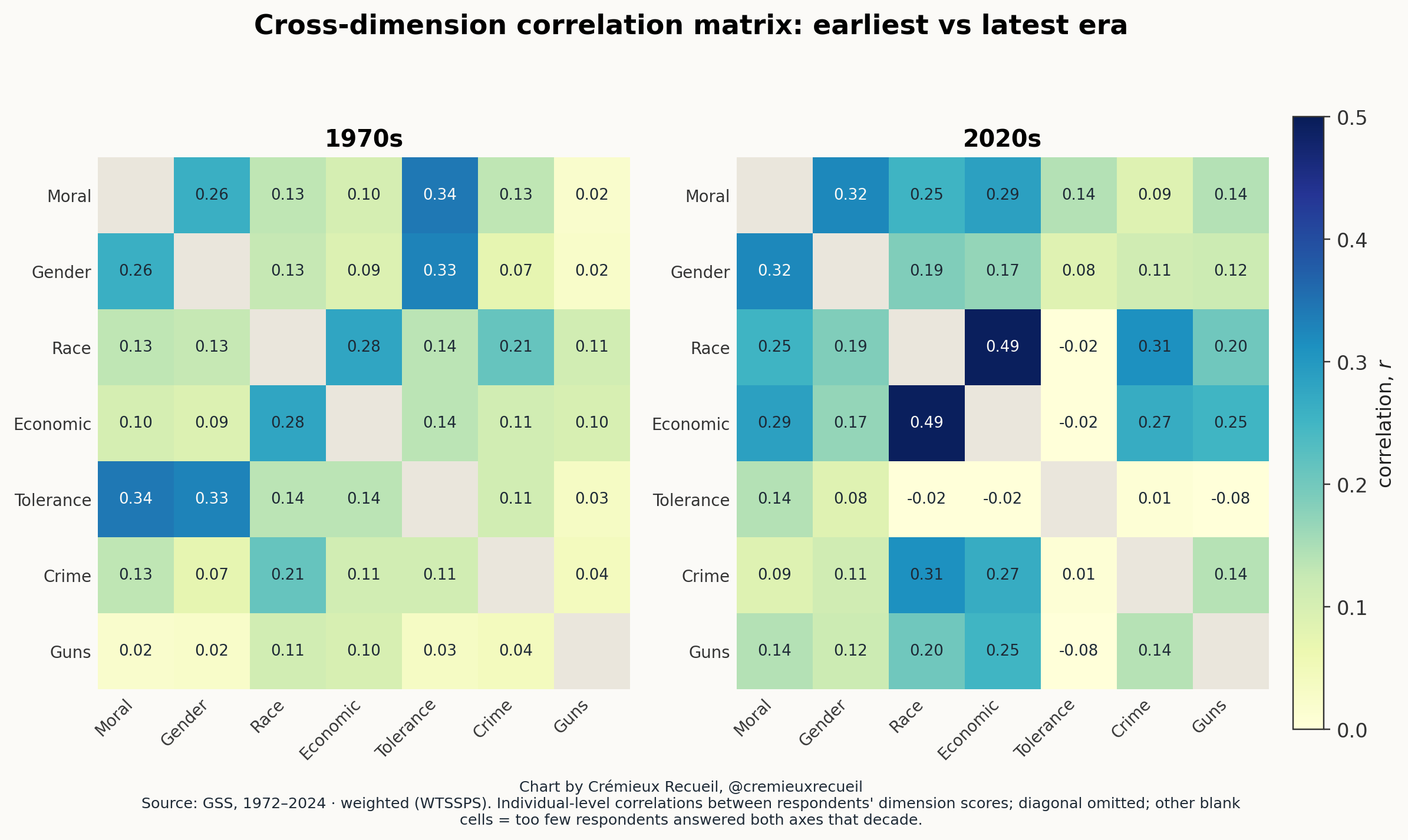
Another interesting finding is that the correlations among different dimensions have changed as people and their views have politically shifted. For example, economic and racial views are now correlated about twice as highly as they were in the 1970s.
Chesterton always has the right quote: "Do not be proud of the fact that your grandmother was shocked at something which you are accustomed to seeing or hearing without being shocked. There are two meanings of the word 'nervous,' and it is not even a physical superiority to be actually without nerves. It may mean that your grandmother was an extremely lively and vital animal, and that you are a paralytic."
I was going to do a very similar analysis to this one based on the General Social Survey, but I do not think the GSS is a good instrument for investigating what the "normal guy in 1995" meme is referring to.
First, note that it would be worth unpacking whether issues gained a partisan split between 1995 and now.
For instance, in your plot, the view that abortion should be legal for any reason appears to have a relatively small change from 1995 to 2024, going from a minority view (~42%) to a majority view (~58%).
However, when you look at views by party lean (https://borncurious.blog/i/157321174/partisanship), there is a much more dramatic change starting in the 1990s. Republican leaning voters support abortion-legal-for-any-reason pretty much at the same levels they did in 1998 (~30%). During that same time frame, Democrat-leaning voters went from minority support (~41%) to a whopping 82% super-majority support in 2022.
Indeed, abortion-legal-for-any-reason went from bipartisan majority opposition to becoming a signature view of the Democratic Party and a purity test for whether someone is accepted within its constituency.
This is much closer, I think, to the pattern of what was once a mainstream viewpoint being construed as "far right" between 1995 and now.
When I stumbled on that phenomenon for abortion, I thought about doing a broader analysis on "The Big Lurch", i.e., the phenomenon in which the Democratic Party's constituency rapidly changed from majority moderate-to-conservative cultural viewpoints to majority radical cultural viewpoints in the 21st century.
However, the GSS just doesn't ask the right questions for this. Abortion-legal-for-any-reason was an outlier because it was added in 1977 in response to Roe v. Wade and Doe v. Bolton in 1973.
The problem is that most GSS questions are from the 1970s and 1980s. It either doesn't ask about the relevant questions for The Big Lurch phenomenon or, if it does, it frames them in an old-fashioned way.
For instance, if the GSS were to ask whether immigration enforcement is intrinsically immoral, I suspect you would see a similar pattern to abortion-legal-in-any-circumstances that tracks with first-term Obama campaigning on immigration enforcement and winning the Democratic primary versus the Biden-era lax immigration enforcement. (Though, many times the Democratic Party leadership doesn't actually reflect its constituency's views, so this is just conjecture.)
There are likely several issues like this that would track with The Big Lurch pattern, but the GSS isn't sufficient for tracking them.
In short, the GSS is always going to frame someone from 30 years ago as "kind of a dick" because the selection of questions that it asks and the way it frames them are archaic.
I might still do my "Big Lurch" analysis, but I put it on the back burner because I realized I need to cobble together public opinion data from multiple sources rather than relying on the GSS in order to do it.