

Bonus: We now have accurate, up-to-date data to track quarterly obesity and GLP-1 usage.
Today’s post is brought to you by my sponsor, Mechanize. They’re hiring junior software engineers at $300K/year base salary.
Always kvetch. That’s how anything ever gets done. In this case, that seems to be how the major electronic health records (EHR) software company Epic was convinced to finally provide quarterly updates on obesity and GLP-1 usage for over 100,000,000 (one hundred million) Americans.1 Now, we can finally resolve a little debate started by The Economist last year: Has America’s obesity rate been declining? The answer? Yes!
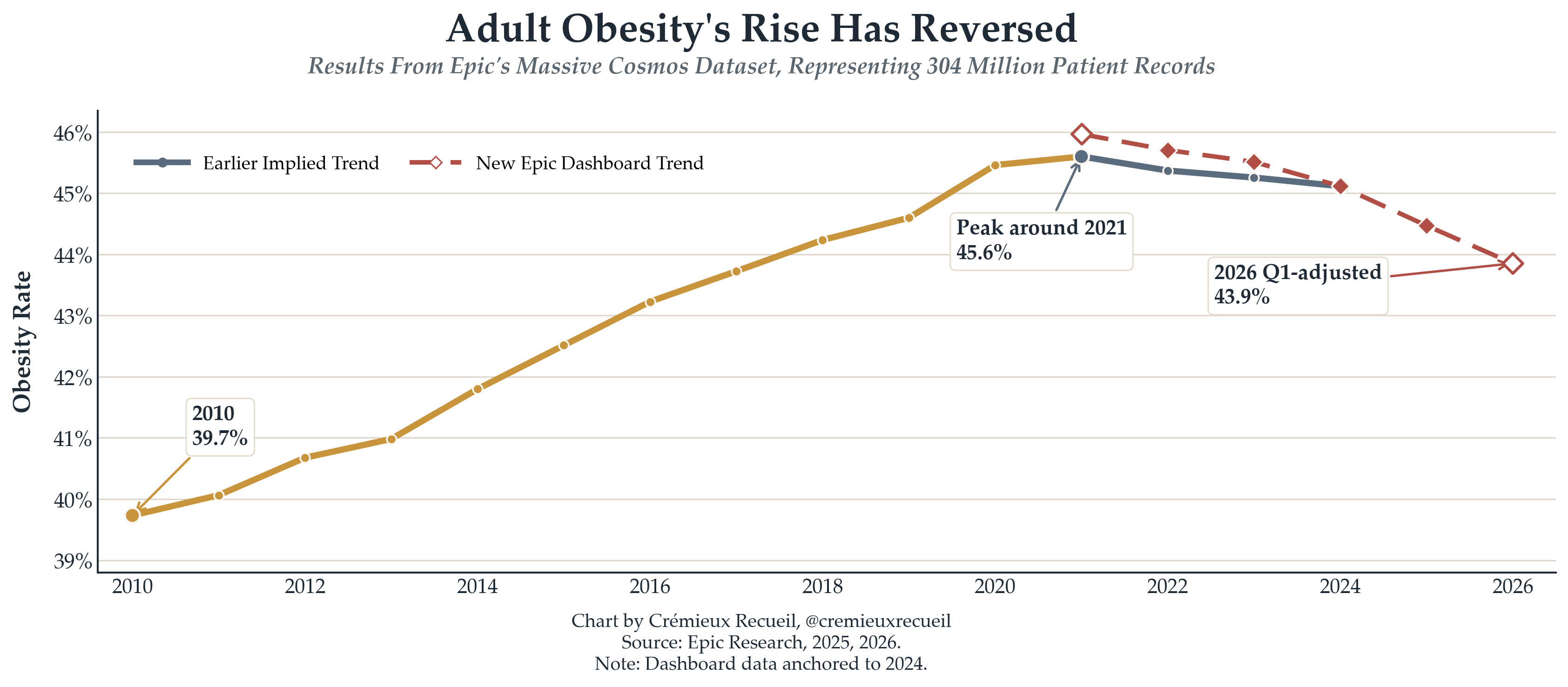
Epic has also been generous enough to supply us with quarterly data for 2021 onwards. Adjusting for seasonality in that period, we can see that the fall is continuing into 2026. This might inform us about the causes. Think about it: if the trend was being driven by a mass die-off from COVID, as some have proposed, for example, then that moment should’ve passed, but the trend is continuing. In fact, every quarter lately is lower than the corresponding one from the previous year:
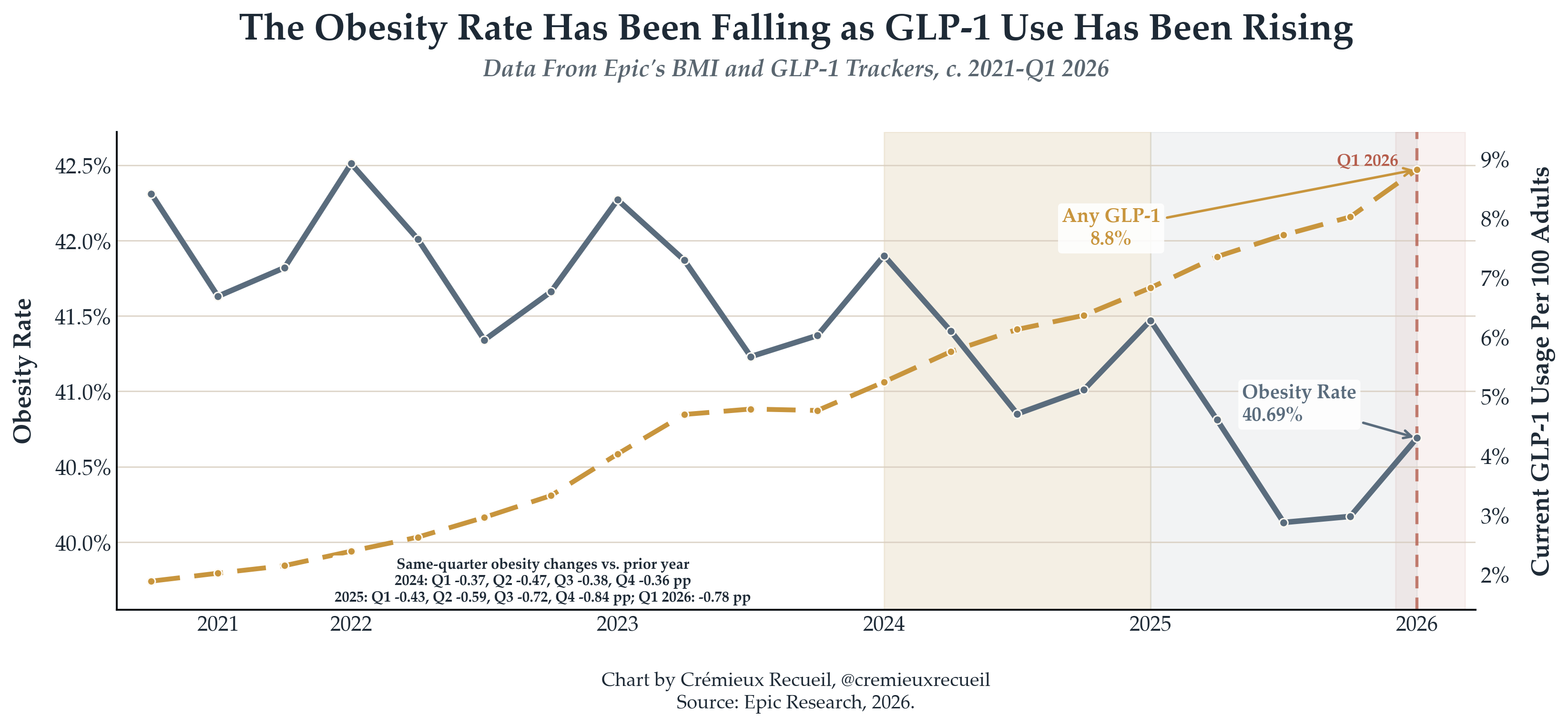
We still don’t know what’s driving this, but we have hints.2 For example, the population is getting older—a potentially countervailing influence—and, perhaps more crucially, the population is increasingly using GLP-1RAs. In fact, as of mid-2024, some 1-in-5 Americans had tried them. Judging based on Epic’s dashboard, that number has likely continued to rise, and the EHR-recorded number has now become ~25% for diabetics and ~13% for the obese.3 Adding plausibility, we know that GLP-1RAs are capable of wiping out obesity.

While not totally satisfying on answers, this data release from Epic is a good start.
A message from my sponsor:
We’re hiring software engineers to build environments and evals that frontier AI labs use to train coding agents.
To get a better sense of the work we do, you can check out GBA Eval, where we had models build Game Boy Advance emulators from scratch and scored their performance.
Base pay starts at $300K/year for junior software engineers, with more for senior roles, plus equity and performance bonuses. Apply here.
This was a timed post. The way these work is that if it takes me more than one hour to complete the post, an applet that I made deletes everything I’ve written so far and I abandon the post. You can find my previous timed post here. I finished this post and then waited to obtain the ad section to add after finishing. In that time, I added the Epic tweet.
This was confirmed to me by some people on Twitter, whom I much appreciate. Ex:

And then Epic themselves seemingly confirmed it:


And we also need to make caveats about the comparability of these samples over time. This is a huge panel, and arguably large enough that it’s closing in on being real population estimates, but it still leaves room for changes over time. However, changes over time in panel composition—which don’t seem to matter for trends in the NHANES, for example— that could fit within Epic’s sampling schema and generate a consistent downward trend, mysteriously only after the mass advent of GLP-1RAs, are hard to imagine.
And this is an undercount due to it being current usage and neglecting things like gray market usage unreported to a doctor and transcribed into the EHR.
And as the cost of the drugs fall...
I do hope future versions will have fewer side effects
This isn't like asking about the effectiveness of antidepressants, creatine or new cancer drugs, this is the equivalent of comparing antibiotics to no treatment. The effects are huge and involve tens of millions of people.