

Today’s post is brought to you by my sponsor, Mechanize. They’re hiring junior software engineers at $300K/year base salary.
Data centers are, in a word, unpopular. They’ve quickly gone from the sorts of infrastructure projects that communities are neutral towards or welcome to being the sorts of projects that enjoy nearly universal revulsion. This is exaggeration, but not by much: the latest polling suggests about 75% of the population dislikes data centers.
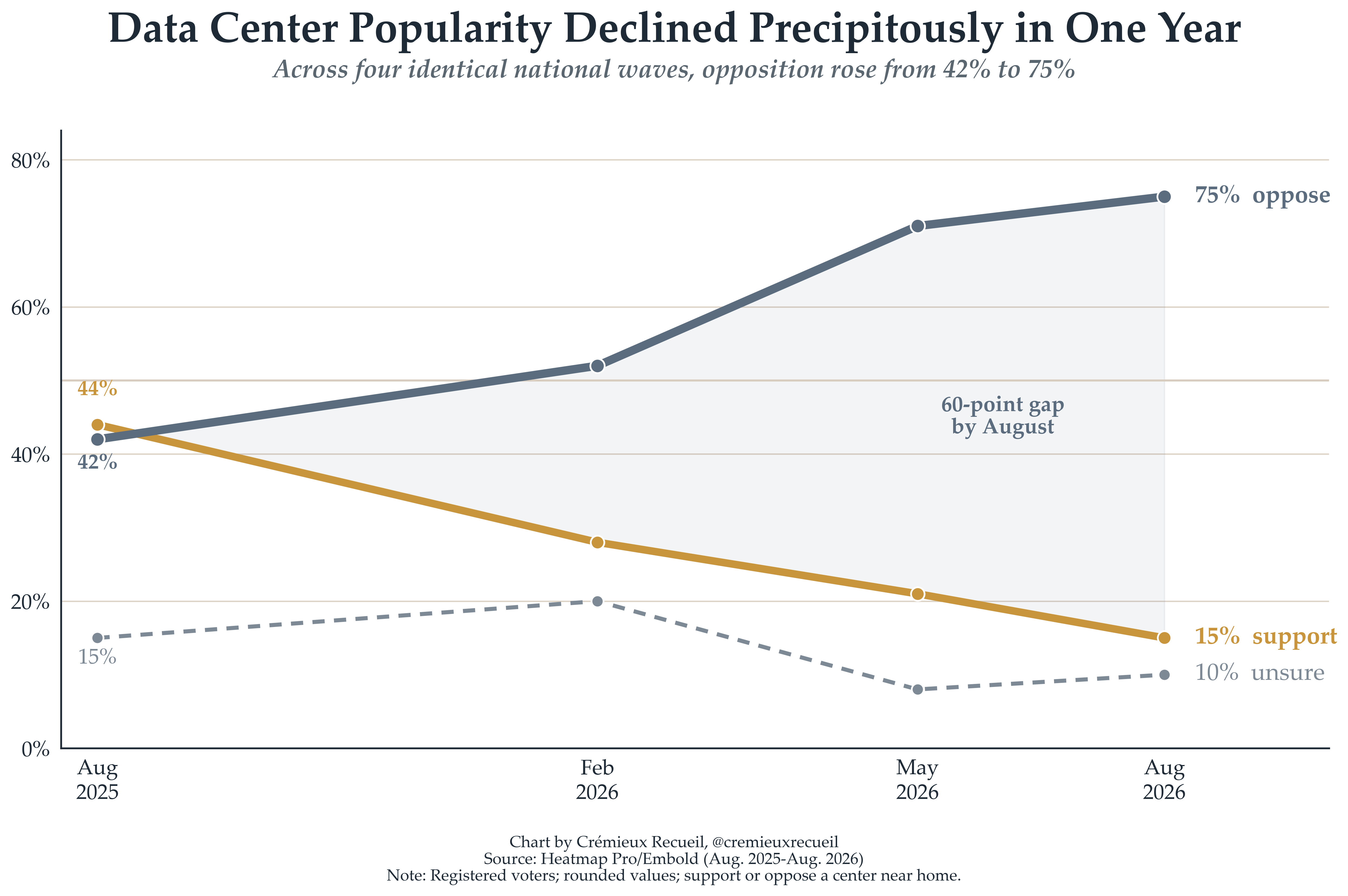
Why? Data centers are clean, they pay high taxes, during their construction they pay a lot of blue collar workers and after construction they continue to stimulate the local economy, and they have very little impact on things like local utility costs or housing prices. But this is not what people believe. When you poll them, they seem to consistently believe that data centers are bad: they pollute and they increase costs.
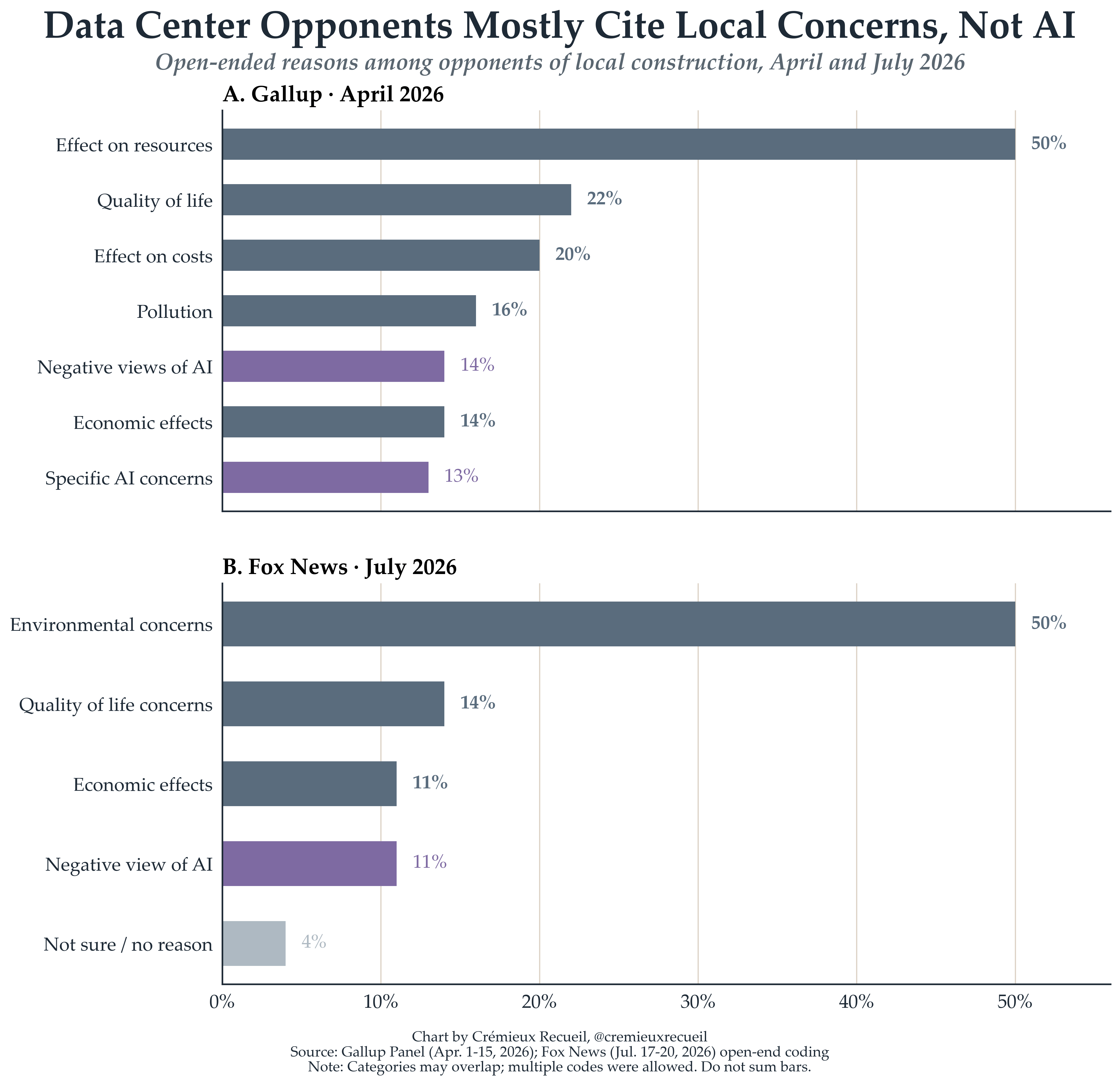
But data centers do not greatly stress local resources or increase costs, so this is an odd set of views. If you’re very online, you might expect that the top reason for opposition to data centers would be something AI-related; that’s at least something real and worthy of concern, whether it’s an AI extinction risk fear or dismay about having one’s job replaced by machines. Alas, that is simply not it, and to suggest otherwise is to suggest that survey respondents are lying, and much worse, it’s a view that can’t even be falsified: if we believe survey respondents are actually worried about AI and they’re just fibbing or answering in confusion, then we can’t justify that view.
Because so many surveys have now been run, we can triangulate what portion of the resistance to data centers is driven by specifically AI-related sentiment. The triangulation evidence is as follows, from strong evidence to evidence that’s merely contextual:
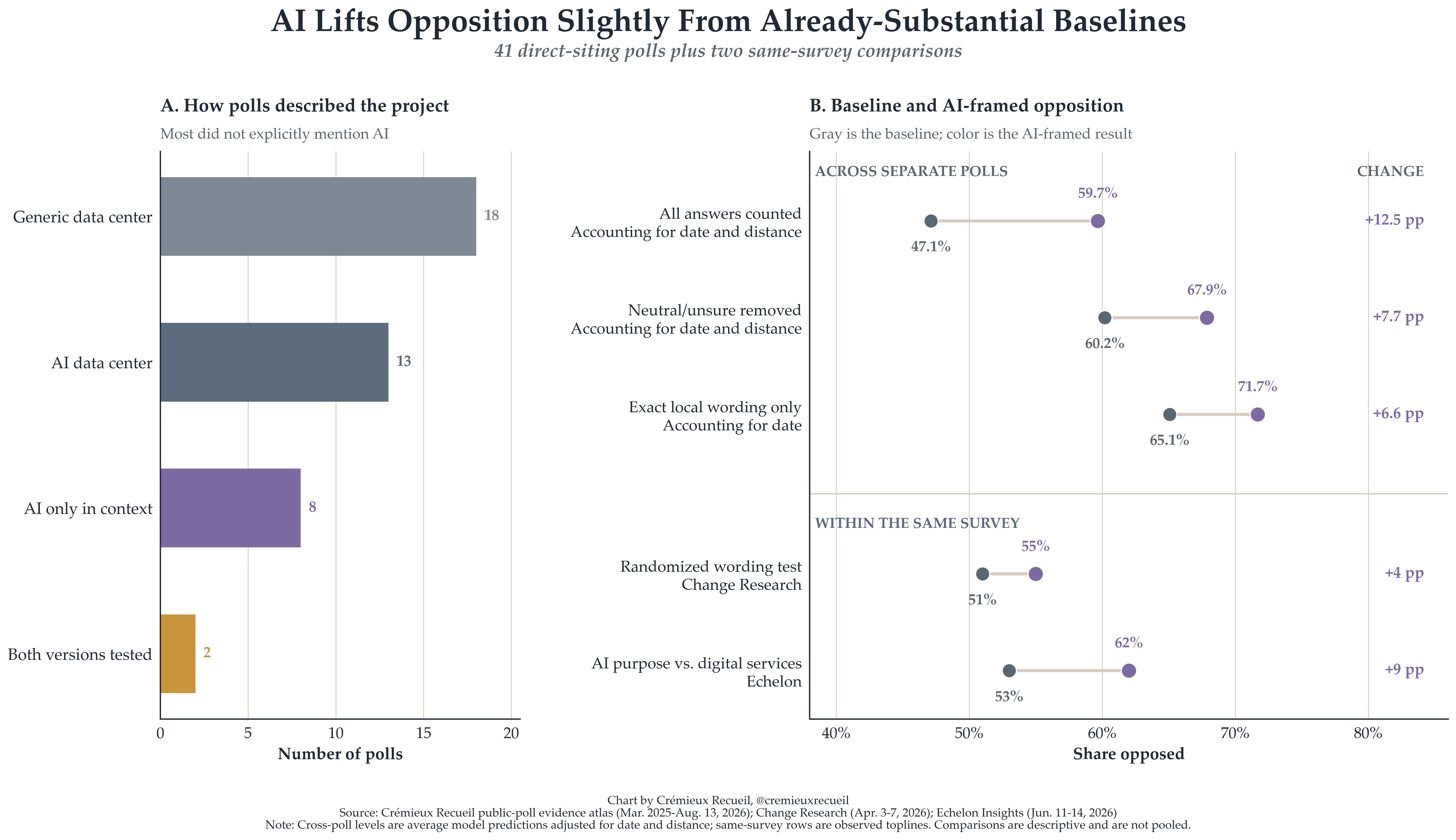
Explicit AI Wording. Generic wording produces considerable opposition, and adding explicit AI wording adds only a relatively small penalty. For example, Change Research in April 2026 found generic wording produced 51% opposition versus AI-specific wording, which produced 55% opposition.
Matched AI-Purpose Comparisons Within Surveys. Across different survey instruments, AI-specific purposes consistently make data centers less popular, but not by a lot compared to the baseline levels of resistance. Echelon recorded AI purpose wording made support “less likely” by 17 points in February; Groundwork found it reduced favorability by 12 points in March; Rainey found that it added 6 points of opposition in May; Echelon found that it added 9 points of opposition in June. To contextualize those values, recall how much people already disliked data centers.
Combined Study-Level Estimates Across the Polling Corpus. 41 direct-siting studies have been done between March 2025 and August 2026, and in the narrowest date-adjusted comparisons of exact local questions, predicted decided opposition is 65.1% generic versus 71.7% AI-specific. Across all distances, that increment averaged 7.7 points, so it’s fair to say AI adds 6-8 points over an already low level of support and high level of resistance.
Temporal Divergence. In Annenberg’s February-July 2026 polls, local opposition to data centers increased by 12 points, but negative expectations about AI dropped by 3 points in the same period. Opposition rose across every subgroup they analyzed while negativity about AI moved in both directions, but generally down.
Repeated Generic and AI-Specific Polling Over Time. All 13 comparable, repeated series became more negative on data centers by between 3 and 39 points, with the largest changes happening under generic wording, not AI-specific wording. Moreover, the opposition followed the same pattern we would expect if NIMBYism were to blame for opposition: it increased from 14 to 51% for a national generic question, from 26 to 65% for a local one, and from 40 to 73.5% for a near-home one. Were AI to blame, locality shouldn’t matter.
Randomized Facility Comparators. Searchlight’s March polling found that opposition at five miles was 39% for warehouses, 54% for data centers, and 69% for workerless automated factories. Puck News’ June polling found more that data centers had 4% less opposition that nuclear power plants, but AI-specific data centers were just 5% more disliked than those plants. The gaps weren’t large and they’re not consistently tilted against AI-specific worries.
Spontaneous Supplied Reasons. In Gallup’s Spring poll and Fox’s July poll, when opponents of data centers were provided with the opportunity to supply their reasons, AI concerns ranked much lower than environmental ones. In the Gallup poll, 14% cited negative AI views and 13% cited specific concerns; in Fox’s polling, 11% cited negative AI views. 50% of each poll’s respondents cited environmental concerns.
Respondent AI Worldviews. Milltown’s polling suggested that negative AI views were common among opponents and not among data center supporters, and harm to the economy was associated with huge swings against data centers. People who thought they would be harmful were 28.1 points more likely to be opponents, and those who had career pessimism were 15.2 points more likely to oppose. Notice the contrast there: general fears versus personal ones, and swings so large that if these were common motivations, AI-specific data centers should have even less support and greater opposition.
AI Opinions versus Local Opposition. In Fox’s July polling, 54% of participants had unfavorable views of AI versus the 70% who opposed data centers.
Prompted Concern Batteries. Across different pollsters, environmental concerns lead, and AI concerns range from 5% as the single biggest to an outlier 52% in a multiple-response battery, with an average far below many other issues.
Material Condition Moderation. Presenting participants with data centers that run off of clean or have their own dedicated power improves support, local electricity and water concern alleviation outperforms talking about winning the race with China, and cost and resource protections move support among 65-85% of people (note: this is not saying that it moves 65-85% to support, but that most people move in that direction).
Age and AI Labor Patterns. AI job losses are expected to lead among ages 18-24, but opposition and environmental worry are nearly flat across ages. In some polls, like Fox’s recent one, the under-30 and 65+ differ substantially on sentiment towards AI, but they’re almost identical in how much they locally oppose building.
The ‘Literally Who?’ Reality. When you poll people on which corporate leaders, companies, and products they recognize and how they feel about them, the results don’t comport with the idea that AI woes drive concern.
99% or more of people have heard of AI, 99% or more have heard of Google, about 98% know of Microsoft, 95% know of Meta, 97% know of Amazon and Apple, etc. But move down from household names and awareness falls off: 82% for OpenAI, 64% for Nvidia, 62% for Anthropic, 51% for DeepSeek, 45% for Palantir, and 30% for DeepMind. The products don’t match the corporation awareness: ChatGPT sits at 92%, Gemini at 84%, Copilot at 81%, Grok at 64%, Claude at 63%, Perplexity at 53%, and specialized products are usually at 40% or less. Musk and Zuckerberg enjoyed high recognizability (98% and 95%, respectively), but beyond that, major AI company CEOs are not widely known: 57% for Sam Altman, 52% for Peter Thiel, 49% for Larry Ellison, 35% for Jensen Huang, and 26% for both Alex Karp and Dario Amodei. Then, the ratings don’t even match! Karp is viewed positively among those who know him, and Dario is, too!1
But then, problematically for the narrative that AI is driving concern, it’s polling better over time, more people are using it over time, and favorability is higher among users than nonusers, with signs of some increase over time, unrelated to history of prior use. Moreover, people simply don’t even seem to believe that massive AI job loss or extinction concerns are realistic possibilities!
There are several lines of evidence that point to the most realistic conclusion: data center concerns are about the things people say they’re about. People are actually worried about things that are not realistic concerns, like electricity prices and water availability. Opposition is not due to worries about AI extinction risk, AI job loss, AI threatening people’s happiness and family time, or anything else like that. AI only adds a small bit of extra ‘oomph’ to the opposition, and the reason is ambiguous. For example, when asked about data centers versus AI-specific data centers, people could oppose it more because they think AI data centers have worse environmental impacts!
There are a lot of things we need to consider in order to get the public to support building more data centers. To do that, I suggest we stop drawing up and relying on narratives that explain why people in our circles might be against data centers, and start, instead, listening to the people who are actually on the ground and in the polls telling us—explicitly—why they oppose them. All signs suggest they’re not lying; they point instead to the much simpler fact that the opposition is mostly just NIMBYs.
Here is the list of surveys I reviewed and/or referenced, listed in field dated order. 2023: Washington Post/George Mason Schar School, 2023; CNBC/Generation Lab youth-and-money study, October 2023.
2024: Axios Harris Poll 100, 2024; CNBC/Generation Lab youth poll, January 2024; Morning Consult AI Super Users, March 2024–March 2025; CNBC/Generation Lab youth poll, April–May 2024; Data for Progress/Accountable Tech, July 2024.
2025: Anne Arundel Community Survey, 2025; HostingAdvice, 2025; Wason Center Virginia survey, January 2025; Public Policy Polling/Tech Oversight Project, January 2025; Change Research, March 2025; Airedale/Modine neighborhood survey, March 2025; Illinois data-center tax-incentive survey, March 2025; Overton Insights, June 2025; North Carolina LCV Foundation, July 2025; Data for Progress/WE ACT, July 2025; Ohio data-center tax-exemption survey, July 2025; South Carolina Policy Council, July 2025; Embold Research/Heatmap, August 2025; Arizona data-center survey, August–September 2025; Minnesota data-center accountability survey, August–September 2025; AARP national 50+ utility-cost survey, September 2025; AP-NORC/EPIC Climate Change survey, September 2025; Mississippi Omnibus Survey, September 2025; Georgia data-center tax-and-bills survey, September 2025; Fairleigh Dickinson University New Jersey survey, October 2025; Marquette Law Wisconsin Poll, October 2025; Data for Progress Alaska, October 2025; Morning Consult, October 2025; Texas data centers and electric-grid survey, October 2025; Harvard Salata Institute/YouGov, November 2025; Hoosier data-center and energy survey, November 2025; Ipsos/Redfin, November 2025; Elon/North Carolina data-center electricity-cost survey, November 2025; Emerson Pennsylvania data-centers-and-AI survey, November 2025; DHM Washington energy survey, November 2025; Morning Consult, November 2025; Caltech/YouGov, December 2025; Navigator Research/Global Strategy Group, December 2025; CCAN Action Fund/Global Strategy Group, December 2025; Change Research, December 2025; Harris Poll data-center survey, December 2025; Blue Rose Research, December 2025; Emerson national poll, December 2025; YouGov daily survey, December 2025; Louisville Metro Office of Planning survey, 2025.
2026: Value of Water Index, 2026; ACSI AI Platforms Study, 2026; Cherokee Nation citizen survey, 2026; Reach3 Insights, 2026; YouGov AI Index/BrandIndex, 2026; Wason Center Virginia survey, January 2026; Georgia pre-legislative survey, January 2026; Morning Consult/Stateline, January 2026; Public First/POLITICO, January 2026; Pew Research Center, January 2026; South Carolina Policy Council, January–February 2026; Climate Power/Blue Rose Research, January–February 2026; Amber Integrated/Oklahoma Watch, February 2026; Embold Research/Heatmap, February 2026; Glengariff Michigan survey, February 2026; SLU/YouGov Missouri technology survey, February 2026; Ohio voter energy survey, February 2026; Marquette Law School Poll, February 2026; Axios Harris Poll 100, February–March 2026; Nexus Pulse, February 2026; Annenberg Public Policy Center/SSRS, February–March 2026; Echelon Insights, February 2026; Quinnipiac University, February 2026; Rainey Center, February 2026; Clean Virginia, March 2026; Gallup, March 2026; South Dakota issues poll, March 2026; Elon University North Carolina poll, March 2026; Marquette Law Wisconsin Poll, March 2026; Illinois data-center regulation survey, March 2026; Searchlight near-home facility comparison, March 2026; Pew energy-bill survey, March 2026; Quinnipiac University, March 2026; Fairleigh Dickinson University, March 2026; Washington Post/George Mason Schar School, March 2026; AARP Oklahoma 50+ utility survey, April 2026; Montana Conservation Voters, April 2026; University of Houston SPACE City Panel, April 2026; Center for American Progress utility-price message testing, April 2026; Zencity/TransformGov, April 2026; Change Research, April 2026; South Dakota News Watch/Chiesman Center, April 2026; Climate Power/Global Strategy Group, April 2026; Searchlight energy-price survey, April–May 2026; Glengariff/Detroit Regional Chamber, April–May 2026; Alabama Republican-primary survey, May 2026; Conservation Colorado, May 2026; Hahn/Escalent, May 2026; Ipsos/Redfin, May 2026; Morning Consult consumer-AI reputation study, May 2026; Reuters/Ipsos, May 2026; Ipsos Consumer Tracker, May 2026; Embold/Compass on-site energy experiment, May 2026; Milltown Partners, May 2026; Change Research Florida, May 2026; UMass Lowell Maine survey, May 2026; Embold Research/Heatmap, May 2026; Rainey Center experiments, May 2026; Utah Stratos survey, May 2026; FM3/Net Zero California, May 2026; UNH New Hampshire AI survey, May 2026; Justice Research Group/Working Families Power, May 2026; The Argument/Embold company-favorability survey, May–June 2026; Environmental Polling Consortium and partners, June 2026; University of Virginia Data Center Opinion Project, June 2026; Utah SD-21 Republican-primary survey, June 2026; YouGov Millennial crossbreaks, Q2 2026; YouGov fame and popularity trackers, through Q2 2026; CBS News/YouGov, June 2026; Reuters/Ipsos AI survey, June 2026; University of Texas/Texas Politics Project, June 2026; AI Policy Institute, June 2026; Echelon Insights, June 2026; Data for Progress moratorium survey, June 2026; Fox News/Beacon Research/Shaw & Company, June 2026; Annenberg Public Policy Center/SSRS, June–July 2026; VCU Commonwealth Poll, June–July 2026; PPIC/Ipsos California survey, June–July 2026; ARI/Morning Consult, July 2026; Hancock County open survey, July 2026; Public First/POLITICO, July 2026; Harvard Harris Poll, July 2026; Empire Center New York energy poll, July 2026; Quinnipiac University, July 2026; Marquette Law Wisconsin Poll, July 2026; Fox News/Beacon Research/Shaw & Company, July 2026; Emerson national poll, July 2026; DHM Oregon Pulse, July 2026; Elon University North Carolina poll, July 2026; Wyoming public-lands poll, July 2026; Data for Progress Alaska, July–August 2026; Napolitan News, July 2026; CNBC/Generation Lab AI-leader trust poll, August 2026; Embold Research/Heatmap, August 2026.
This was a timed post. The way these work is that if it takes me more than an hour to complete the post, an applet that I made deletes everything I’ve written so far and I abandon the post. You can find my previous timed post here.
A message from my sponsor, Mechanize:
We’re hiring software engineers to build environments and evals that frontier AI labs use to train coding agents.
To get a better sense of the work we do, you can check out GBA Eval, where we had models build Game Boy Advance emulators from scratch and scored their performance.
Base pay starts at $300K/year for junior software engineers, with more for senior roles, plus equity and performance bonuses. Apply here.
In forced-choice polling like CNBC’s, 65-81% of people say they don’t trust AI leaders, but they only offered the options of “Trust” or “Don’t trust” and didn’t provide familiarity option. That means the result is incredibly noisy.
I would have bet that way. Just like bird choppers.
"Data centers are clean, they pay high taxes, during their construction they pay a lot of blue collar workers and after construction they continue to stimulate the local economy, and they have very little impact on things like local utility costs or housing prices."
You write like it's a simple cut and dry fact and yet there's no source? In fact a quick Google search pulls up tons of studies that contradict this or point to the need for more research and regulation. Stating it so matter-of-factly is misleading.