

Today’s post is brought to you by my sponsor, Mechanize. They’re hiring junior software engineers at $300K/year base salary.
Depending on the poll, the two biggest issues the public has with data centers are:
They take all the water;
They increase electricity prices.
The former complaint is scientifically illiterate, dead and done, and gets its limited intellectual backing from analyses that were shown to have included mathematical errors that inflated water use estimates and others that have spuriously attributed water use elsewhere to data centers. The latter complaint has been found to be not just false but backwards for the period before today’s hyperscale buildout, so proponents of the idea have shifted their defense to stating ‘That might’ve been true, but now the buildouts are radically increasing electricity prices!’
I’ve decided to take this possibility seriously. To that end, I’ve made a continuously-updated website that assembles that latest available data on data center energizations and electricity prices. You can explore the website—wattsmybill.org—by clicking here.
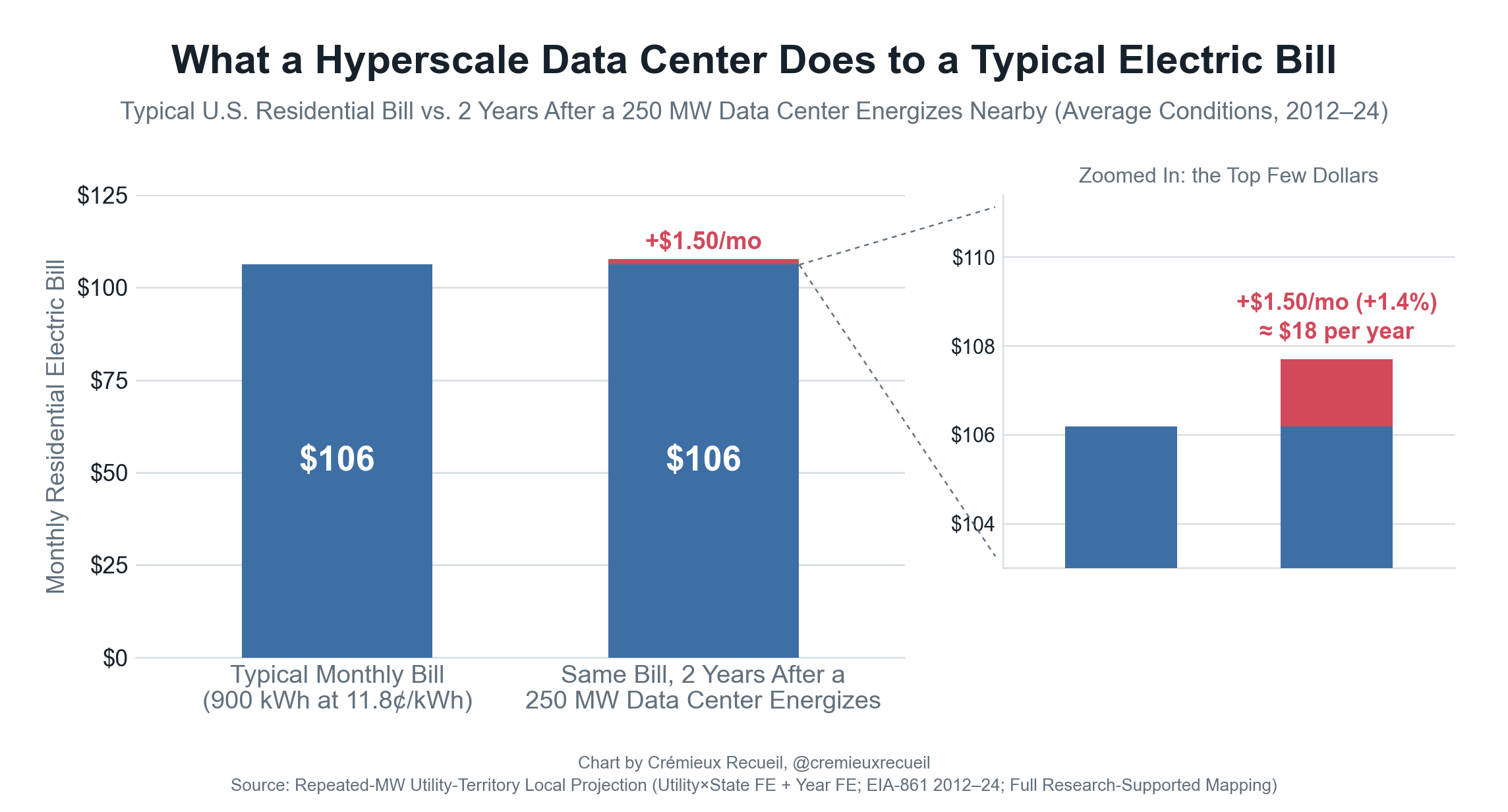
What did I find? Firstly, there is an effect of new data centers on electricity prices. However, the effect is small, and it appears to plateau. Secondly, the effect of new data centers on electricity prices is driven most sharply by large, recent buildouts. Finally, projections based on the existing data suggest there’s plenty of room to build out data center capacity without major effects on electricity bills.1
Here’s how average price effects from a “hyperscale”—250MW—data center being built locally look for a typical household as of August, 2026; in short, they’re small:
If you want to play around with the data, check the expected effects of data centers on your bill, or just explore all the analyses I ran, go check out the site by clicking here! If you have requests for additions to the website, then go and leave a comment below.2
This was a timed post. The way these work is that if it takes me more than an hour to complete the post, an applet that I made deletes everything I’ve written so far and I abandon the post. You can find my previous timed post here.
A message from my sponsor, Mechanize:
We’re hiring software engineers to build environments and evals that frontier AI labs use to train coding agents.
To get a better sense of the work we do, you can check out GBA Eval, where we had models build Game Boy Advance emulators from scratch and scored their performance.
Base pay starts at $300K/year for junior software engineers, with more for senior roles, plus equity and performance bonuses. Apply here.
Because people have concerns about electricity prices, builders have shifted towards paying more than their share—a historically unusual practice that’s unfair to these businesses, but which should help as a way to bribe communities into permitting building. As a result, we might soon see these already piddly estimates go completely null or negative, at least for hyperscale buildouts. The only barrier to doing that will be the communities doing the permitting themselves. If they allow data center builders to come in and make deals, they will, and the communities will benefit. If they forbid them, then they’ll ensure they only benefit from data centers from afar.
As a final side note, yes, I am fully aware that if the interconnection queue/permitting issues with America’s electrical grid were fixed, there might be no effect of data centers on electricity prices and prices would be considerably lower. NIMBYs also tend to oppose new energy generation capacity more generally, just as they oppose building new data centers.
It might be outside your area of interest as a data guy, but I'd love to see you explore how to actually convince the relevant populations to accept data centers in their communities. You previously showed that data is not effective. From your last article:
>Given how much disdain people hold at baseline, how strongly they hold their most errant beliefs, and how unconvinced they are by statements of fact, you might expect supplying facts to have little effect. You’d be right! People’s opinions moved in the direction of supporting data centers, but by a barely significant amount
As I read that quote again, it's clear you find them frustrating. That makes sense since they are saying something you know is false and operating in a way that clashes with your values (using data instrumentally rather than as a means to truth). It's really hard to build cooperation without a foundation of goodwill though. Should you trust someone who hates you and has little curiosity for you (who, in place of a clash of values, sees you as simply bad and wrong)?
This is amazing! Every time I hear/read the broad statements like examples 1 and 2, my mind defaults to “ok, based on what”?
Did you see the commercial of Jason Kelce promoting Garage Beer and Liquid Death? Look it up on YT if you haven’t seen yet…