

Today’s post is brought to you by my sponsor, Mechanize. They’re hiring junior software engineers at $300K/year base salary.
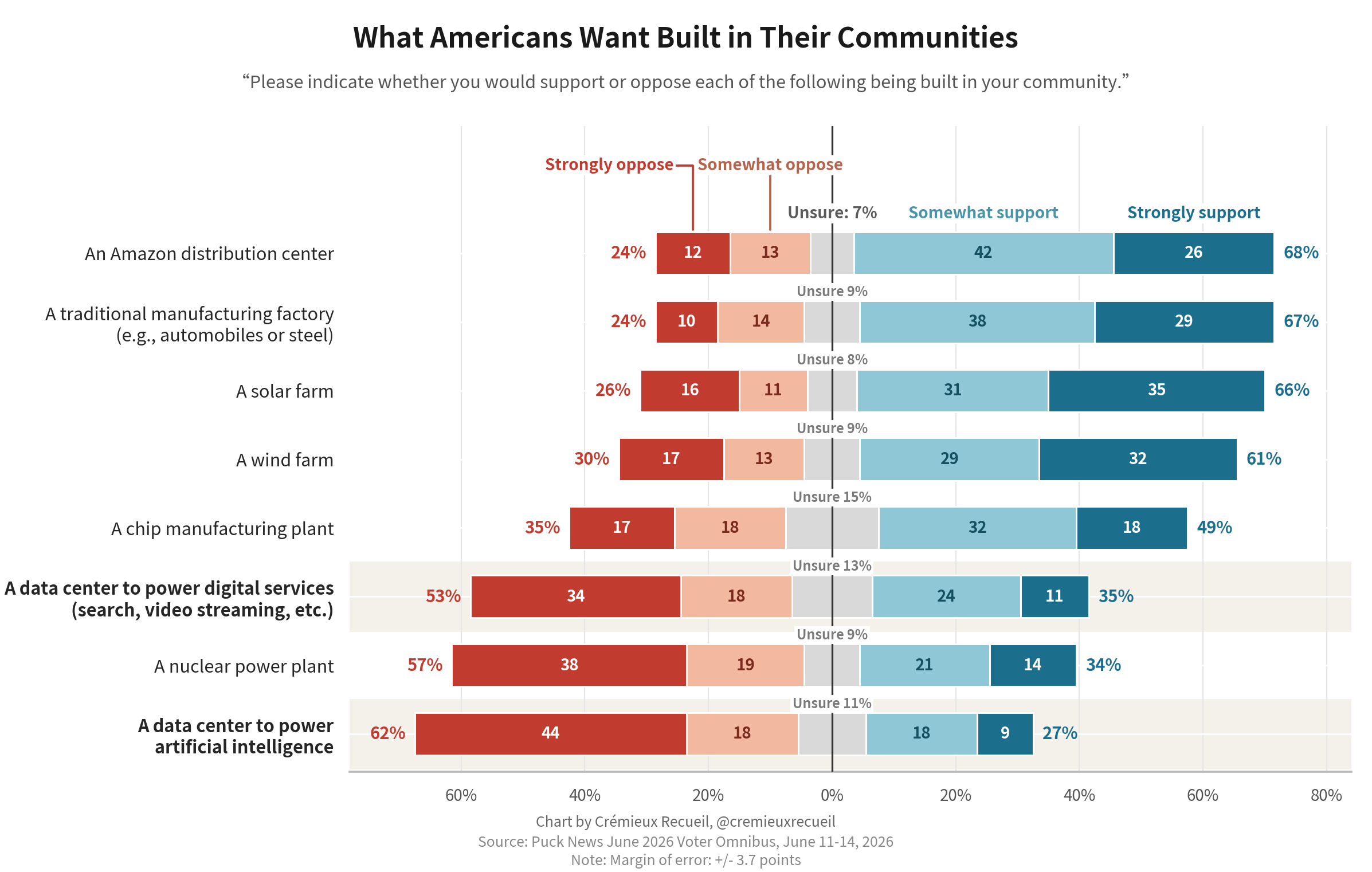
Data centers are very unpopular right now, for all sorts of reasons. The latest polling is abysmal: people want a data center in their community less than they want a new nuclear power plant, and they really don’t want to live near a new nuclear power plant.
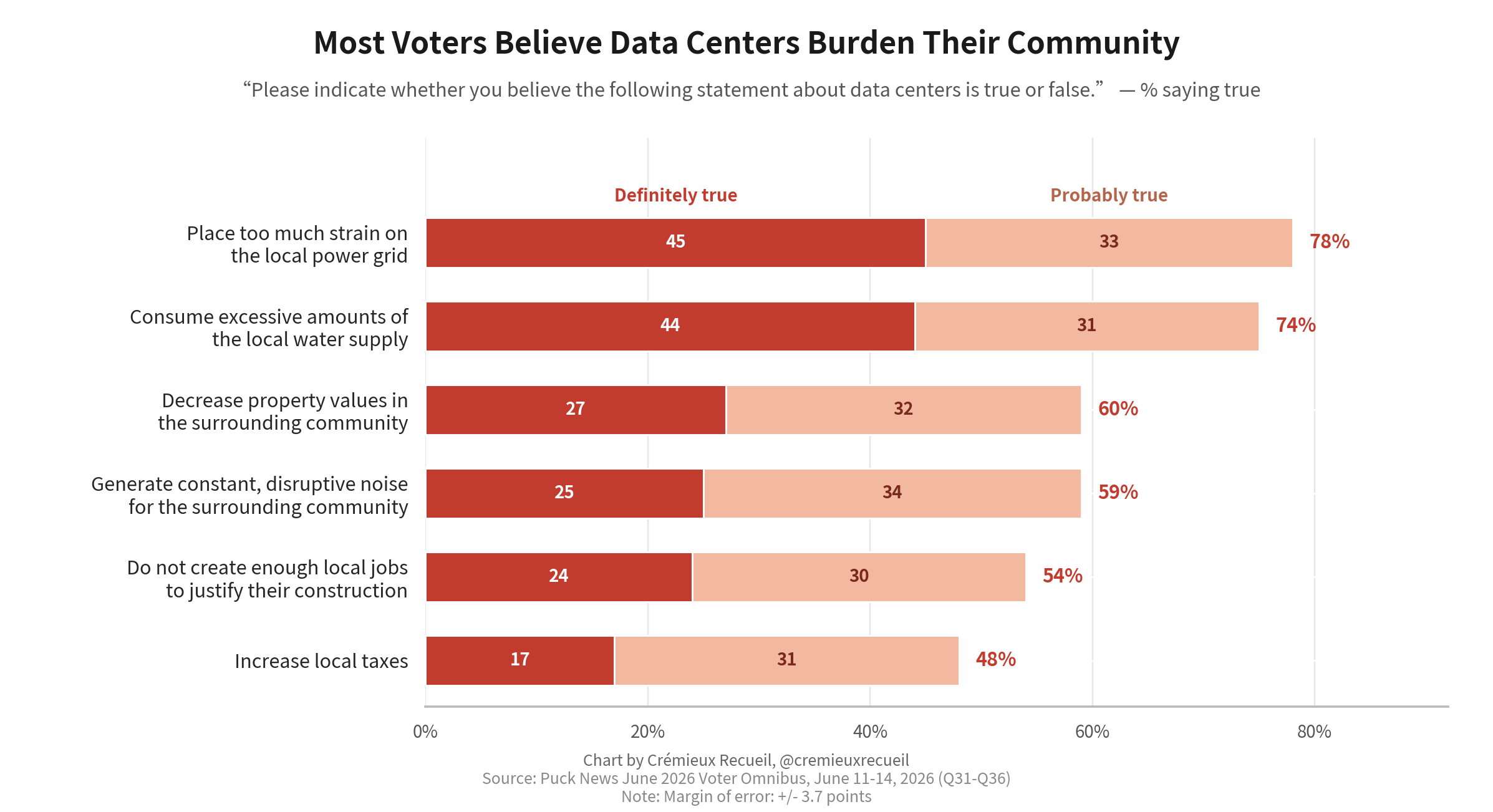
The reasons people supplied for not wanting a data center will be familiar to you if you’ve seen other polling. The most slanted beliefs were that data centers strain the electrical grid and that they consume extreme amounts of water, pushing up the utility bills of local residents. People even tend to believe things that are extraordinarily obviously untrue, like that data centers tend to lead to increased taxes and lower property values. Apparently they don’t see the contradiction, but I digress.
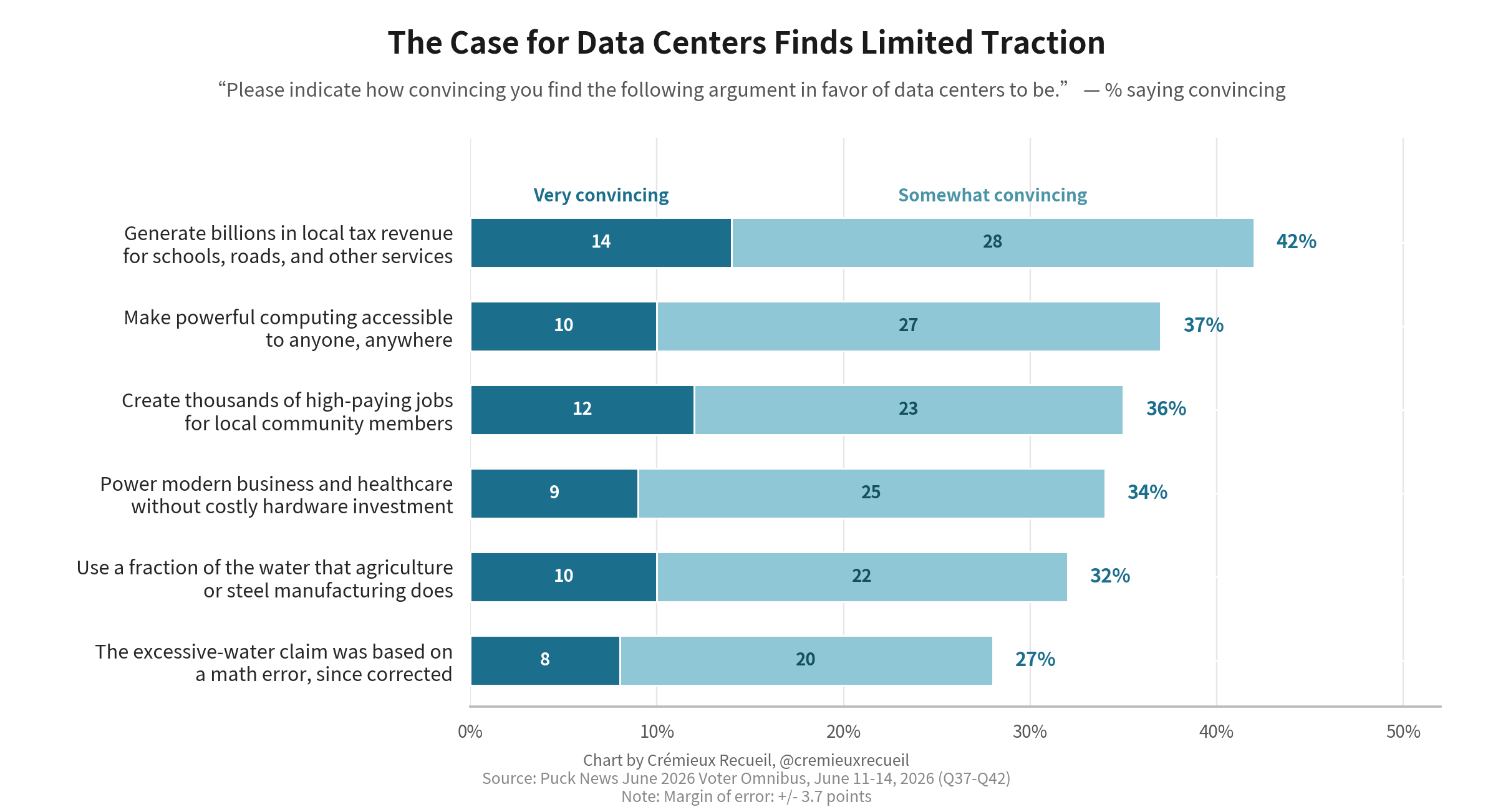
The unique thing in this poll was that the pollsters sought to see if they could change people’s views. They wanted to test if they could unravel people’s misinformed views about data center harms by telling them the truth. Unfortunately, people don’t tend to believe the truth, even when you present it to them directly: they don’t think data centers generate tax revenues, that they make AI more widely available, that they create high-paying jobs, power modern business applications, or—critically—that they actually don’t use very much water.
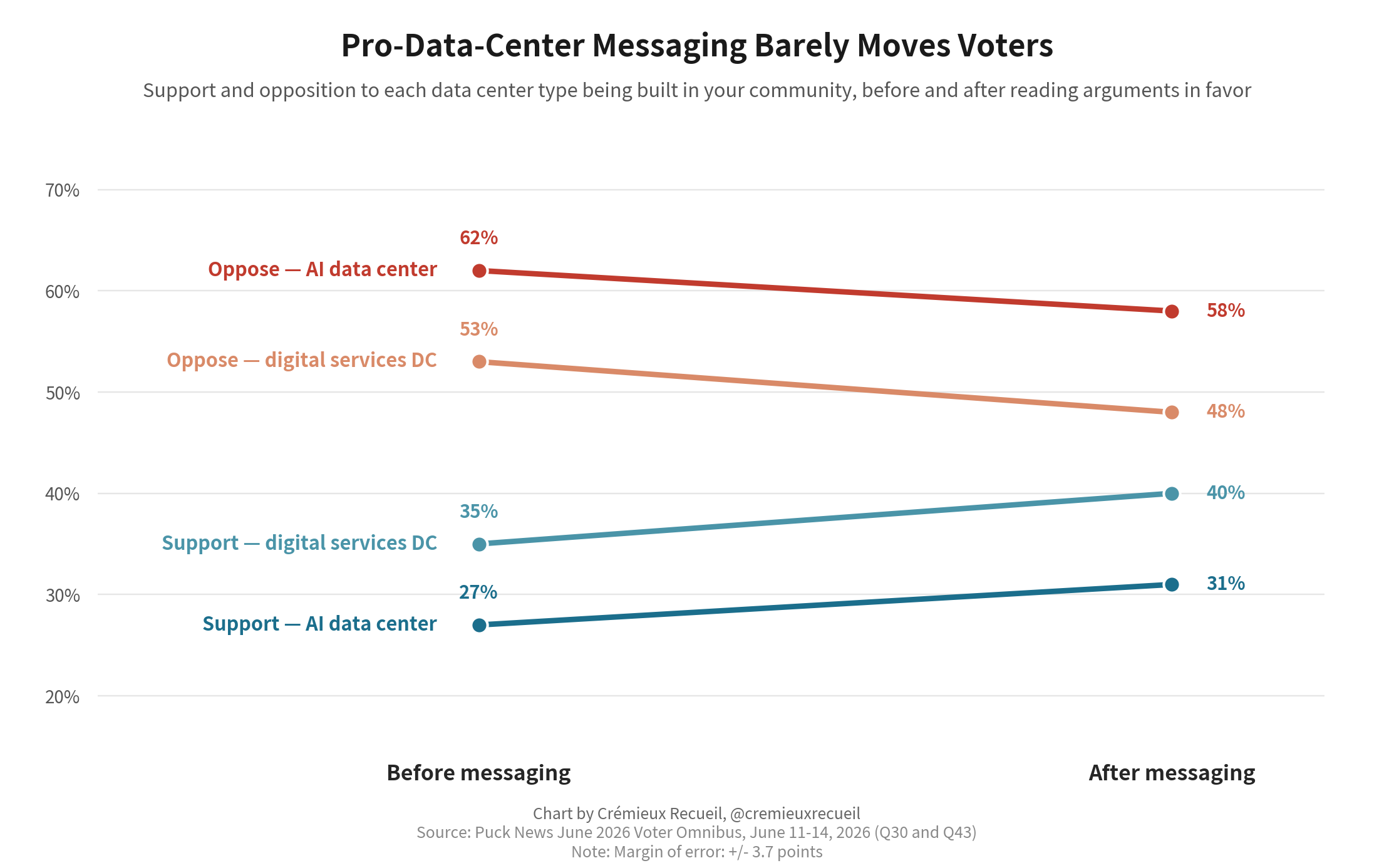
Given how much disdain people hold at baseline, how strongly they hold their most errant beliefs, and how unconvinced they are by statements of fact, you might expect supplying facts to have little effect. You’d be right! People’s opinions moved in the direction of supporting data centers, but by a barely significant amount.1
How Can We Usher in the Future?
There can be little room for doubt that AI is the future of the global economy. To develop and power that AI, we need to increase the available amount of computational power, which means more data centers. But the public opposition to data centers is acting as a very effective Luddite revolt against realizing the benefits of this future by bringing the promise of AI to fruition. How exactly do we stop it?
My first thought was to look at the results of other persuasion experiments. When researchers have assessed the impacts of political campaign messaging on persuasion, they’ve generally come up empty-handed. Experiments on persuading people to be less hateful through interpersonal conversation sometimes turn up results, but in the best analyses, the effects are meager. The effects of online political advertising on the propensity to vote for a given party have also been estimated to be small and they fade fast, much like TV ads. Common shortcuts like deploying people with shared demographic characteristics to do persuading also don’t seem very valuable.
Persuasion experiments in the published literature turned out to be mostly irrelevant, so I was disappointed by them. But, I did find some NIMBY messaging experiments.
Monkkonen and Manville asked 1,300 LA County adults about hypothetical apartment buildings proposed on their block. They presented the participants with arguments against buildings the apartments, and all such arguments helped to convince people to be against building, often by a very considerable degree. For example, telling people that the developer serves to make large profits increased opposition by 20 whole percentage points. To get people to support building required basically bribing them: most participants (63%) increased their support for projects if developers offered community benefits.2
Walker, Wiersma and Bailey ran a postal survey in England, where they asked people about an offshore wind farm near them. Some participants were asked about it without any framing, others were told about community benefits, and the rest were told about the wind farm’s community benefits and common counterarguments. Without the counterarguments, people became more supportive of the wind farm when they were presented as a boon to the area. The whole support boost evaporates the moment wind farm project benefits are labeled ‘bribery’.
Liebe, Bartczak and Meyerhoff asked Germans and Poles about wind farms near them and found that, firstly, Poles are more accepting or new turbines than are Germans, and secondly, people more readily accept wind farms when they’re owned by local citizens, when the electricity is consumed regionally instead of being exported, and when citizens perceive that their community is involved in the planning process. A lucky finding was that those who had already been exposed to wind turbines were more accepting of additional wind turbines, but it’s not exactly clear why this is. It could be that exposure indexes prior support rather than an exposure effect per se.
Vuichard, Stauch and Dällenbach asked Swiss people about what would increase support for local wind farms, focusing on financial inducements. They found that the only thing that worked to raise acceptance was a local resource tax that benefitted everyone in the community. This was politically split. Conservatives just weren’t convinced at all, and leftists had generally high support for the wind farm and only had their support boosted with the wind resource tax idea. However, centrists actually saw notably increased support with every inducement—they just saw the most with the resource tax idea.
Knauf ran a conjoint experiment in Germany where they found something similar: financial benefits for wind energy projects increased support, but only among those who already supported them or who didn’t have any strong views. Among those who were opposed, benefits failed to move them.
García et al. found that, in Norway, the amount of required compensation to increase local support for wind farms was contingent on how the benefits were delivered. Private payments needed to be much larger than compensation delivered in the form of local services or infrastructure improvement, in order to generate the same support increases.
Muñoz and Tormos ran a survey in Catalonia where they found that framing a wind or solar project as being done “somewhere in Catalonia” led to more support compared to when it was framed as being in one’s own municipality. Opposition to projects also increased with scale, but it decreased when benefits to the environment or municipal tax reductions were offered.
Doberstein, Hickey and Li found that Canadians in a fast-growing, car-dependent mid-sized city were strongly opposed to new developments on their street, but were less opposed to developments elsewhere in town. They softened their stance and became more supportive when the message noted the public benefits of residential densification, but they were unconvinced by private benefits or by the presentation of expert views on benefits. They were also able to have their views shifted by learning what their neighbors felt about the development.
To summarize the literature on NIMBY/YIMBY messaging experiments:
People care about the community benefits of new building.
They want public, widely-shared benefits.
They don’t want private benefits per se.
People care about feeling involved in the process of development.
Some people cannot be convinced in the short term by any reasonable message.
When it seems like proponents of building are personally benefitting, opposition increases dramatically.
Opposition to building is driven by a mixture of disdain for unsightly builds, demands to preserve community and environmental character, pure resent, and so on. These are generally not rationally motivated concerns, which helps to explain why fact-based messaging doesn’t work that well: you can fully convince someone that they were wrong about some particular empirical claim about building’s harms or lack of benefits, but they still won’t budge. I would avoid persuasion techniques generally.
It is likely that enough of the fact-based pushing can win out in the longer term, as always happens with technologies. People resisted the internet, the automobile, the telephone, and even electrification writ large, but familiarity, aging, and progress eventually wear down resistance and absurd myths tend to die—who besides crazies now believes that electrical wires make the communities they’re in sick? But this is a poor assurance to people who want to bring that progress about sooner.
For near-term progress, the strategy is clear: give people what they think want, first of all, even if you don’t give them what they’d get through a real negotiation process. Run roughshod over them with any permitting workarounds possible while giving the appearance that locals have been listened to, in messaging. Ensure they know building is costless for them: pay for electricity, pay for water. Then talk about the implicit and actual bribery that comes in the form of construction jobs, permanent white-collar jobs, and property tax abatements, more funding for schools and parks, whatever.
At every stage in history, progress has been resisted, and in some places and times it’s been halted entirely, resulting eventually in a humiliating, unnecessary national defeats. We now face the same challenge and rising to it is our choice to make.
This was a timed post. The way these work is that if it takes me more than an hour to complete the post, an applet that I made deletes everything I’ve written so far and I abandon the post. You can find my previous timed post here.
A message from my sponsor, Mechanize:
We’re hiring software engineers to build environments and evals that frontier AI labs use to train coding agents.
To get a better sense of the work we do, you can check out GBA Eval, where we had models build Game Boy Advance emulators from scratch and scored their performance.
Base pay starts at $300K/year for junior software engineers, with more for senior roles, plus equity and performance bonuses. Apply here.
This isn’t an RCT, there’s no control group, so we don’t actually know how responses might’ve drifted in the absence of the messaging. This within-person design could be subject to regression to the mean, so the effectiveness of the messaging is likely to be something of an upper-bound, at least for this design.
It’s also worth noting that 23% of the participants supported the project only if it wasn’t built on their block—quite literally ‘Not In My Back Yard’.
It's astonishing that Amazon distribution centers poll so well. I would think they poll terribly given the road traffic they must generate.
Facts don't work, bribery (implicit and explicit) hopefully will, as you noted.