

Today’s post is brought to you by my sponsor, Mechanize. They’re hiring junior software engineers at $300K/year base salary.
I recently read an article that claimed climate change research has peaked, as measured by the number of papers being written on the subject since 2020 rapidly declining. The paper’s recorded decline is dramatic: the number of peer-reviewed publications labeled “climate change” went from a peak of about 900,000 in 2020 to a near-term nadir below 200,000 in 2026.

The article explains this dramatic change in terms of “the teats [being] squeezed dry”, the field of climate change research being “on repeat”, totally hollowed out of new territory to look into, data to model, and hypotheses to propose. I don’t believe this explanation, but I could believe some explanation like ‘People have realized that we’re going to beat climate change, so the energy is going elsewhere’ and ‘The decline could have accelerated recently due to papers reclassifying themselves away from being about climate change in order to avoid the ire of the Trump administration.’
However, before we try to explain phenomena, we must determine if there’s anything to explain. As I’ve noted before, abrupt changes are usually fake and we have a duty to determine if what we’re critiquing or supporting is valid to the greatest extent we can.

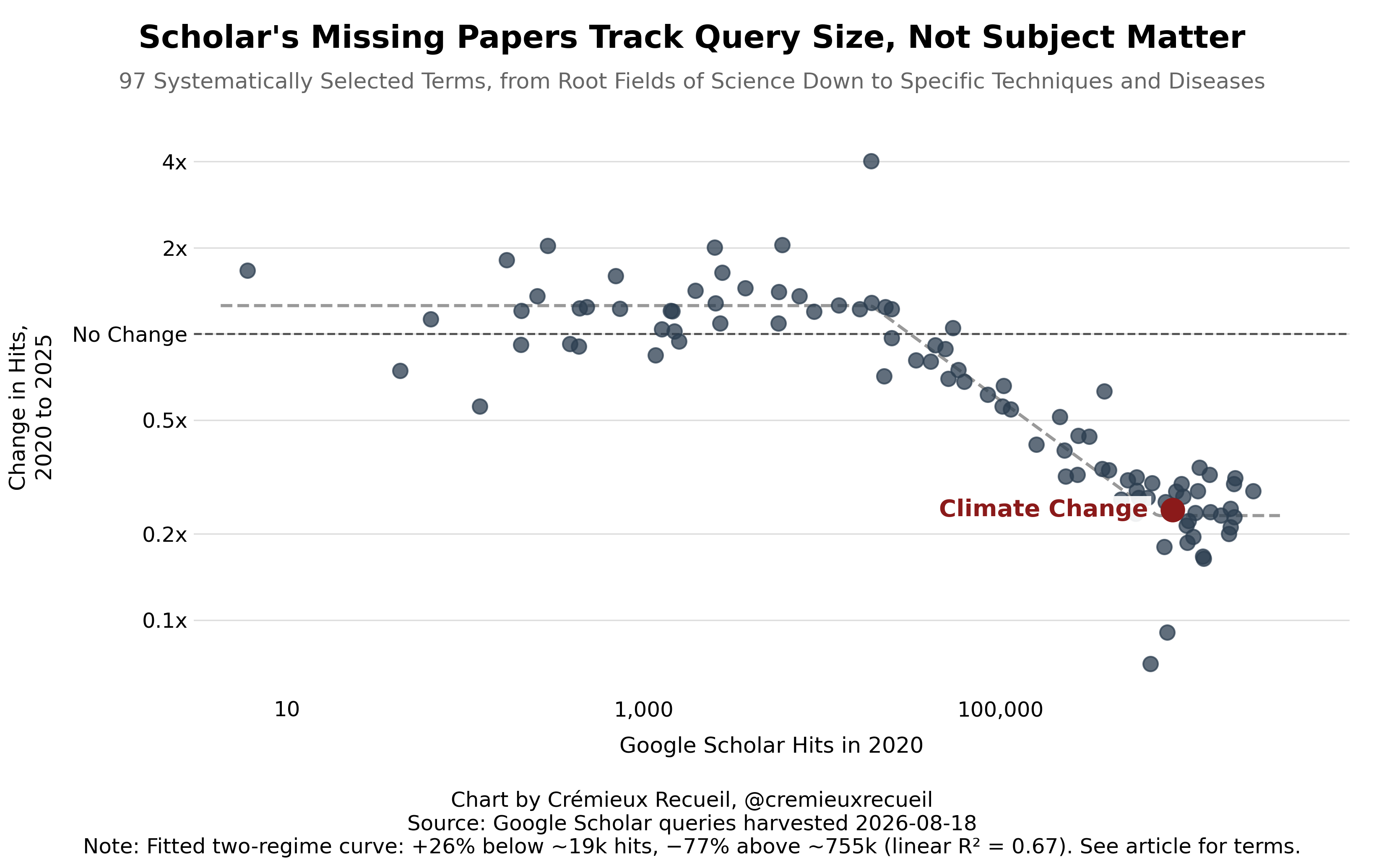
So, how did I check if this article was correct? Three ways. First and weakest, I looked at the article’s own source: Google Scholar. I checked if there was a generalized service-wide decline that mirrored what the blogpost noted for climate change-related research. As it turns out, there was! Fields with more hits in 2020 had considerably fewer hits in 2025. This is odd, but it’s not explicable by something specific to climate change research changing.1
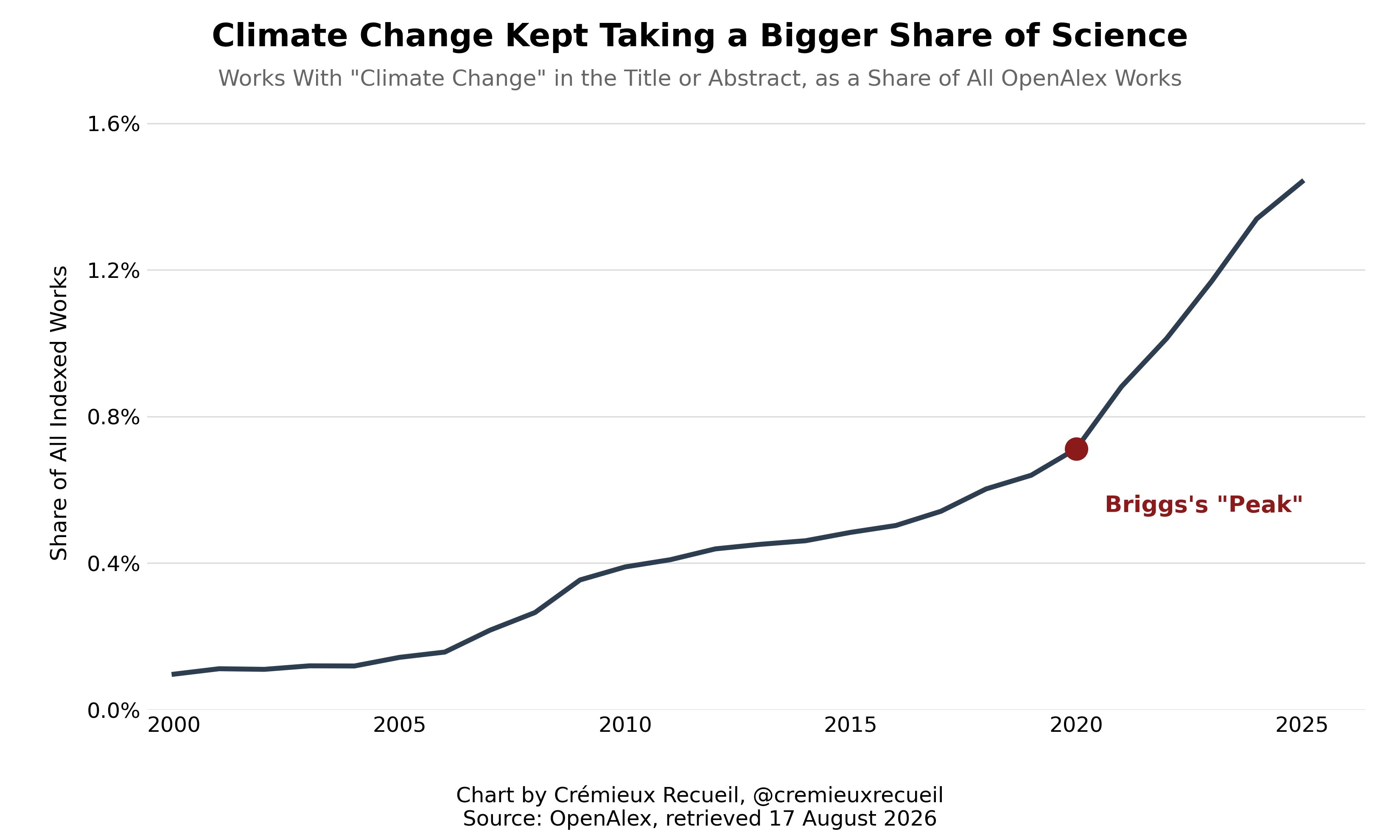
Second, I looked into another repository, OpenAlex. I tried to replicate the peak the blogpost observed, but, well, take a look:
Third, I replicated this again. After all, we don’t want a game of warring repositories; we don’t want to just play Google Scholar off against OpenAlex, so I also looked at Semantic Scholar, Crossref, OpenAIRE, PubMed, Europe PMC, and DOAJ.2
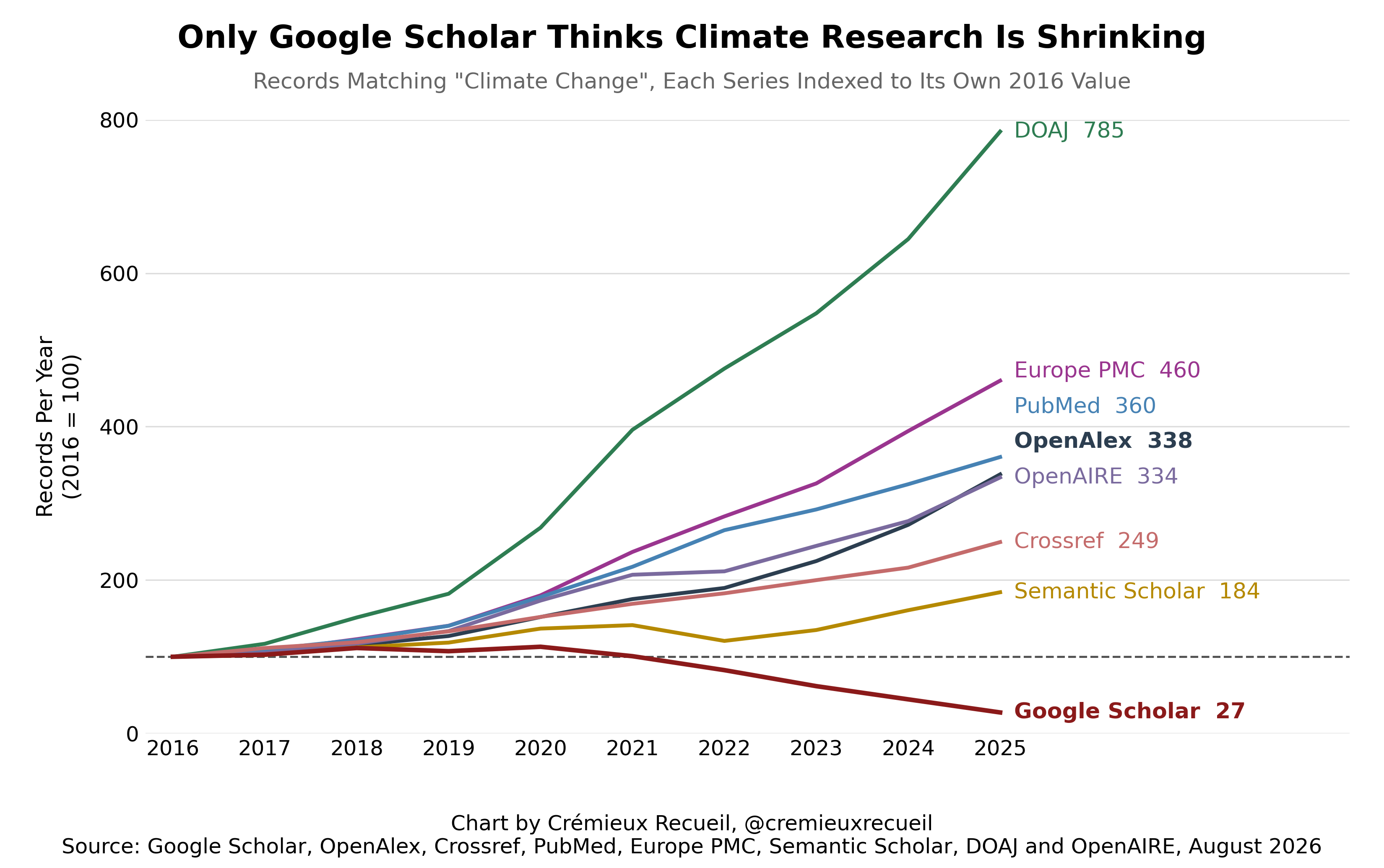
The question of whether climate change research paper numbers have declined in the COVID era is an empirical one that’s worthy of looking into, and the answer is ‘no’. Accordingly, we have no reason to speculate about why it’s declined, as the truth is that it hasn’t. But we do have reason to repeat once again that we must verify things need to be explained before we explain them; we must avoid that harmful impulse.
This was a timed post. The way these work is that if it takes me more than an hour to complete the post, an applet that I made deletes everything I’ve written so far and I abandon the post. You can find my previous timed post here.
A message from my sponsor, Mechanize:
We’re hiring software engineers to build environments and evals that frontier AI labs use to train coding agents.
To get a better sense of the work we do, you can check out GBA Eval, where we had models build Game Boy Advance emulators from scratch and scored their performance.
Base pay starts at $300K/year for junior software engineers, with more for senior roles, plus equity and performance bonuses. Apply here.
Here’s the word list, including my original word list from here:
# Root fields (OpenAlex level-0 concepts)
- Computer science
- Physics
- Medicine
- Biology
- Engineering
- Materials science
- Political science
- Chemistry
- Philosophy
- Geography
- Mathematics
- Psychology
- Art
- Business
- Sociology
- Geology
- Environmental science
- History
- Economics

# Top subfields (level-1 concepts, ranks 1-10 by works count)
- Humanities
- Artificial intelligence
- Optics
- Internal medicine
- Law
- Biochemistry
- Quantum mechanics
- Remote sensing
- Organic chemistry
- Genetics

# Sampled subfields (level-1, every 5th rank from 15)
- Statistics
- Surgery
- Geometry
- Social psychology
- Information retrieval
- Metallurgy
- Endocrinology
- Neuroscience
- Theology
- Computer vision

# Low end (level-4 concepts by rank)
- Nucleofection
- Gestational period
- Diafiltration
- Emperipolesis
- Sclerodactyly
- Ocrelizumab
- Divertor
- Neutral beam injection
- Magnetic energy
- Langmuir probe
- Magnetohydrodynamic drive
- Cyclotron radiation
- Neutron emission
- Ballooning
- Transcriptome
- Superconducting Super Collider
- Cyclotron resonance
- Genomics
- Single-nucleotide polymorphism
- Gene expression profiling
- Repressor
- DNA methylation
- Acceleration voltage
- Magnetic particle inspection
- Clade

# Low end (level-5 concepts by rank)
- TSG101
- Articular cartilage damage
- Proteogenomics
- Protein isoform
- Durvalumab
- Pandemic
- Magnetic amplifier
- Edge-localized mode
- Central core disease
- Genetic association
- Coronavirus
- Genome-wide association study
- SNP
- DNA Transposable Elements
- KEGG
- Good agricultural practice
- Social distance
- Prompt neutron
- RNA-Seq
- Conservation-dependent species
- Neutron probe

# Original battery
- climate change
- the
- cancer
- protein folding
- machine learning
- quantum computing
- gene expression
- randomized controlled trial
- solar cell
- coral reef
- stochastic volatility
- nonlinear Schrodinger
Something I also consider notable is that the Google Scholar hits for “climate change” contradict the blogpost’s chart titles. The source includes preprints, which are often not yet peer-reviewed publications, but the charts refer to peer-reviewed publications and are not exactly reproducible with the exclusion of papers that are hosted on preprint servers.
I excluded DataCite since it’s about datasets rather than publications, but it confirms the overall result we see with publications, increasing 188% between 2020 and 2025 with the peak in the latest observation year (i.e., probably not at peak yet). arXiv showed a similar trend (142% between 2020 and 2025), but I excluded it because of its physics- and computer science-heavy focus. I excluded PMC because it’s within Europe PMC’s corpus. I excluded CORE because it requires a registration key and BASE because it requires IP whitelisting, and they would be basically superfluous given the OpenAIRE and OpenAlex results. Finally, I excluded Dimensions, Scopus, Web of Science, and Lens because they require licenses or API keys and don’t offer non-grant free programmatic access.
Basically everything either does or should agree with one another, except for Google Scholar, which showed an artefactual change in paper listings in the affected time period.
Very interesting. I'm curious what explains the differences between Google Scholar and the other academic databases.