

Today’s post is brought to you by my sponsor, Mechanize. They’re hiring junior software engineers at $300K/year base salary.
I post quite a bit about one of my favorite AI companies, Pangram. I think Pangram makes an amazing product: they’ve got the only working AI text detector, and they’re also quick to update it in response to malicious text humanizers that crop up. I trust the Pangram team and I know their product is real and works as it says on the tin. Why, then, do so many writers seem to disagree?
If you read about Pangram, you’ll quickly see a bunch of people claiming that it doesn’t work. Worse, they’ll sometimes claim that it’s biased. Pangram allegedly discriminates against autistic authors, against anti-vaccine authors, against people I’d politely describe as ‘conspiracy theorists’ on both sides of the aisle, and, most prominently, against African writers. How? Well, it supposedly flags their work as AI!
There are a lot of articles about Pangram and other AI detectors ‘mistakenly’ flagging Black and African authors as using AI to do or assist with their writing. The most prominent piece that comes to mind for me was published in the Pan African Review. The piece was an unusual breakout for the Review: the journal generally enjoys a pretty limited circulation. I suspect this is because of the import of the topic area and the utility of providing an example to point to when people want to explain why they were ‘wrongly’ flagged as using AI for writing. So, I’ll consider the perspective of this piece to be emblematic of a community’s wider concerns given how much it resonated.
The piece is authored by one Timi Olagunju. Olagunju is “a lawyer and public policy expert working at the intersection of tech, governance, and development.” His claim is that writing in formal English will be flagged as AI-generated by AI text detector:
Consider an international student in the United States. She has spent years being told that her English must be grammatically correct. She avoids slang, checks every verb and structures each paragraph carefully. Then a detector labels her work artificial because it is controlled and predictable. First, the institution tells her to master standard English through IELTS and TOEFL. Then it treats mastery as suspicious.
This allegedly explains why “African (or black) writers” are liable to have their work flagged by AI detectors:
For many African writers like Falade, English is both a language and an inheritance shaped by colonial history. In Nigeria, Kenya, Ghana and other former British colonies, generations of students were taught forms of English influenced by British education. Teachers emphasized correctness, formal composition and structure.
Is this the case? We can test this right away by inputting Olagunju’s own article into Pangram and… it receives a 100% AI score with high confidence. Surely he wouldn’t use AI to write, right? Let’s consider his thesis in good faith and perish the thought—for now. Surely the other writers in the Pan African Review wouldn’t use AI to write either, right?
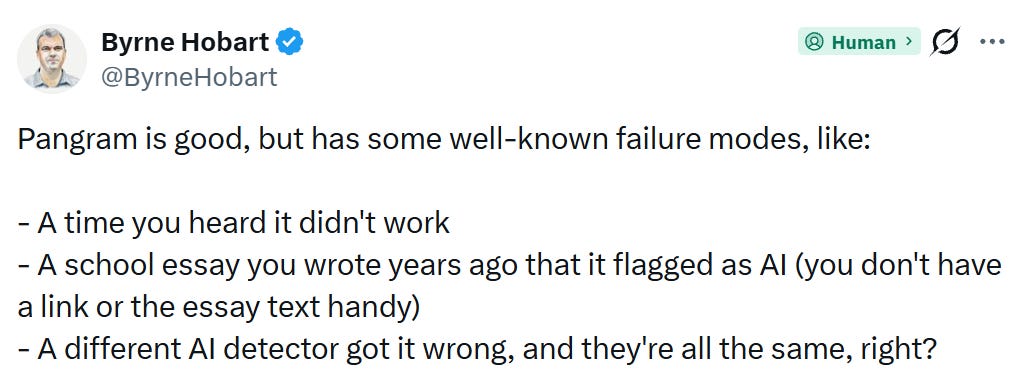
To test the extent of AI adoption in the Pan African Review, I looked at how much Pangram flagged articles there over time. Unfortunately, the site is currently down, so I had to extract whatever articles I could from the Internet Archive.1 What we see right away is a total rejection of Olagunju’s thesis: articles were never flagged as AI-generated before the advent of LLMs, and the share flagged as AI-written has rapidly crept up afterwards. This is not what we expect if African writing generally is to be considered liable to be flagged as AI.
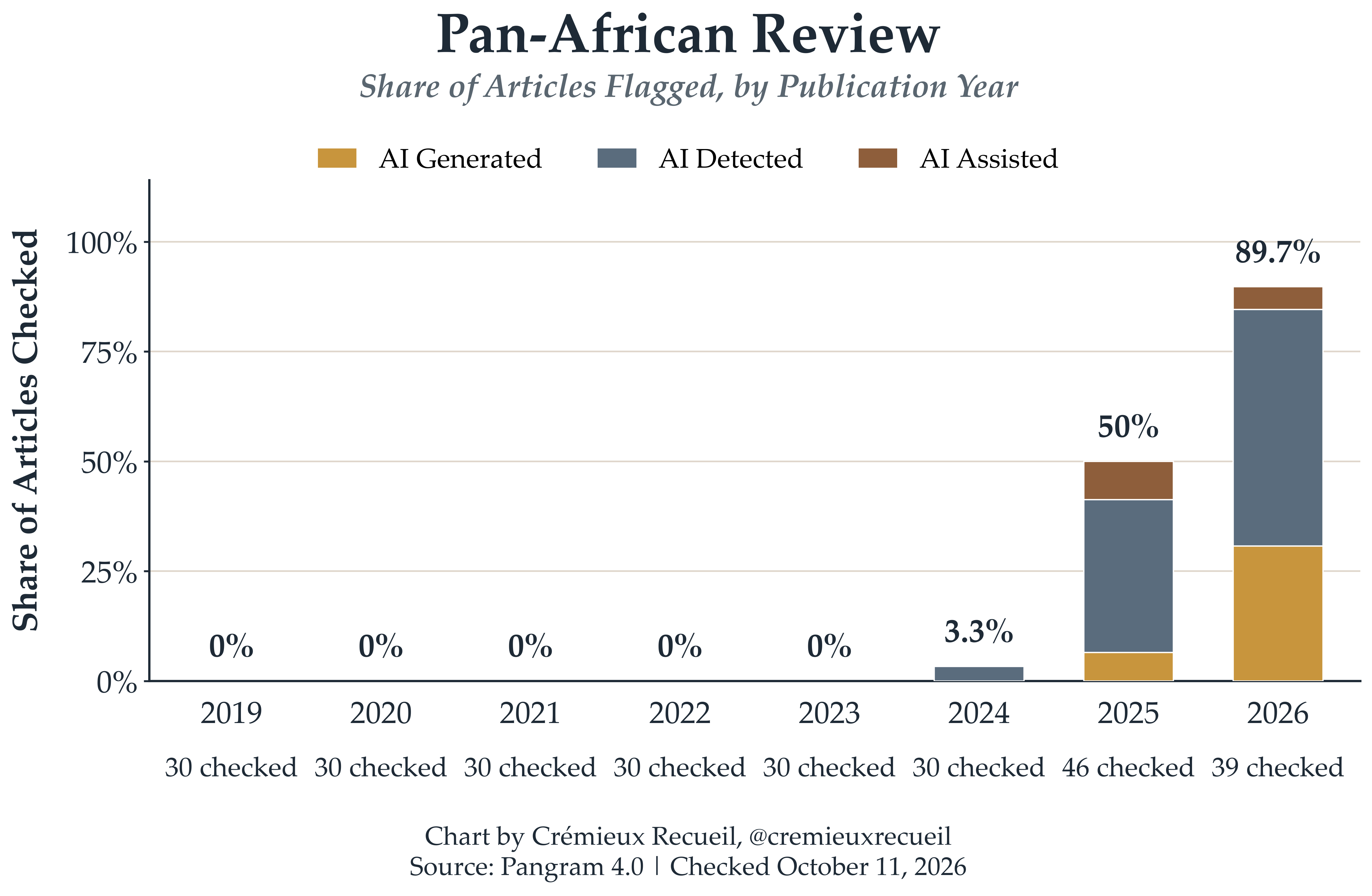
Another test of Olagunju’s thesis is to simply look at his writing. He wouldn’t lie about this stuff, would he? All of his past work before LLMs came out should return a 100% AI score with at least moderate confidence. Alas, quite literally none of it that I could find does. All of it shows up as human-written. It’s only after LLMs came out that his work started being flagged as AI-generated.
But maybe we’re at fault here. Maybe Pangram trained on the Pan African Review and Olagunju’s work and they flag pre-LLM work as AI-generated because it’s in the training set. To get at this question, I asked Pangram CEO Max Spero if that was the case: was “Pangram trained on the articles in the Pan African Review?” “It was not.”
Pangram doesn’t discriminate—not against Africans, not against the disabled, not against people who think mRNA vaccines contain nanobots. Pangram detects AI.2
This was a timed post. The way these work is that if it takes me more than an hour to complete the post, an applet that I made deletes everything I’ve written so far and I abandon the post. You can find my previous timed post here.
A message from my sponsor, Mechanize:
We’re hiring software engineers to build environments and evals that frontier AI labs use to train coding agents.
To get a better sense of the work we do, you can check out GBA Eval, where we had models build Game Boy Advance emulators from scratch and scored their performance.
Base pay starts at $300K/year for junior software engineers, with more for senior roles, plus equity and performance bonuses. Apply here.
This could have made the selection non-random since the articles most likely to be archived might be those least likely to contain AI-generated text prior to the advent of LLMs, but I consider this possibility a distant one and I’ll check if it’s true when the site is back up.

This is extremely funny.
To be fair to his thesis, there are well-documented cases of African English linguistic quirks being picked up by LLMs and becoming quintessential ‘LLMisms’, the most famous probably being ‘delve’:
https://www.theguardian.com/technology/2024/apr/16/techscape-ai-gadgest-humane-ai-pin-chatgpt
Now obviously this phenomenon surely isn’t so great as to explain a 100% AI result, but there isn’t *nothing* to this. It is plausible enough that African writing sounds like AI at least a little, especially to the human ear.