

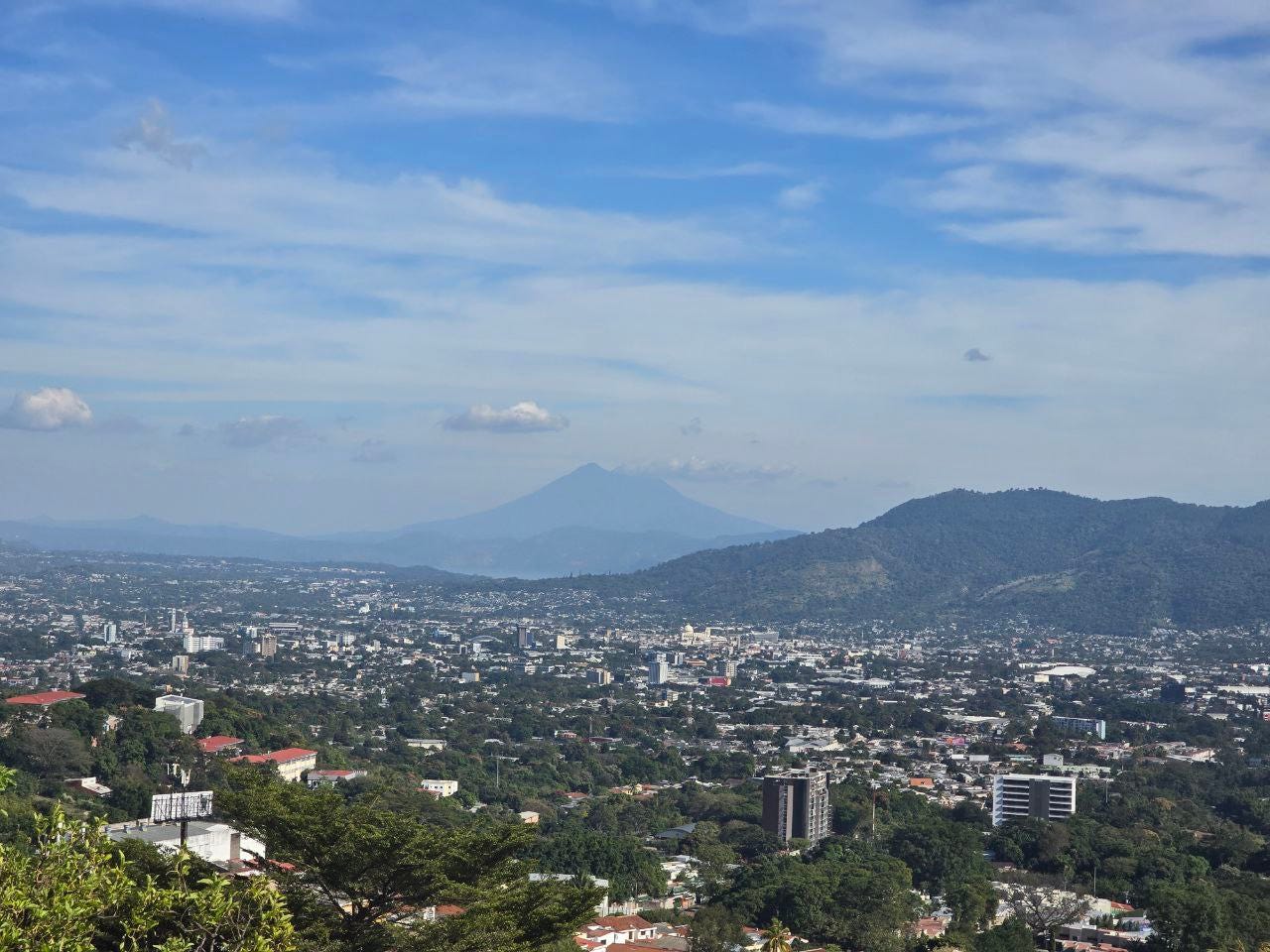
I recently got back from spending some time in El Salvador. I was there for a few reasons, one of which was to attend Werner K. Zagrebbi and Duncan McClements’ Second Order conference, which went swimmingly, and included one of the most motley and fun panels I’ve attended. I would state the speakers, but Chatham House Rules governed the conference. In any case, it was a lot of fun and I commend Werner for hosting such a great conference.
One of the big things that I wanted to see down in El Salvador was improvement. I wanted to know if the country had really become as safe as the statistics suggest. I was not disappointed.
When you walk off your plane, you’re greeted to a newly constructed airport terminal that’s designed pragmatically: departing and entering passengers are completely physically separated; all routes include artwork with ample signage; you don’t have to walk back-and-forth through a maze of retractable-belt stanchions if there’s no line because the attendants will pull them back to let you through. It takes about five minutes to get through passport control and to arrive at baggage claim.
The baggage claims work, unlike the ones in so many other third-world countries. This isn’t a high bar to clear, but it’s still appreciable. You grab your bag, you walk outside, you call an Uber, and plenty are available.1 About forty minutes later, you’re in downtown San Salvador.
If you look around at this point, you’ll notice a lot of the trappings of third world living: iron bars on windows, barbed wire on roofs, gates over doors. But unlike most places with similar set-ups, the gate and the door behind it are often open. Surprisingly large numbers of people feel free to leave their doors open during both night and day. Judging by all the locks, heavy metal garage doors, and other security measures galore, they clearly did not feel that safe just a few years ago.


When Bukele began El Salvador’s gang crackdown (the Estado de excepción, or State of Exception) in 2022, the public was crying out for it. It came on the heels of a wave of violence by gangs after negotiations with the government broke down. 92 people were dead for no good reason and Bukele saw the opportunity to end the problem once-and-for-all. So, he did. He suspended some civil liberties that impeded his plan and began to lock up everyone with gang facial tattoos.
This effort was heavy-handed; fittingly, El Salvador’s gang crackdowns have historically been called “Mano Dura”—Iron Fist. It involved police going to known centers of gang activity like malls, parks, and city centers, and rounding up anyone who looked to be affiliated with the gangs, as evidenced by their characteristic tattoos.
Gang tattoos are a holdover from their prison gang origins and they’re earned through committing violent acts, such as murder, assault, or rape. Persons who had similar tattoos, or just tattoos on the head or face, would be policed by the gangs if they were not, in fact, a member. This policing was often swift and came in the form of murder. That is to say, if you had similar tattoos but weren’t part of a gang, you better not let the gangsters see you, or you might end up being killed.
The gangs also policed non-gang crime. If someone who was unaffiliated, for example, tried to steal a person’s wallet on gang territory and a gangster saw it, they would be apprehended and beaten, killed, or expropriated of their ill-gotten goods (and usually more). As a consequence, the gangs dominated all crime, and when their members were rounded up into CECOT—the massive prison constructed to house all of them—not only did murder disappear, so too did most crime.
To quote a friend of mine who put it succinctly:
It's still funny how much El Salvador resembles a philosophy hypo.
“Okay, what if a country has the highest murder rate in the world, but every criminal tattoos ‘I am a criminal’ on their face. THEN could you arrest them without due process?”
The heavy-handedness I mentioned comes from the methods and the errors that followed from applying them at scale. For example, El Salvador’s methods resulted in a large number of police confrontation deaths that they elected not to include in their homicide totals. Per the Congressional Research Service, some analysts—who we know to be opposed to Bukele’s crackdown—calculated that if “police killings, prison deaths, or the discovery of remains as homicides… were added to the government’s reported homicides… the 2023 homicide rate would be up to 47% higher than the government’s reported rate.”
Adding 47% to the homicide rate is quite the boost in relative terms, but in absolute terms, this would only bring El Salvador’s 2023 rate up to 3.53—much lower than America’s 5.8 in the same year.2 Moreover, the police confrontation share kept declining as the extent of violence required to contain the gangs fell, missing persons numbers fell as the gangs disappeared, and mass grave discoveries became less common even as imaging of the landscape increased, presumably because they were running out of mass graves to dig up!
While there have been issues like potential miscounting and even misidentification of gang members by police resulting in improper imprisonment, the scale of these issues has uniformly declined over time and the government has sought to openly and rapidly remedy these problems.3 The scale of remaining issues in identifying criminals and crimes is now widely agreed by opponents and proponents alike, to be meager. With all the reservations noted, it should not be forgotten: the populace always approved of Bukele’s efforts, even with the mistakes and heavy-handedness involved! The gangs were bad enough that the people would tolerate almost anything to see them done away with, and they still greatly appreciate and overwhelmingly approve of Bukele’s efforts even after the gangs no longer have a presence.
I spent a good amount of time walking around the country’s capital, San Salvador. I saw a lot: I saw grand new buildings next to shantytowns; I saw prostitutes and a handful of mostly-foreign businessmen; but I didn’t see any criminals. What most intrigued me was the feeling of safety alongside the intense levels of poverty. There were poorly-constructed wooden buildings with sheet metal roofs, without proper doors, and with people inside who still agreed: viva Bukele!
What’s been done for crime in El Salvador proves that it is possible to make anywhere and any population group—race, ethnicity, sex, whatever—peaceful, including the denizens of the murder capital of the world. All that has to be done is the rigorous enforcement of justice. And the result is not so much the thousands incarcerated as the millions freed from the tyranny of crime.
But El Salvador’s situation also shows that’s not enough. There are plenty of cranes in the sky, but they are not growing their economy notably faster than their neighbors, and they’re still poor by anyone’s measure. It’s not clear where they ought to go from here. Criminal justice seems to be one thing that’s quite distinct from all the other aspects of government, or at least, it’s something that can be.
El Salvador also has looming concerns with crime. Petty crime—pickpocketing, shoplifting, trespassing, disorderly conduct, vandalism—was all suppressed by the gangs, since they didn’t want anyone operating on their turf. But now that the gangs are gone, is there enough state capacity to ensure that petty crime doesn’t reassert itself? You may banish gang violence, but what happens when the population’s normal propensity for violence comes back as a natural consequence of generational turnover? Things surely won’t be as bad, but they can be less tolerable for foreigners looking to invest in El Salvador. Bukele and his advisors should keep this in mind.
It’s also not clear that Bukele can deliver a growth dividend. If he doesn’t, will he be able to stay in office when the economy inevitably turns down? Only time will tell if he can take a country that’s expected to have low growth rates and bring them towards high incomes. That is a much harder problem than solving the murder rate.
Miscellaneous Notes
Is El Salvador safe for gay and trans people? Yes, it seems to be, at least in the capital and the surrounding beachside areas. My group of friends included two trans people, a girl that dressed androgynously, and tons of gay and bisexual guys, and they didn’t have any problems, even walking around at 1-3 AM without any sort of security downtown.
Is El Salvador cheap? Expect to pay American prices in areas frequented by tourists, and expect to pay American prices for anything that’s actually high-quality. You’ll likely be eating things that the locals don’t normally eat, but if you did, you would find that unappealing, while being very cheap. It’s still a poor country, but it’s one with a lot of very palpable, and often visible class segregation.
One way the class segregation crops up is in incredibly intense racial stratification by class. Go to any fancy restaurant and you’ll notice that when they’re not tourists, the El Salvadorans are often White—blonde, blue and green eyes, light brown hair, pale skin, etc. Some of the other people you’ll see in those establishments are Levantine, although very few of them still speak any Arabic. You’ll also increasingly notice Chinese people here and there, since the country has been welcoming Chinese government-led construction projects and investments.
Were there any third world-style outages? Yes, at two points in the trip, the water went out. Not the power or anything, but the water. I don’t know why this happened, but I was assured it is extremely uncommon and I was just unlucky enough to see it happen.
How was the milling? I’d say half the population spends the majority of their waking time milling about. To me, this seems like a stationary labor force ready to be put into productive work. I don’t know why they’re not, but I suspect whoever can get them into productive work will increase El Salvadoran GDP by double-digit percentages. The same goes for so many other third world countries.
What was the obesity rate like? High. Like all of Latin America, El Salvador is getting fat as it gets wealthier, and it’s doing so at a staggering rate. Addressing this is going to be much harder than it will be for the developed world where GLP-1RAs are available as an option. Because the drugs are not cheap, they’ll have to do something else. Most likely, they’ll just live with it until they’re wealthier, and then make it a priority.
Was that really Bukele’s dog? Yes, that German Shepherd I posted was gifted to Bukele. He’s the first dog being trained for a new El Salvadoran military unit. He’s a good boy and his trainer—unprompted!—said that he hates pit bulls.
Did you like it? I loved it. I am a fan of all of the places I go in Latin America, and I want only the best for the people of those countries. The same applies to El Salvador. If I had to pick between all my recent Latin visits including it, Honduras, Mexico, Nicaragua, and Argentina, I’m not sure which I’d pick as my favorite except that the answer is not Nicaragua or Mexico. They each have their charms and reasons to visit.
Will you go back? I am already scheduled to go back.
If you have any other questions, shoot!
And they are very cheap; they don’t keep with American price levels like they seem to in some other third world countries. One of the things you’ll notice when you use the app is that the tip amounts are tiny and they have overstated descriptions: “10%: You Saved Me!”
On a related note, the reduction in the homicide rate cannot be attributed to regression to the mean, as El Salvador has blazed past their historical mean and the mean of their neighbors and achieved record-low homicide rates that are even below Canada’s. More importantly, known killers have gone from being gang members to not being gang members, as the gang members have been locked up. All of this is as one would expect, and as practically every El Salvadoran adult you ask on the streets will tell you is obviously the case.
For example, by freeing misidentified gang members.
Did the locals you interacted with seem optimistic?
Their long national nightmare is over, but does it feel there is a Salvadoran Dream to aspire to?
I cannot comment on El Salvador, but increasing obesity in Mexico correlates with a very successful marketing campaign by Coca Cola.