

This was a timed post. The way these work is that if it takes me more than one hour to complete the post, an applet that I made deletes everything I’ve written so far and I abandon the post. You can find my previous timed post here.
Did you know that many Israelis received reparations for the Holocaust?
The first agreement to pay Holocaust reparations was signed in 1952 between Israel and West Germany. The terms of the deal were that the latter agreed to help resettle Holocaust survivors to Israel. In 1953, West Germany began providing individual payments to some survivors, but eligibility for the payments was limited to only a small number of those affected. In 1956, many more Jews became eligible for payments and immediately received a lump-sum equal to 100% of Israel’s GDP per capita, followed by a monthly stipend equal to 30% of average wages. In 1957, eligibility expanded once again, and take-up became widespread, with recipients set to receive 25% of the GDP per capita and a monthly stipend equal to 12% of average wages. Then, in the 1990s and 2000s, eligibility expanded once again.
Hazan and Tsur leveraged Israeli data on those who became eligible in the 1950s compared to those who became eligible long after their reproductive years (in the 1990s and later) in order to understand the effects of subsidies on the birth rate. We know subsidies work to boost the birth rate—that much is not in question. What makes this study interesting is that it provides an answer to a different question: How should we set up fertility benefits for maximum effectiveness?

Take a look at this graph from the paper, which is stratified by the sex of the household’s reparations recipient, and see if you can tell what the answer is.
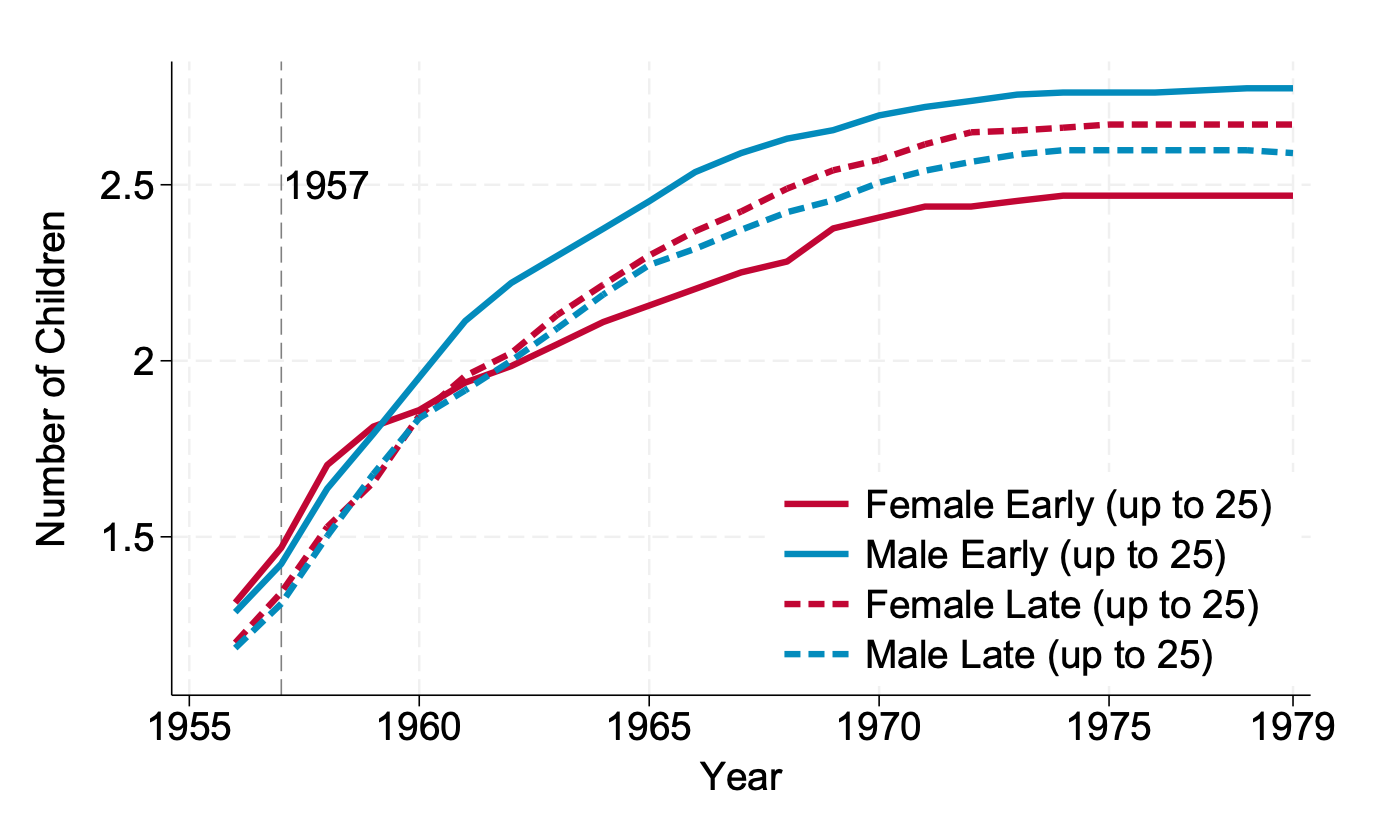
In households where the male partner received the reparations, fertility was a bit higher. In households where the female partner received the reparations, fertility ended up lower. Per the authors:
By comparing fertility outcomes by timing of receipt, recipient gender, and age, we show that young women who received reparations early had significantly lower fertility than comparable households in which the male received reparations. The effect—emerging after 1957 and persisting through the end of the reproductive years—amounts to a reduction of 0.25–0.4 children…
[W]hen women’s individually controlled resources rise, completed fertility falls. This creates a potential policy tension with per-adult UBI. Unconditional transfers that raise individually controlled resources may dampen the effectiveness of pronatalist, child-contingent programmes that lower the marginal cost of an additional birth.
These findings don’t seem to be driven by women changing their labor supply, but instead, through the simple mechanism of greater female bargaining power. That is, when women’s resource control increases relative to men’s, their relationships change in a way that hurts fertility prospects.
This finding is a replication; it’s far from the first time this pattern has shown up.
Among lottery winners, the fertility of men tends to increase, while the fertility of women seems to be unaffected. This appears to be marriage-mediated, as male winners end up with higher rates of marriage and lower rates of divorce—both things that facilitate fertility—and women end up with higher rates of divorce and no change in the incidence of marriage.
The Appalachian coal boom also increased fertility. What makes this such an interesting scenario is that the coal boom was basically purely beneficial for the status of men, as it increased their general employability, their wages, and their bargaining power relative to women. As a result, when the coal boom set in, fertility rose, and when the bust set in, fertility fell, as household incomes fell absolutely, and men’s fell relative to women’s.
Natural resource shocks like the one in Appalachia have actually furnished many examples of male-biased fertility benefits. For example, oil shocks—which primarily boost male career prospects—have been found to boost fertility in Indonesia as well as with America’s fracking boom.
One of the most interesting studies in this area leveraged variation in immigrant numbers to identify the effects of sex ratios on these sorts of outcomes. With data from the 1910, 1920, and 1940 Census samples in hand, it was found that relatively more men from a given immigrant group in an area led the group’s members to marry more, for the women to work less, and to higher male and total couple income:
The… results for men are consistent with the view that higher sex ratios cause men to marry sooner and to try to become more attractive to potential mates… A number of specification checks support the notion that the primary factor mediating these links was increased female bargaining power in the marriage market.
This result may seem different from the expectations you’d get via modern studies, but it makes sense for its era, when women had not really begun entering the workforce en masse yet. But it’s just a digression here; it’s not really on-topic when the topic is male-biased fertility benefits working better than balanced or female-biased ones, it’s just something to think about.
Moving away from causal studies, cross-sectional results generally also support the same pattern regarding bargaining power. In the U.S., for example, the more husbands earn, the more likely they are to have children, whereas the more their wife earns, the less likely kids are. By contrast, in contemporary Sweden, there’s a positive income-fertility gradient for both men and women, but the gradient is stronger and more monotone for men, and it’s more sensitive to timing and parity for women.
With all this information, an obvious solution for fertility policy is to explicitly inject a bias towards men. This may be obvious, but it is a political non-starter. It’s simply not possible policy because it is unacceptable, and it’s not clear how it could be implemented in a way that even had any facial, let alone real, fairness. No one credible would stand for this. We have to consider this ‘obvious’ option off the table.
February 28, 2026 Update:
Two papers on this subject have come to my attention after writing this article. The first is from 2016. It’s an analysis of Finnish longitudinal register data and information about plant closures. Its authors found that when men lost their jobs, there was little-to-no effect on subsequent fertility (~0%), whereas for women, losing their jobs was related to having slightly fewer children (about -3%).
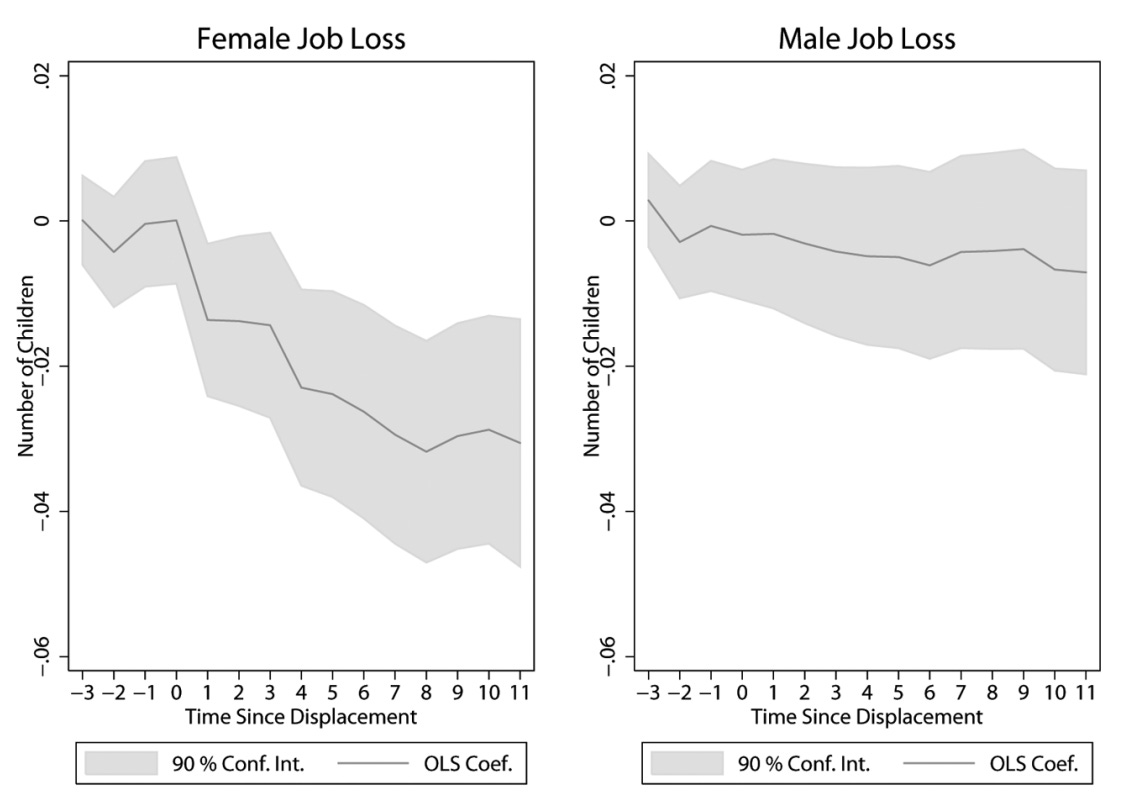
This isn’t a huge shock, it is a shock to employment and, indirectly, income, and it’s not a statistically very powerful study, but it is still sort-of a replication failure for the results above, and that should be kept in mind.
The second study just came out. It used Danish longitudinal register data and exploited a much broader shock: tax reforms! It found that increases in female wages lowered fertility, whereas increases in male wages caused it to rise. But there’s nuance.
This second paper produced results that are explicable if you remember Gary Becker’s income and substitution effects. Those are, respectively, the effect whereby having a higher income leads to greater fertility because people can afford more kids, and the effect where having a higher income leads to lower fertility because one’s time is more costly. We can see how this plays out, with a log-unit higher wages leading to about 0.05 fewer children for low-skilled women and 0.04 more children for low-skilled men.
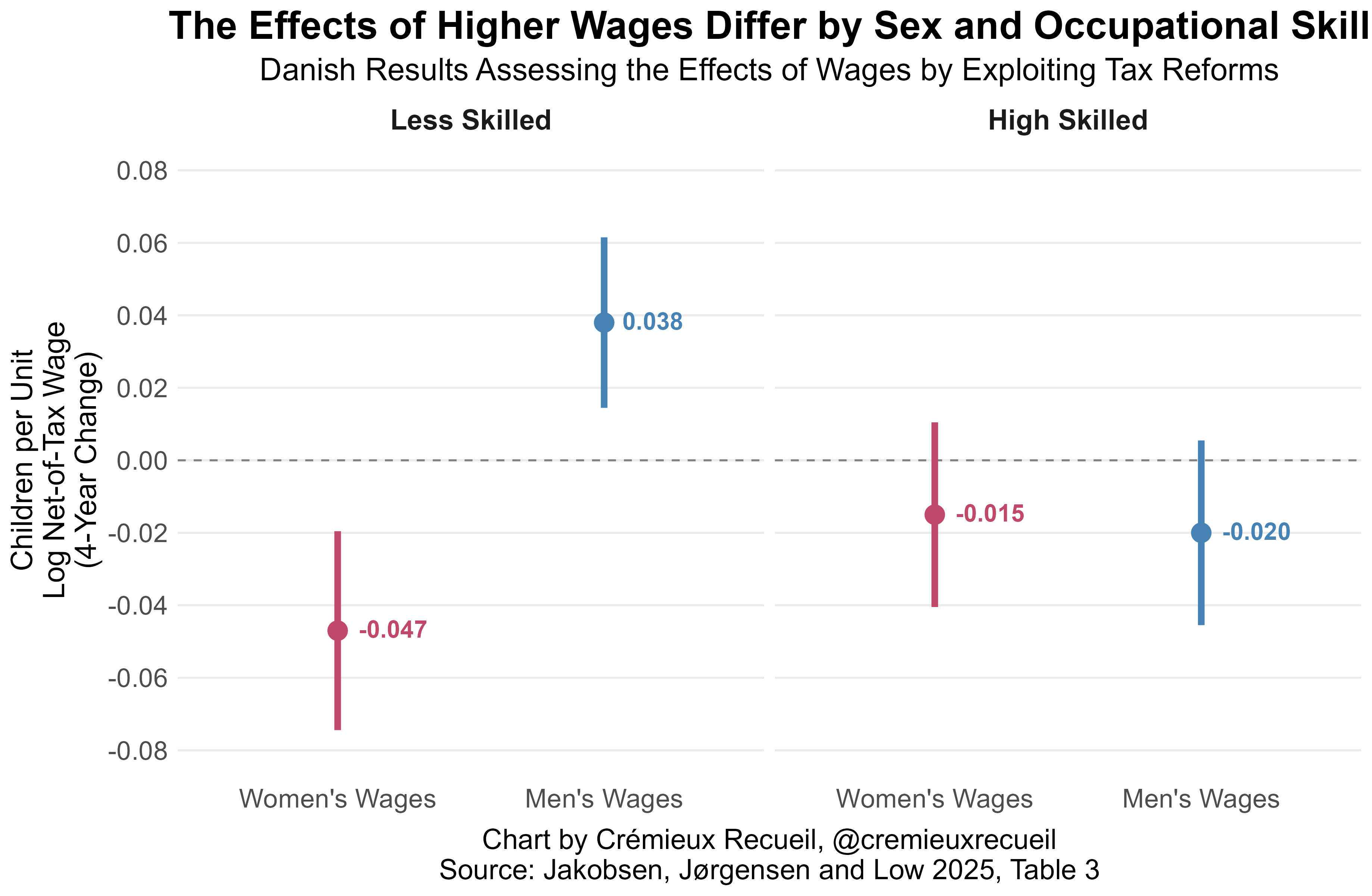
But wait, notice the skill difference? There’s no effect for the high-skilled, and indeed, it seems like higher wages are just bad for them, although, again, this isn’t significant, at least when split by sex. The asymmetry across skill levels has to do with the relative balance of substitution and income effects, which hinge on how much children burdens fall on each sex and how substitutable market time is with child-rearing time.
For the less-skilled women, opportunity costs are high: their market wages are low and childcare is less likely to be outsourced. A wage increase tilts their time allocation sharply towards doing additional work and away from childbearing. Their male partners’ wage gains, however, loosen household budget constraints without pulling them away from childcare they already weren’t in the habit of doing, so the income effect dominates and when they experience a wage gain, fertility rises.
For high-skill couples, on the other hand, both effects are attenuated. High-skilled women already outsource a lot of their childcare, and indeed, would likely find it hard to partake in a skilled occupation if they had to deal with childcare. High-skilled men’s income gains also matter less at the margin because they’re further from the binding constraint where additional income would tip their fertility decisions. Thus, neither coefficient reaches significance (plus, we have to deal with the fact that there’s less identifying variation hitting this part of the income distribution in the first place).
The pattern across studies is that money can matter, and very often, it matters such that money in men’s hands raises fertility and money in women’s hands reduces it. This isn’t because women don’t want children, per se, but rather because they bear disproportionate costs from having them, as in the Danish case, or because women’s bargaining power shifts and pairing becomes less likely, as in the reparations case.
There seem to be multiple mechanisms through which the male-money-helps and female-money-hurts channels exist. This arguably makes the headline finding more robust, since it isn’t dependent on a single mechanism. Although, one could certainly still argue that these findings actually operate through a single mechanism.1 In any case, sex-biased income effects leave us with a serious policy quandary.
August 28, 2026 Update:
A study of the Finnish Basic Income Experiment came out and its results comported with the Israeli ones: in scenarios where women received money, fertility was lower; in scenarios where their spouses received money, fertility was higher. Take a look:
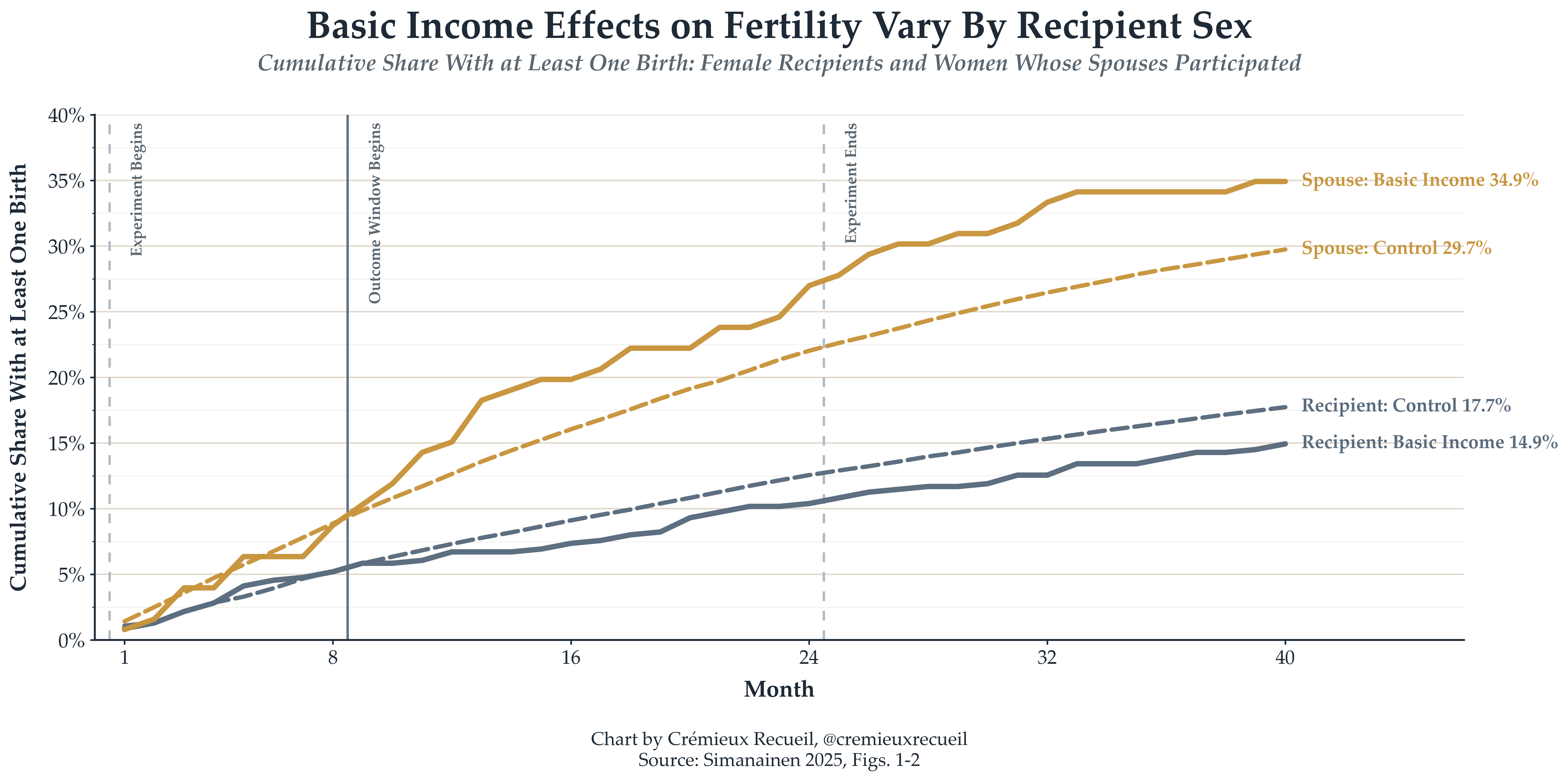
Look at this carefully: there appears to be something wrong, in that the group whose (male) spouses received a basic income and the group in which women themselves received a basic income have very different intercepts. This suggests they’re not at baseline comparable, which could explain the trajectory difference. The most convincing reason for this is that the sample with spousal recipients included people who were all, by definition, married (and ages 20-39), whereas the sample of female recipients (ages 25-39) were a mixture of partnered and unpartnered, and we expect people who are unpartnered to have less near-term fertility in general.
Is this the explanation? I don’t think so. If we scour the paper’s tables we can see that in the female recipient sample, those who were partnered didn’t see a fertility bump, but instead, a decrease relative to the control group. Moreover, the interaction by recipient sex was significant at both 16 and 24 months (p’s = 0.015 and 0.018).
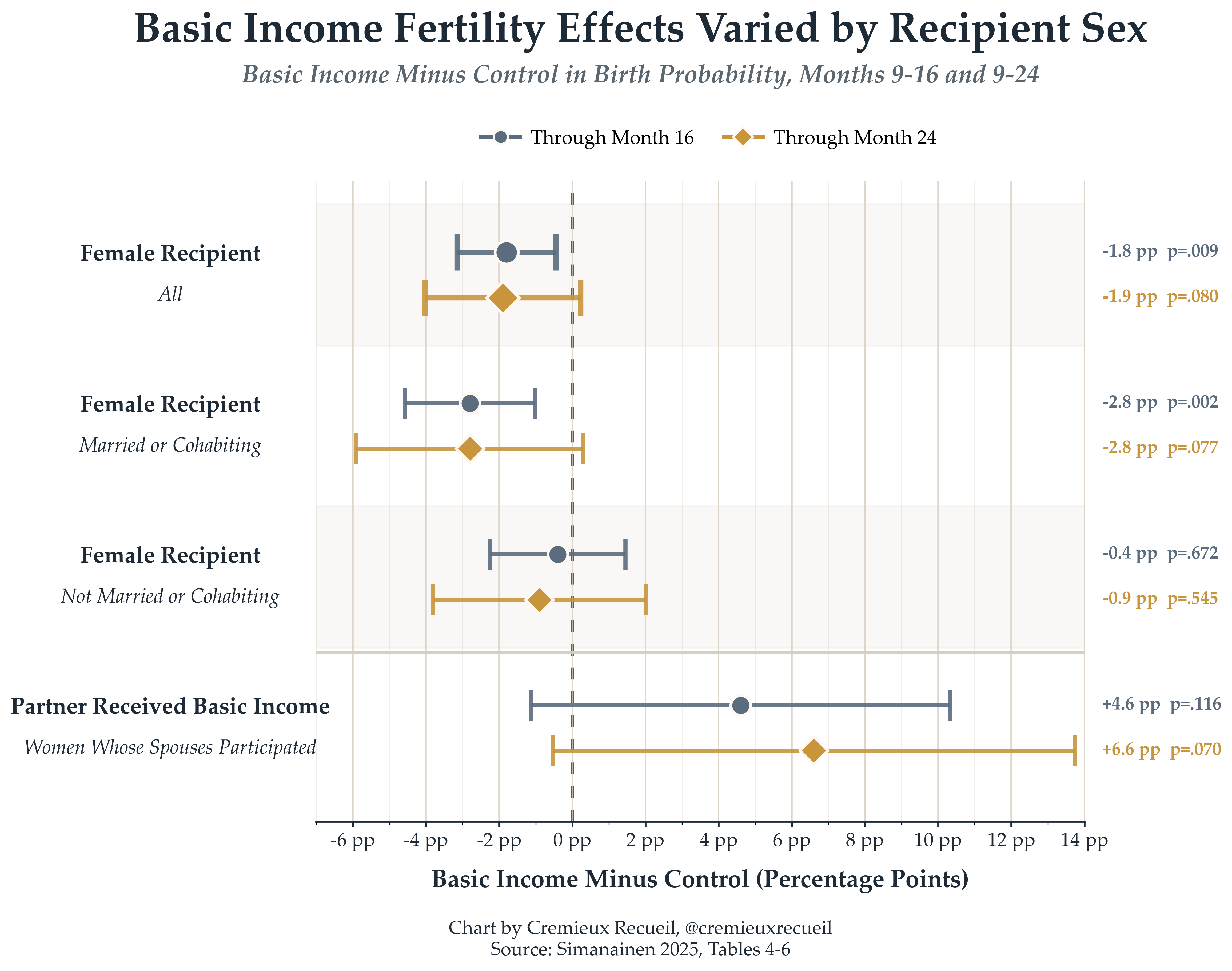
These are not very statistically impressive results, but they do comport with existing results (see above), and they have their strengths: treatment was randomized within each study population; fertility came from administrative registers and because the data is contained within population registers, there’s no attrition; the patterns are persistent; etc. However, the samples are small, so we should update in the direction of the idea that giving benefits to males instead of females is good for fertility, but on the basis of this particular study, let’s not move too much.
