

Today’s post is brought to you by my sponsor, Mechanize. They’re hiring junior software engineers at $300K/year base salary.
It’s taken for granted these days that inequality is a major problem. Inequality has been proposed as a driver for homicides and assaults, burglaries and robberies, rioting and discontent, depression and anxiety, and so much more. The truth of the matter is that inequality is correlated with all sorts of bad outcomes. However, it’s not clear if this is inequality’s fault or if something else is going on. Consider:
Measured Inequality: This is how high inequality actually is in an area, in the real world, at a given point in time. This could be differences between people, neighborhoods, or whatever in terms of education, income, or other measures of status.
Perceived Inequality: This is how unequal everyone feels an area, at a point in time, to be. It could be high, low, correlated with measured inequality, or not. In fact, it can be negatively correlated with actual, real inequality.
If these two quantities don’t correspond, then measured inequality doing anything to people like making their lives worse or disposing them to violence is going to be hard to justify without a seriously complicated theory. So let’s ask: Do people even know how unequal their environment is?

The biggest relevant aggregate is the country, so let’s look at that. When faced with vignettes showing five diagrams of society from a steep pyramid to a diamond with most people in the middle class, people usually do not pick the one that corresponds to their country’s Gini. Most people—across 40 different countries—do not seem to know how unequal their country is!
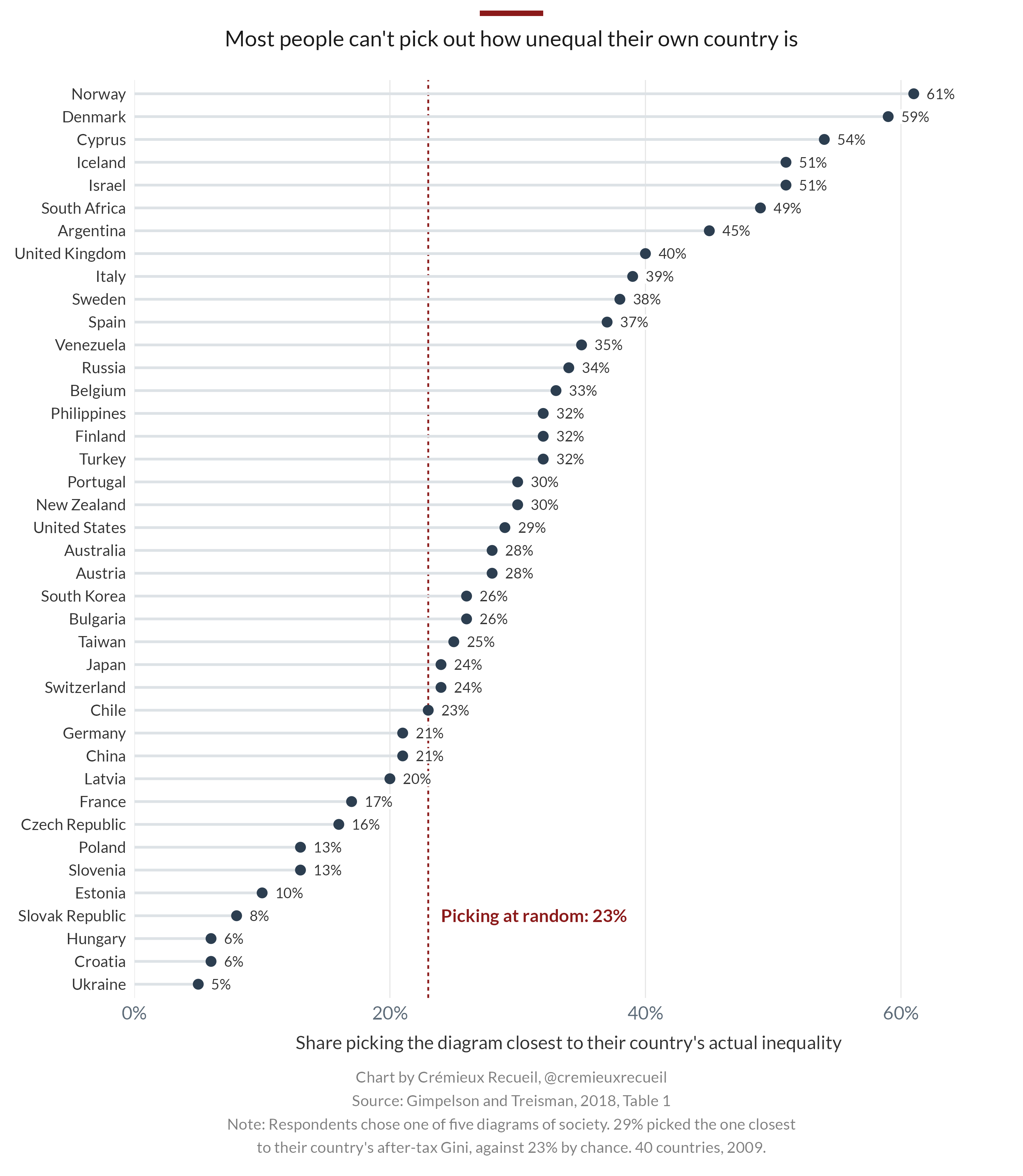
Overall, just 29% of people chose correctly where picking at random would have gotten 23%. Norwegians managed 61%, with Ukrainians on the other end clocking in just 5%. Think about that. Which of those countries do you think is more unequal? Shockingly, Ukraine was one of the most equal countries in the sample, but most Ukrainians picked the diagram corresponding to the highest level of inequality.
Overall, across countries, perceived Gini only correlated at r = 0.37 with after-tax Gini and r = 0.01 with pre-tax Gini. In a similar analysis by the World Bank, the correlation was about r = 0.25. In Pew’s Spring 2013 Global Attitudes Survey, they asked people whether the gap between rich and poor had grown over the preceding half-decade, finding that people only got the direction right 34.6% of the time—roughly random guessing. Further, a plurality said the gap grew in more than 90% of countries. Likewise, Eurobarometer asked about poverty in their 2010 Poverty and Social Exclusion report. In 8 of 27 countries in the survey, poverty had risen, but in all 27 at least 65% said it had risen.
Perceptions and reality are related, and they also co-move. Within countries over time, a one-point rise in the Gini coefficient is associated with a 0.17-point rise in the average perceived Gini. Something problematic is that a one standard deviation shift in the Gini moves perceptions roughly as much as a one standard deviation change in unemployment. This is unfortunate since it suggests perceptions track hard times about as much they track inequality. (Maybe people think of them similarly?)
What is Perceived Inequality? What Does it Do?
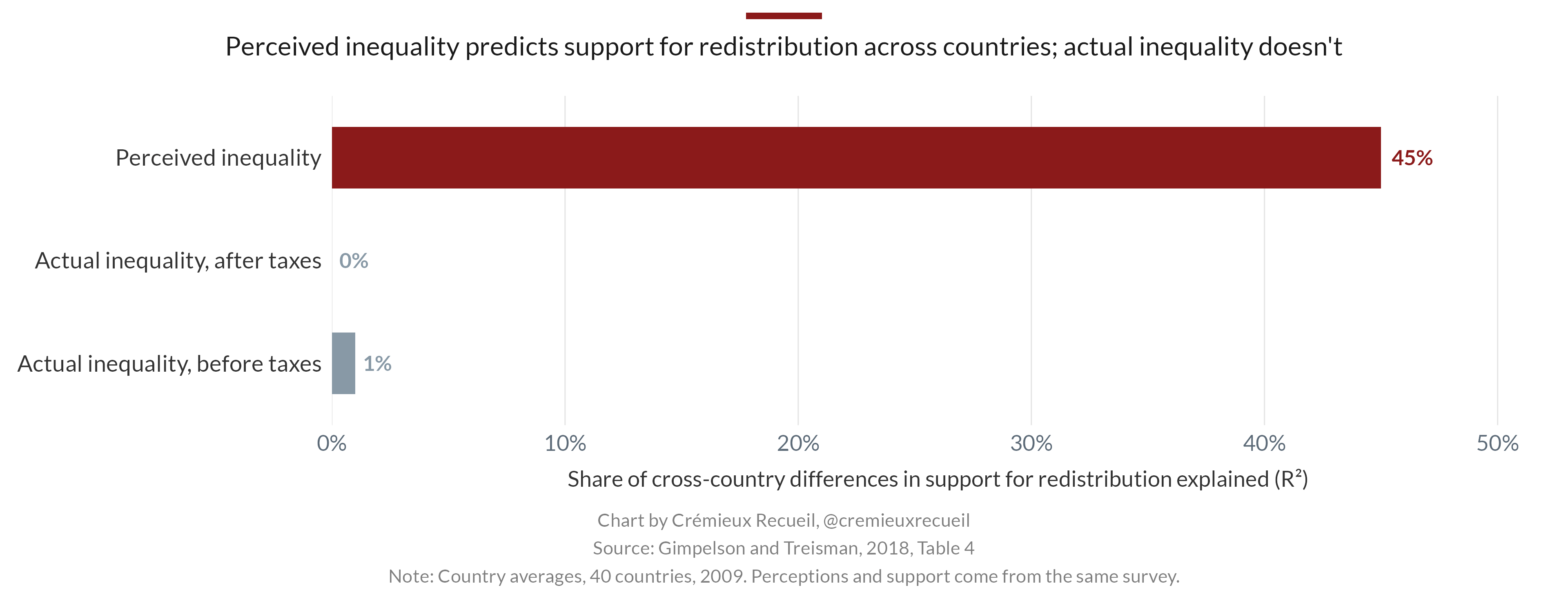
What’s really incredible is what perceived inequality predicts. Perceived inequality correlates at a staggering r = 0.67 with preferences for redistribution. On the other hand, actual inequality predicts virtually nothing about whether people want to redistribute wealth.1
But, why? Set that aside for now. I want to note that I can think of four reasons why we should not think of this as evidence that perceptions drive preferences.
Perceptions and outcomes are derived from the same questionnaire. Those who say inequality is high are those who say the government ought to reduce it. If someone answers one way, that tends to show up on both sides of the regression presented above. They could do this due to mood or acquiescence. The Gini, however, comes from tax and household survey data, giving it no such inherency.
Perceptions look very similar to ideology. In Barcelona, left-wing ideology predicts redistribution preferences five times more than perceived inequality does, and left-wingers clock in about 0.25 SD bigger believers in perceived inequality. A World Bank study found that perceived inequality didn’t relate to redistribution preferences after accounting for ideology. In an experimental setup, when the rich are described as having earned versus extracted their incomes, extraction leads to a 10.9-point higher estimate of the income share of the top 10%.
As Bryan Caplan noted, “If most people in your country see a lot of inequality, you’ll probably support a lot of redistribution – even if you’re high status and don’t think there’s a lot of inequality!” It seems that a shared belief about inequality is stronger in effect than individual beliefs.
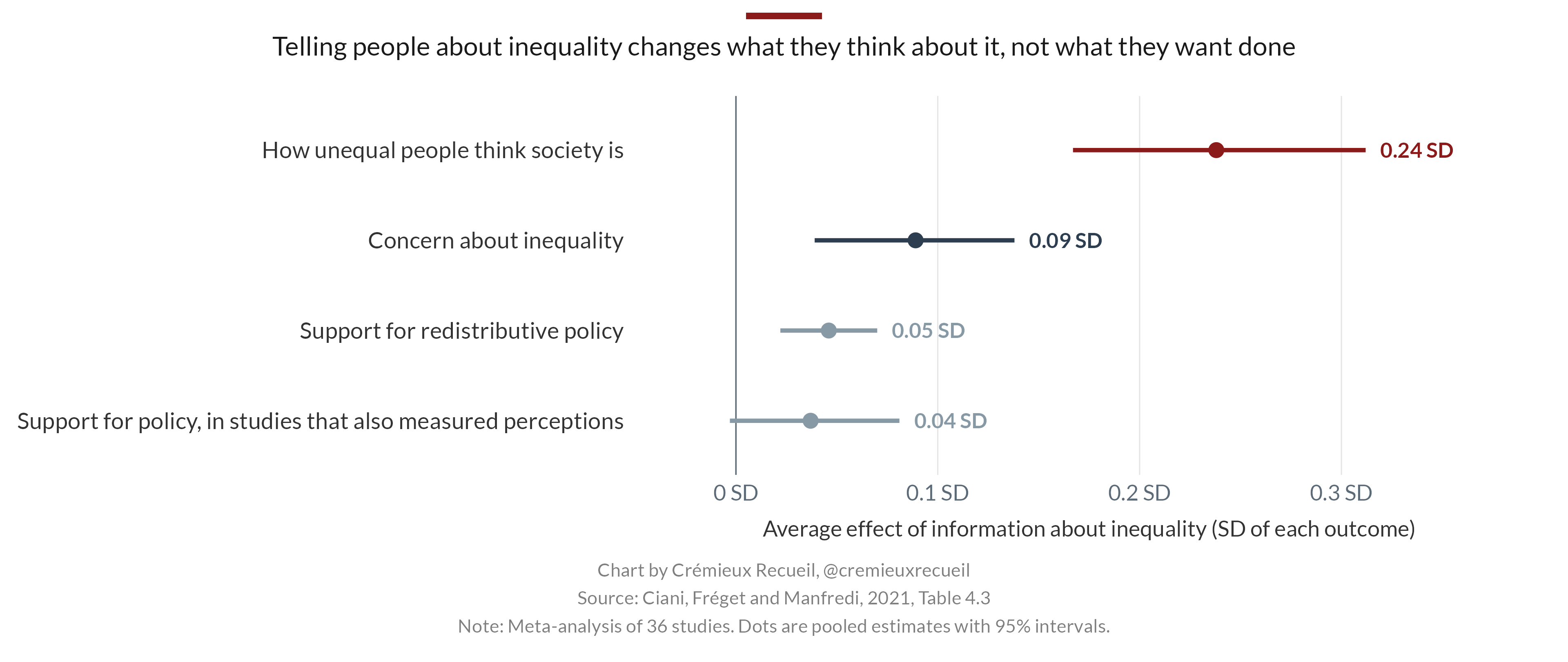
In experiments, information about inequality boosts how unequal people think society is, how concerned they report being about inequality, and their support for redistributive policy, but in studies where they measure perceptions, the effect is nonsignificant. In fact, across studies measuring support for redistributive policy, the effect is very small (0.05 SDs). Other studies largely agree.
The most interesting—and perhaps literature-defying—work on this topic comes from a recent paper by Max Lobeck and Morten Støstad. This paper didn’t just ask how unequal society was, but what people believed inequality did. People tended to believe inequality was pretty much universally bad on net, excepting effects on innovation.
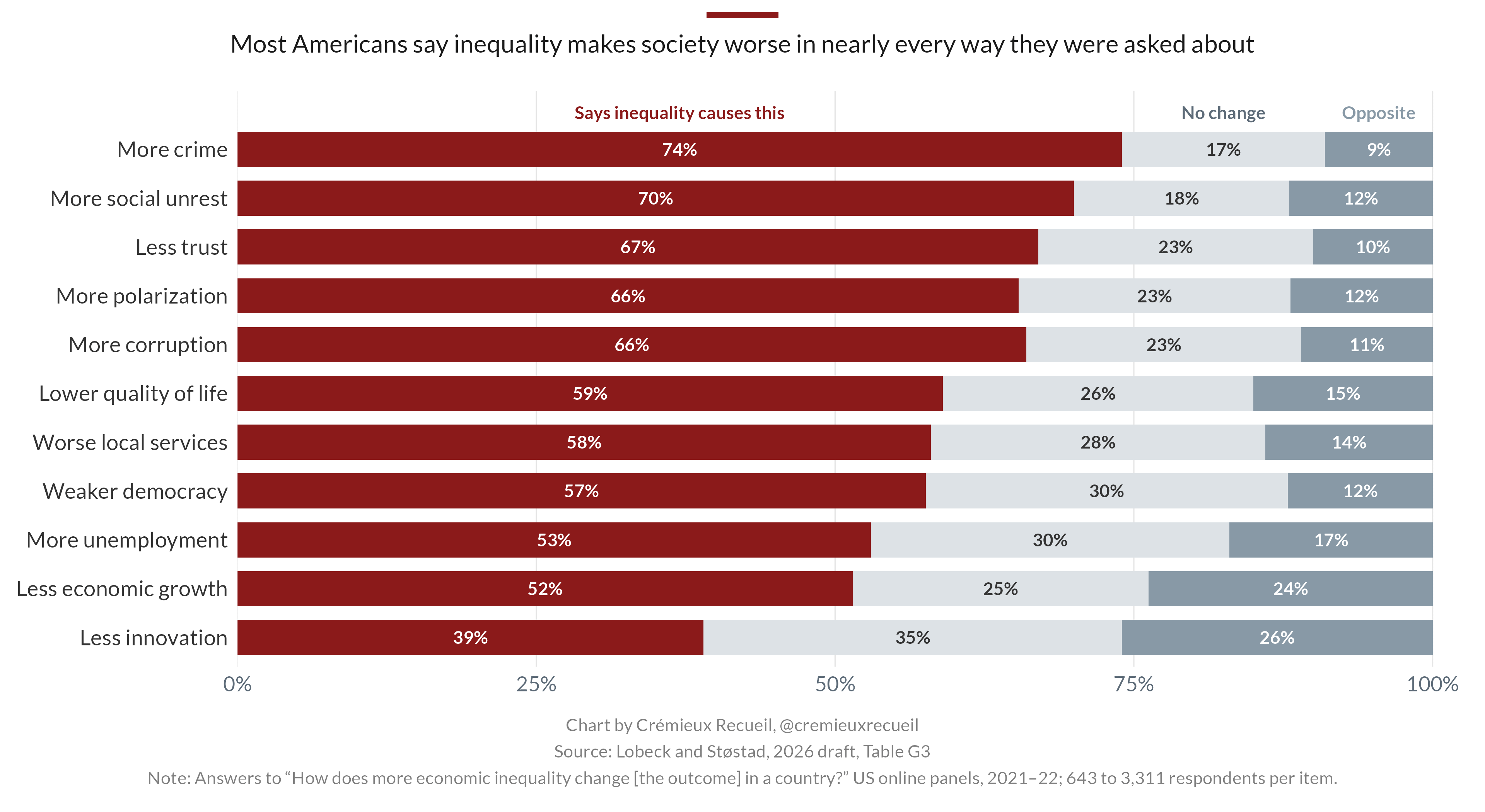
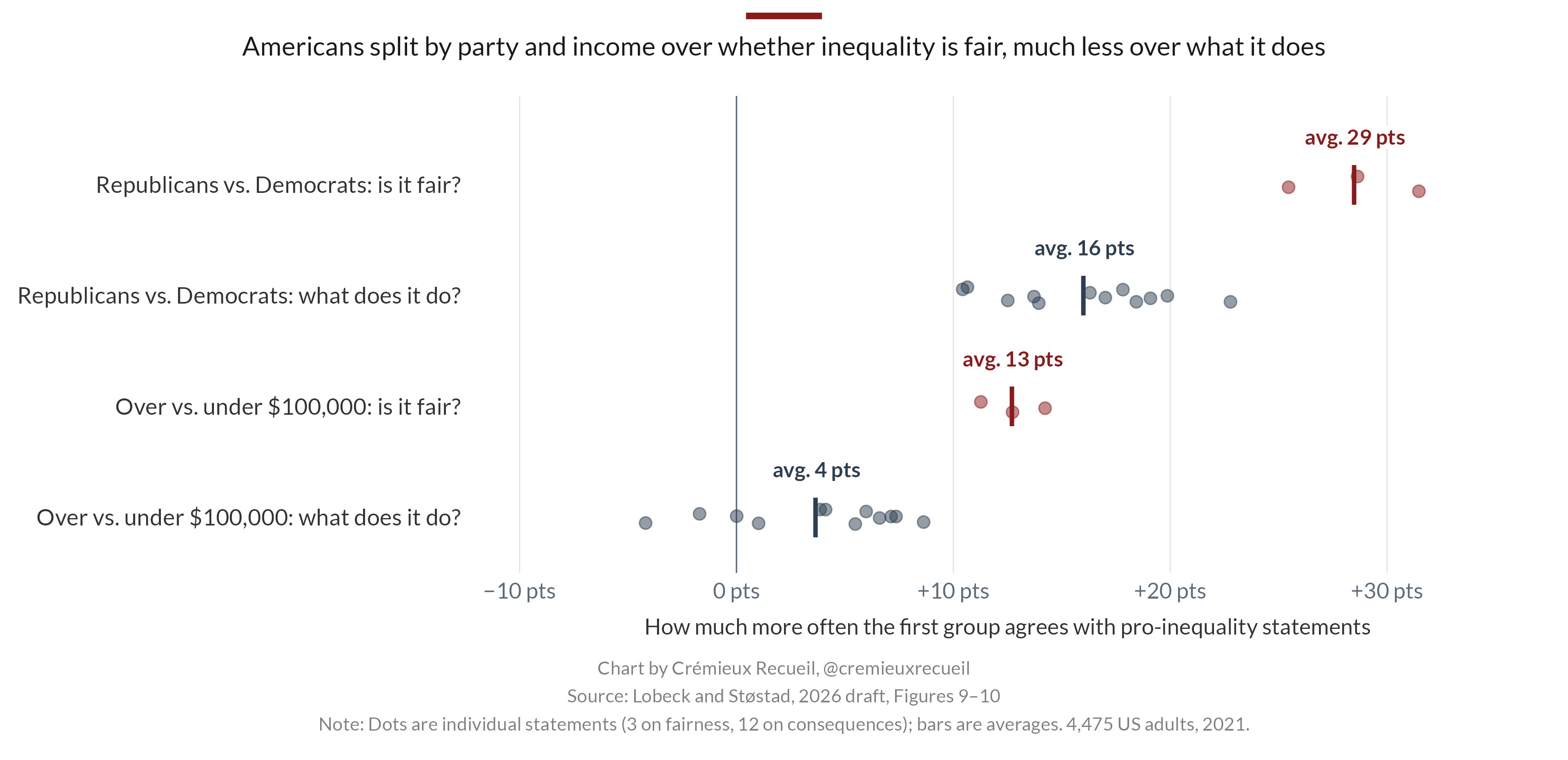
Strikingly, these views didn’t divide people across ideological lines that strongly. The divide actually comes from questions about whether inequality is fair, much less so over what it actually does. And, interestingly, on average people who earn more than $100,000 rate inequality as a bit more fair and a lot less likely to do much of anything.
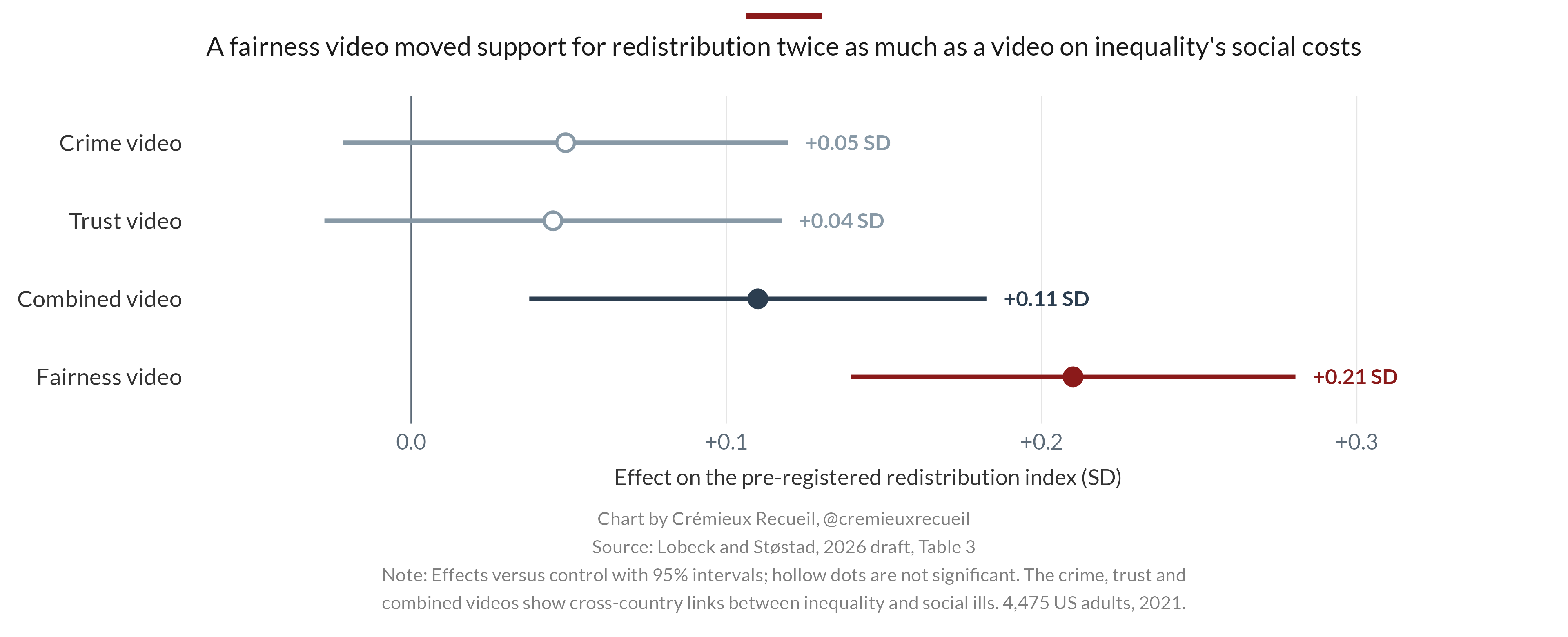
The study authors went on to run an experiment: watch a short video showing cross-country correlations between inequality and homicide or inequality and distrust, or a combined version adding more correlations, or, be split into a fourth group that watches a video about fairness, focused on wages lagging productivity (a popular myth) and the top-1% share rising. People were most moved by the video on fairness and barely at all by either of the lonesome videos on crime or trust. The effect of the combined video seemed to be basically additive.2
Does Inequality Even Matter For the Body and Mind?
People are not very aware of how unequal their surroundings are, they believe inequality is broadly harmful, perceptions seem to play some role in policy preferences with socially-held perceptions mattering more than personally-held ones, and people can be convinced that inequality is harmful and we need to do something about it. So, then, what does inequality actually relate to, in the world of variables that matter?
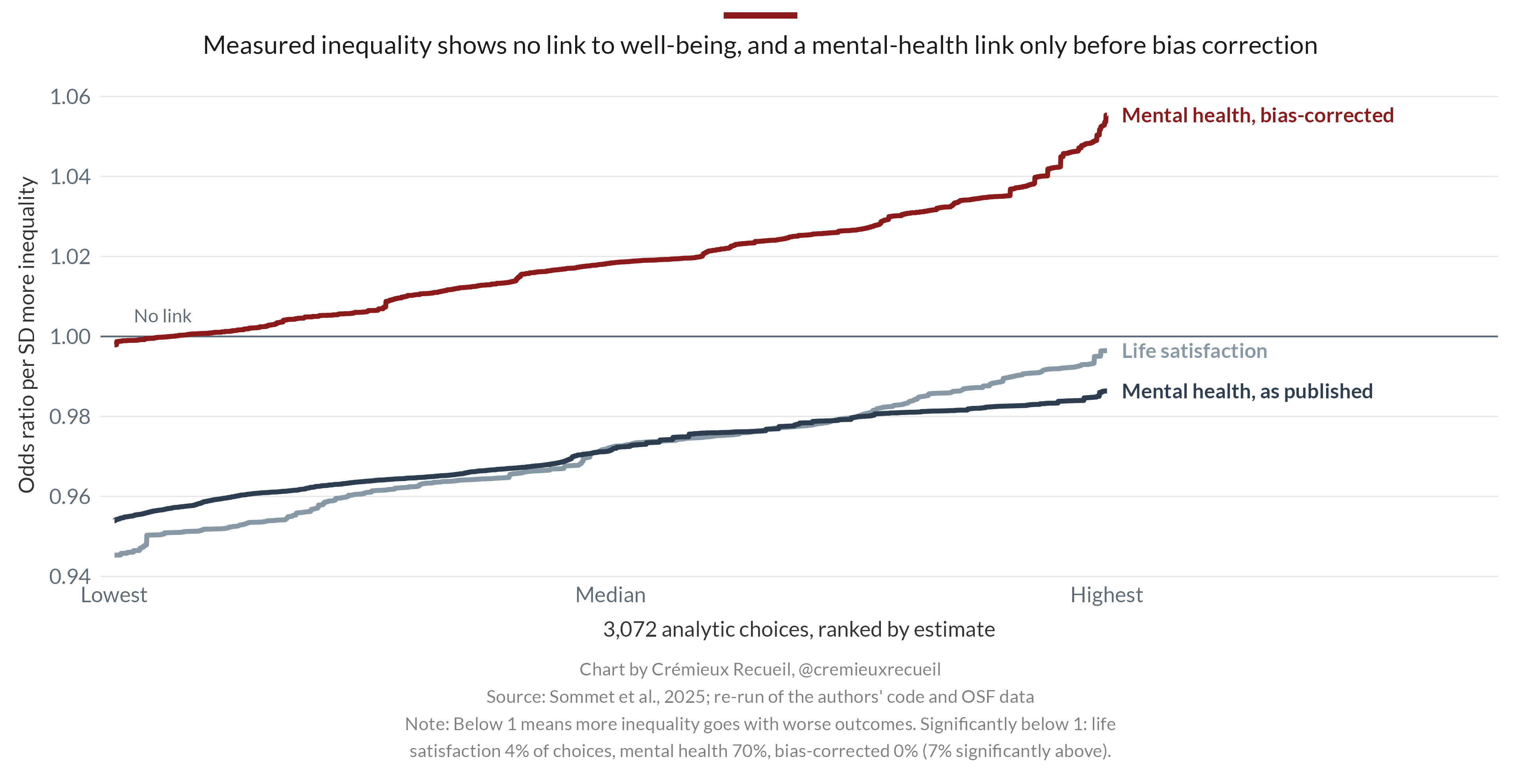
The biggest test of inequality’s effect on happiness came from a meta-analysis published in Nature last year. This study was quite interesting, because across thousands of specifications, the associations between economic inequality and mental health or life satisfaction were usually null and always small. Shockingly, when corrected for publication bias, they even pointed the other direction, towards inequality being beneficial!
Contrarily, perceived inequality is associated with life satisfaction, the association just shrinks by about half when development indicators are included, suggesting that it’s partly a measure of poverty. Curiously, experimentally strongly shifting perceived inequality, reported life satisfaction didn’t move.
If we want to be more objective about mental health, we can also look at whether changes predict things like antidepressant prescriptions or suicides. In both cases, the result is actually negative: higher inequality co-moves with fewer prescriptions for antidepressants and lower suicide rates.
A review of studies looked at the relationship between inequality and self-rated physical health and inequality and mortality and found similar things: weak, tenuous correlations, and in the one case where the results were causally informative, there was a null. For the physical and mental, it just doesn’t seem like inequality does much.
Does Inequality Even Matter For Trust? Community? Crime?
Effects of inequality on trust in elites, voting intentions, populist attitudes, voter turnout, far-right voting, and so on just do not support much effect, if any, and they almost universally suggest that perceived inequality is more powerful than real, measured economic inequality. Similarly, meta-analytically, the relationship with crime in the cross-section is very small, between r = 0.007 and 0.123 after correction for publication bias. Charitable giving? Also not affected. And migration? Well, that one is interesting: migration intentions are responsive to inequality through people’s prospects, not through their desire to escape inequality per se.
What we see again and again if we take a comprehensive view of the literature is that inequality is, objectively, not that efficacious, even when it comes to cross-sectional relationships with all their confounding and bias. A clear way to see this is to contrast the correlation with homicide among countries to the correlation between changes in inequality and changes in homicides. The former looks bad:
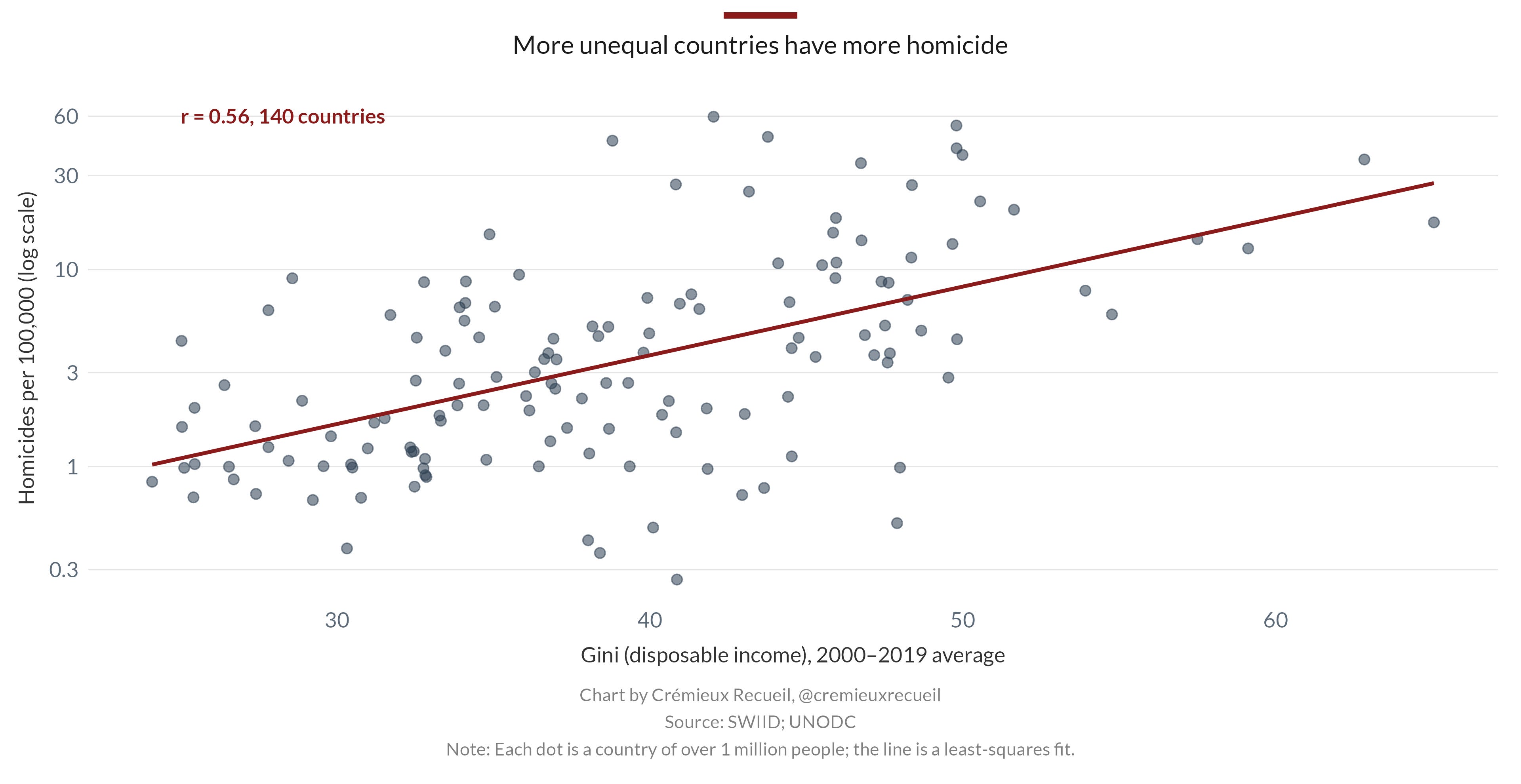
If you looked at this, you’d assume inequality drives people to kill one another. But look:
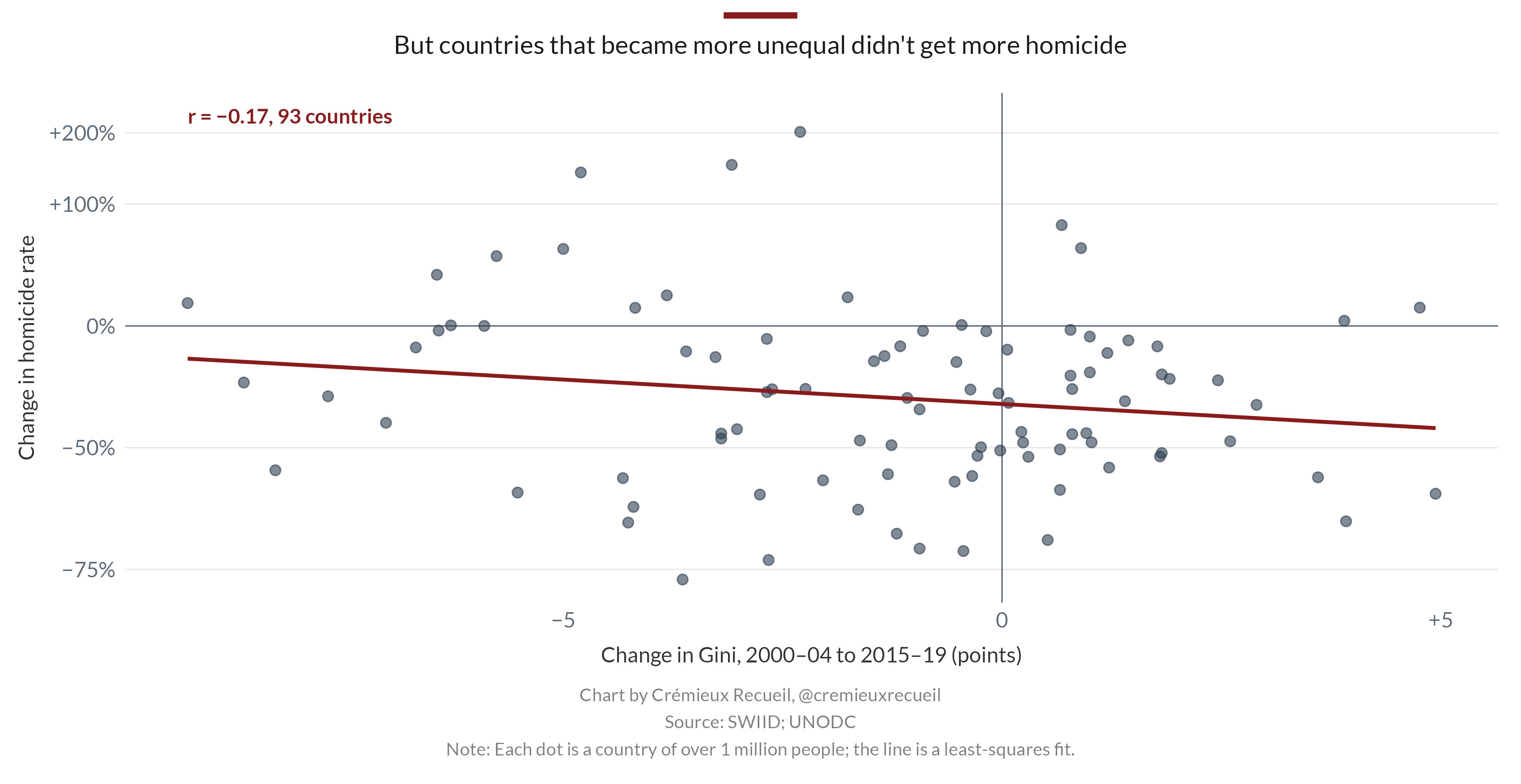
Changes in inequality predict, if anything, better results when it comes to homicide. This is probably artefactual like the original correlation so the direction isn’t that notable, but at the very least, it’s curious that rising inequality doesn’t yield the results people expect. The same holds across other outcomes and lag lengths:
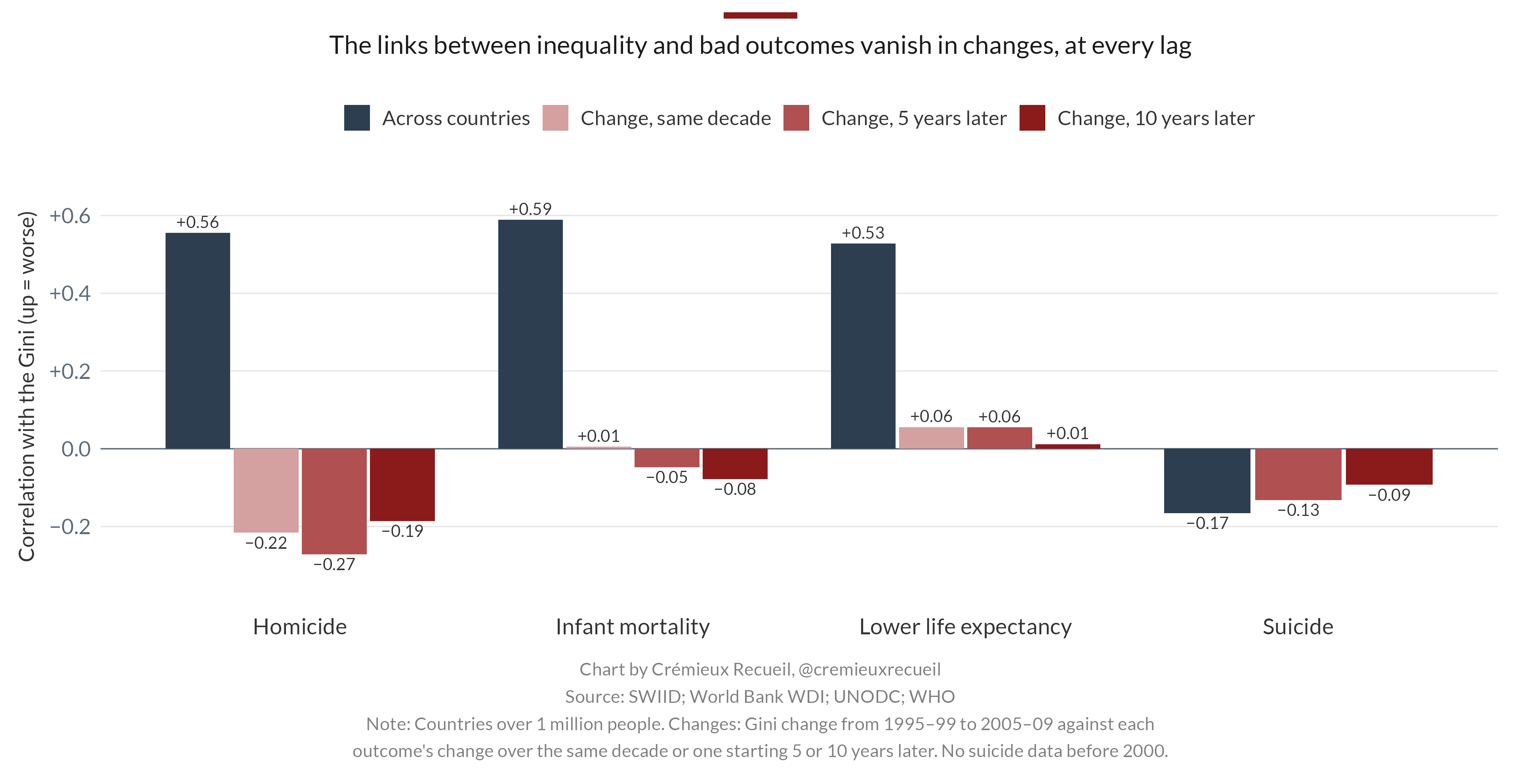
If we’re being serious about these things, we have to ask ourselves: why would this be any other way? Most homicides are fairly random acts of violence by out-of-control people, not something planned to take revenge against the rich or to oppress the poor. The trends in inequality and other outcomes should be pretty much independent because they’re caused by very different things that have no real reason to go together!
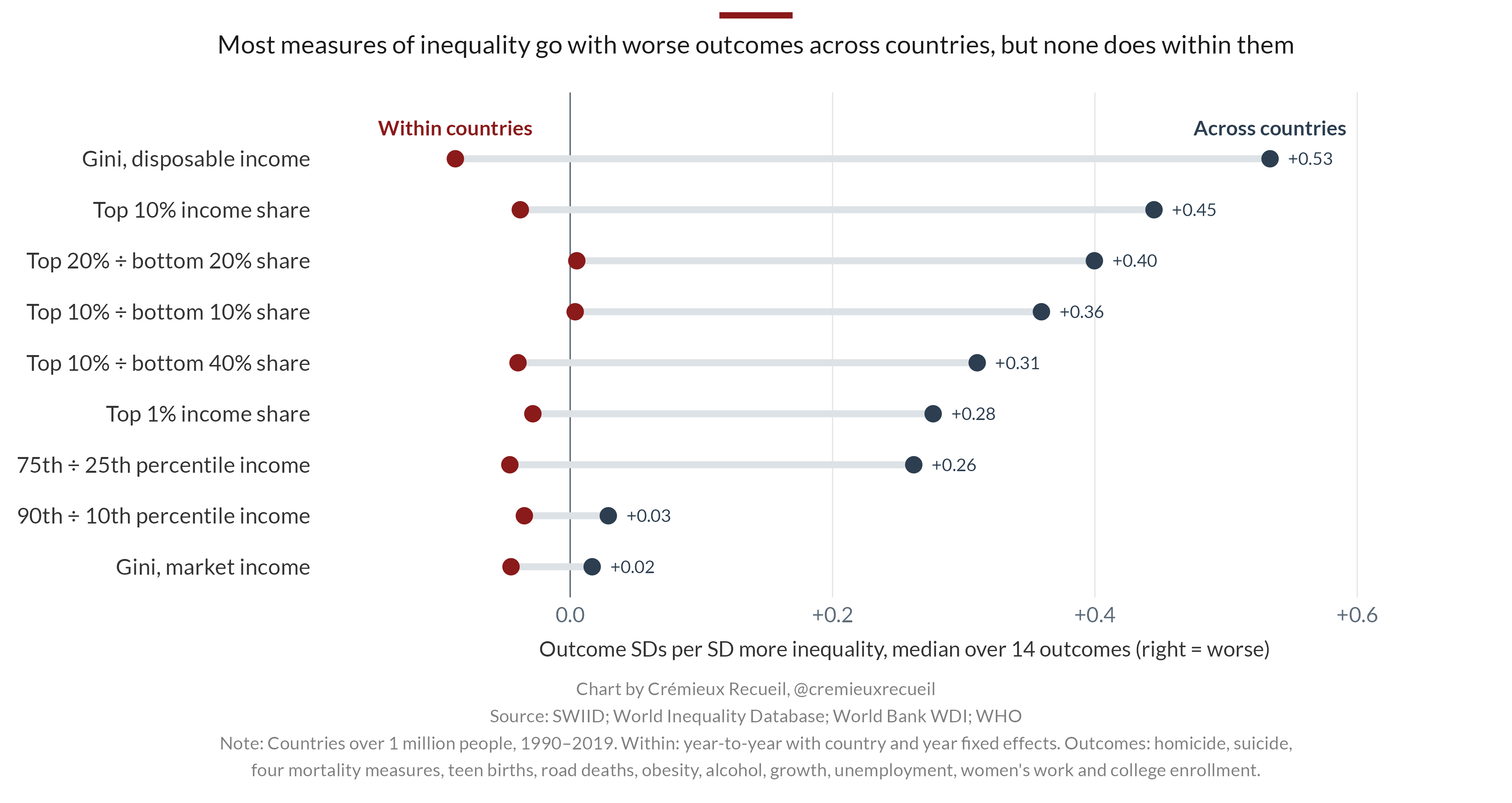
We can replicate this result across basically every measure of inequality available to us:
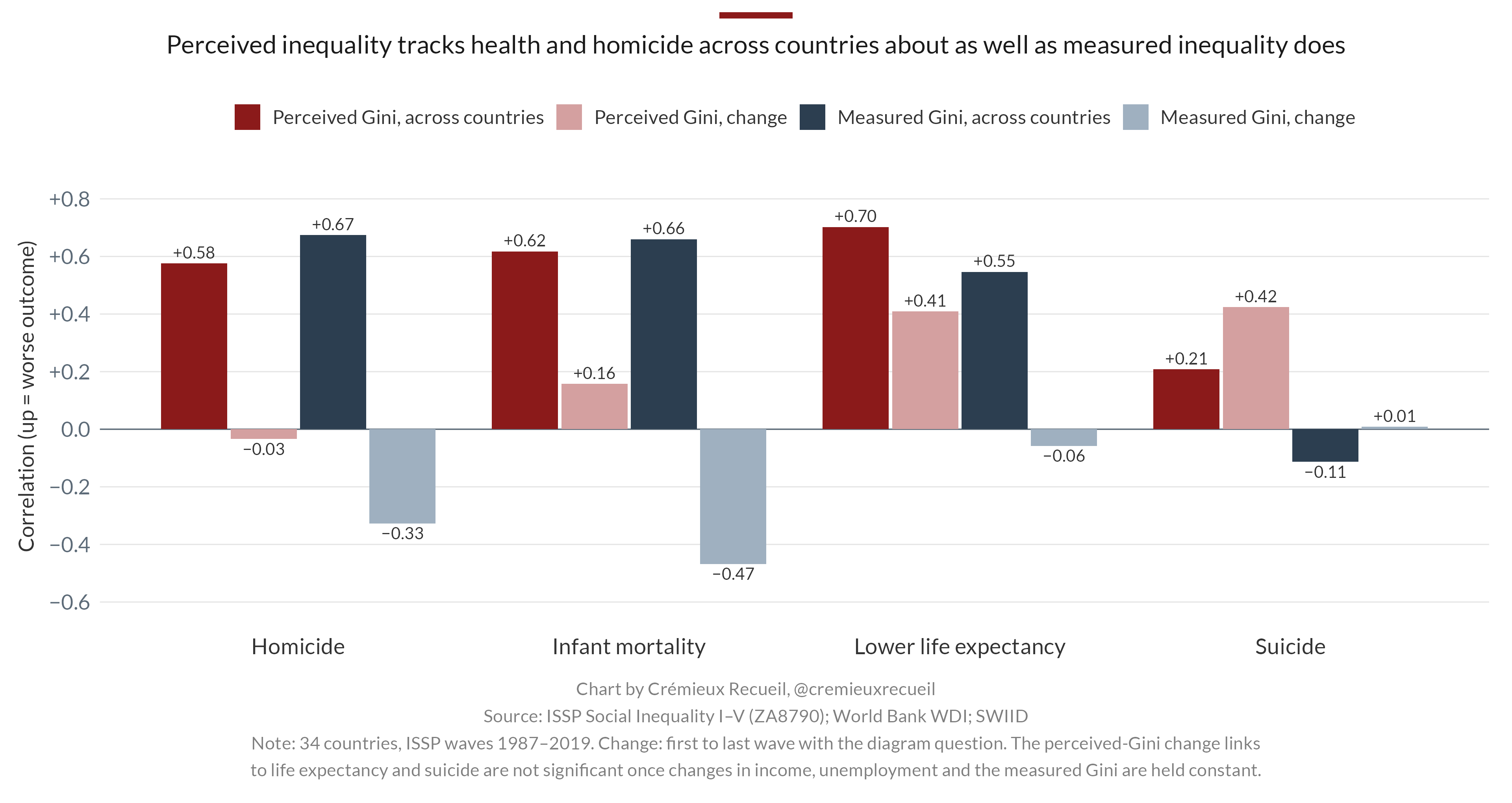
And if we take this further and look at perceived inequality, we see that it too doesn’t seem to do very much despite a strong cross-sectional correlation. But, curiously, perceptions do matter more: changes in perceptions predict suicides and they predict changes in life expectancy (partly as a result), even though actual inequality does not:
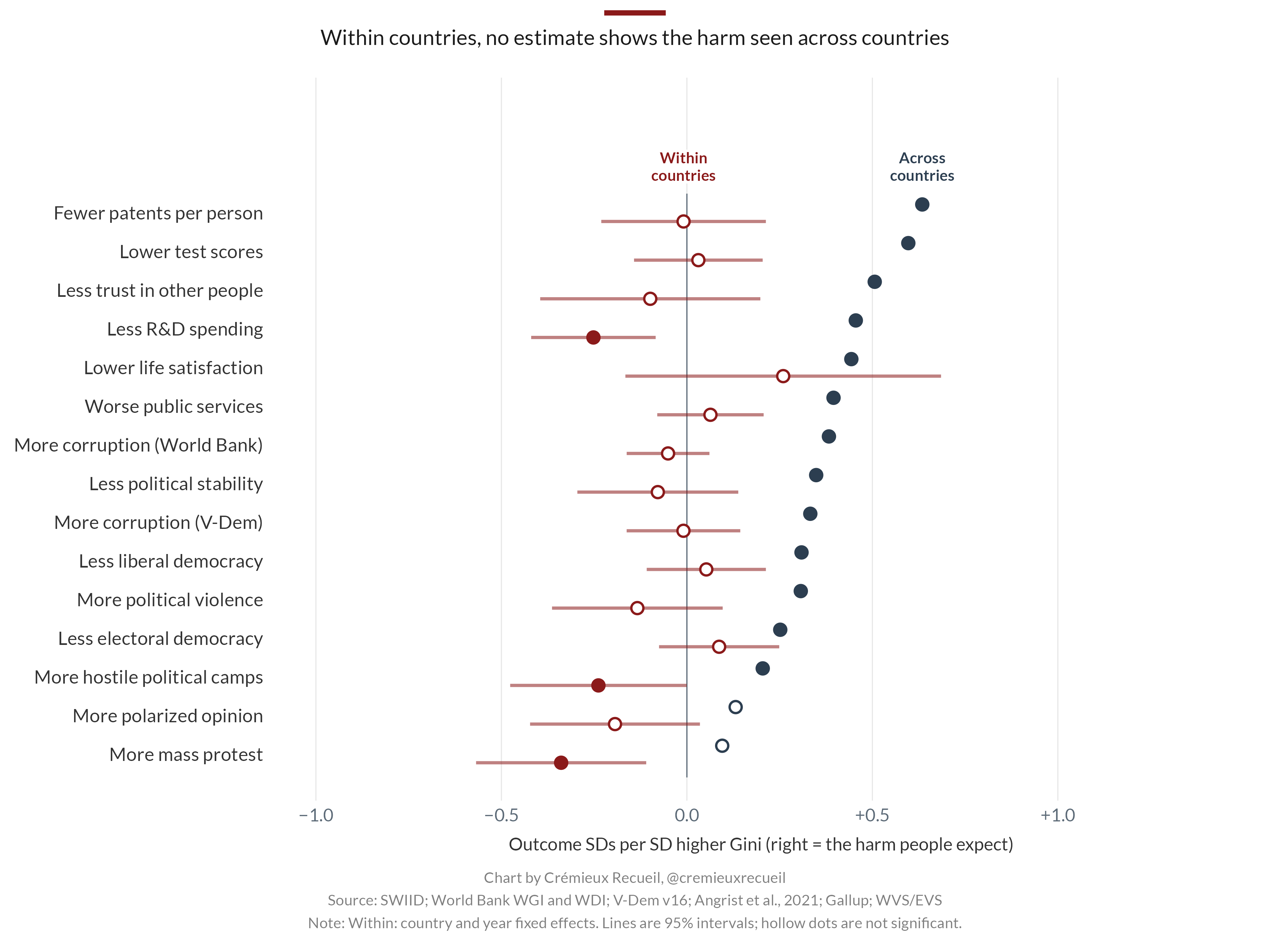
If we go back and look at the things people thought were affected by inequality, we don’t see anything bad, for any outcome (even accounting for measurement error, of course):
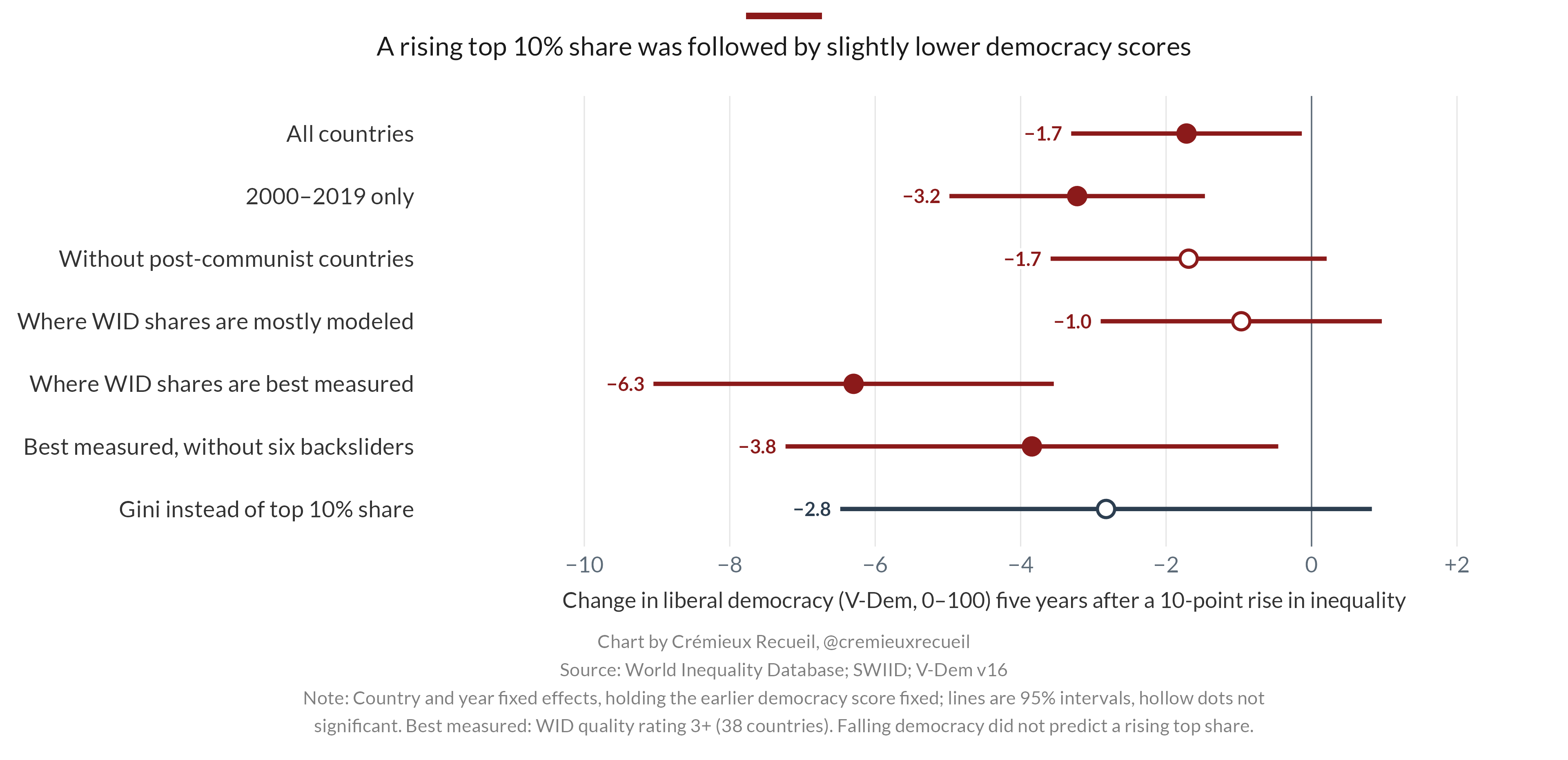
If we want to actually get to what rising economic inequality predicts, we have to look at biased measures, like academic-produced scores of how “democratic” polities are. These academics, of course, are biased towards inequality being bad, so would almost invariably claim that places experiencing growth in inequality have been becoming less “democratic” despite the lack of real effects on populaces:
The Problem is Attention
Allow me to summarize:
People misperceive inequality—badly. Their perceptions predict their attitudes and policy preferences better than actual inequality does.
A lot of the predictive power for perceptions comes from beliefs about fairness.
Beliefs about inequality’s consequences are widespread and unusually bipartisan.
Inequality actually doesn’t do very much, but changes in perceived inequality do a bit.
The obvious conclusion from all this, then, is that we ought to punish discussing and exaggerating the extent and consequences of inequality. The people who are actually causing inequality-related issues are not3 those who contribute to material inequality by being poor or rich, but those who make inequality into a big issue, the people who build mountains out of molehills. The problem is not your economic betters, but those who would fashion you into a political tool.
You can find my replication data, code, and more here:

Enjoy!
A message from my sponsor, Mechanize:
We’re hiring software engineers to build environments and evals that frontier AI labs use to train coding agents.
To get a better sense of the work we do, you can check out GBA Eval, where we had models build Game Boy Advance emulators from scratch and scored their performance.
Base pay starts at $300K/year for junior software engineers, with more for senior roles, plus equity and performance bonuses. Apply here.
This has reflected at least three times and I’m aware of no contradictions.
It’s unclear if this additivity would show up with more singularly-focused videos being combined, or if the effect just reflects acknowledging that inequality could have broad effects.
At least in the political environs of the developed world.