

Today’s post is brought to you by my sponsor, Mechanize. They’re hiring junior software engineers at $300K/year base salary.

The idea that vaccines cause autism rose to prominence after a fraudulent 1998 paper in The Lancet argued that the combination measles, mumps, and rubella (MMR) vaccine caused a fake condition dubbed “autistic enterocolitis”. The paper was eventually retracted, but the damage was done; public discourse had been seeded with the notion that vaccines might cause autism. Various poor arguments making the case followed and, nowadays, around 10% of the U.S. population seems to believe that vaccination leads to autism.
There’s ample evidence that makes it nearly certain that vaccines do not cause autism, but the literature on this subject is actually surprisingly limited in terms of how much of it comes from causally informative studies. Most of the extant evidence has to do with mechanistic reasoning, cohort studies, and international comparisons.1 Though these are convincing, they’re not enough for certainty. To that end, I’ve compiled a wealth of causal evidence that you can access at this website: vaccineeffects.com.
The way my method works is simple. Different jurisdictions implemented vaccine mandates and rollouts at different times. The first affected cohorts should show jumps in autism rates that remain elevated above the preexisting trend afterwards. Combined with data on actual uptake, these jumps allow us to estimate the extent to which autism rates rose as a result of vaccines being given out, because earlier cohorts won’t have been exposed to nearly the same degree. Or, restated graphically:
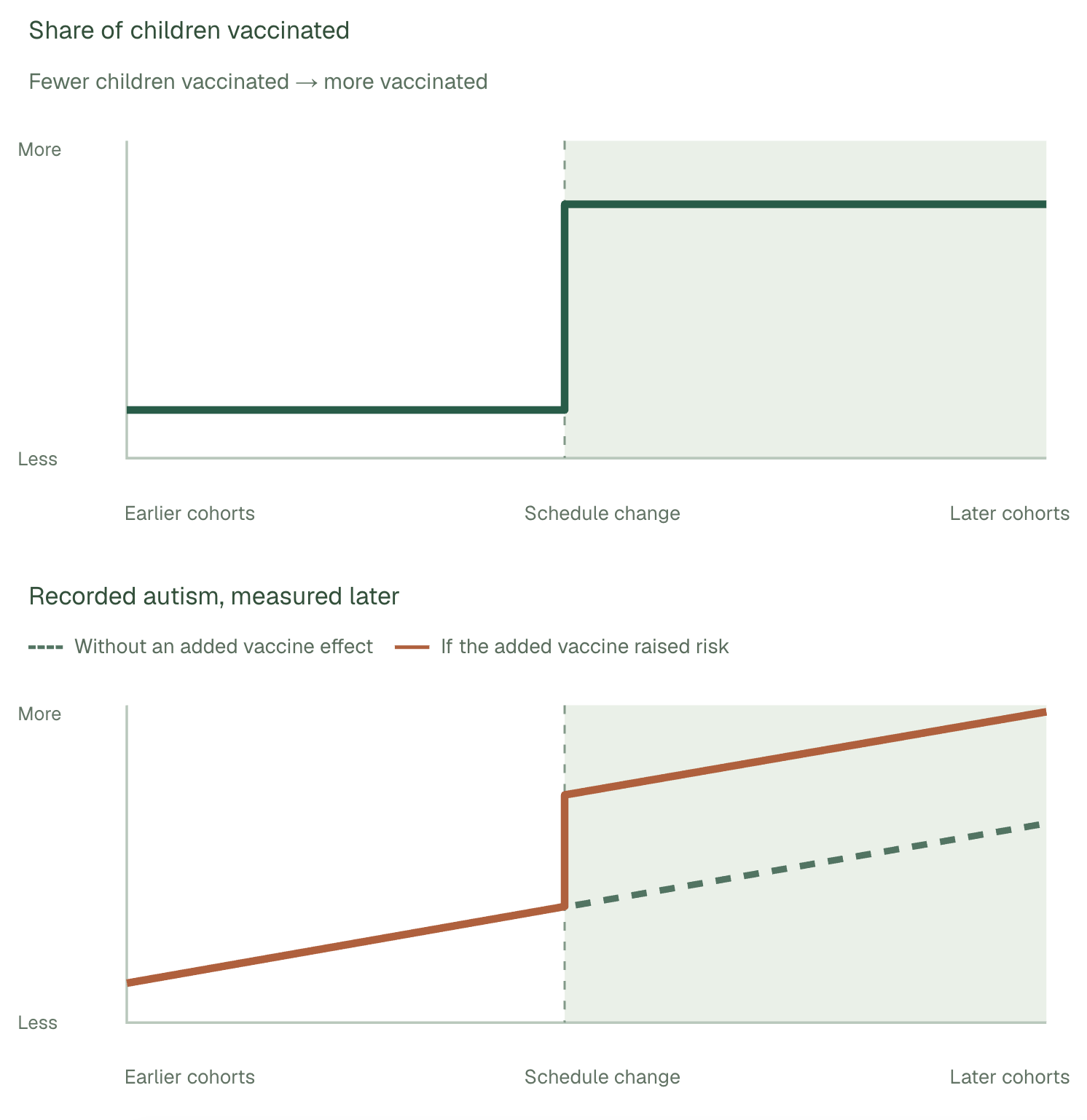
So, what happens when we leverage this design on the universe of available data? This:
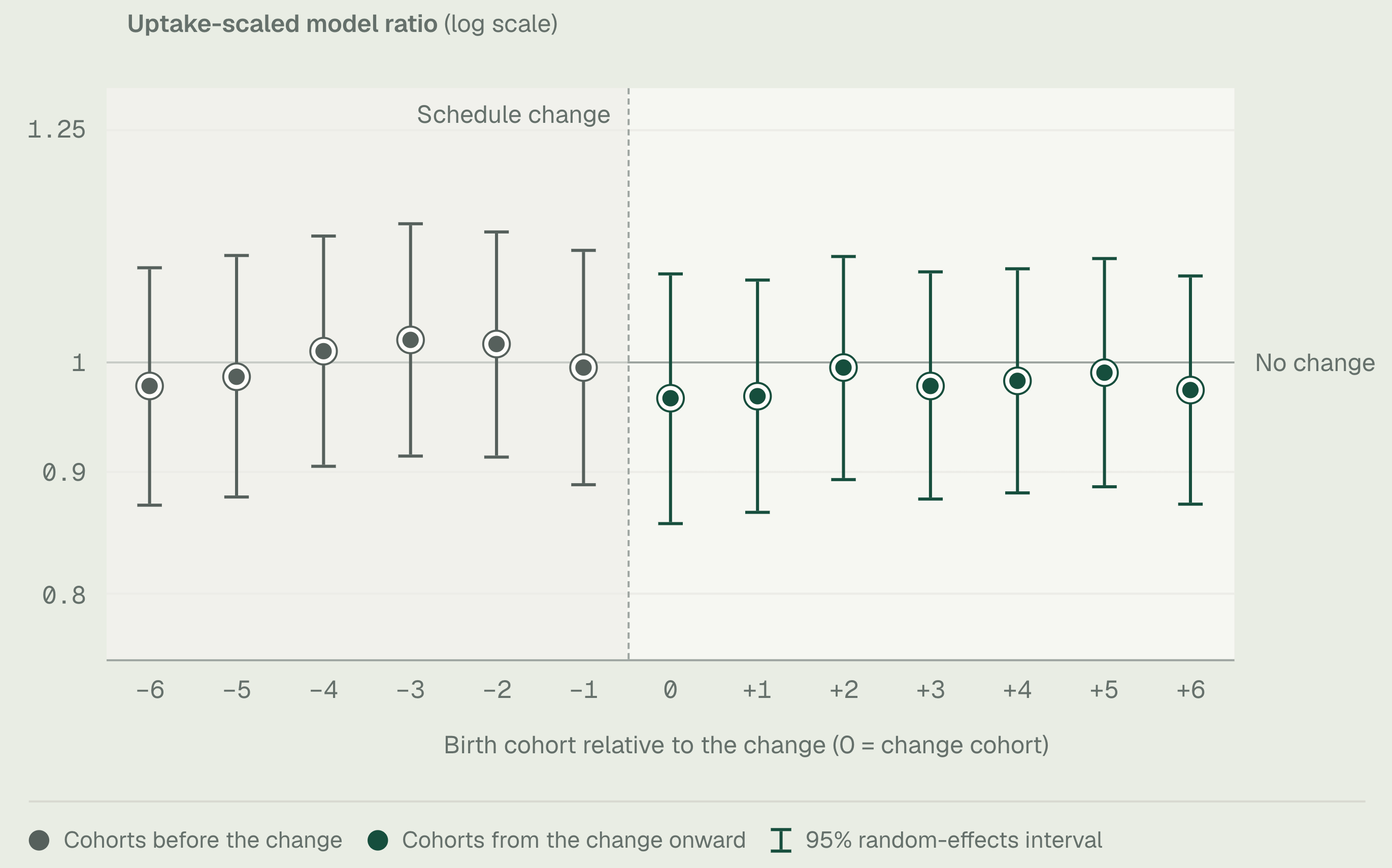
For those unfamiliar with risk ratios, a ratio of 1 means no difference between groups. Numbers above 1 denote positive effects—increases—in the treated group and numbers below 1 indicate negative effects—reductions. When the confidence interval goes over 1, that means the effect is not statistically significant (i.e., the p-value is greater than 0.05 in the case of 95% confidence intervals). As you can see, the effect of vaccination is not statistically significant or even anywhere near being significant: the central estimate is 0.97—a reduction in autism, if anything—and the 95% confidence interval ranges from 0.84 to 1.13, ruling out even modest effects in either direction. Or, in other words, strong, causal evidence now shows: vaccines do not cause autism.2
A message from my sponsor, Mechanize:
We’re hiring software engineers to build environments and evals that frontier AI labs use to train coding agents.
To get a better sense of the work we do, you can check out GBA Eval, where we had models build Game Boy Advance emulators from scratch and scored their performance.
Base pay starts at $300K/year for junior software engineers, with more for senior roles, plus equity and performance bonuses. Apply here.
Personally, my favorite evidence comes from decompositions that show there hasn’t even been a rise in autism net of diagnostic drift.
Check out the website, the accompanying paper, the supplementary analyses, and the replication package to see more possibilities that were ruled out, such as vaccine effects on numerous other conditions and cumulative and interactive effects of changing the vaccine schedule as well!