

Today’s post is brought to you by my sponsor, Mechanize. They’re hiring junior software engineers at $300K/year base salary.
When you think of the people interested in longevity—people who ‘want to live forever’—, what comes to mind? Early bedtimes? Rigid dieting? A 60-item supplement stack? Peptides? Five hours a day in the gym? Never eating out or drinking alcohol? Testing your girlfriend’s vaginal microbiome before having sex?
All of that is fair—it certainly has become part of the image—, and, to varying degrees, those things can be fine; they’re even useful for some. But much of that defeats the point of trying to live forever. I don’t know if I even want to live forever if it means eking out a regimented, overly-engineered existence. That can scarcely count as living.
Take a look at this tweet from longevity advocate David Sinclair. Try not to be aghast.

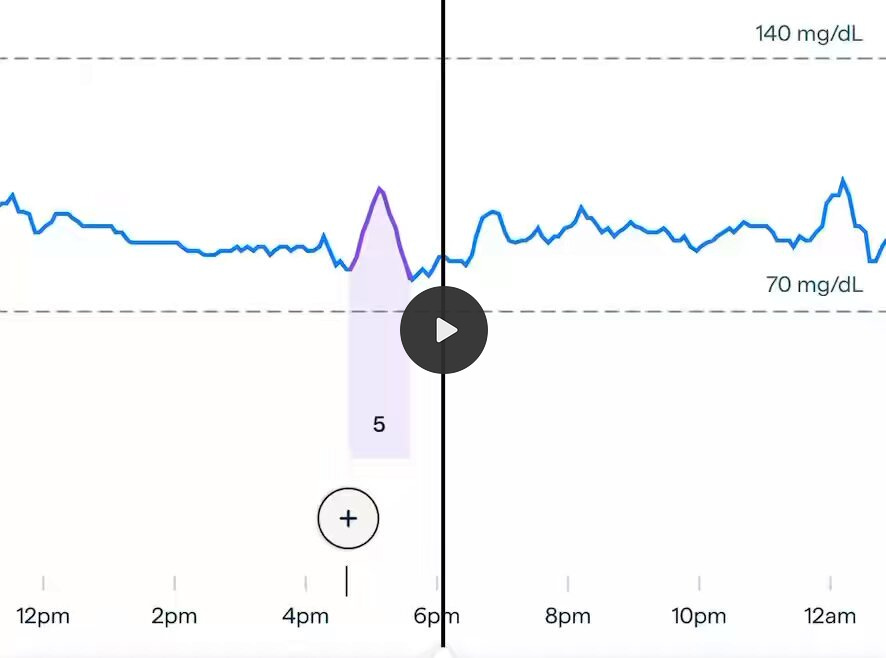
Despite all the things David does for his health, all the advice he gives to others for their health, and all the research he does in the hopes of improving human health, David can’t handle a single snack bar before bed.
Is this longevity? Is this how you wants to live your life? Do you want to be cowed by carbs? Paralyzed by protein? Fearful of fat? Hoping for the right nutrient timing, lest your glucose spike a teensy tiny bit and you wake up having made yourself—and let’s be clear, this is psychosomatic—ill?
This is not the longevity movement I want. Longevity should be grander: immunity to the environment, life without the need for concessions, eternal life rather than a few piddly years of extension. It is possible.
Think about the torrent of significant medical innovations coming out, one after another, right now. Just in the past few years, we’ve gotten to witness the rise of GLP-1s, the advent of PCSK9 inhibitors, cancer after cancer transitioning from a death sentence to a few months of treatment followed by near-complete recovery. And biotech is just getting started. It can deliver a grander longevity movement.
Consider a recent phase-1 result from Eli Lilly for their new gene therapy VERVE-102:


VERVE-102—or more likely, something similar to it—will make it so people can eat whatever and live however they wish and still have low LDL cholesterol, allowing them to avoid most heart disease. When this happens, we’ll have achieved a one-and-done solution to a problem that prematurely kills millions of people each year.
Vertex Pharmaceuticals is working on implantable islet cells to treat type-1 diabetes. If those work, the condition might be curable, and maybe one day even non-diabetics could benefit, reclaiming or improving their glycemic control. There are a handful of stem cell companies working on fibrosis reversal, and it seems to be working—that could be another major killer down. Gene and antibody therapies for muscle preservation could help to defeat age-related sarcopenia and make weight loss more healthful. It’s possible to edit people for resistance to numerous diseases like HIV and malaria, and there are even experimental anti-drug vaccines that bind nicotine, cocaine, opioids, methamphetamine, etc., making it so less reaches the brain.
The list can go on and on and on. There are people working on therapeutics that allow you to feel just as rested on less sleep. There are companies working on genetically-modified versions of common gut bacteria to prevent hangovers. There are companies pursuing vaccines for tons of common diseases from chlamydia to gonorrhea to Epstein-Barr. Some companies are working on ways to permanently lower inflammation. Alnylam seems to be close to a once-every-six-months injection to control blood pressure. Cyclarity may be poised to actually reverse atherosclerosis.
No one can seriously doubt that we’re on the cusp of having a much better world through biotechnology. But everything I’ve listed so far only gets us to where proper longevity work starts; it’s all longevity normalizing: it brings up the left tail of the lifespan distribution.
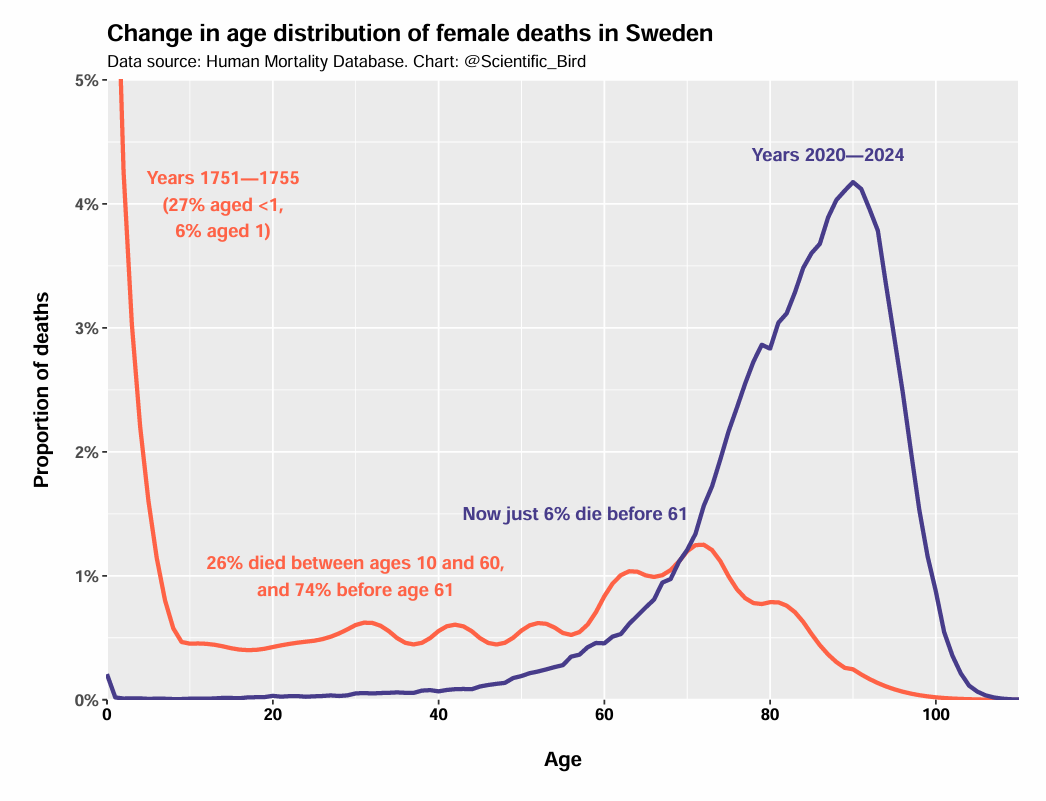
Normalizing is how lifespans have increased across countries historically. Take Sweden and compare the distribution of ages at death in the 1750s to the distribution in the 2020s and you’ll see what I mean:
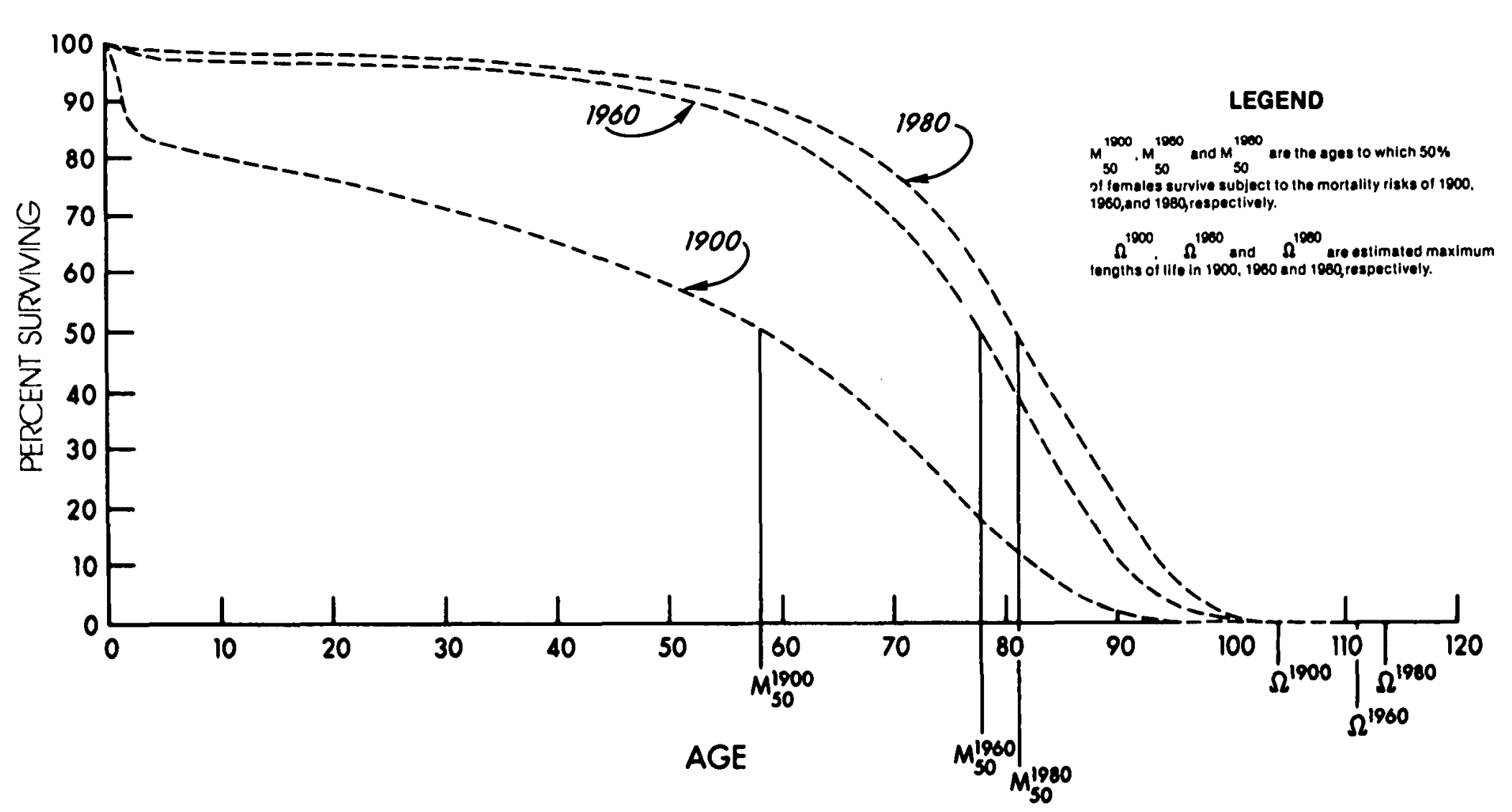
Another way to look at this is to look at the percentages surviving to given ages across different years. This chart hopefully makes the problem clear: despite massive increases in average life expectancies, the right tail barely moves. We’re bringing the left tail up, but not actually seeing extension of maximal lifespans.
If we have a revolution in everything related to what I’ve listed so far, we conquer the travails of living. We become effectively immune to our environments: an end to infections, an end to degradation from plaque accumulation and the stress of glycemic spikes, a practical end to withering. It also means an end to wellness culture—no regimented dieting required, no extra benefits from structured exercise programs and retreats. You’ll be able to drink and party and you’ll be no worse off for having done it.
But that revolution does not conquer death; it lets us live, and it makes room for what’s next. After reaching that state and finding that maximal lifespans still aren’t ticking up and healthspans still degrade, the focus should naturally shift towards promoting more radical approaches: facilitating immunity to mutation, regeneration of limbs, tissues, and organs, cell programming, targeted DNA repair, and eventually, slow, methodical, and hopefully unnoticeable full-body replacement. That is the goal.
A message from my sponsor, Mechanize:
We’re hiring software engineers to build environments and evals that frontier AI labs use to train coding agents.
To get a better sense of the work we do, you can check out GBA Eval, where we had models build Game Boy Advance emulators from scratch and scored their performance.
Base pay starts at $300K/year for junior software engineers, with more for senior roles, plus equity and performance bonuses. Apply here.
It will be funny, interesting, and heartbreaking to see how society reacts to the abolition of the need for discipline (as we are already seeing, in a small way, with Ozempic).
I hope there will not be too many serious countermovements against such treatments. It will be sad to see movements that argue for death.
We live in a new world. There is finally, perhaps, the faint light of dawn on the horizon. Finally, a realistic chance of truly doing something against Death, the last enemy.
What a time to be alive.
Reminder that defeating death is possible in principle with today's technology. See e.g.:
- https://www.theguardian.com/science/2024/dec/01/with-brain-preservation-nobody-has-to-die-meet-the-neuroscientist-who-believes-life-could-be-eternal
- https://www.greaterwrong.com/posts/E9xfgJHvs6M55kABD/less-dead