

Today’s post is brought to you by my sponsor, Mechanize. They’re hiring junior software engineers at $300K/year base salary.

In 2015, El Salvador was the murder capital of the world. Now it has the lowest murder rate in the western hemisphere—below even Canada.
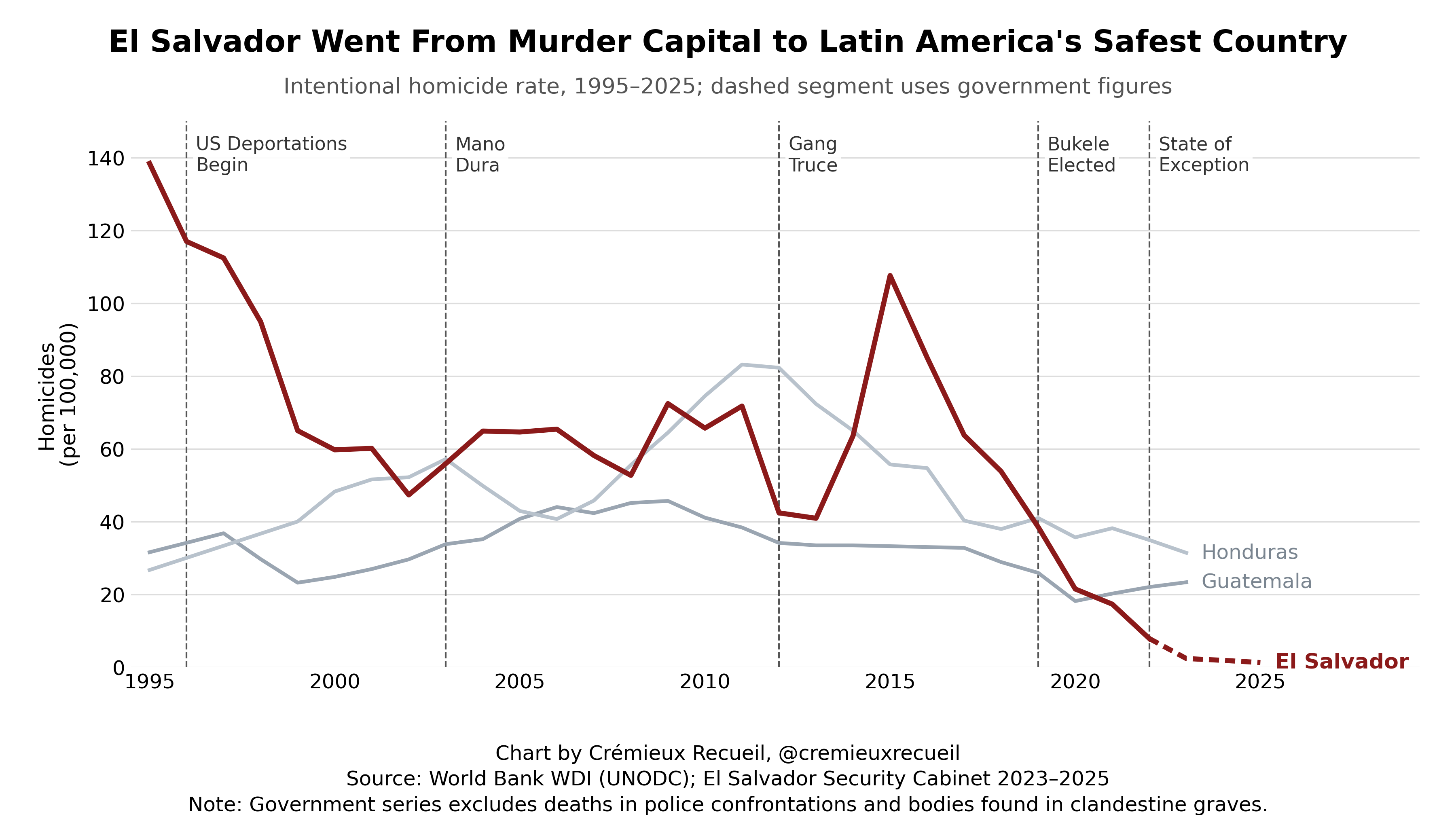
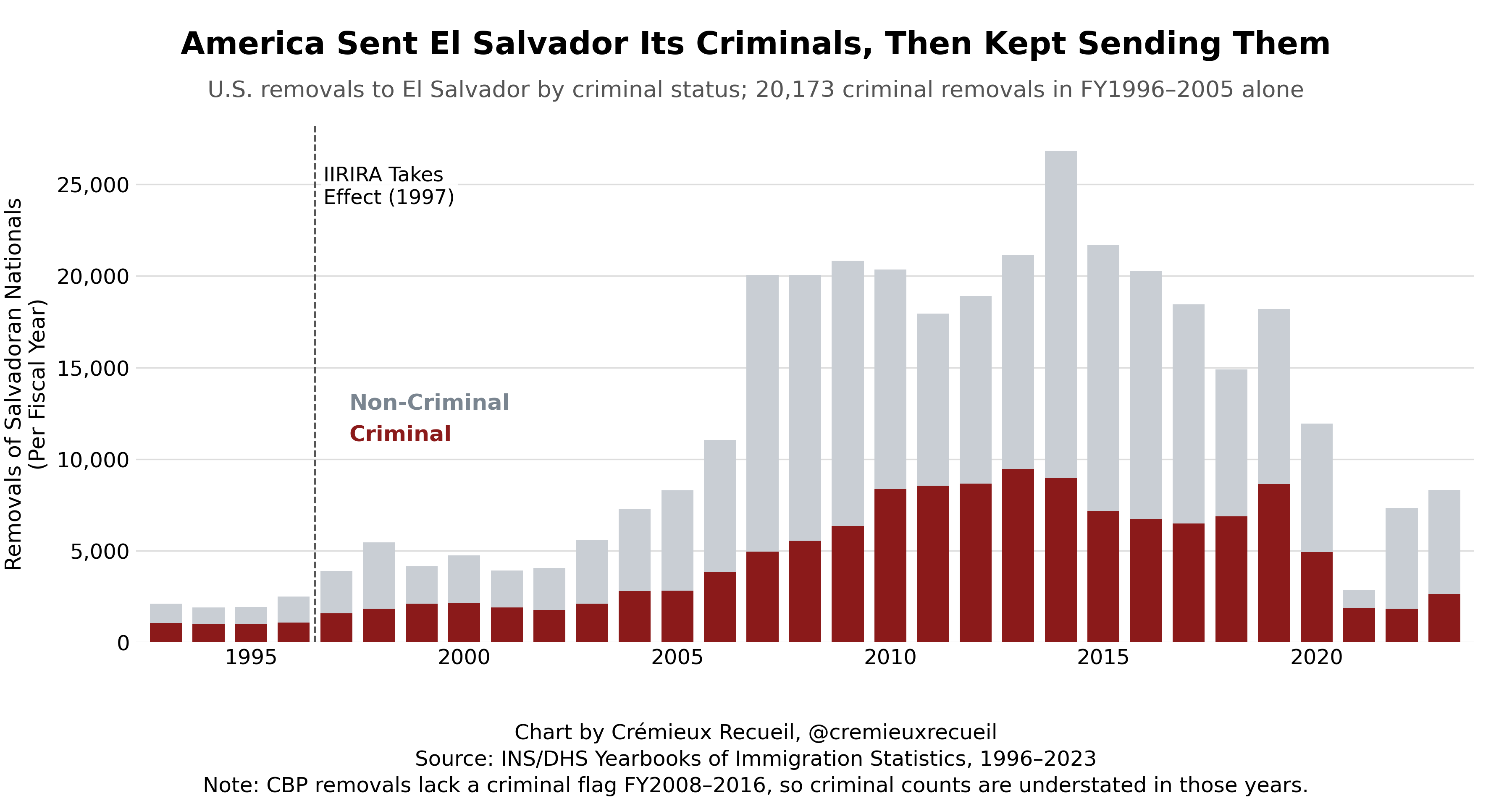
El Salvador’s high homicide rate was actually an American product. Hundreds of thousands of Salvadorans fled during the country’s civil war circa 1980-92, and many of those refugees ended up in Los Angeles. Some number of those people got involved in gang violence. Naturally, they gravitated towards establishing their own ethnic gangs, giving birth to MS-13 and, in some cases, joining the existing 18th Street Gang. Until 1996, deporting these people was difficult, but when Congress passed the Illegal Immigration Reform and Immigrant Responsibility Act (IIRIRA), that changed.
The first wave of IIRIRA deportees included some 500 Salvadoran gang members who were sent back to the country not long after it had demobilized its army and only just started building a police force. The flow of criminals was staggering, and it couldn’t have come at a worse time for El Salvador.
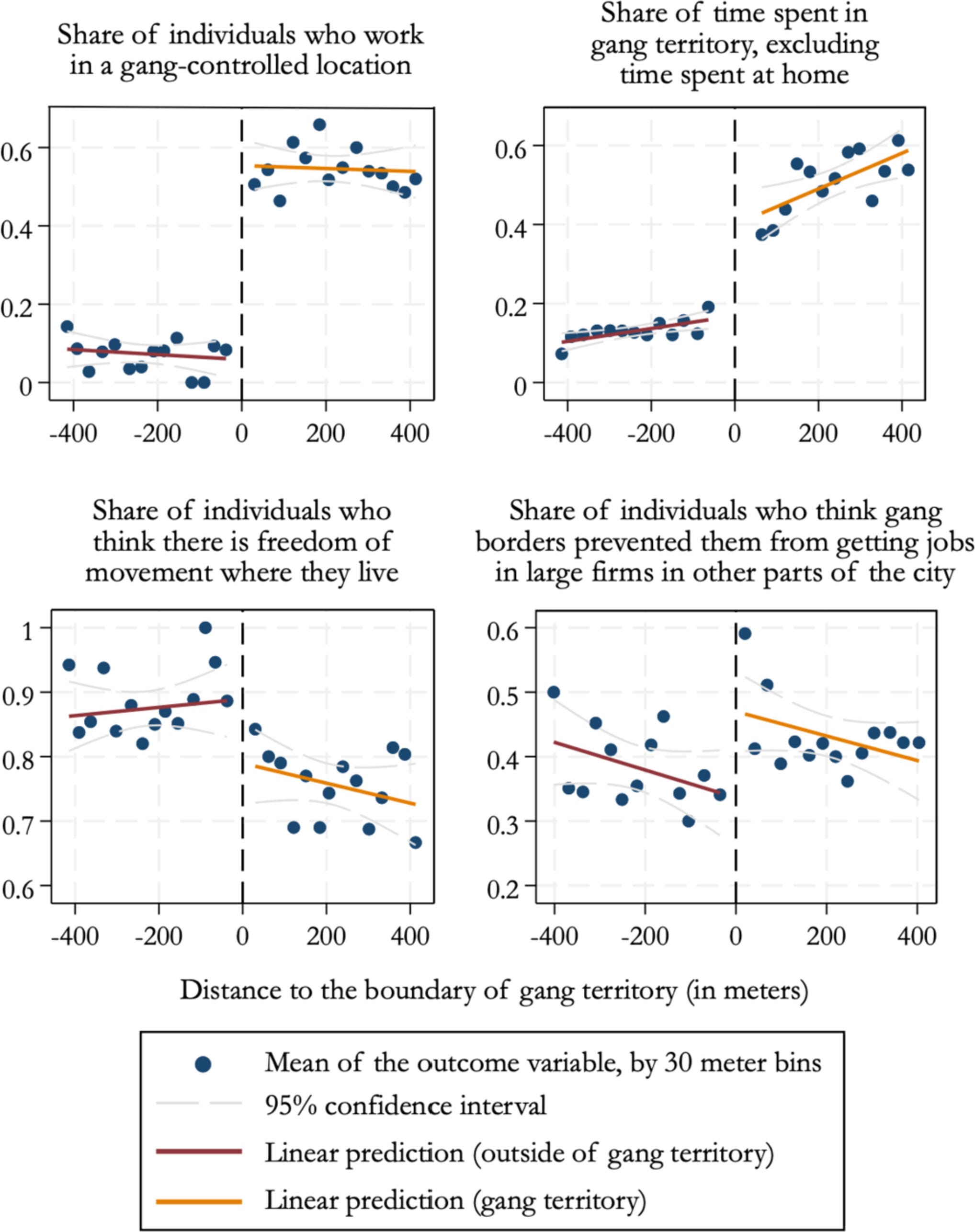
Criminal Salvadorans brought the Los Angeles gang model with them. They began carving neighborhoods into territories, setting up lookouts along major roads and interchanges, and doing whatever they could to keep police, informants, and members of rival gangs out while keeping ‘their people’ in. They began to monopolize the urban cityscape of San Salvador and then spread this habit to other cities. Eventually, they were able to capture whole swathes of the population in gangland.
One recent paper found that residents right inside gang territories were 50 percentage points more likely to work inside said territory and 12 percentage points less likely to work for a large firm compared to people living just 50 meters away from them. Living in gangland also evidently lowered their incomes and made it harder to obtain an education, because these differences didn’t exist prior to the arrival of the gangs.
What made these gangs so much more violence-prone than the gangs and cartels in other Latin American countries is that they lacked access to the lucrative drug trade. Instead, they lived off extortion: of households, of shopkeepers, even of bus lines, strippers, fishermen, tourists, bureaucrats, and banks. The gangs were a mixture of poor and predatory to all, which made for a decidedly unpopular combination.
Mano Dura
El Salvador spent two decades alternating between different failed strategies for dealing with the gangs: truces and Mano Dura—the Iron Fist. The Iron Fist amounted to a generally mild crackdown, and because it failed to go far enough, it backfired in some ways. Take the 2003-04 instantiation. This resulted in filled-up prisons, but the prisons ended up becoming centralized headquarters for the gangs.
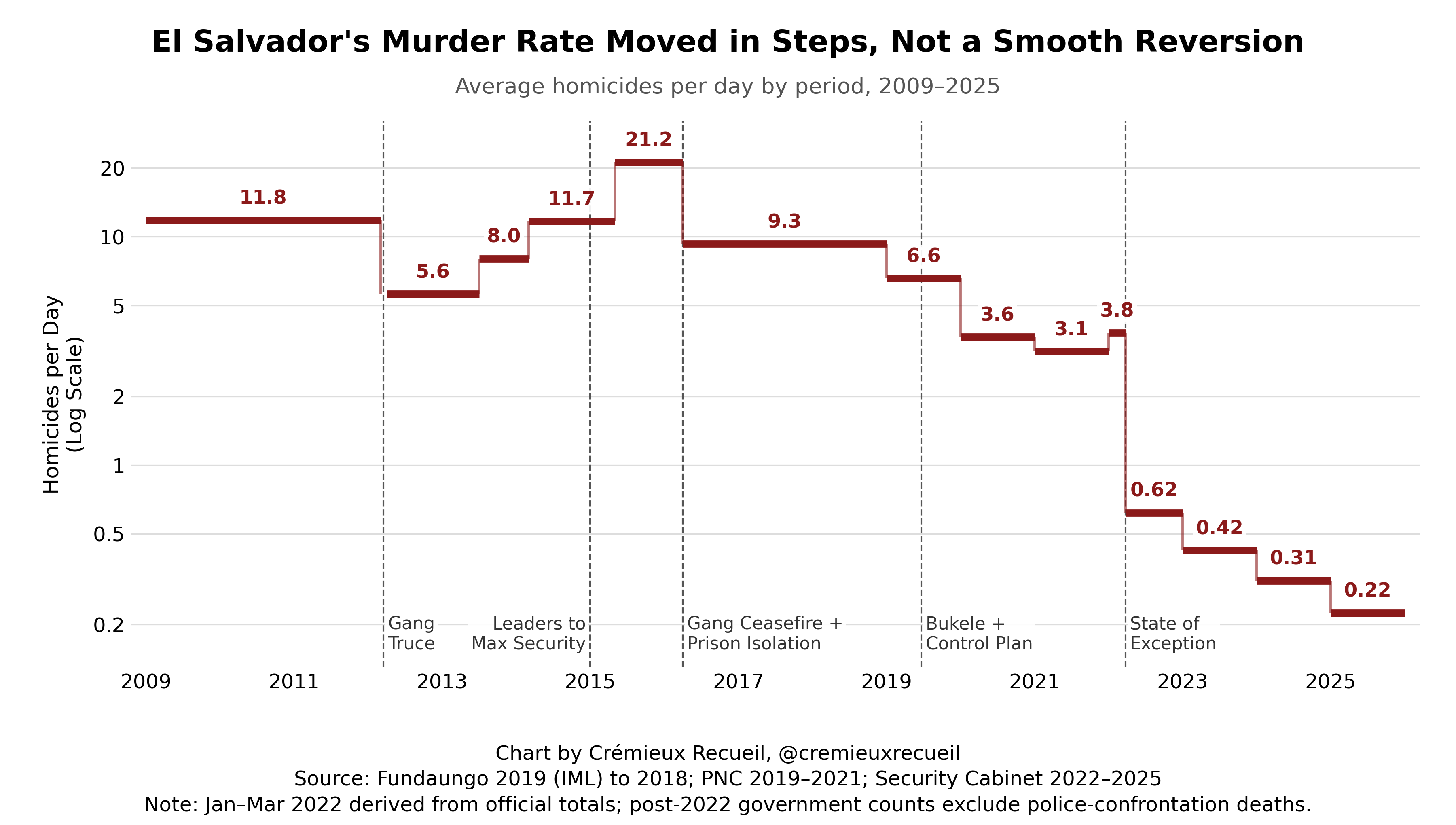
In 2012, the government asked for a truce: gangsters outside of prison would do less violence in exchange for moving gang leaders out of maximum security, to more favorable prison conditions. This halved the homicide rate overnight, but the truce didn’t hold and the terms of peace eroded, resulting in open urban warfare between gangs and police forces in 2015.
What ultimately broke this multi-decadal tension between gangs and government was Bukele declaring enough to be enough. After a particularly violent weekend in which the gangs killed 87 people in 72 hours, Nayib Bukele and the public had enough. Bukele was suddenly politically empowered to declare the régimen de excepción—the state of exception—and to begin El Salvador’s first real, extensive crackdown.
The police began snatching up gang members identified by their tattoos. This is generally where the non-Salvadoran understanding of what the government did ends, but it goes substantially further than this. In fact, various gangs had already told their members to stop getting facial tattoos after the first Mano Dura. By 2022, many gangsters were unblemished by ink.
The crackdowns were really a community effort and many Salvadorans were proud to snitch on their local gangster, often putting their lives at risk to do so. Police were also happy to finally go after everyone they had been monitoring over the years. The effort ultimately broke the gangs and drove the homicide rate to where it lies today by putting them behind bars at a truly stunning scale.
Are We Sure?
There are many people who would like to dismiss El Salvador’s success for whatever reason. The most commonly given explanation given for how El Salvador achieved its low homicide rate is regression to the mean: they were at the highest rate in the world, so the only place to go from there was down. There are many problems with this explanation. For one, El Salvador’s homicide rate decline was the most stunning ever:
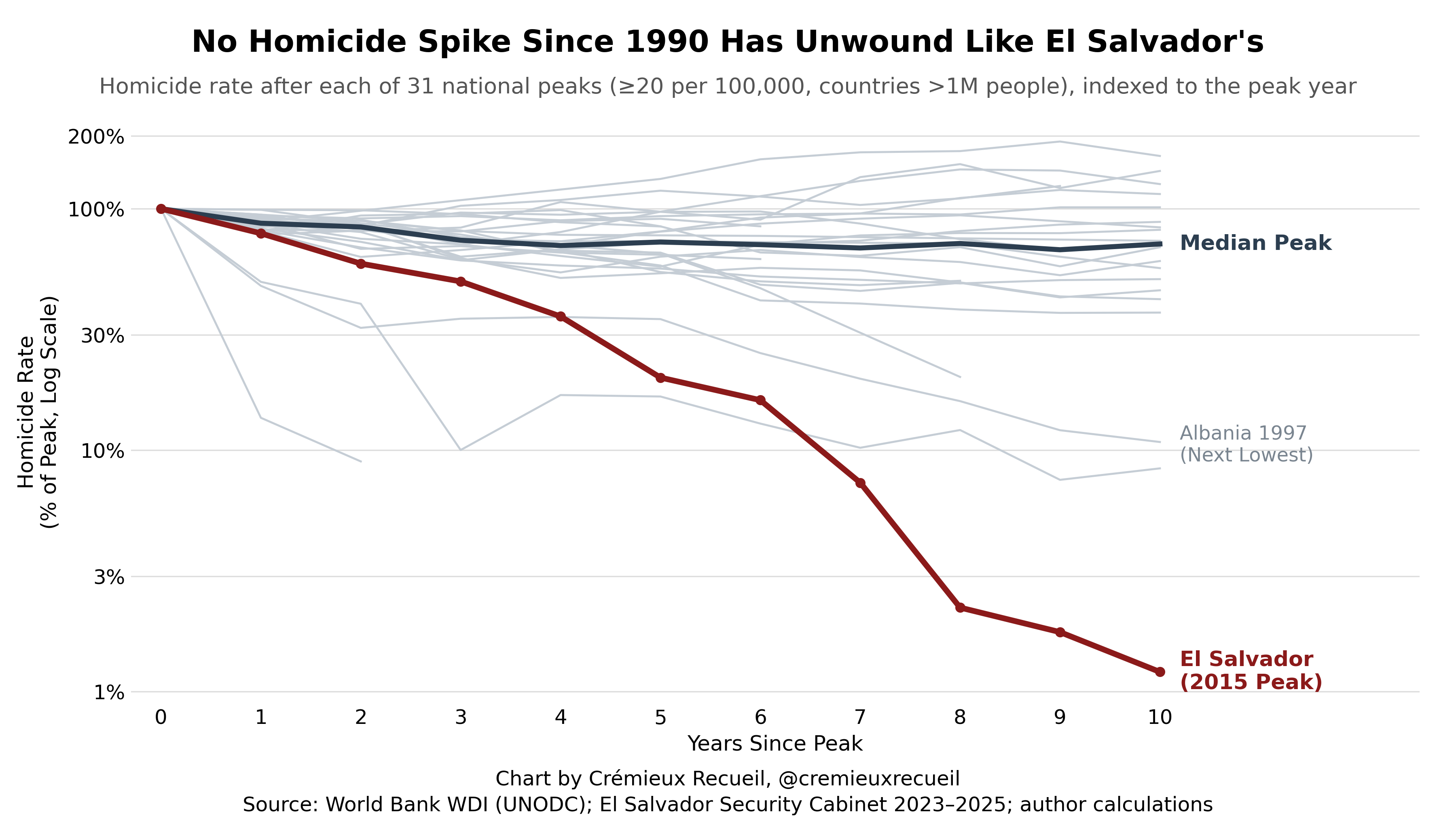
This is highly unusual. Some part of it could be regression to the mean, but we know it’s not because we can take the analysis to a much more granular level.1 In fact, we can see that Bukele’s initial, pre-crackdown territorial control take-back plan cut homicides right away; the state of exception cut them even further at a more rapid clip:
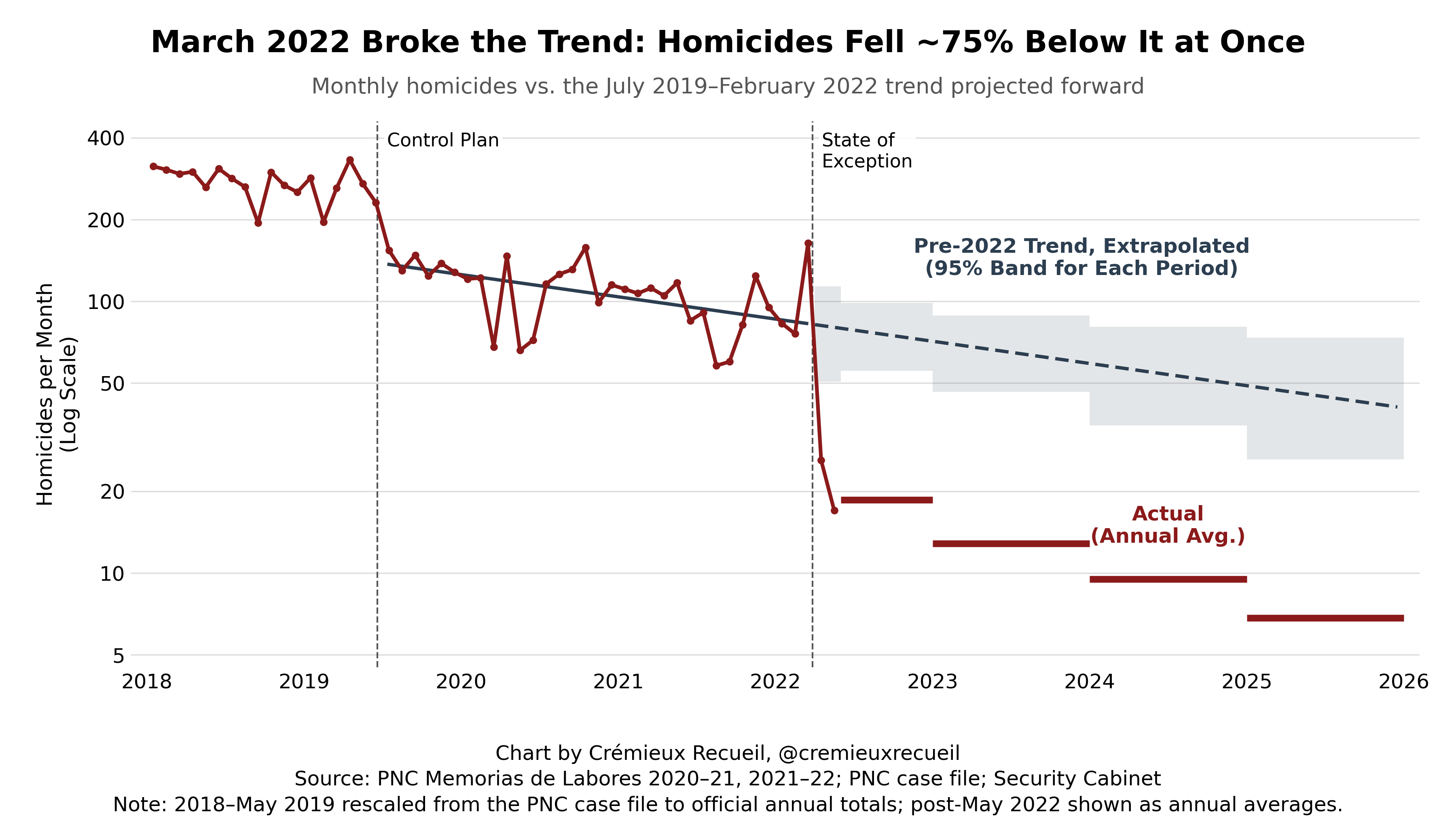
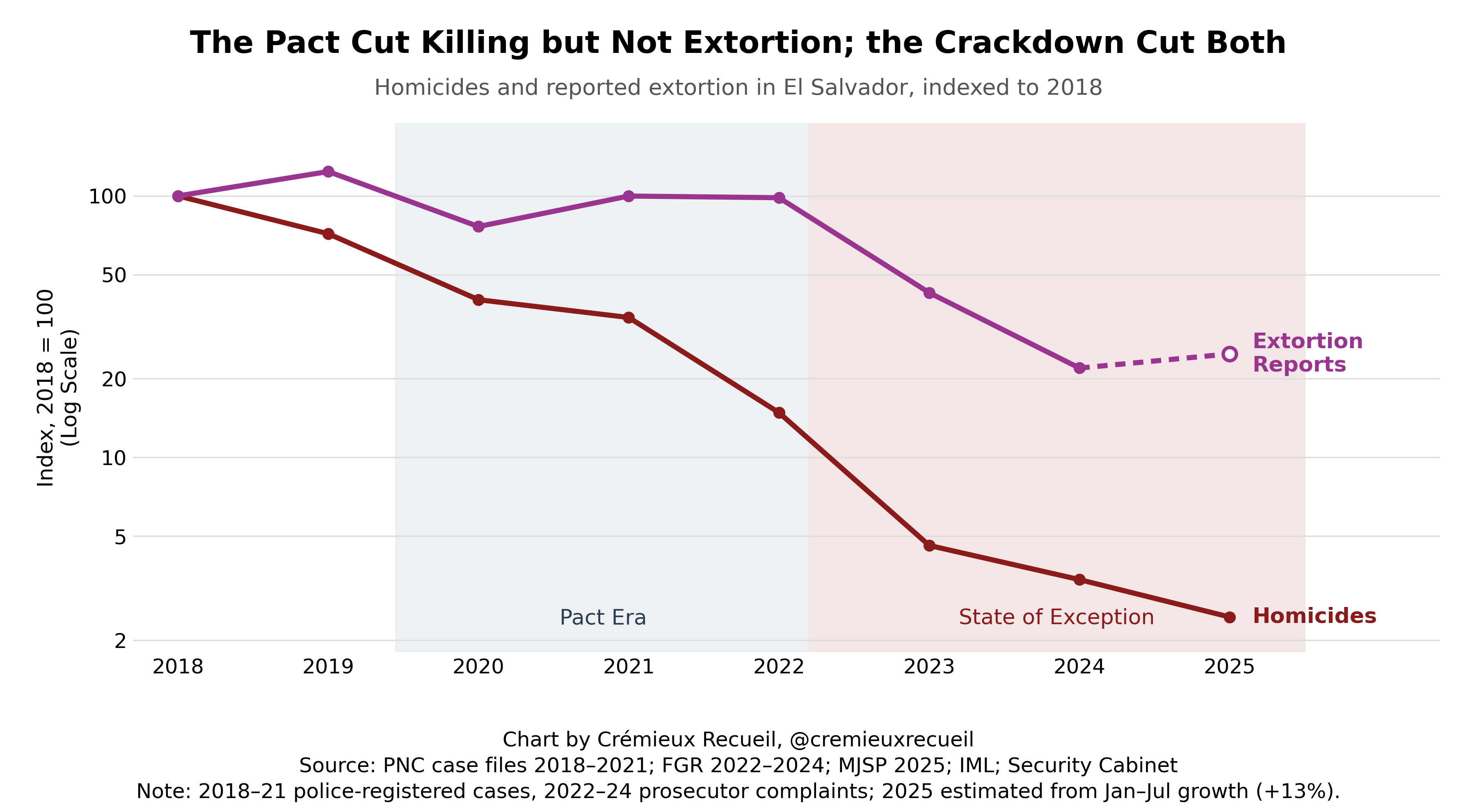
This movement from a homicide rate that was normal for the region to a level that’s exceptional for the entire hemisphere was clearly directly policy-driven and unprecedented. Moreover, it’s not just homicides that were affected. Under the earlier Control Plan, the government had evidently reached an agreement with the gangs, resulting in fewer homicides, but no less extortion. When Bukele actually went after the gangs and finally decided to put them all in prison, reported extortion fell too:
Is Bukele Suspicious?
Nayib Bukele is right-wing with both a libertarian and an authoritarian bent, and his methods were decidedly conservative-coded to the rest of the world. It is unsurprising, then, that he’s generated a lot of distrust from the largely left-leaning establishment involved with NGOs. Reports have been made about human rights abuses, wrongful detentions, secret deals with gangs that are the real explanation for the murder rate going down… Frankly, there’s a lot people have said, but it’s all highly exaggerated.
Consider three points.
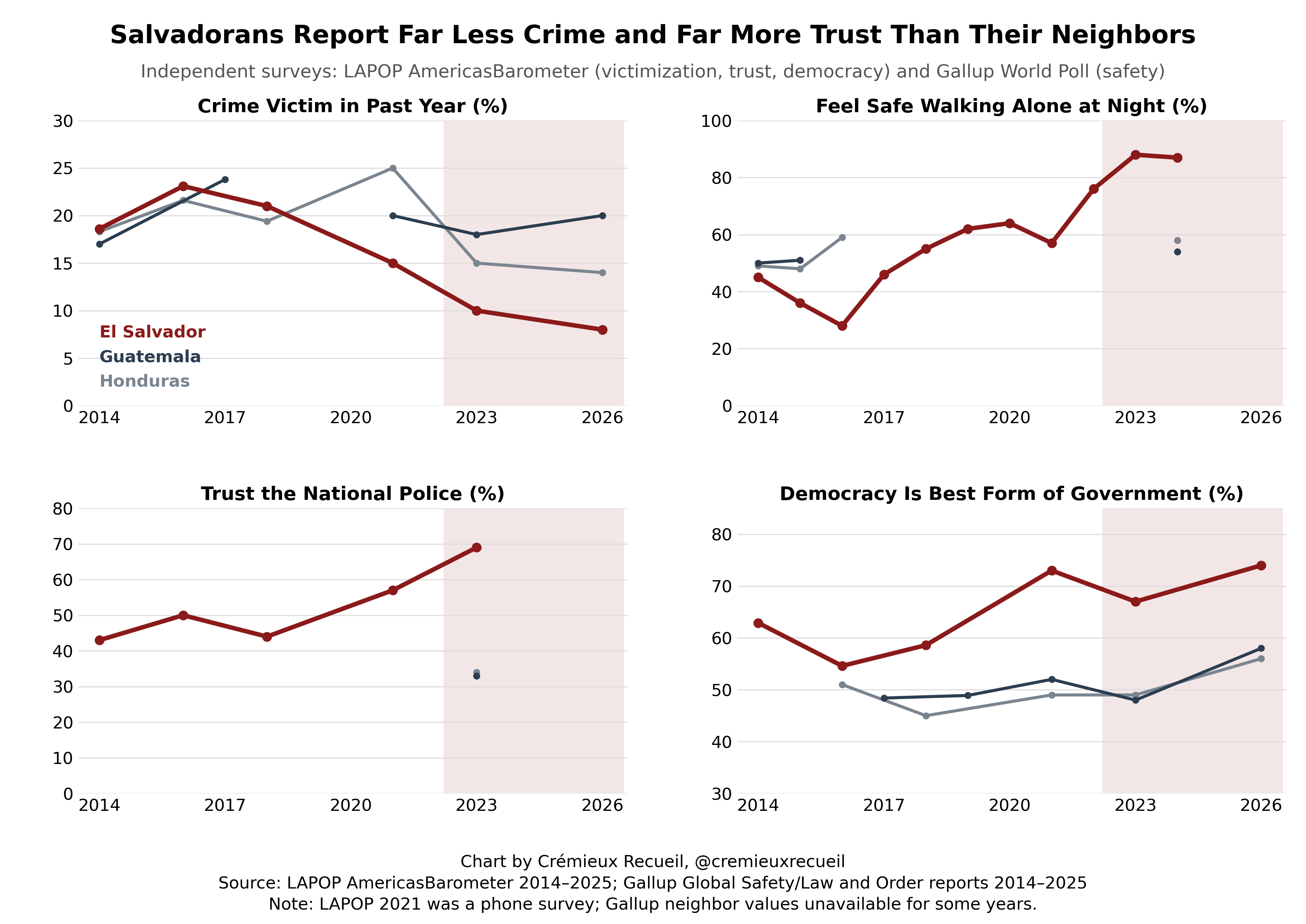
First, surveys run by outsiders agree with the public sentiment assessed within the country and with the election results.2 Trust in the National Police is up, criminal victimization is down, and feeling safe to walk alone at night is way up. Plus, people even believe in democracy more (all of this, among other things).
Second, falsification tests don’t look suspect. Gangs didn’t cause traffic deaths and they weren’t noted for sexual violence. Those things were unaffected by the crackdown. If Bukele’s government was just lying to make everything look good, presumably these would improve too.
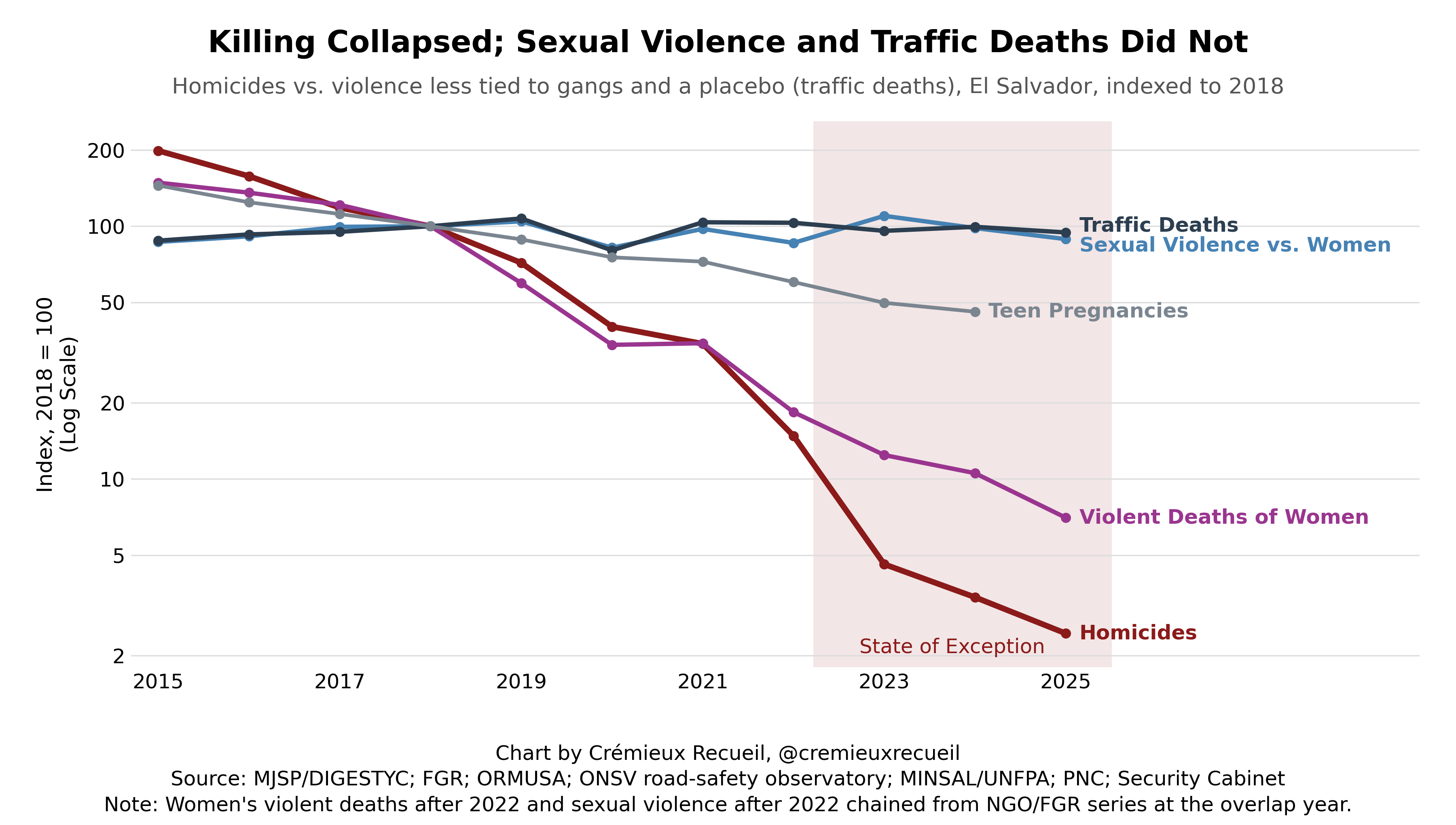
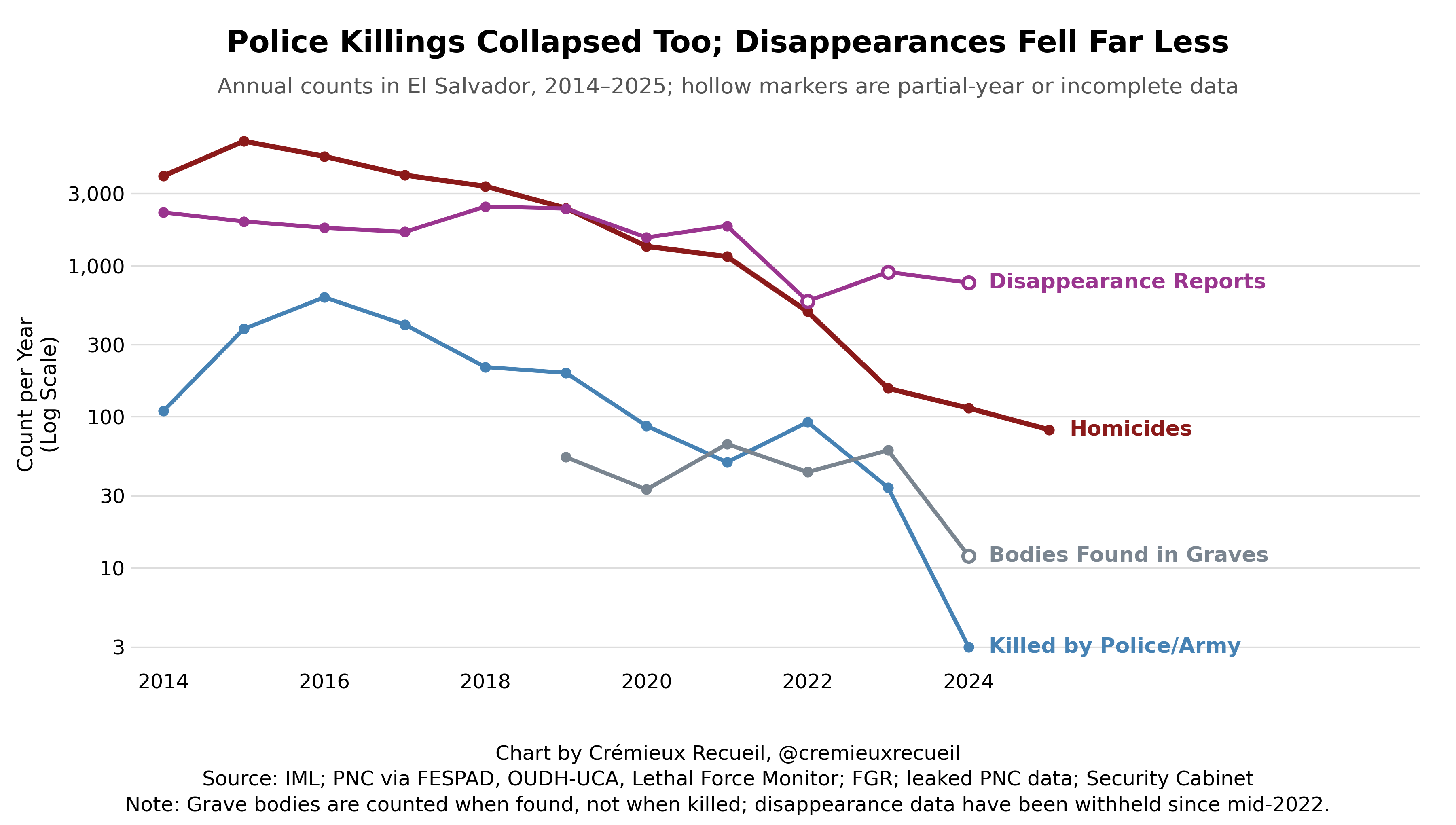
Third, other potential sources of homicides that have gone uncounted have also been declining. This refers to police killings—usually of gang members—, disappearances, and bodies found in mass graves dug up from the era when the country was embroiled in a civil war. All of this is down, leaving little in the way of room to argue that there are hidden deaths not entering the count. Even adding every disappearance report to the 2024 murder rate, it’d be down 67% from 2021 and 89% from 2015.
But What Did It Cost?
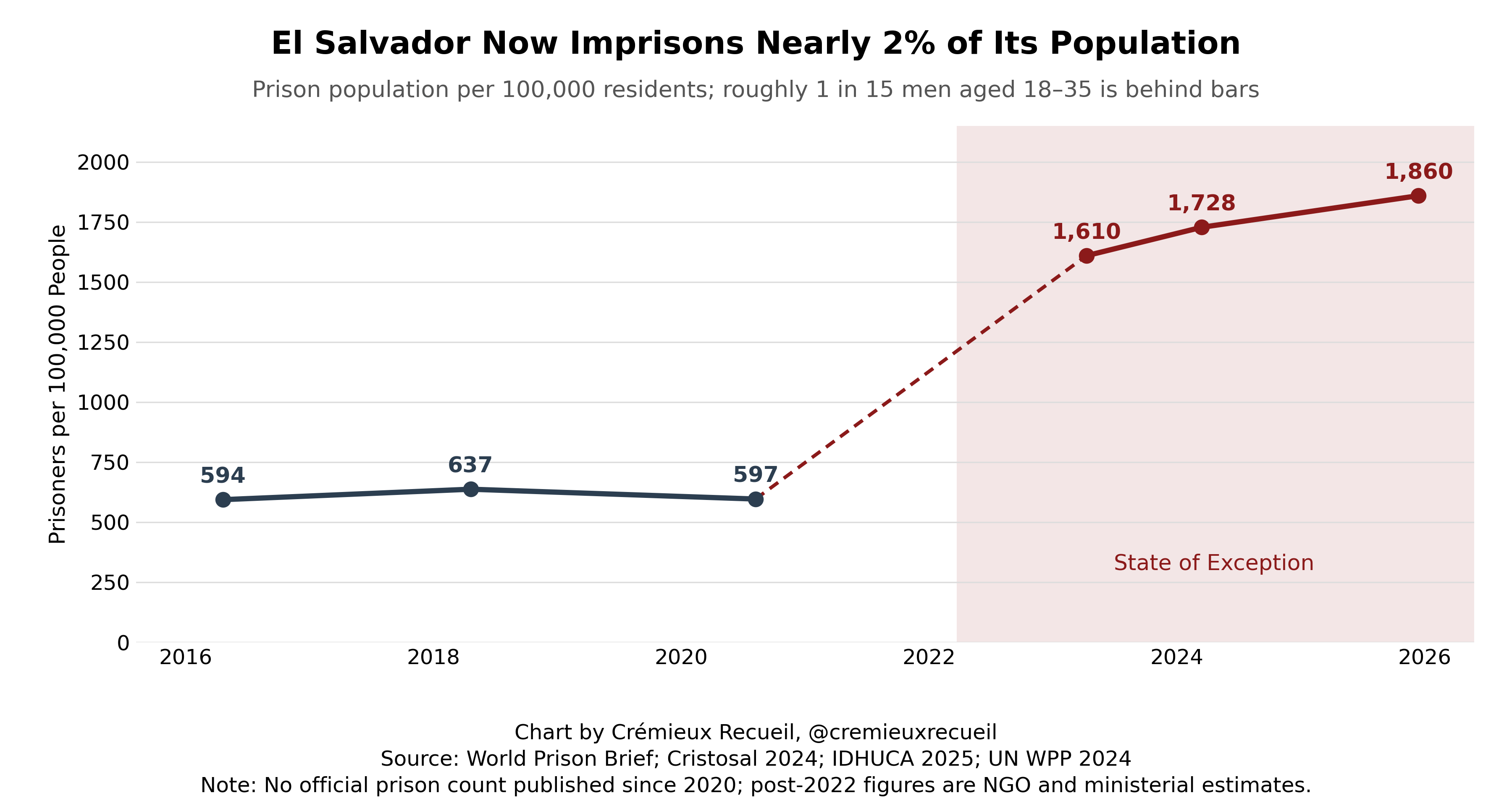
El Salvador did suspend due process to get the crackdown done. This resulted in close to 2% of the population being incarcerated, largely without trials.
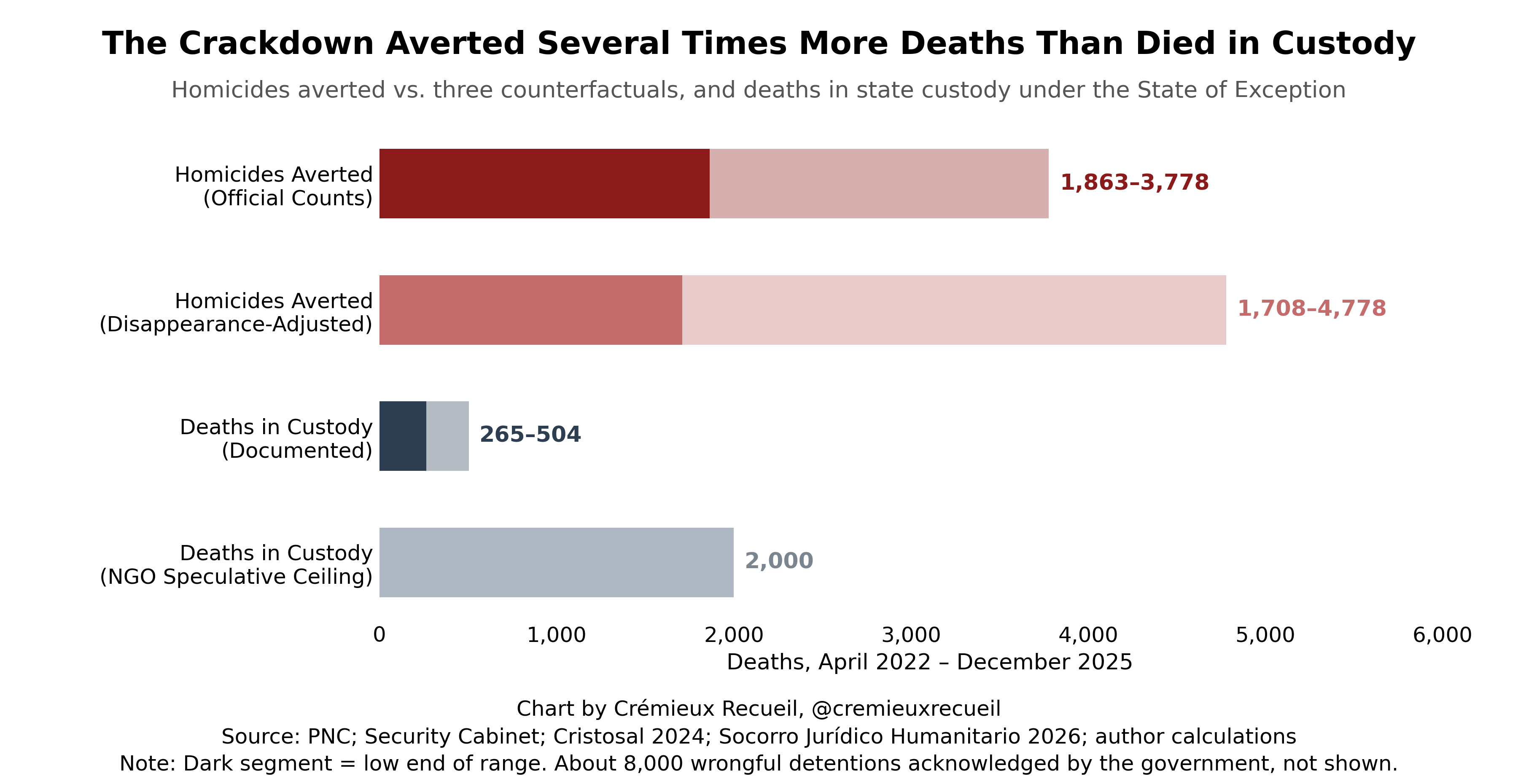
The crackdown has also resulted in about 8,000 people being wrongly detained because they were mixed up with gang members. More tragically, somewhere between 265 and 504 people died in state custody between April 2022 and December 2025. But these numbers must be kept in context. For the wrongfully imprisoned, they didn’t lose their lives, just a few months or years. For those who died in prison for whatever reason, their numbers pale in comparison to the number of deaths averted by the crackdown. Given how many lives were saved, it’s hard to argue that the crackdown wasn’t worth it.
Salvadorans agree: they strongly support Bukele, his government, the crackdown, and its continuance. They remember the hell of life under the gangs and they don’t want to return to it. The benefits far outweigh the costs for the vast majority of the population.3
Does Fixing the Murder Rate Help the Growth Rate?
I visited El Salvador back in January of this year. I noted how it definitely feels safe. Random people I spoke to praised Bukele on the streets, talked about how different things are, left their doors unlocked, and I was even fine to walk around what felt like a shantytown without any real sense of danger. The country is safe; far safer, in fact, than the norm for the other Latin American countries I’ve been to (most of them).

One thing I speculated about was that even though El Salvador is now clearly safe, this might not improve the growth rate. It also might not even improve the crime rate in the longer term, because the void left by the gangs might eventually get filled—not by murder, so much as by pettier forms of crime. But I hope I’m wrong. It would be incredibly nice if safety reforms were enough to make an economy boom.
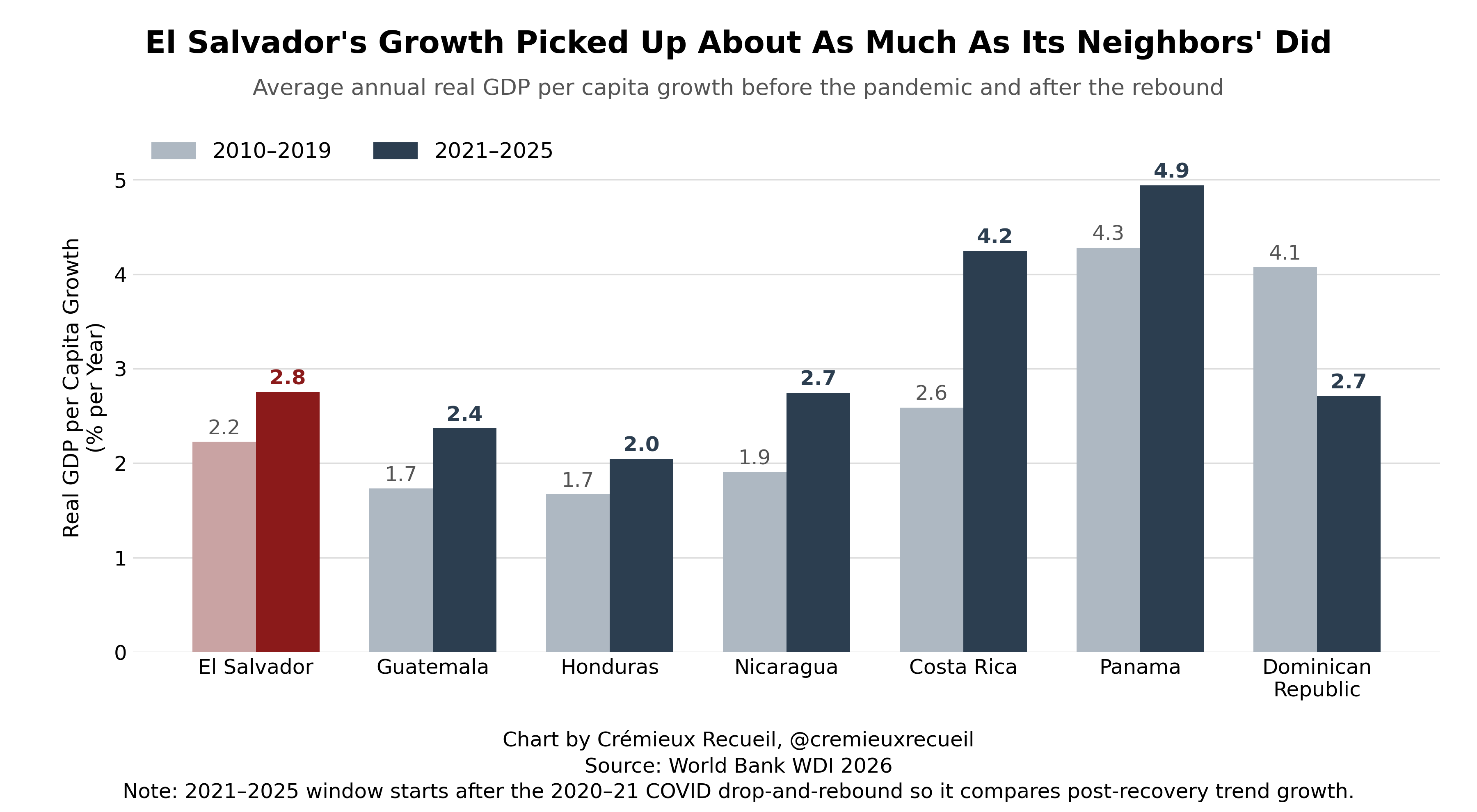
Growth in El Salvador does not stand out through 2025.
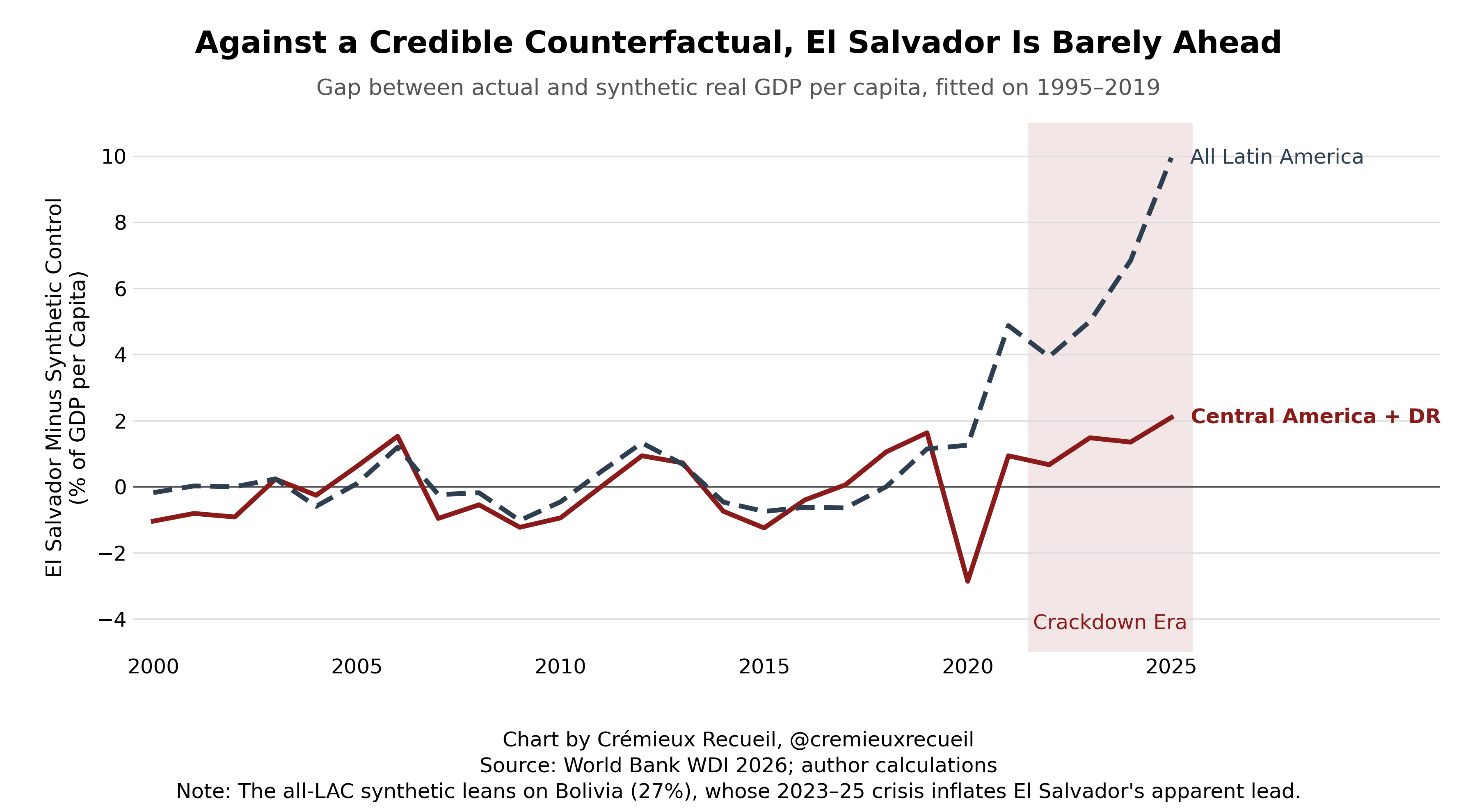
Comparing El Salvador to a synthetic version of it assembled from its neighbors as a benchmark reveals that it’s not doing that much better than its peers. In fact, without Bolivia in the sample, its boost over peers is not yet significant.
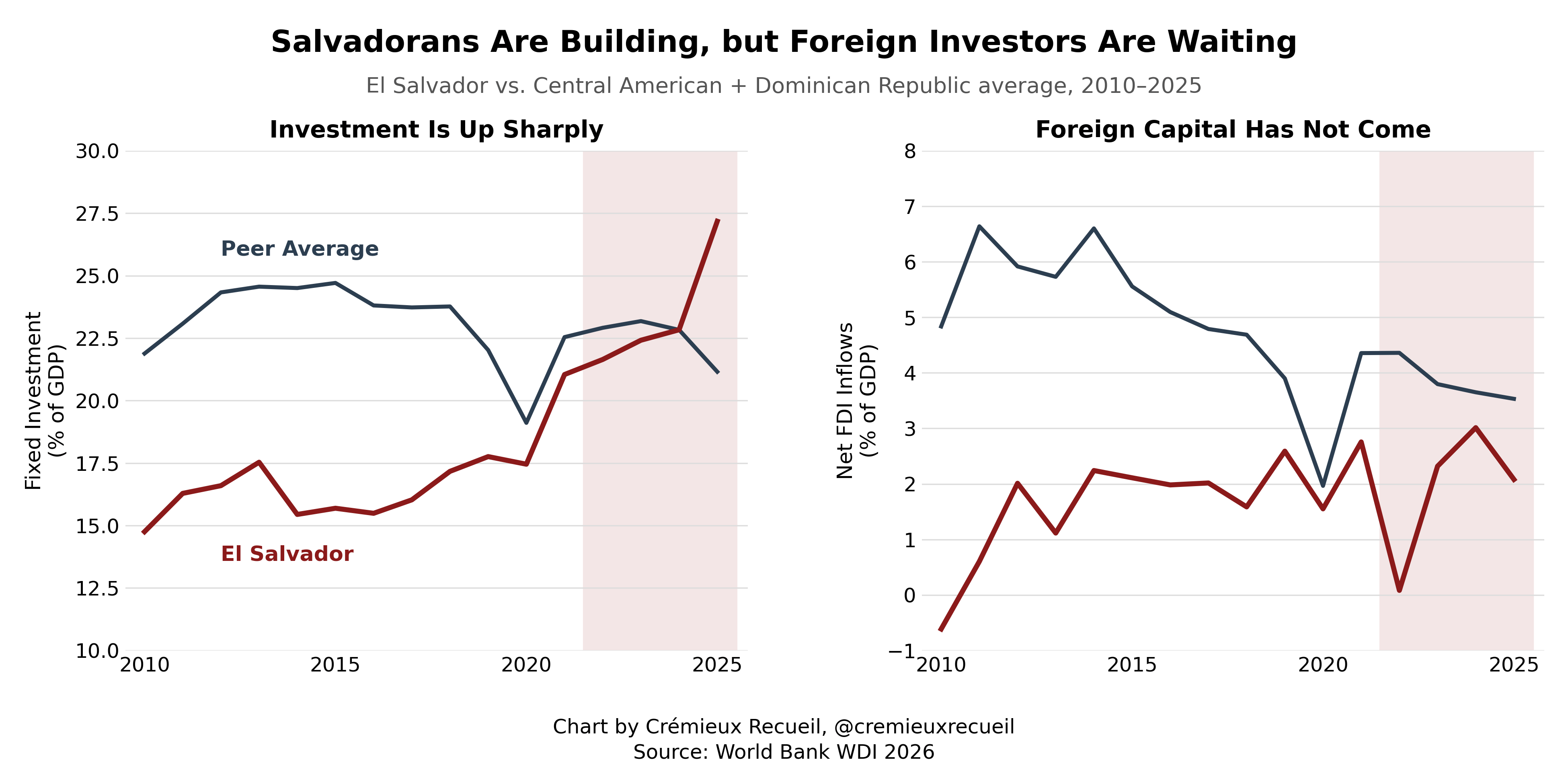
There are signs of change; it’s not all dismal. For example, domestic investment has boomed. Unfortunately, foreign investment hasn’t followed suit. Construction activity is up 48% over 2019, tourism earnings—clearly downstream of improved safety—have doubled in the same period, and new business registrations—also likely downstream of gang cleanups—have doubled just as well.
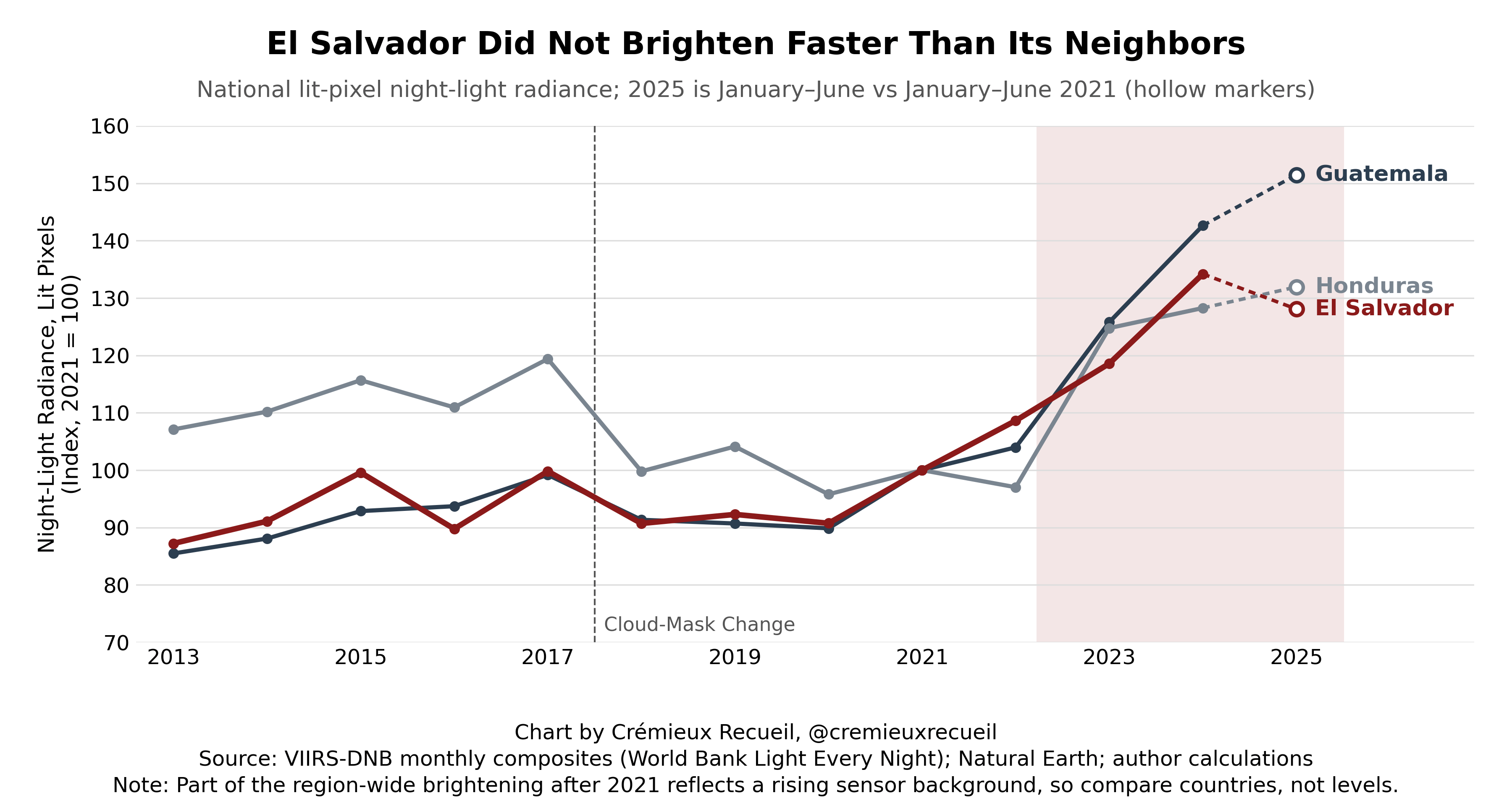
One method that’s commonly used to evaluate countries’ growth is to look at nightlights. When economic activity increases, consumption tends to rise, and that leaves a signature we can see from space because people want to have their lights on for longer, at greater intensities and utilizations, and so on. This has been used to show that tariffs hurt economic growth in targeted countries, that COVID lockdowns hurt economic activity, that authoritarian countries fudge their GDP numbers, and more. El Salvador does not look exceptional by this metric:
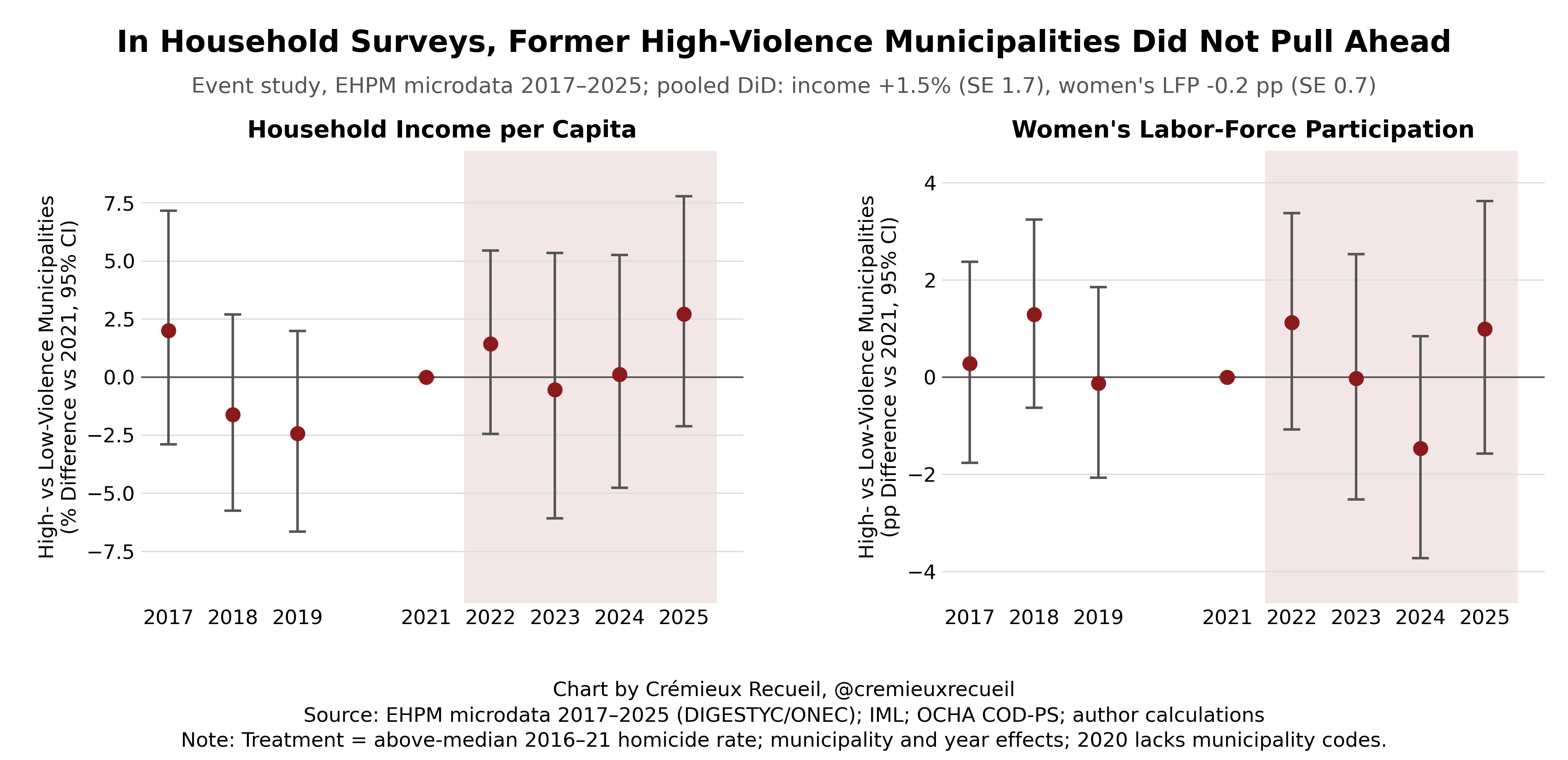
Household surveys also don’t show improvements to economic activity. Household incomes, earnings, employment, and women’s labor force participation are all not different comparing areas with high pre-crackdown violence to those with lower levels.
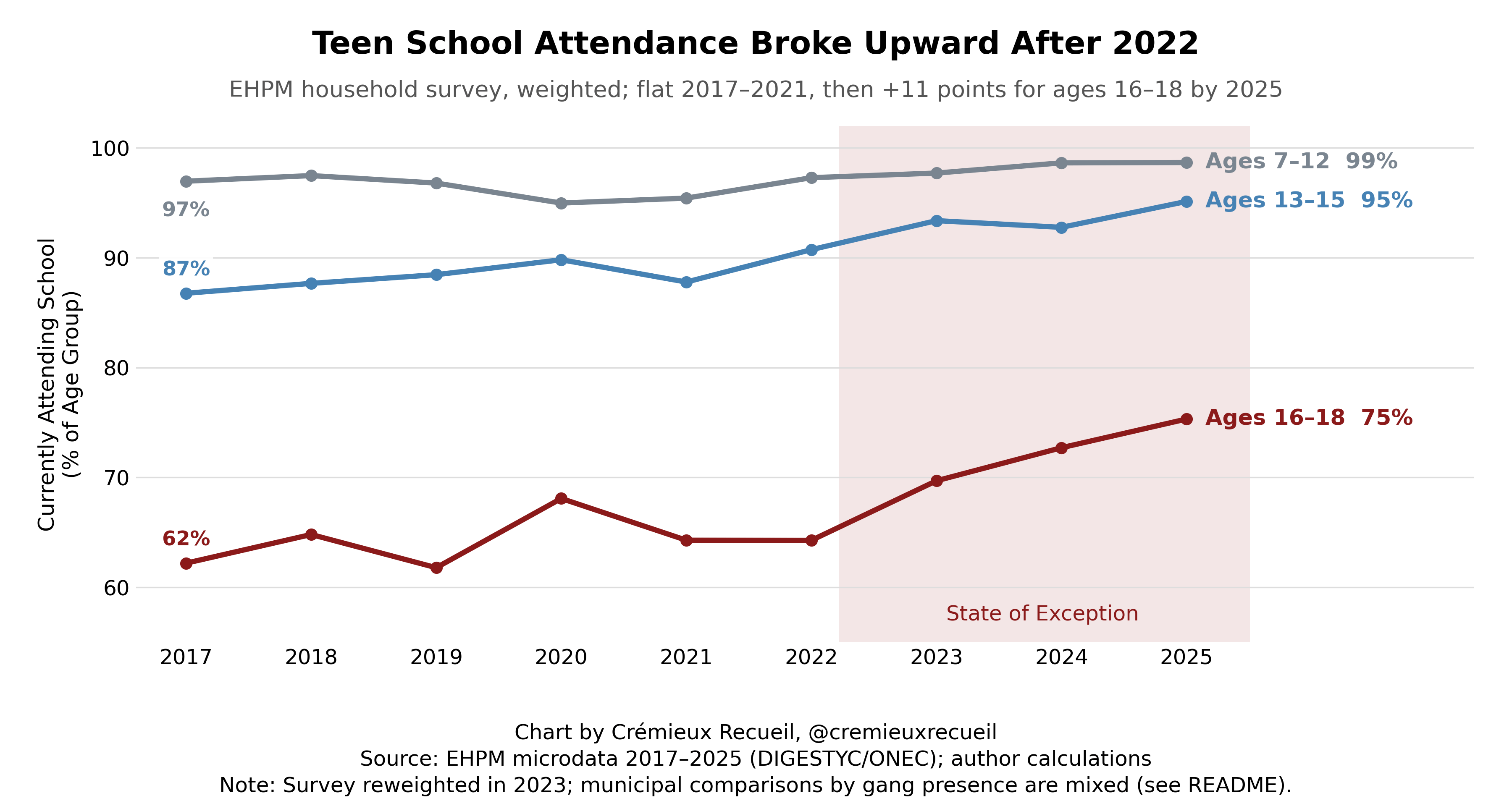
The most encouraging recent number is that school attendance is up for late teens—the ones most likely to have been wrapped up with gangs. But this is not a very big result, and it’s unclear if this will translate to benefits for the country down the line.
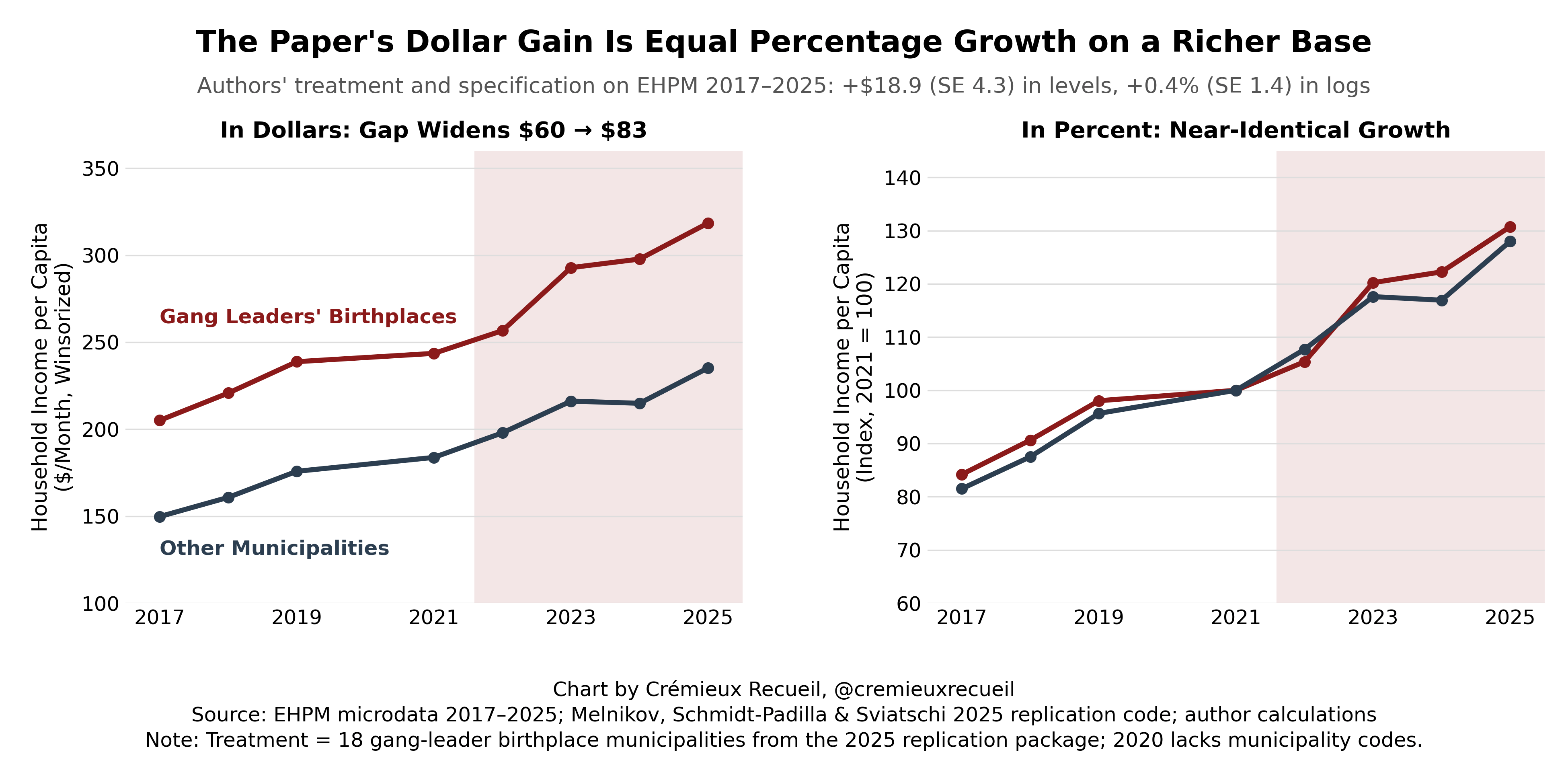
The best evidence that the crackdown paid off in economic terms comes from a recent study that showed $20-$25 per month greater incomes in municipalities with above-median gang presence.
The paper’s measure of gang presence is based on a policy registry of gang members, and it’s not public. Drats! An earlier paper from these authors defined municipal gang presence as the 18 municipalities in which deported gang leaders were born. Fine! I used this measure and found that, in percentage terms, there’s basically identical growth between places where gang leaders were and were not born. This comes with the impression of higher gains to those places with gang leaders because they had higher initial incomes.4 This suggests the signal in the paper is misleading about total economic benefits to the country.
Is ‘El Salvador’ Repeatable?
Can other countries just do what Bukele did, lock up their criminals and call it a day? Theoretically, yes, but it’s difficult. The conditions in El Salvador were perfect for fixing their crime problem because of the unique nature of their poor gangs. Other countries have nominally attempted to do what Bukele did, and they’ve failed.
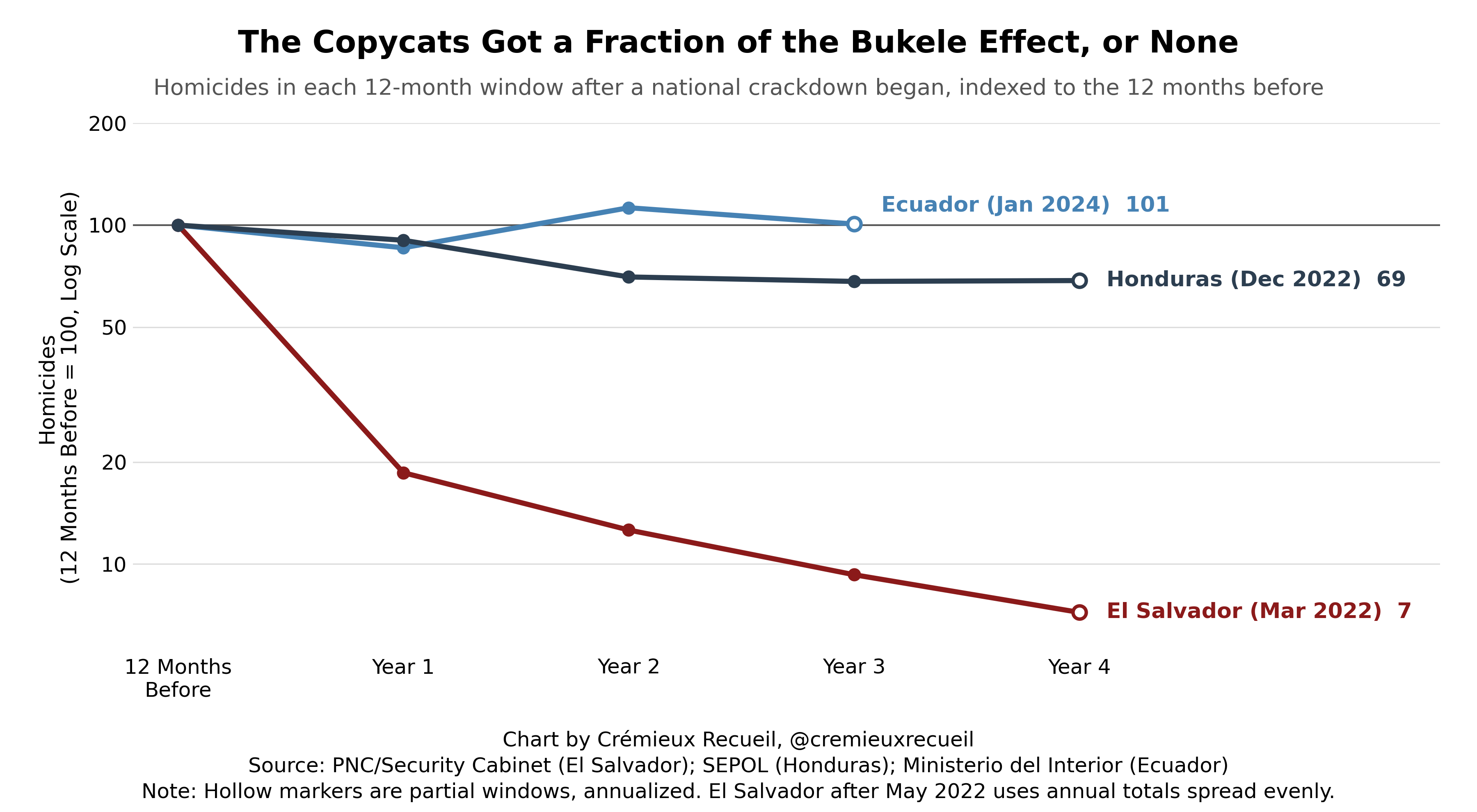
Ecuador and Honduras both made attempts, but their issues were not ripe for a fix, and their efforts were too partial, not going nearly far enough to actually make a dent. Ecuador and Honduras didn’t have the leverage El Salvador did. El Salvador fought poor gangs that relied on extortion, not cocaine cash that can finance resistance and pull in successor groups; El Salvador targeted everyone simultaneously instead of focusing on single groups so as to avoid power vacuums getting filled; El Salvador retook the prisons from the gangs; El Salvador went all-in and arrested almost 2% of the population, something no one else attempted to do.
In a sense, El Salvador’s experience is definitely repeatable. A good candidate country would be Brazil, where a large share of the homicides are due to gangs and other forms of organized crime. But try doing this in the U.S. and you’d have a harder time because such a comparatively small share of the homicides can be attributed to gang violence. Incarcerating more people to deal with much more random sorts of violence is possible and would work at some scale, but it’d end up being more expensive and less durable.
Let’s Summarize
El Salvador crushed its gangs, rendering its violent crime and homicide rates among the lowest in the western hemisphere. This feat is impressive and undoubtedly real. This has led some commentators to speculate that El Salvador will now experience rapid economic growth, that it’ll take off because it’s a safe place with a government that can reliably guarantee the streets are clear of crime and the people are free from the abuses of their fellow men. Tourists? Investors? Safe, so it should grow.
But so far, this just hasn’t happened. Order has arrived, but it’s not ‘institutions’, and it’s not yet growth either. It’s an open question where El Salvador goes now. Over the coming years, we will learn if the security miracle will lead to an economic one.5
A message from my sponsor, Mechanize:
We’re hiring software engineers to build environments and evals that frontier AI labs use to train coding agents.
To get a better sense of the work we do, you can check out GBA Eval, where we had models build Game Boy Advance emulators from scratch and scored their performance.
Base pay starts at $300K/year for junior software engineers, with more for senior roles, plus equity and performance bonuses. Apply here.
It’s also important to note that regression to the mean is not an explanation for going to never-before-seen lows. The idea is fundamentally misapplied in the El Salvadoran case.
Those results, by the way, aren’t meaningfully contested by international observers and NGOs. The Organization of American States, Human Rights Watch, and Freedom House all agree Bukele won his election in a landslide victory. They are just upset about how he’s ruling and the changes he’s made to allow him to run for reelection.
The same begrudging recognition has been extended to El Salvador’s criminal reporting: there’s annoyance about removing police killings, but acceptance of the residual numbers. Plus, even if police killings are added back in, they’re not that numerous and they’re in decline, so they can’t make a big difference. There’s also ire over the exclusion of discovered mass graves (basically all from much earlier years) and not counting deaths in detention, but those are on the decline and not that numerous anyway.
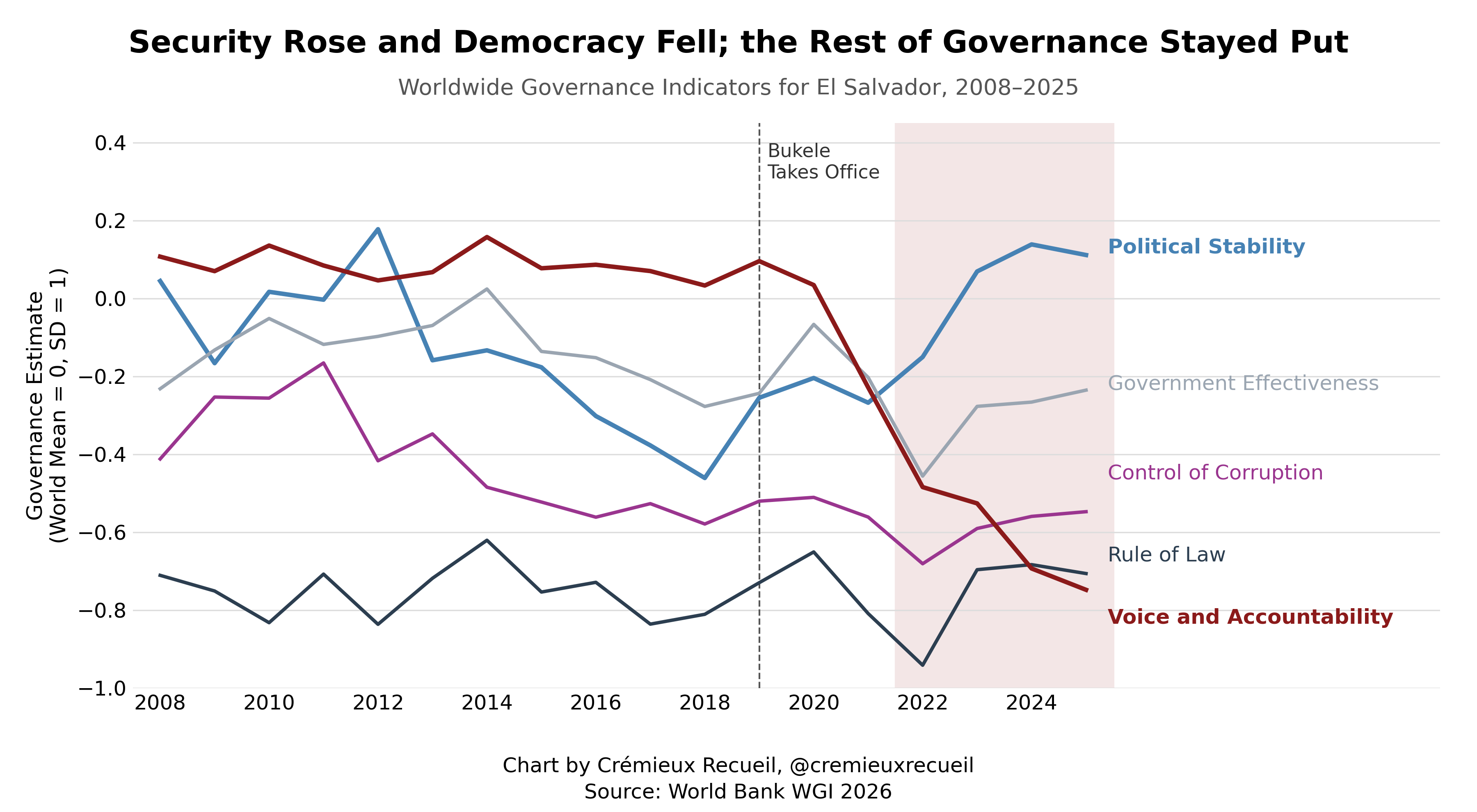
Worldwide Governance indicators, of course, suggest El Salvador has largely gotten worse though. Voice and accountability are down, political stability is up, and overall, El Salvador is described as a worse place to live. This is clearly wrong given the material conditions on the ground and how the citizenry feel about them.
It’s unlikely that the registry-based result would differ from this directionally because the gang phenomenon was primarily urban and thus concerned relatively well-off municipalities compared to the rest of the country.
