

Today’s post is brought to you by my sponsor, Mechanize. They’re hiring junior software engineers at $300K/year base salary.

America has few large cities and they usually have a bad rap. They’re known for being crime-ridden, inhospitable places dotted by ‘bad neighborhoods’ and poor architecture, with hostile design elements, poorly-maintained streets, and unenticing public art. The prototypical example of this is Detroit, Michigan, which was once a booming industrial powerhouse containing nearly two million people, museums and gorgeous art deco homes, towers, and squares, and America’s highest household incomes. Now, it would be all too polite to call it a ‘hellhole’, and it’s not alone.
America’s cities are, by and large, bad.1 The easiest way to see this is to understand the primary reason why they’re so bad: crime. The big benefit of cities for countries is that they’re economic engines of progress due to agglomeration effects: benefits and cost-savings that appear because companies, services, and workers are geographically collocated in them. But agglomeration effects are negatively related to crime. Look:
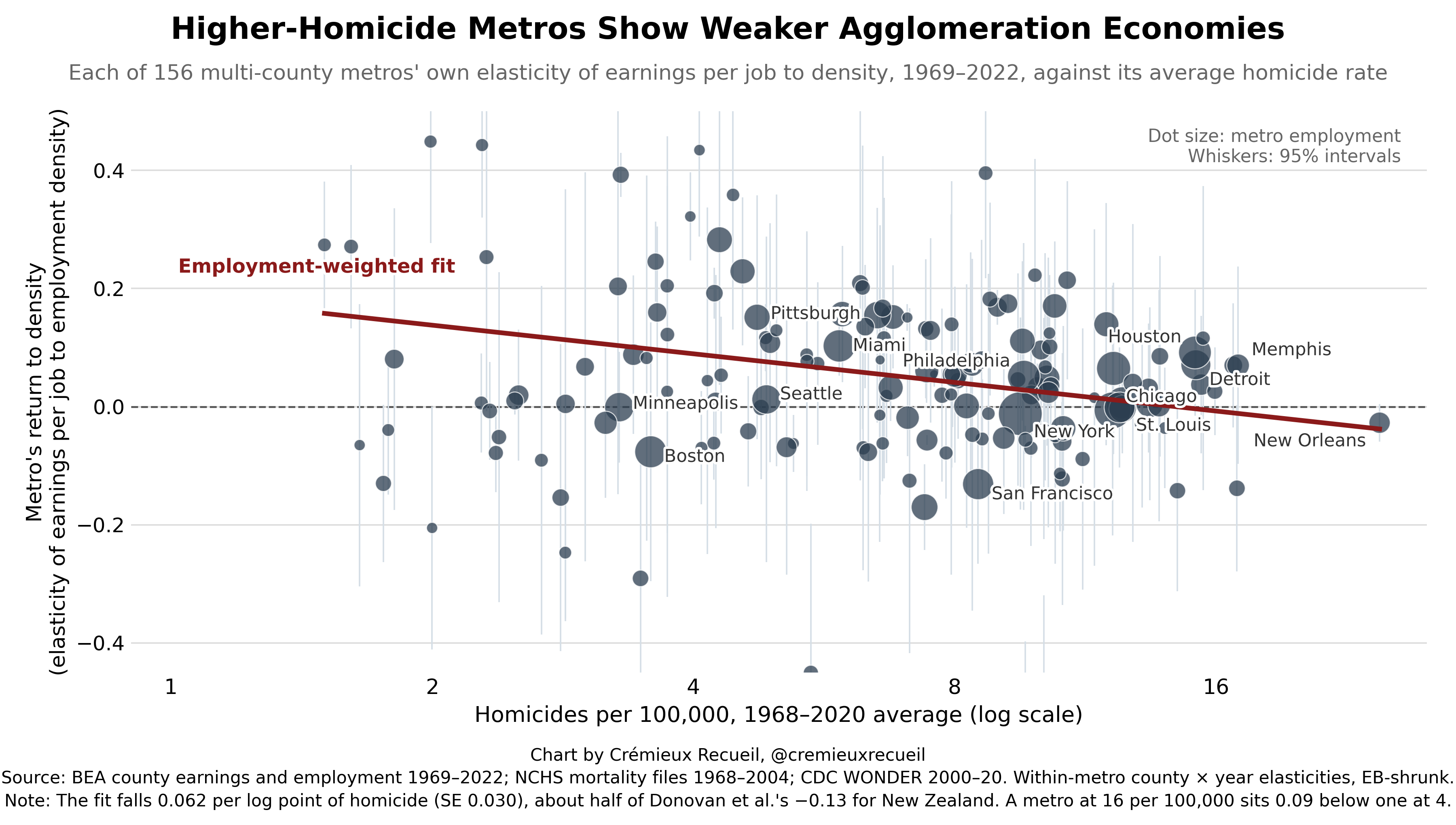
But is this causal? Does crime reduce the extent of agglomeration economies? To a major extent, yes, and we know it thanks to a suite of different disasters—bombings, fires, earthquakes, hurricanes, etc.—, to random events that displaced populations—the Mariel Boatlift, Japanese internment, close elections that appointed discriminatory mayors, etc.—, to the historical period known as the Great Migration—the mass movement of African Americans from the southeastern U.S. to the rest of the country’s urban areas. My replication package deals with all of these, and they produce convergent results, but for this article, I’ll just talk about the clearest example.
The Great Migration started just before World War I and ended just after the passage of the Civil Rights Act. The era was marked by African Americans leaving the South for two main reasons: to escape Jim Crow laws and to seek economic opportunity in the factories of the North.
The Great Migration accelerated thanks to World War II, when draft- and casualty-related labor shortages allowed Blacks to move from low-skilled to semiskilled jobs en masse2, and it accelerated once again with the Supreme Court’s 1948 decision in Shelley v. Kraemer, which forbade neighborhoods from having state-enforced racial covenants—agreements to evict Blacks from certain neighborhoods and to prevent them from buying homes in them. What remained post-Shelley were merely private, much more loosely-enforced agreements not to sell property to members of certain races.
Labor shortages and racial covenants provide us with causal leverage: the former are driven by random deaths and pre-war demographics that are displaced by draft boards; the latter are driven in all sorts of unclear ways and broken due to preferences that are plausibly unrelated to the existence of the racial covenants in the first place. Interesting, no? Accordingly, where African Americans wound up and the occupations they were able to enter there had a large degree of randomness to them.
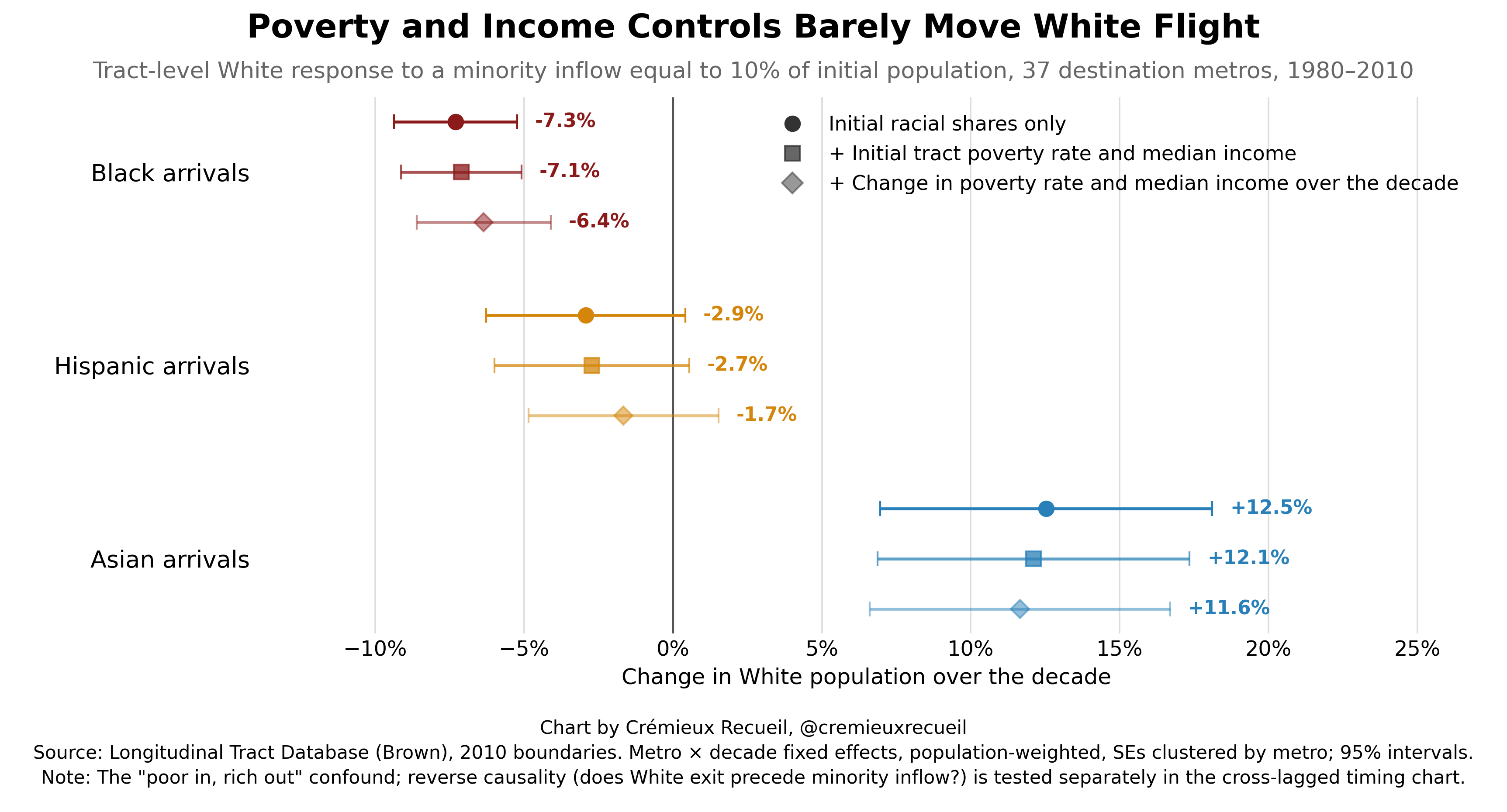
These facts, coupled with African Americans’ persistent association with violent crime, allow us to leverage their inflows to assess effects on agglomeration economies via crime. We can say ‘via crime’, since a mere racism angle doesn’t fit the data given that other racially distinct but lower-crime demographics that were discriminated against do not seem to lead people—in particular White people, in the phenomenon known as ‘White flight’—to leave from the places African Americans show up3, even controlling for socioeconomic status, and because anti-agglomeration effects are particularly distinct for violent crime, which is the type of crime African Americans are associated with, as opposed to property crime.
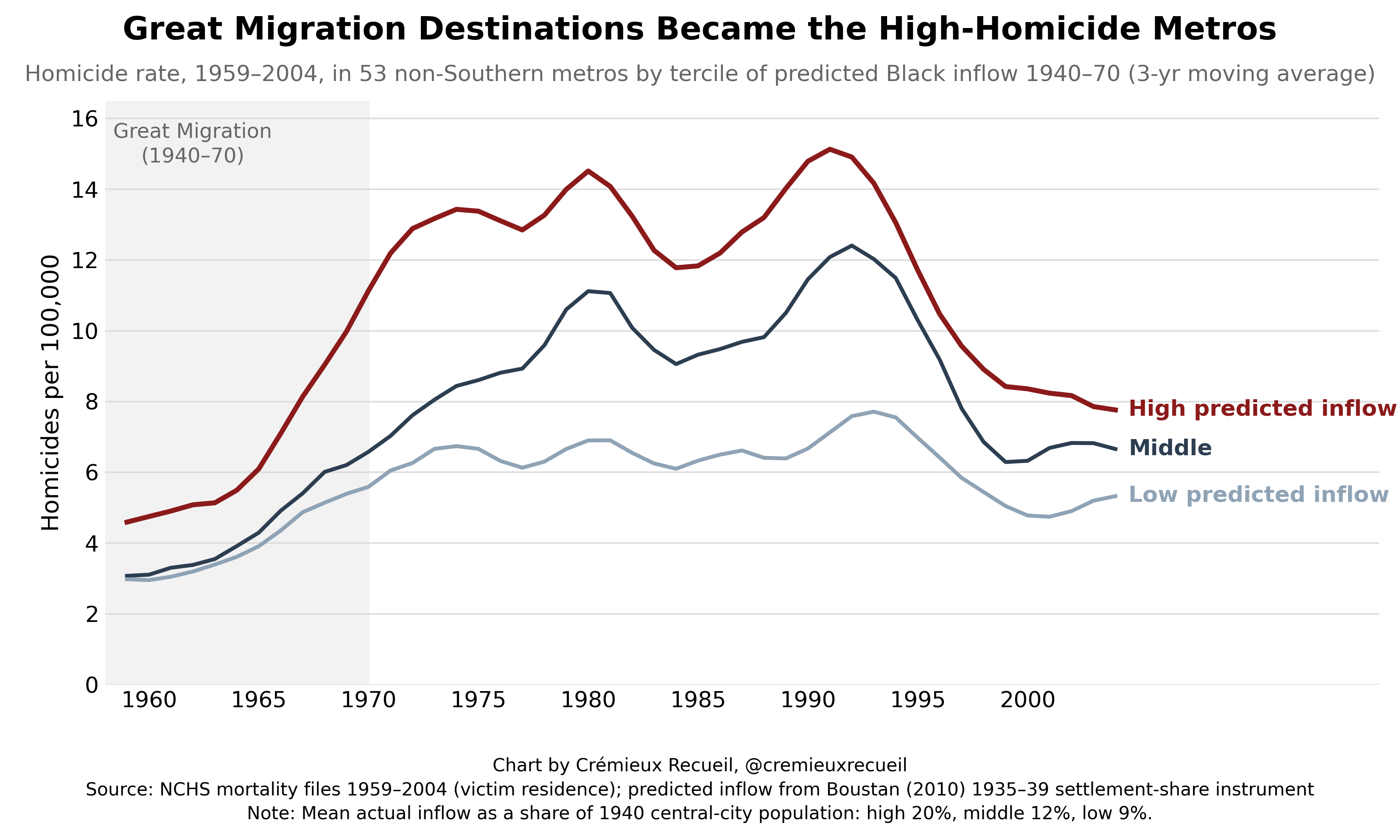
Cities that received more African Americans during the Great Migration saw larger increases in homicide.4
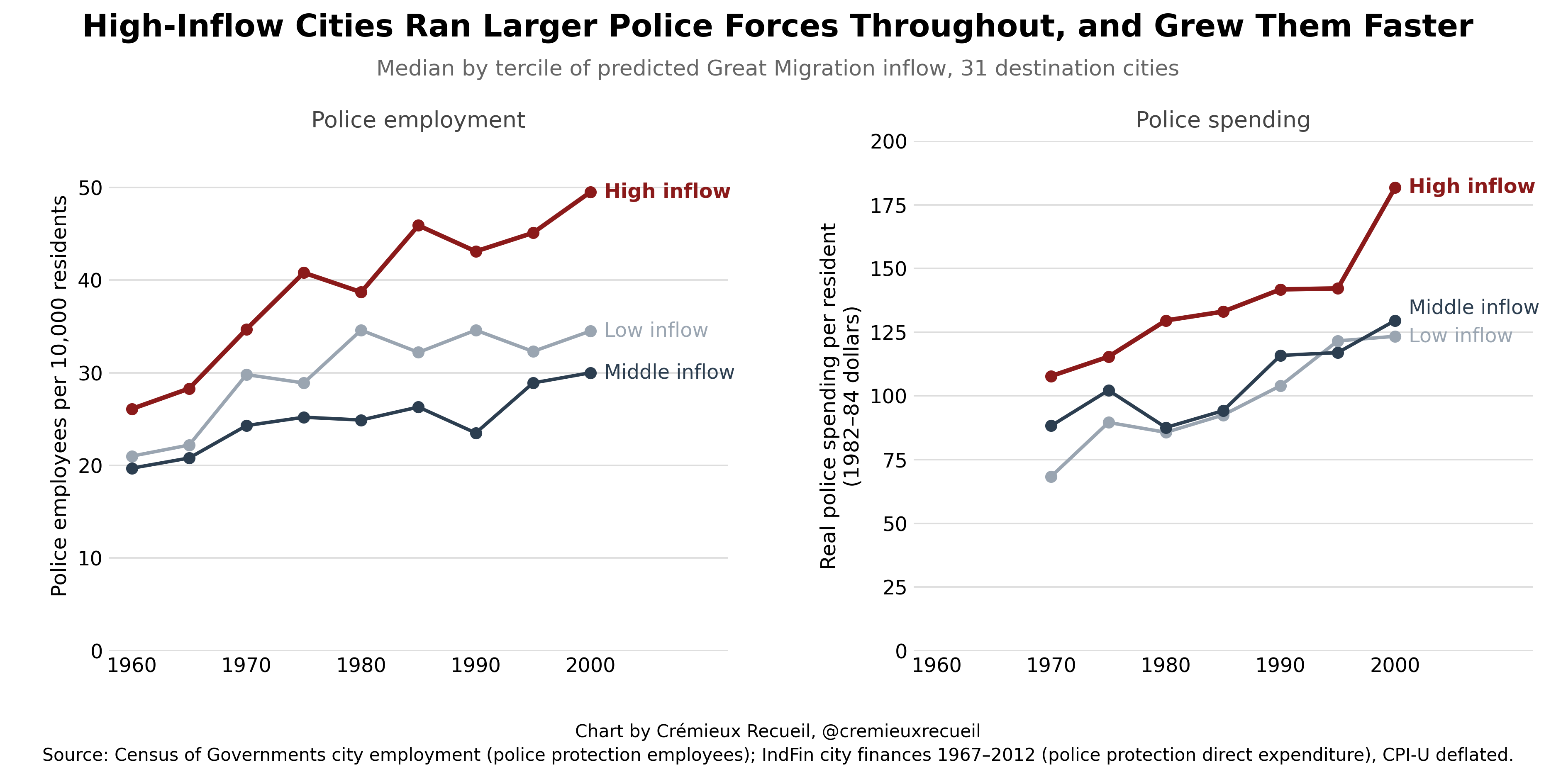
Cities attempted to counter this, and those that received the largest African American inflows increased hiring and funding of police in response.
Nevertheless, the homicide rates increased, violent crime overtook America’s urban centers, and White flight went into full swing, with Whites leaving metropolitan areas in favor of suburbs and new homes further afield. As a result, city total populations and population densities declined and labor productivity became worse off for it.5
Agglomeration is about two margins: density and returns to density, and crime is bad for both. We can observe and quantify the costs of crime-reduced density and density returns. The cost of the Great Migration density effects alone is about $888 per year per American, and the effect of the 1960s to early 1990s crime wave is another $392 per capita, but even those are lower bounds, as they’re just the costs we see.6
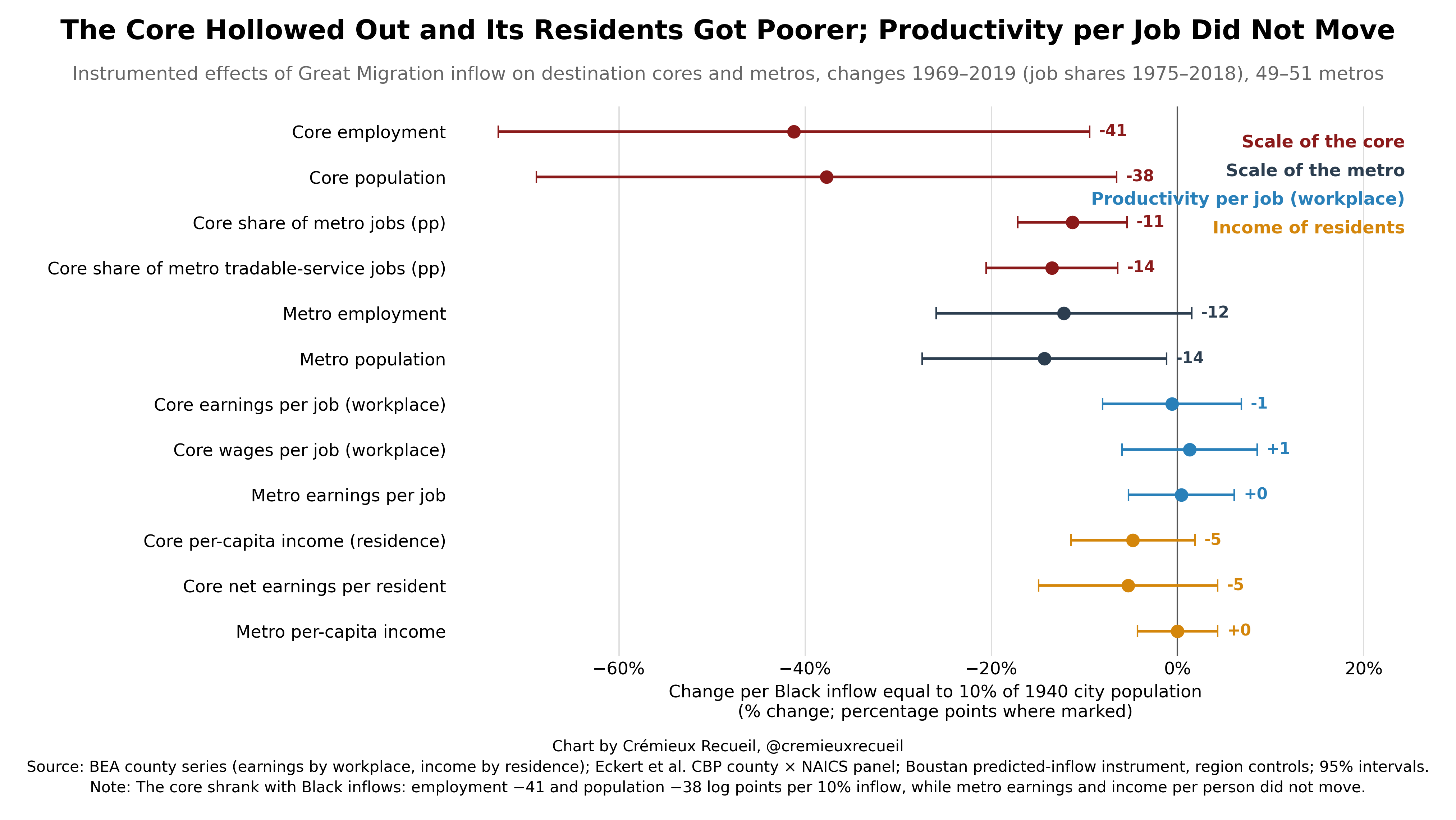
Cities are also arranged worse, leading to tangible and intangible losses. On the tangible side, cities are arranged in strange ways and their architecture is hostile so people can avoid crime; on the intangible side, patents are foregone, nightlife is more limited, police presence has to be greater and more concentrated, segregation is stronger, and NIMBYism—which is suboptimal for policy, as it also harms agglomeration, labor mobility, etc.—is reasonable as a means of exposure control.
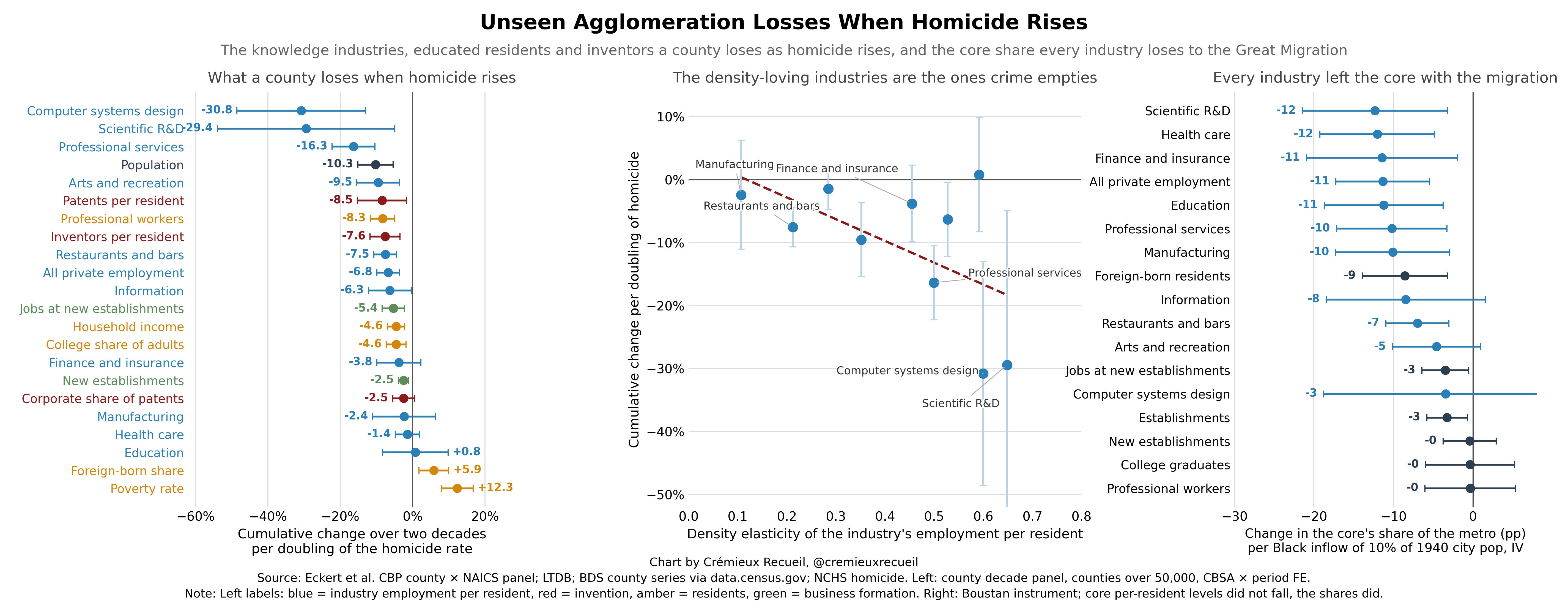
We, as humans, not just Americans, miss out in untold ways because of the foregone agglomeration effects that result from our failure to have the gumption, the gusto to reclaim our cities from crime and dysfunction, let alone poor governance.
You can explore my replication package and all of its analyses by clicking here.
This was a timed post. The way these work is that if it takes me more than an hour to complete the post, an applet that I made deletes everything I’ve written so far and I abandon the post. You can find my previous timed post here.
A message from my sponsor, Mechanize:
We’re hiring software engineers to build environments and evals that frontier AI labs use to train coding agents.
To get a better sense of the work we do, you can check out GBA Eval, where we had models build Game Boy Advance emulators from scratch and scored their performance.
Base pay starts at $300K/year for junior software engineers, with more for senior roles, plus equity and performance bonuses. Apply here.
And if we’re being serious there’s only one, maybe two, ‘real’ cities in America nowadays.
Two things:
First: there are coding errors and implausible counts in this study, but its result is minimally changed when they’re corrected.
Second: WW2 labor shortages did not per se have a pull effect on African Americans, but they had an exposure effect because they promoted Blacks in workplaces into occupations that had more and higher-educated White workers, they promoted Black wages allowing them to move into Whiter, higher-class neighborhoods, reducing neighborhood segregation, etc. Effects on agglomeration are greater when they affect more-educated, more-skilled workers, and exposed Whites moved out in a class-biased way.
This is not reverse-causal. You can see this from the events I analyzed or from charts like this lagged one, which is expanded on in the replication materials:
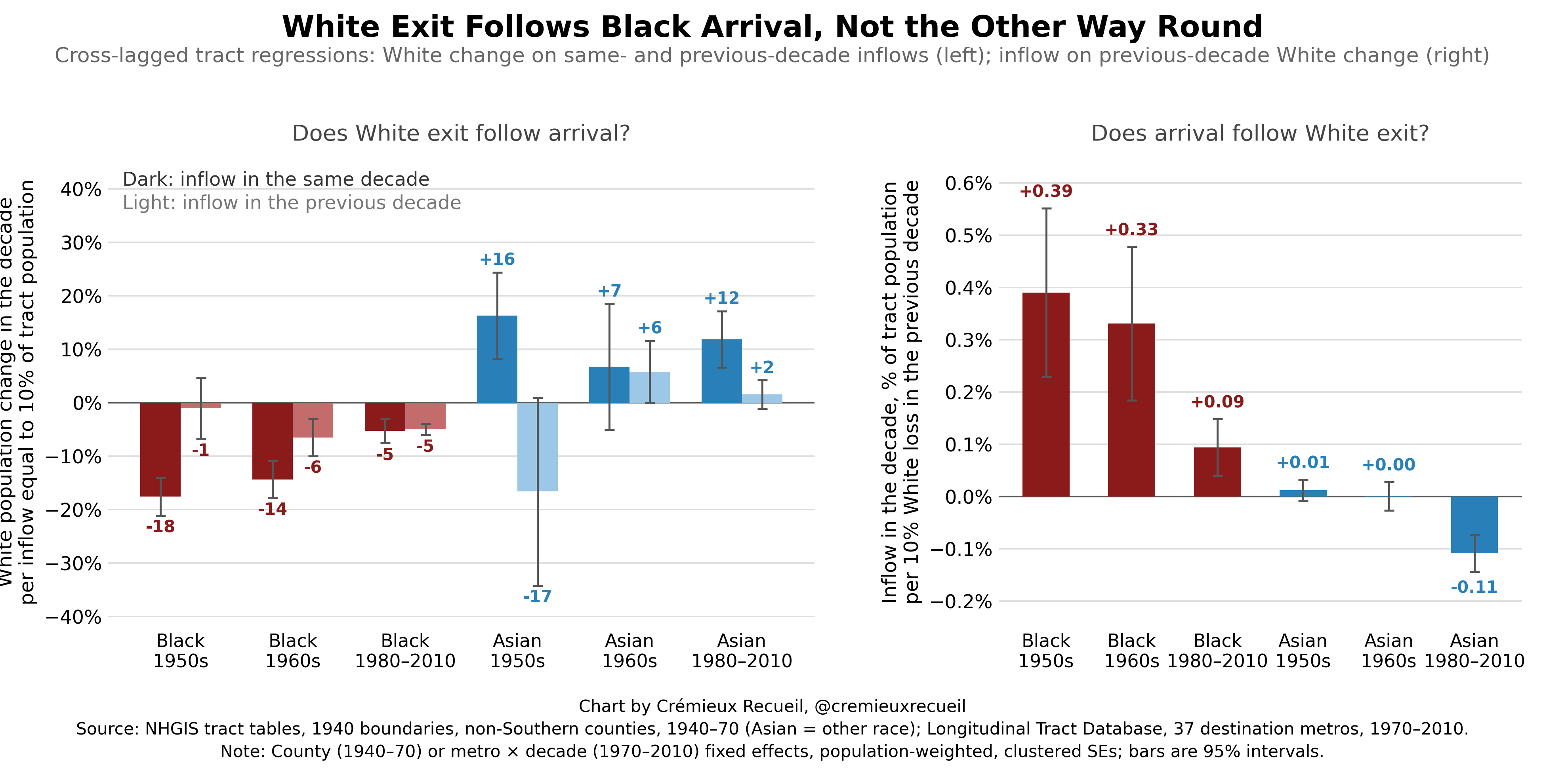
Also, notice, the 1950s prior-decade result is nonsignificant. This is due to those inflows being very small.
This is perhaps not the best chart for illustrating this because it looks like preexisting differences across metropolitan areas may be explanatory, but that is not the case, as the result shows up at the tract level.
Thus, estimated agglomeration benefits fell:
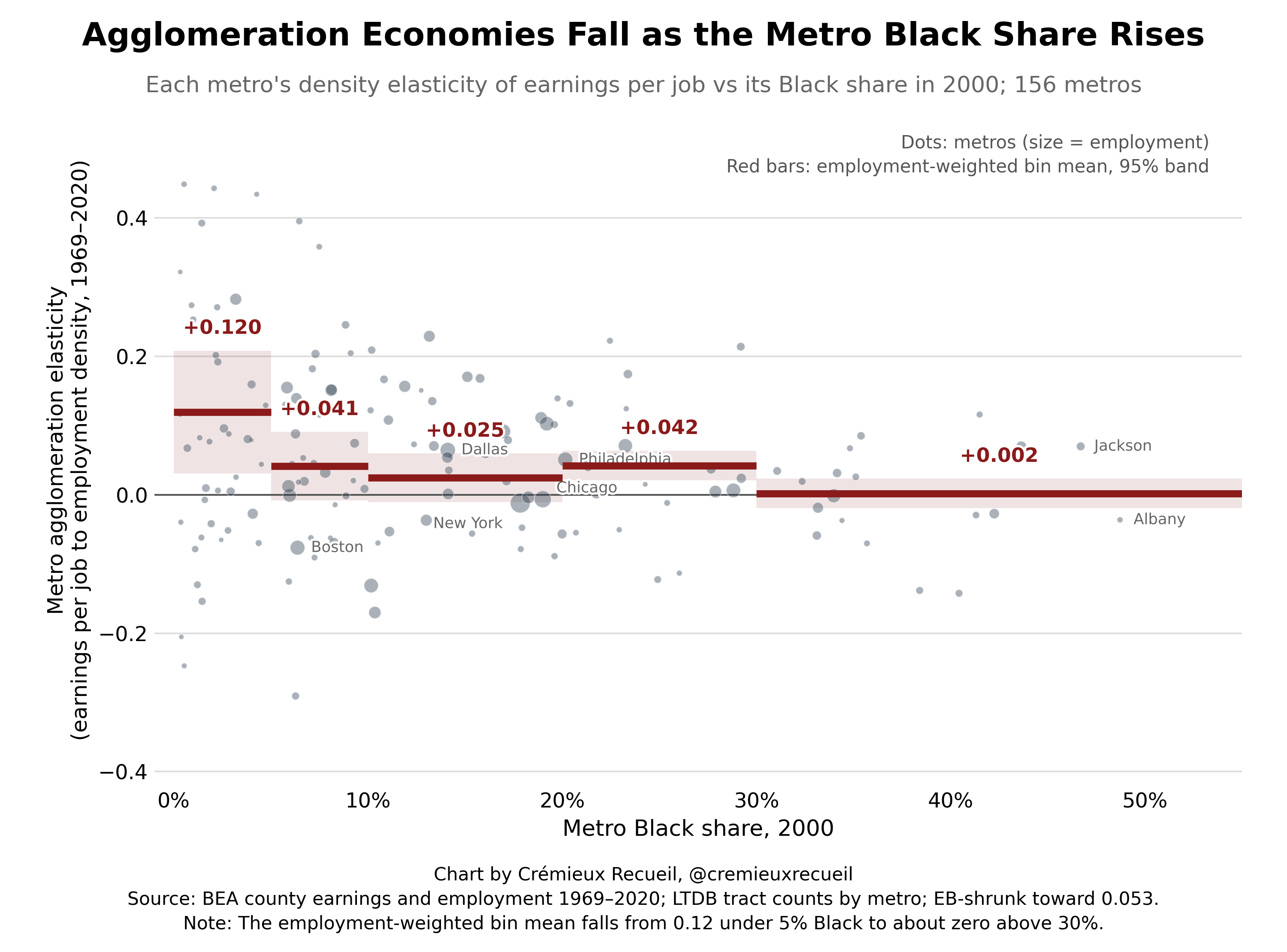
Chart-wise, the observable costs look like so:
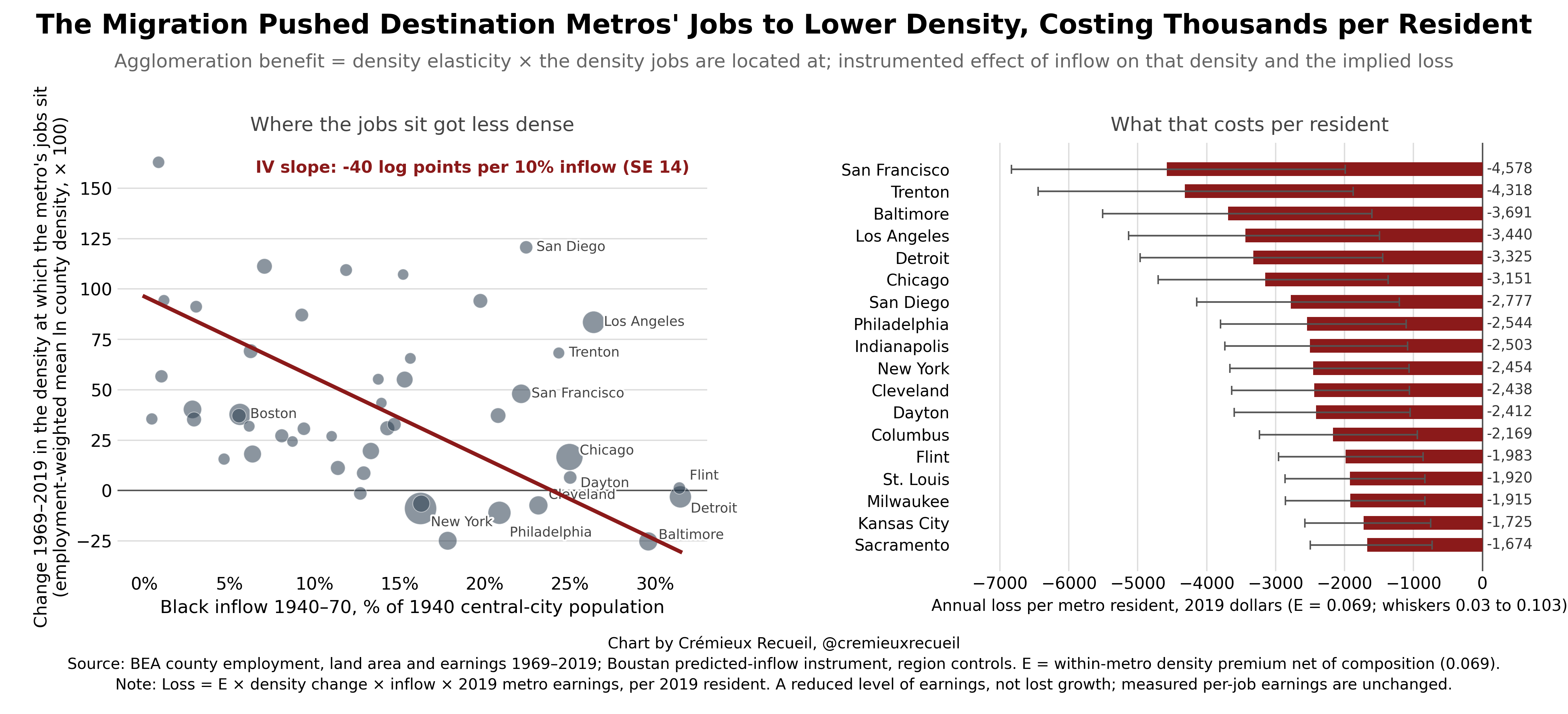
It is also worth noting that this estimate excludes the direct cost of crime. It is just loss via the agglomeration channel. It also does not include any estimate of the effect of the Great Migration helping to agitate for the modern welfare state in the Civil Rights era whose legislation it inspired in order to quell the riots the resulted in Northern cities, and it does not quantify the unseen losses in innovation, industries that could more easily be preyed on by China as agglomeration economies fell, or having to enact more extreme policing and redistribution policies at the local level to accommodate Great Migration migrants, etc.
It is also worth noting that the Great Migration could have been a net positive financially despite the fact that it hurt agglomeration so much. This could be the case due to Black workers’ income gains as a result of relocating to Northern metropolitan areas where their labor would be more productive, even if, say, as Derenoncourt (2022) found, the move lowered long-run upward mobility (regression to the mean could explain this and thus flatters my estimate below). The counterfactual world where it happened without harming agglomeration—perhaps because cities worked to quell resulting crime issues more aggressively?—would’ve just been even richer.
So, I went ahead and estimated this. This estimate is only about private income gains. It omits gains to the South (i.e., wages of those who stayed rose as labor left) and the general equilibrium output from moving labor to more productive locales, and I’ll note that the density loss reflects a revealed preference for lower density in response to crime rather than a pure deadweight loss per se. The central estimate is that Black gains were 28% as large as Black migration-induced losses and the optimistic estimate is that they were 45% as large, and as I noted, this barely counts all the unseen and political downsides. Even if you count out Black-carried losses due to the agglomeration losses, the estimates of Black gains relative to aggregate losses remain lopsided. Here’s a helpful chart:
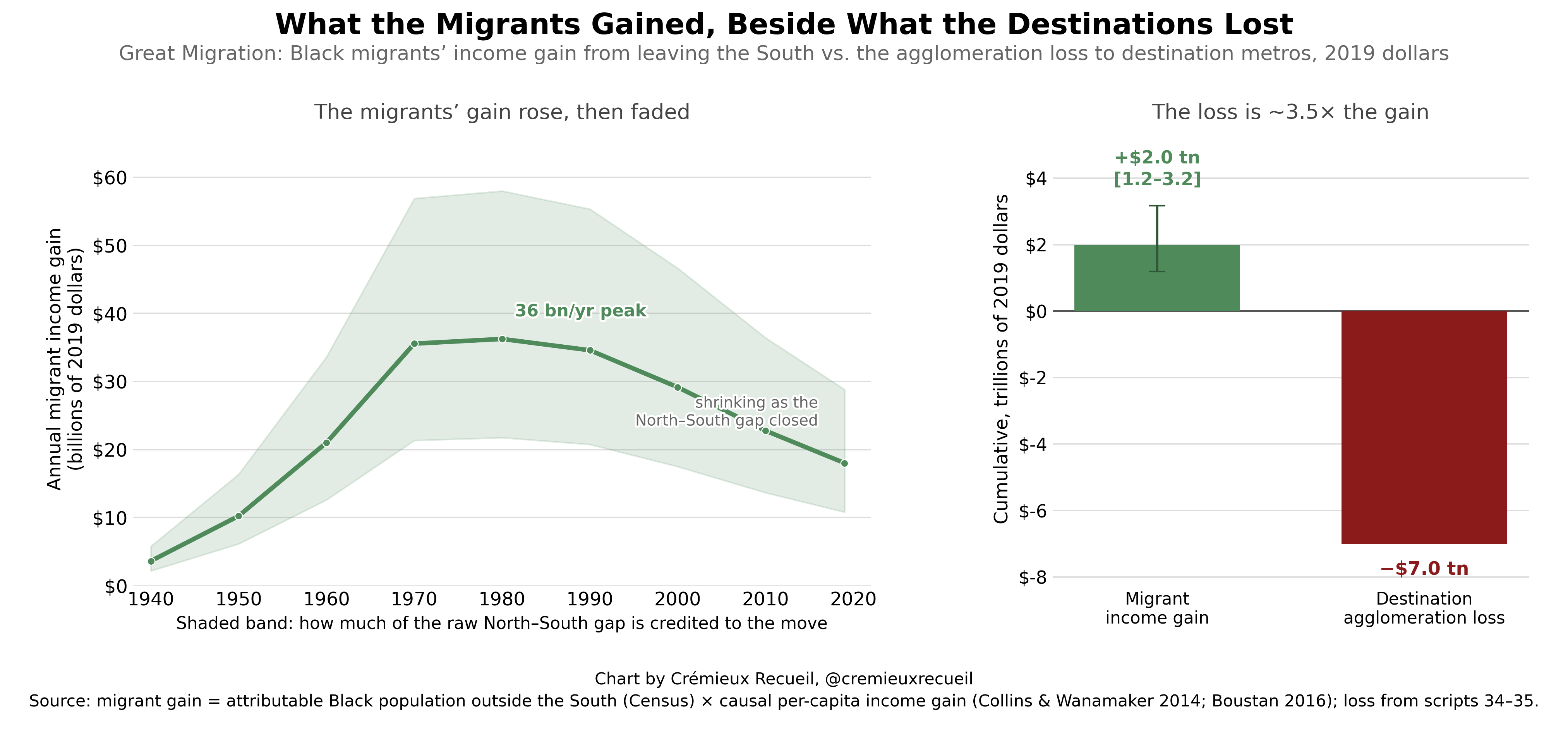
September 8, 2026 Update: Someone asked me about migrants’ role in North-South income closures. The direct effect would be making them closer together through the induced harms, but if there’s a federal policy effect such that the migrants inspired policy that resulted in the South catching up, then the gains from the migrants could be underestimated. But unless you fully attribute catch-up to that or a similar channel, it’d be hard for the gains to outweigh the harms.
Are there studies on how much homeless encampments (and related things that would fall under 'disorder' rather than 'crime') hurt agglomeration?
Related: https://www.journals.uchicago.edu/doi/10.1086/715713, estimates the annual cost of crime in the US as ~$5 trillion including transfers from victims to criminals and ~$3 trillion net of transfers, or ~$16,000 per American including transfers / ~$10,000 net of transfers.
Unpaywalled version: https://www.researchgate.net/publication/358417739_The_Aggregate_Cost_of_Crime_in_the_United_States.