

This was a timed post. The way these work is that if it takes me more than one hour to complete the post, an applet that I made deletes everything I’ve written so far and I abandon the post. You can find my previous timed post here.
Our society is obsessed with credentials. People with PhDs, MDs, JDs, and even Ed.Ds are lauded as if the credentials they’ve earned signify that they’re more generally capable than their uncredentialed peers. The fact that they are on average because there’s a correlation between real-world qualification and educational attainment is the kernel of truth that has allowed people to be misled into thinking that the credential, the degree itself, is what matters. But it’s not, and you’ll realize it’s obviously not if you think about it for even a moment:
Have you never met a bad doctor? A shoddy lawyer? A barista with a PhD?
Nevertheless, laws have been written, policies have been crafted, and decisions have been made on the basis of credentials that frequently don’t even matter and should instead be downweighted in favor of other, fairer and more important criteria.
The End of Credentialism?

Credentialism has polluted the American psyche for generations, and it has impaired the functioning of the job market and the government in the process. At one point, it was believed to be necessary, if not useful, good, and perhaps even complementary to meritocracy. But that belief is delusional, and we are all now victims of credentialism.
Let’s discuss credentialism in education as a particularly galling case: parents and schools seem to think that the educational credentials of teachers matter for how well they teach students.1 Do they? Not a lot; certainly not enough to support the idea that teaching should be the exclusive domain of those who’ve been taught how to do it.
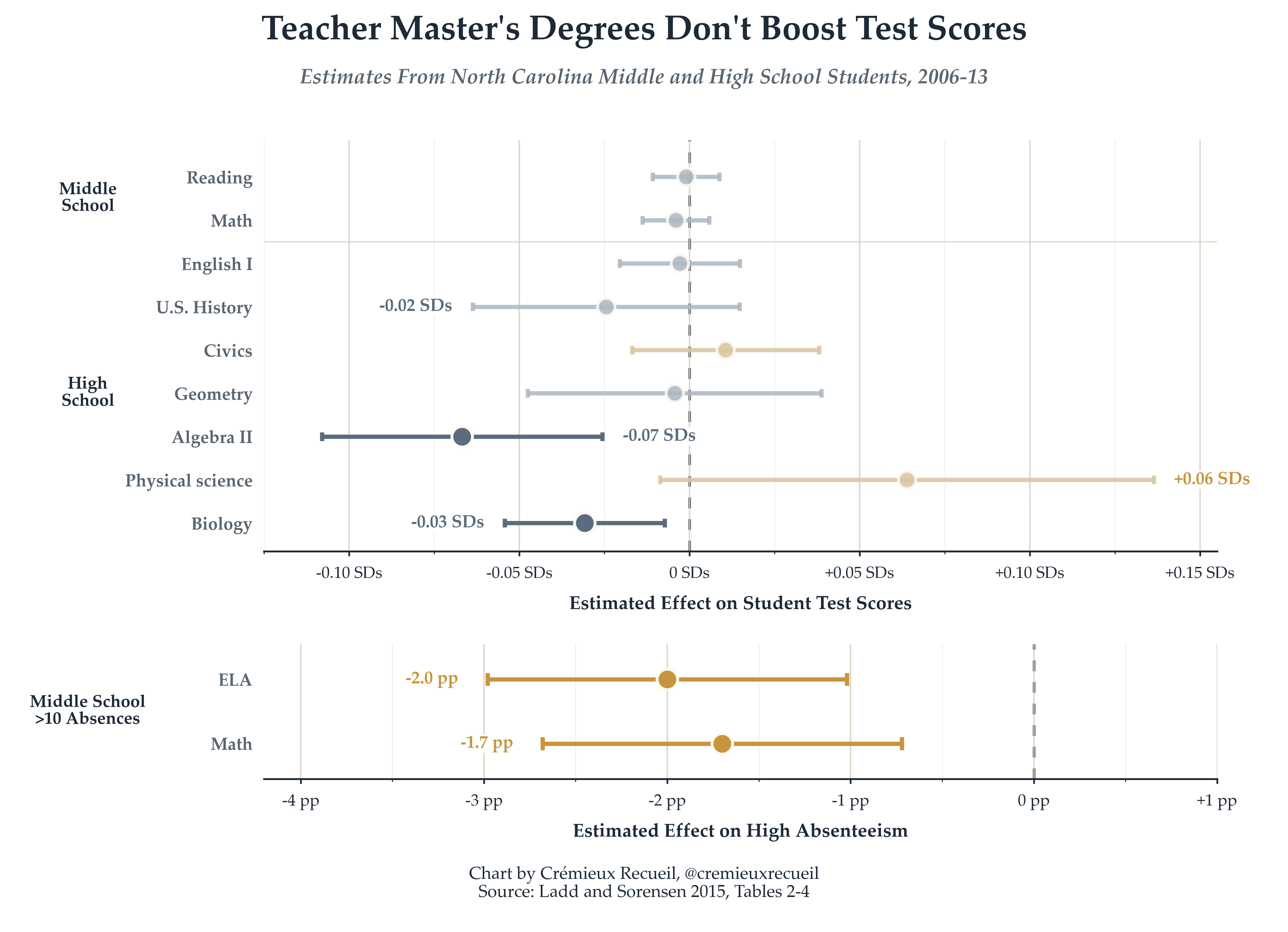
Ladd and Sorensen’s seminal 2015 paper on this topic used administrative data from North Carolina to assess the effects of teachers earnings Master’s degrees with fixed effects for teachers, students, and schools. With these fixed effects, it’s possible to estimate the effect of Master’s degrees after accounting for things that are constant among these groups. Thus, the question from this study is less ‘Do teachers’ Master’s degrees correlate with their success?’ and closer to ‘Does being conferred a Master’s degree make teachers more successful?’ The answer is a resounding ‘no’, with the only effect being on rates of high absenteeism among the kids, for some reason.

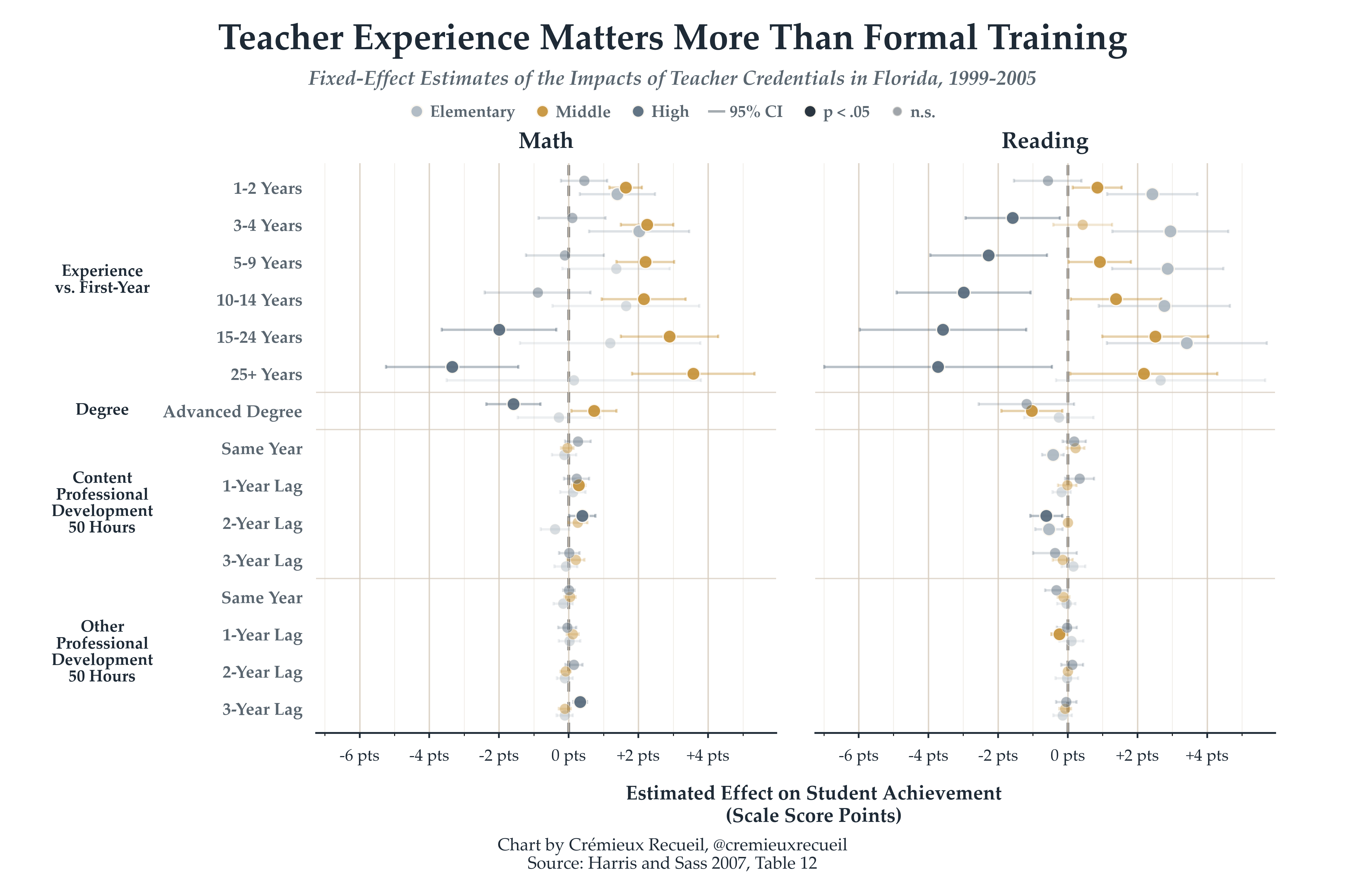
Harris and Sass published a similar study with a focus on broader teacher training using administrative data from Florida. They had data on professional development trainings, degree attainment, and years of experience, and they found that years of experience were irrelevant or slightly positive in elementary and middle school, and negative or null in high school. Everything else was meager at most, with one scale score point being about 0.04 standard deviations of annual achievement gains or 0.027 standard deviations of achievement levels.
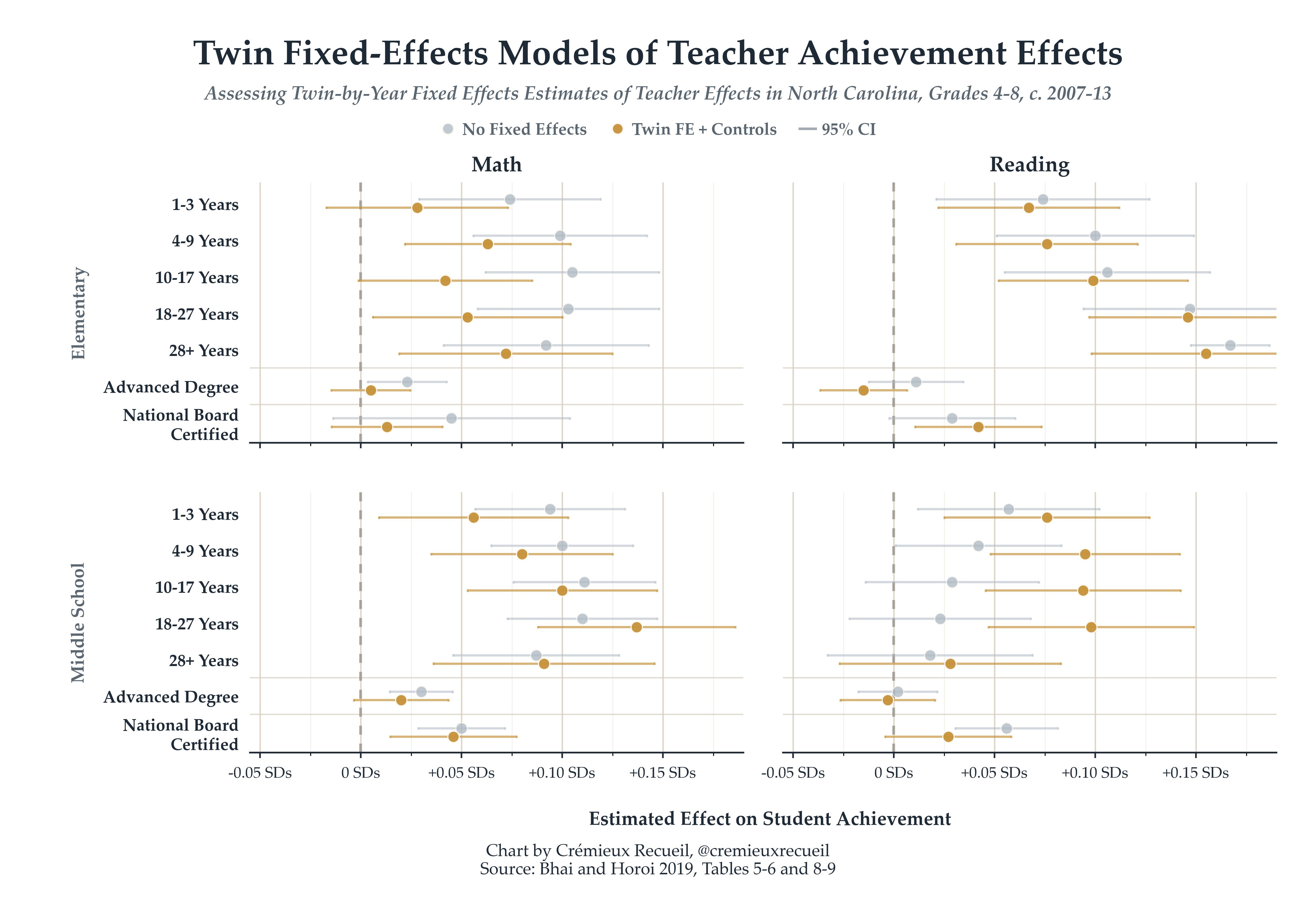
Bhai and Horoi used administrative data from North Carolina, but this time not so much for the longitudinal side, but instead so they could have a twin control. Twins end up in different classrooms, so we can use them to estimate the effect of teachers’ experience, credentials, and so on, by controlling for a person’s genetic endowment and home environment. They didn’t find a whole lot: they found that lots of experience was good, but advanced degrees were not.
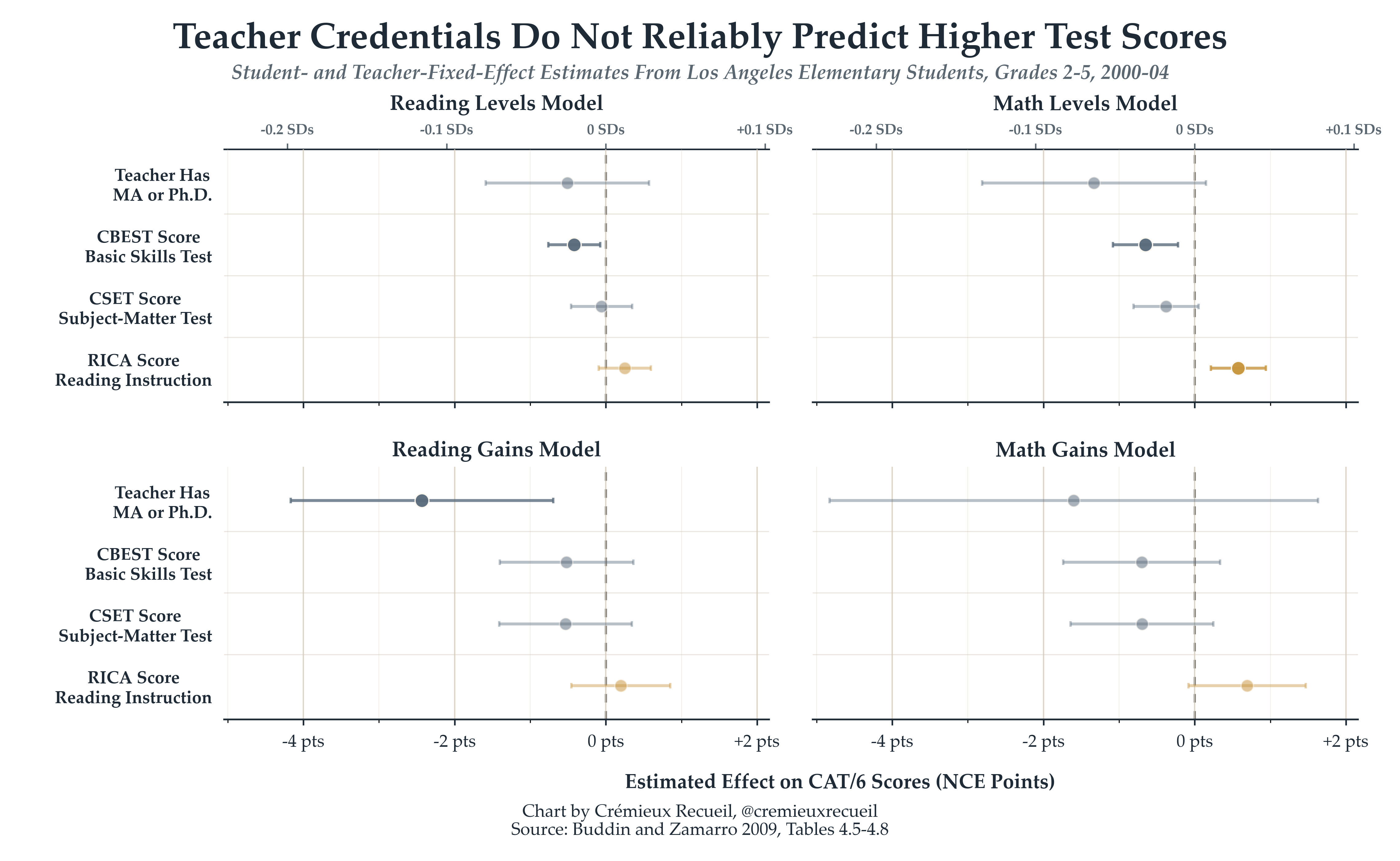
Buddin and Zamarro looked at whether teacher qualifications related to student achievement in a sample of Los Angeles elementary schools. Student- and teacher-fixed-effects models rendered the effects of teachers having advanced degrees null to negative, and also made the California Basic Educational Skills Test (CBEST) and California Subject Examinations for Teachers (CSET) licensure tests look harmful, meaning that more ‘qualified’ teachers had worse effects on students. Contrarily, the Reading Instruction Competence Assessment (RICA) seemed null to helpful. But all effects were small.
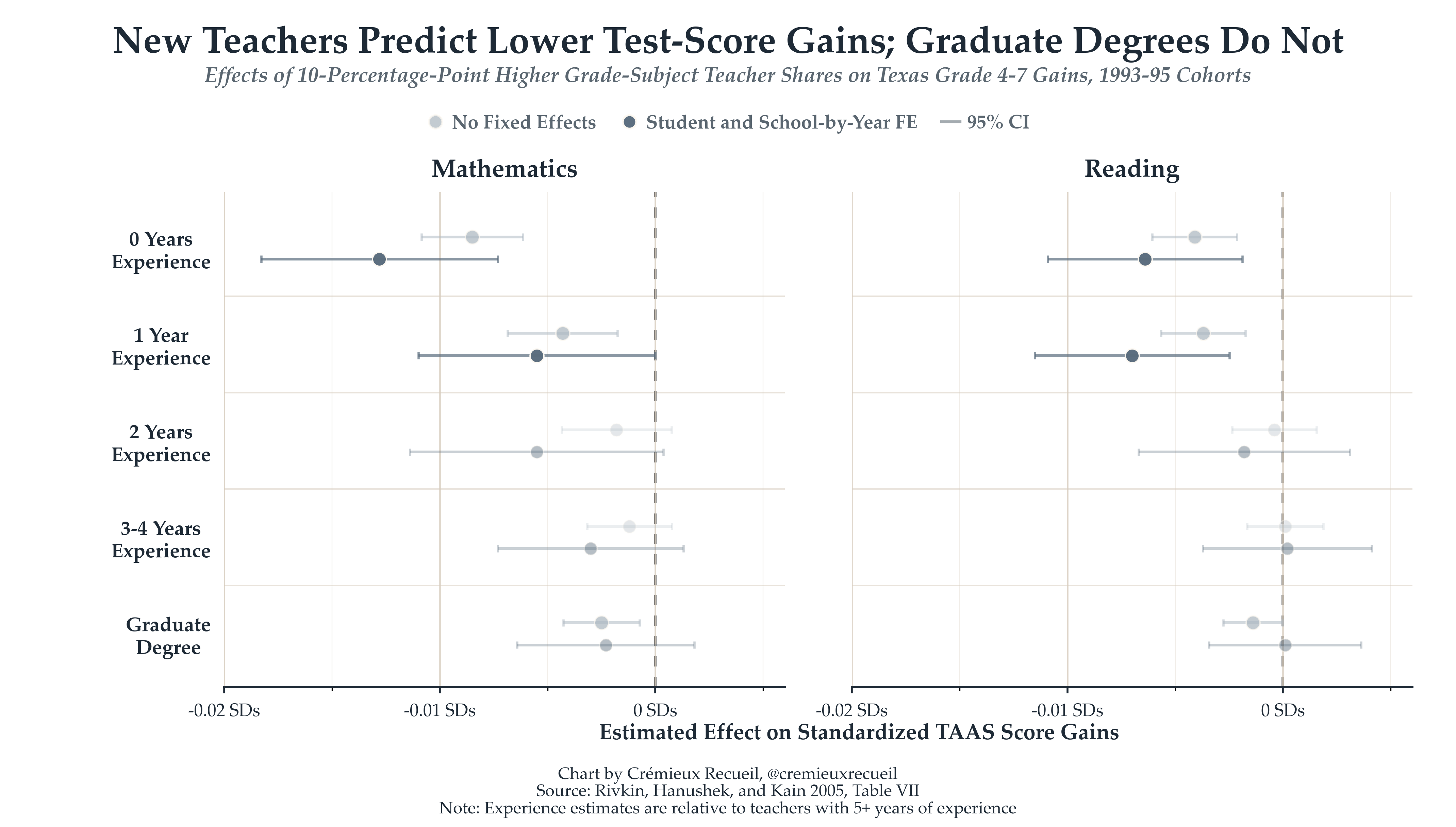
Rivkin, Hanushek and Kain used Texas Schools Project data and found that, with student fixed-effects, grade-subject teacher characteristics were irrelevant to student achievement. Graduate degrees and experience were unimportant, and though having little experience was significantly related to lower rates of performance gain, the scale of this was less than 0.01 SD in reading and less than 0.02 SD in mathematics, or just about nothing.
These results replicate again and again and again, and the message is clear: degrees, licensure, union requirements, professional development courses, trainings, experience, and so on have an, at most, limited effects, and at their worst, they’re slightly bad for students. Even letting people without formal teaching experience enter the profession doesn’t seem that bad! These are supported by replications from across the U.S. and the world in large, well-done studies with excellent measures.
But what about something more than degrees in general? What about specific degrees? Sancassani found that those don’t do much either. In a within-student, within-teacher fixed-effects model, a subject-matched degree only boosted student test scores by 0.035 standard deviations—and this was in an international sample where effects were larger in less developed countries!2 Inoue and Tanaka found practically the same thing using earlier waves of the same dataset. Their conclusions mirror the literature.
People are too obsessed with easily identified teacher qualifications. They shouldn’t be. Plenty of people without qualifications make for good teachers, and teachers with higher credentials aren’t much better than teachers with lesser ones. Don’t get confused by the allure of credentialism, or you might end up believing wacky things, like that homeschooling isn’t possible for parents without educator credentials.
As an aside, in aggregate, schools explain little variance in student achievement cross-sectionally:


This study also estimated the effect of years of experience and found that the benefits peaked at 18 years, at about +0.065 standard deviations, whereafter they decline to about 0.0275 standard deviations around 38 years. They rose from about 0.038 standard deviations at one year in.
Another aspect of requiring advanced degrees is the continuation of student loan debt. I work in the mortgage industry and see many teachers with student loan payments that exceed their car payments. If a teacher is married to another teacher, monthly payments can equal or exceed the mortgage payment they are applying for.
The system in my state requires the continuing education to advance up the pay scale. This system guantees income for universities on the backs of the teachers.
Am I misinterpreting the first graph or do high school teachers seem to get worse with time, to about the same degree that elementary and middle school teachers improve? This is surprising to me