

This was a timed post. The way these work is that if it takes me more than one hour to complete the post, an applet that I made deletes everything I’ve written so far and I abandon the post. You can find my previous timed post here.
All the nations of the world have come together to compete to see who has the greatest athletes. It’s time for the Olympics.
I will assume that every reader is familiar with what the Olympics are, and I’ll endeavor to explain something interesting about them: host advantage. As it turns out, the Olympics do not seem entirely fair; hosting countries have notable advantages: they win more medals and take home a higher share of the prestigious golds! Why this is has always been mysterious. Visually, the host advantage looks like:1
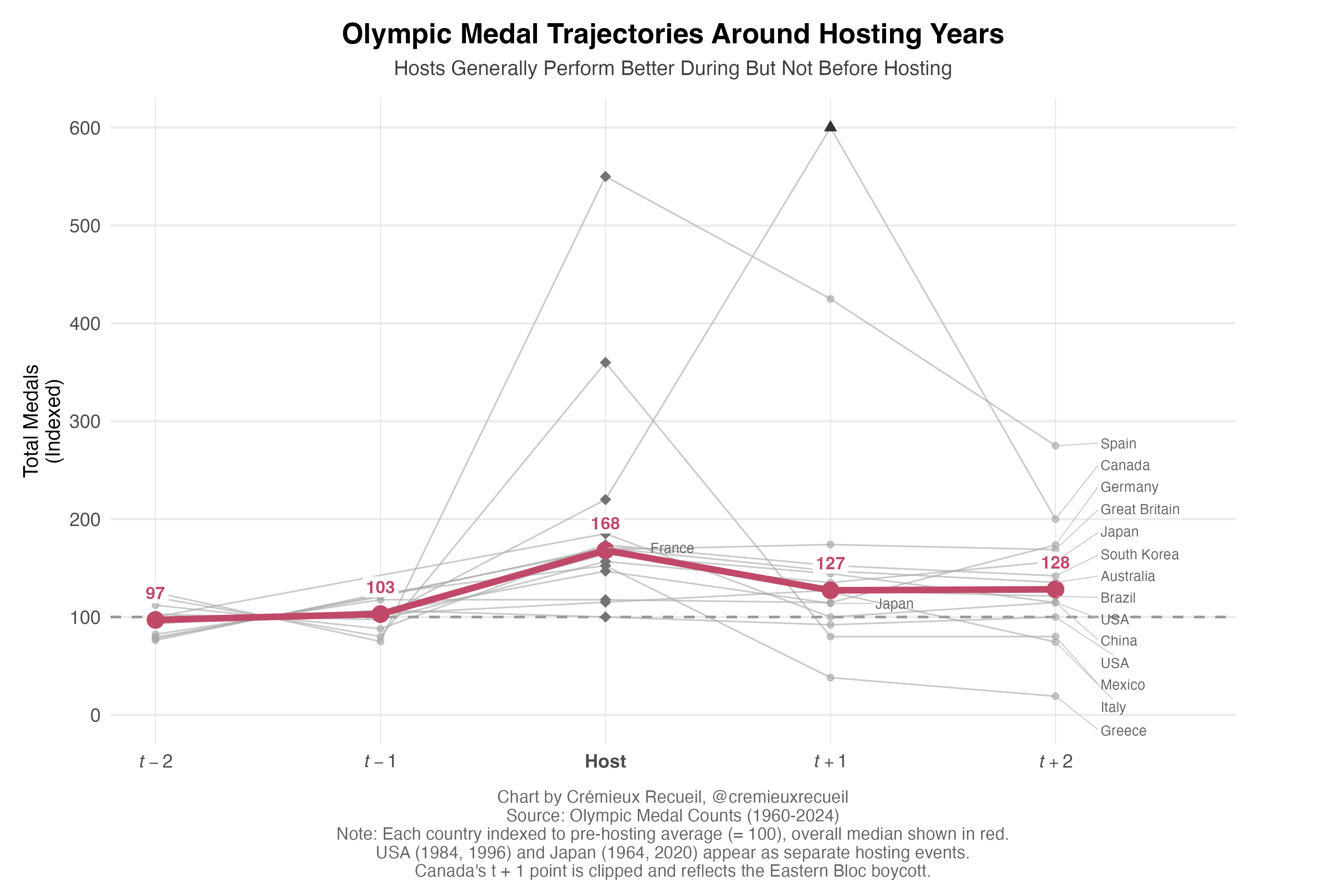
The Olympic host advantage is large, but it substantially fades out. There’s some room to think that hosting countries might invest more effort into finding and training athletes, but that’s unlikely to be all there is to this, since they don’t perform as well in subsequent games. We’ll have to dig deeper.
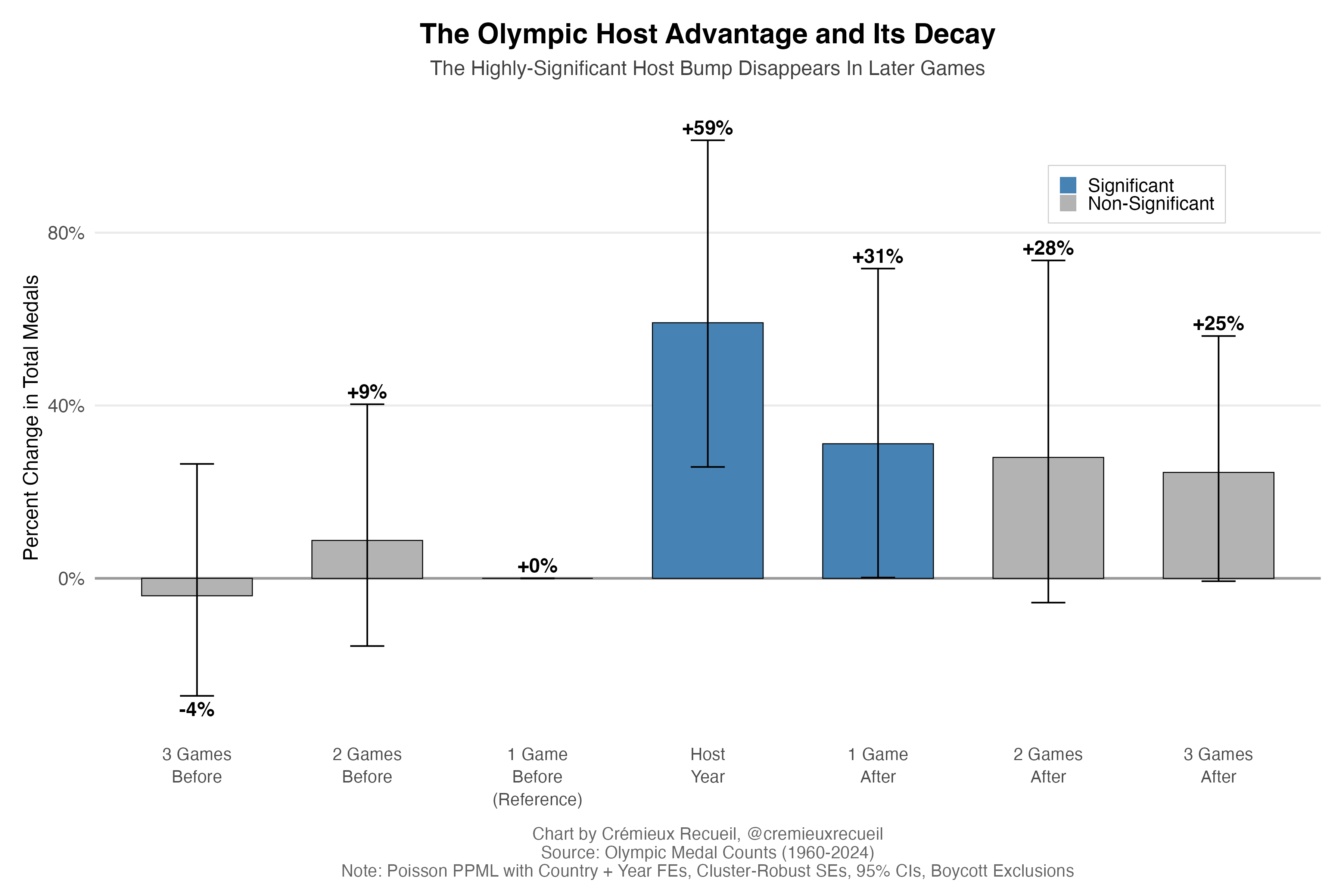
To start, we’ll look at the difference-in-differences effect of hosting on winning medals:
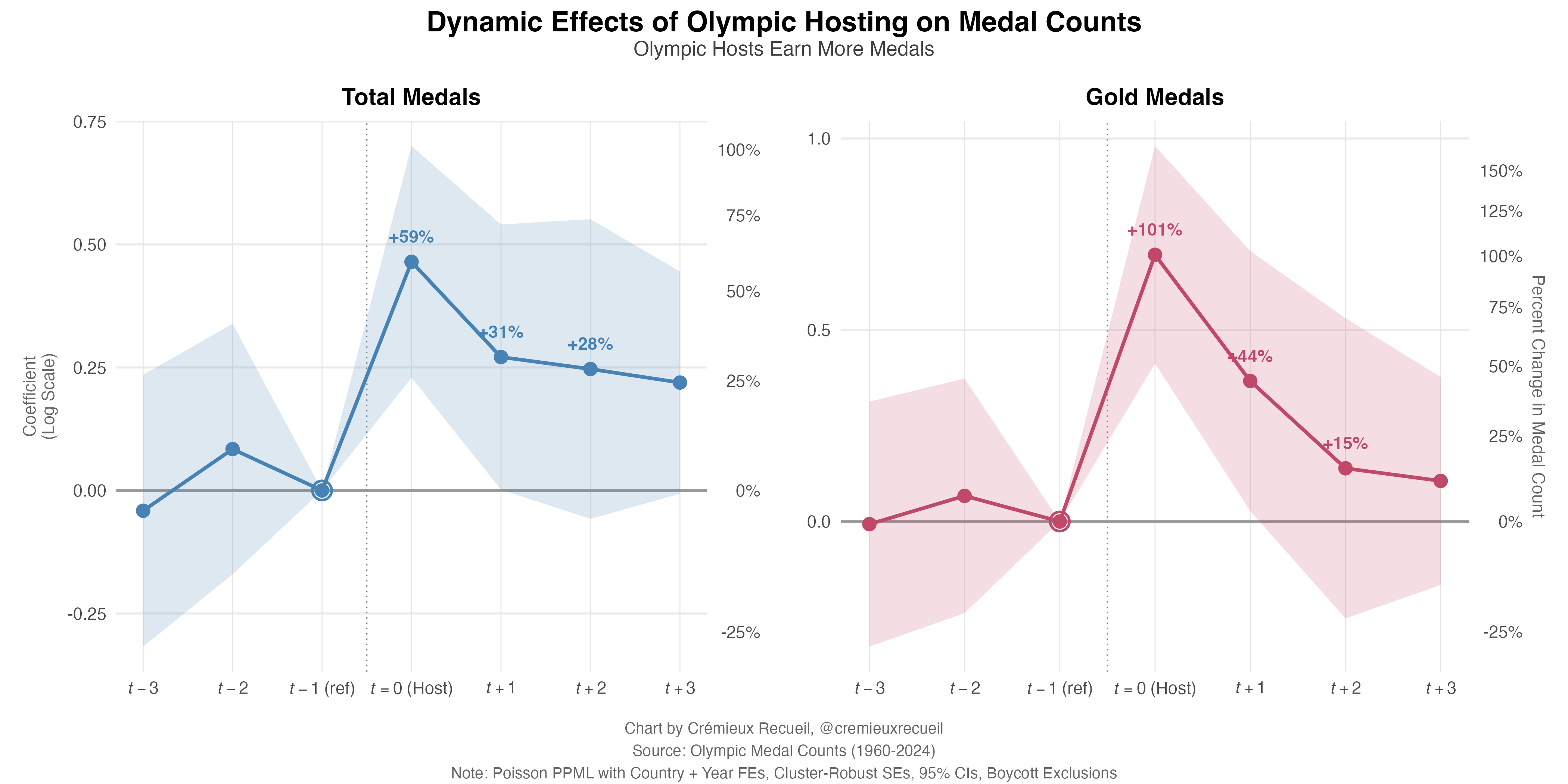
The effect is large, it is statistically significant, and it significantly fades, too. The effect is also robust to alternative specifications2 and it affects both total and gold medals.3 Does it hold when controlling for (World Bank 2015 US$) GDP Per Capita and population size?4 Yes! So those variables on their own are not what explains the host effect either:5
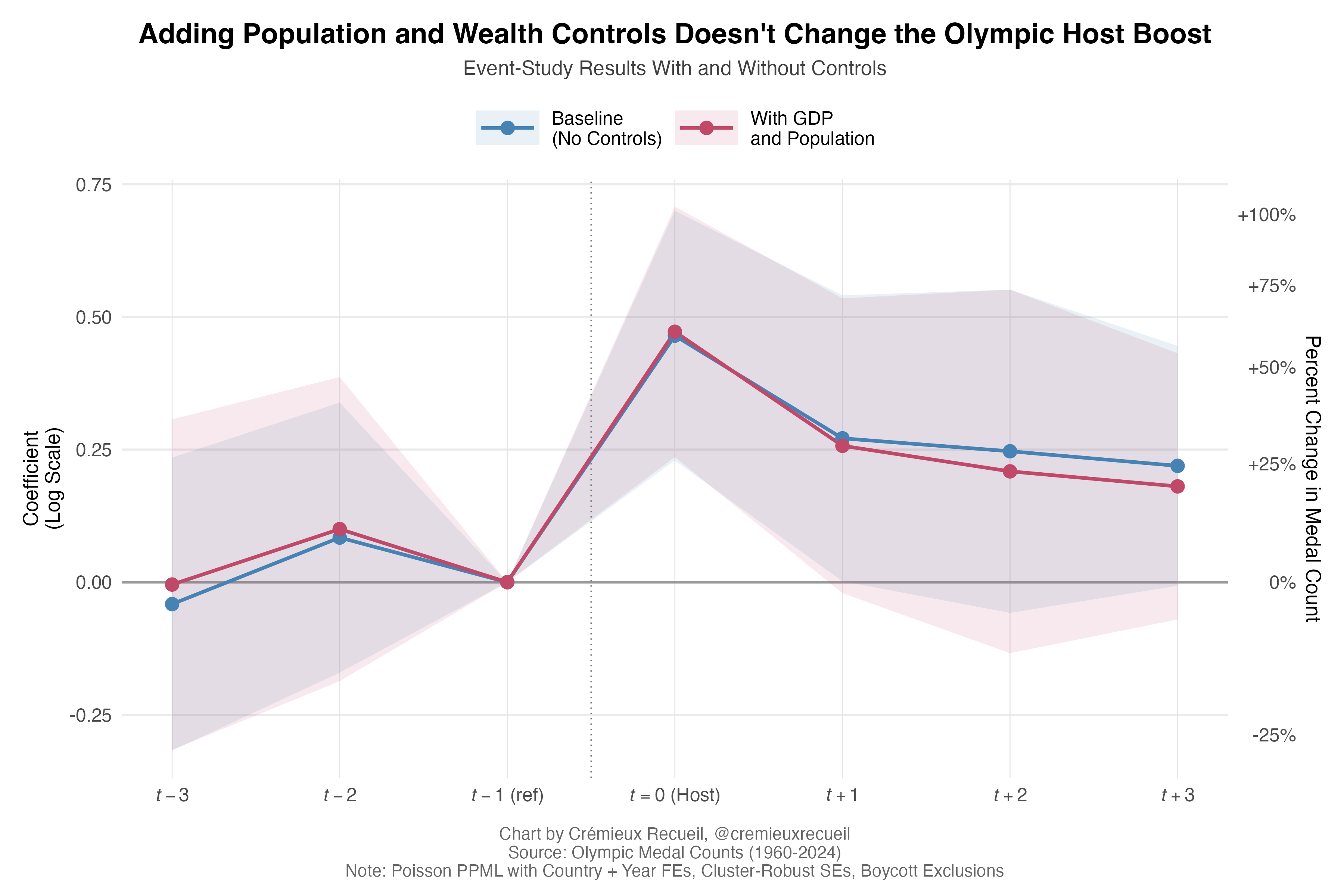
So far, we’ve narrowed down the possibilities somewhat, but we still haven’t reached any interesting answers as to what the host advantage really reflects. This next test does get us closer: the host effect is relatively larger for smaller countries.
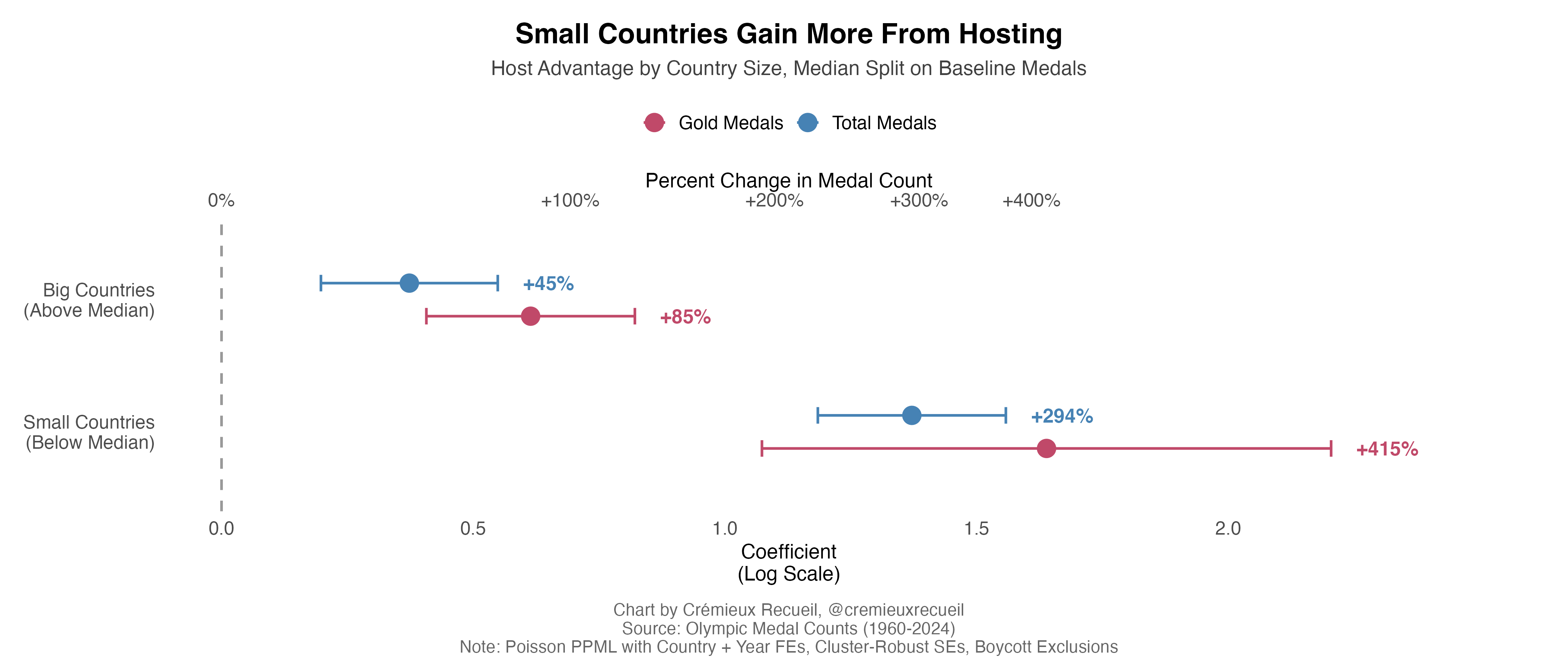
Why might small countries gain more from hosting the Olympics? The answer isn’t immediately obvious until you consider that the host gets to bring more athletes. Whoever is hosting will tend to have a big boost to their delegation size because their athletes will automatically qualify for many events that they might not have been able to submit athletes for had they not been the host.
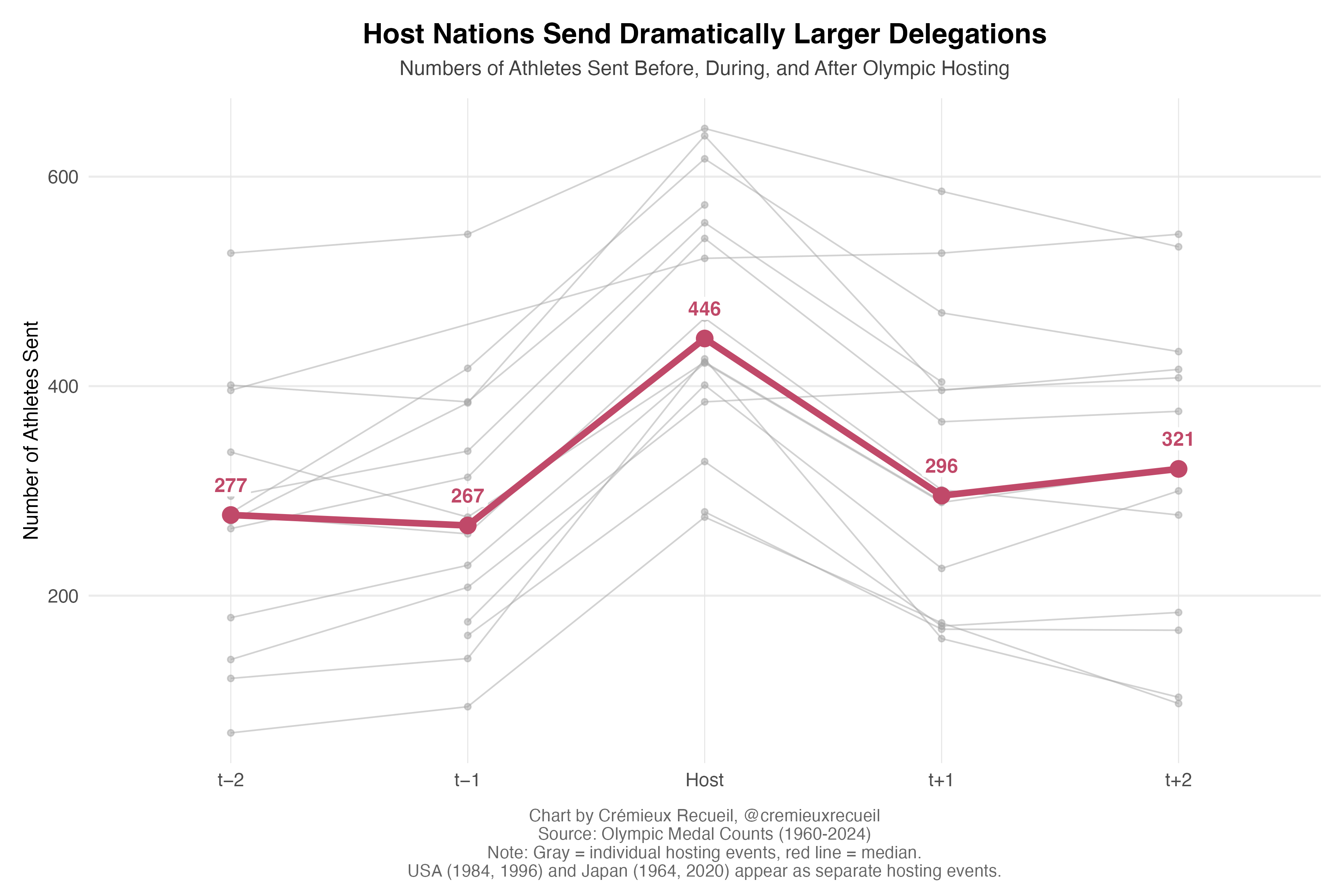
Consistent with this, hosting results in a huge bump to the number of athletes a country sends and then afterwards, they return to a more normal, but slightly elevated number in subsequent games.
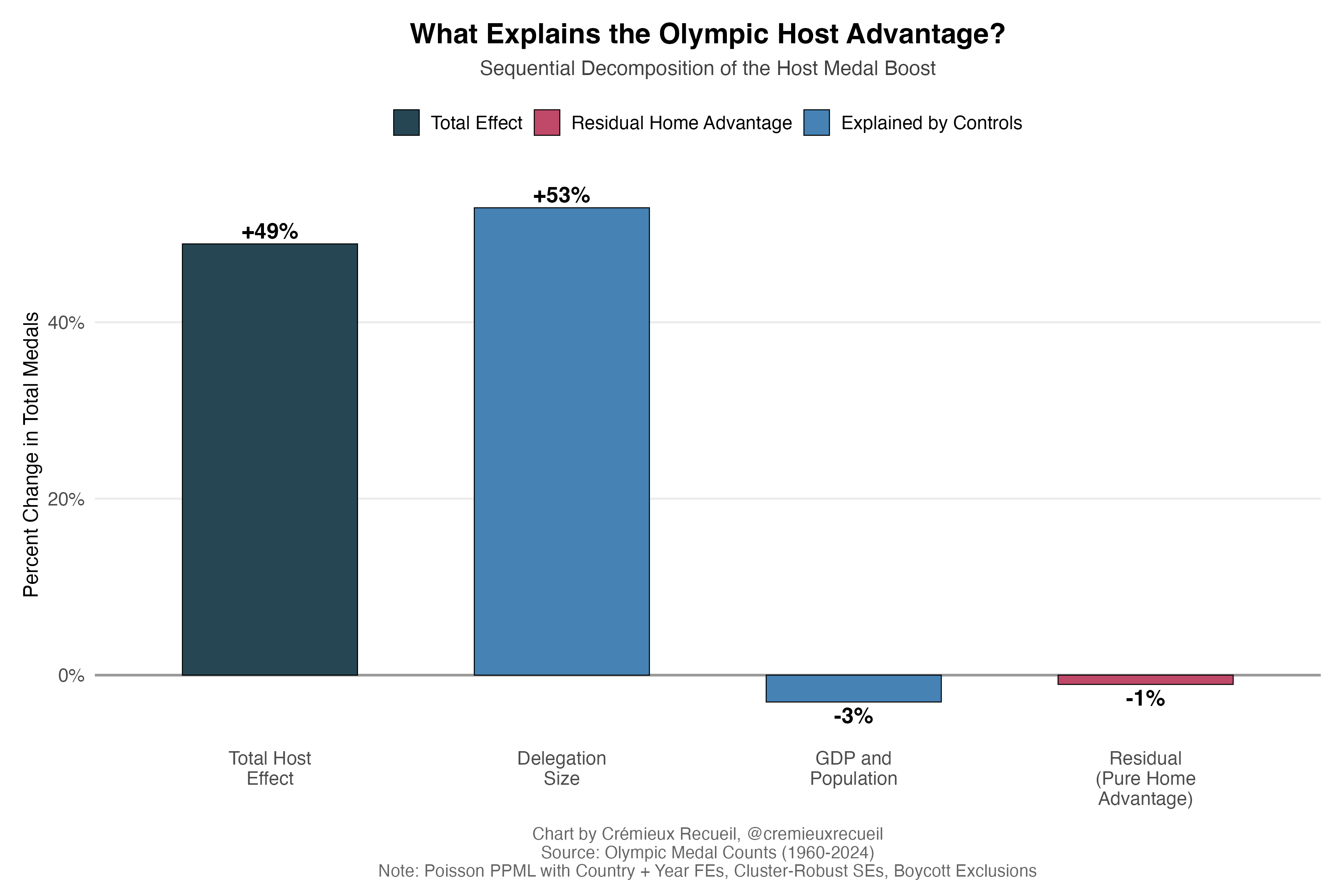
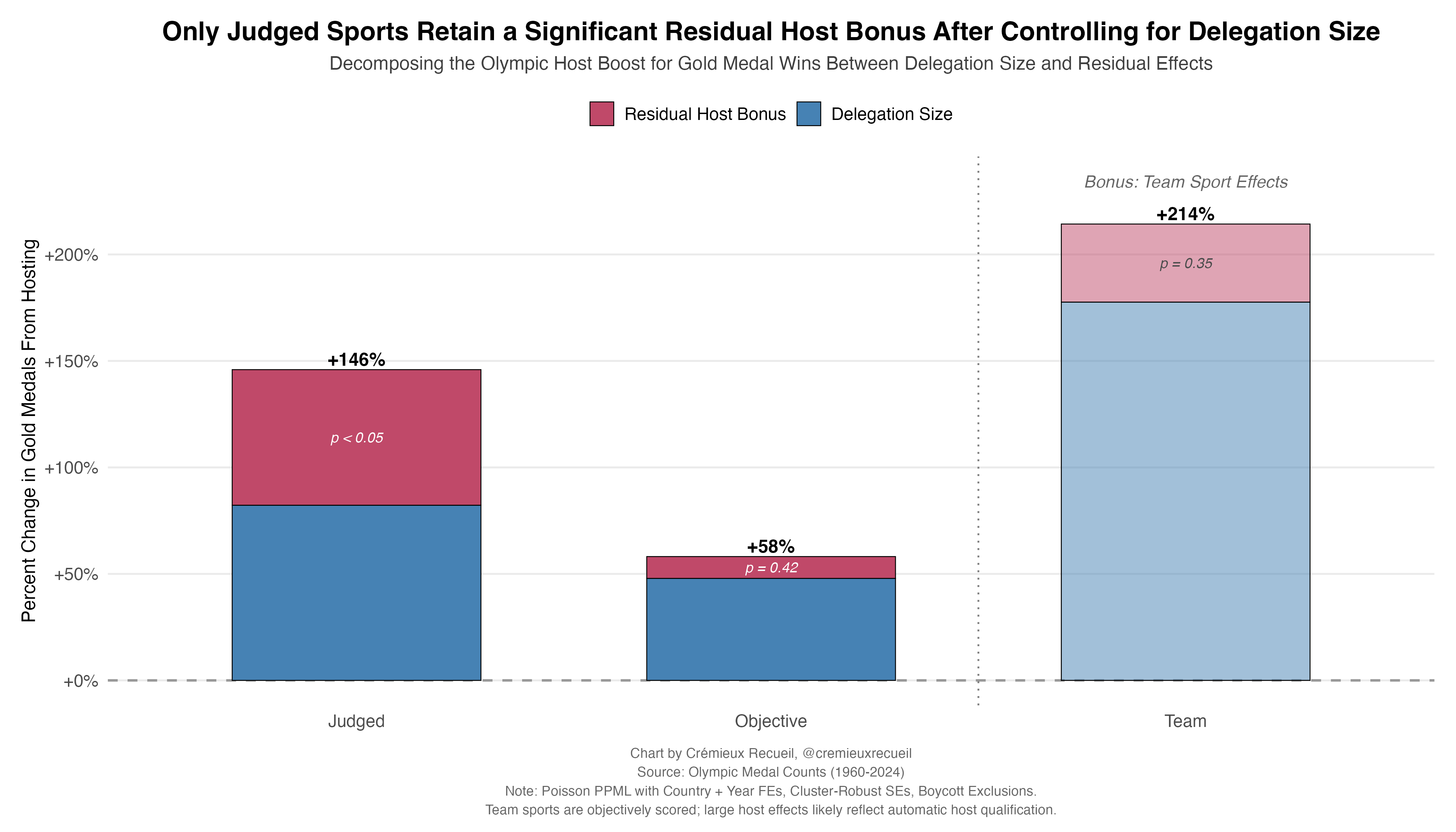
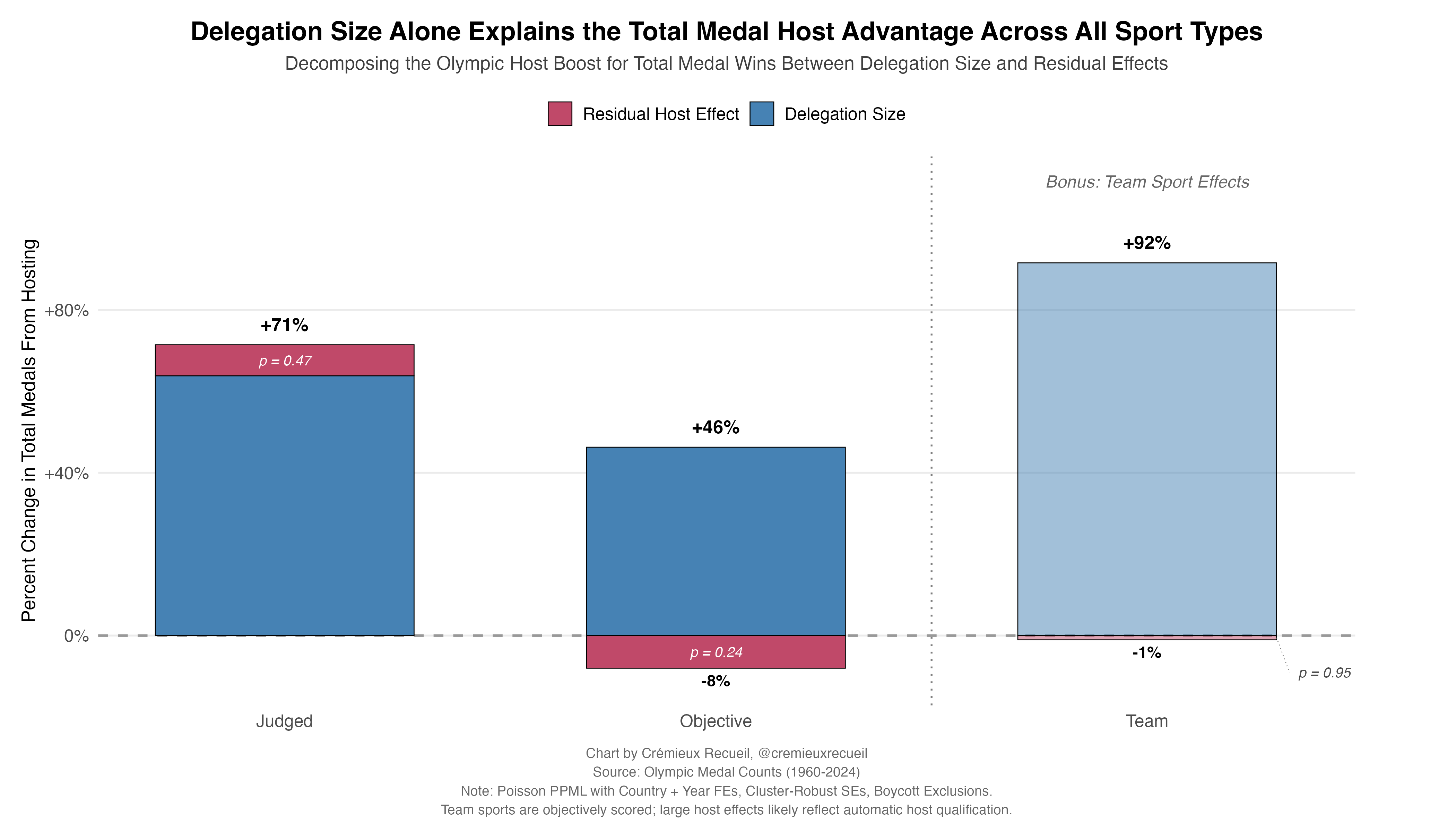
With just these variables in mind, we can decompose the host advantage6 and see that delegation size actually explains more than 100% of the host bonus! What this suggests is that hosting countries send a lot more athletes, but said athletes may not be as high-quality as the athletes they’d normally send, so they end up less successful on average, while bringing home more medals because they’re more numerous. Although, this residual is not significant, so let’s not make too much of it.
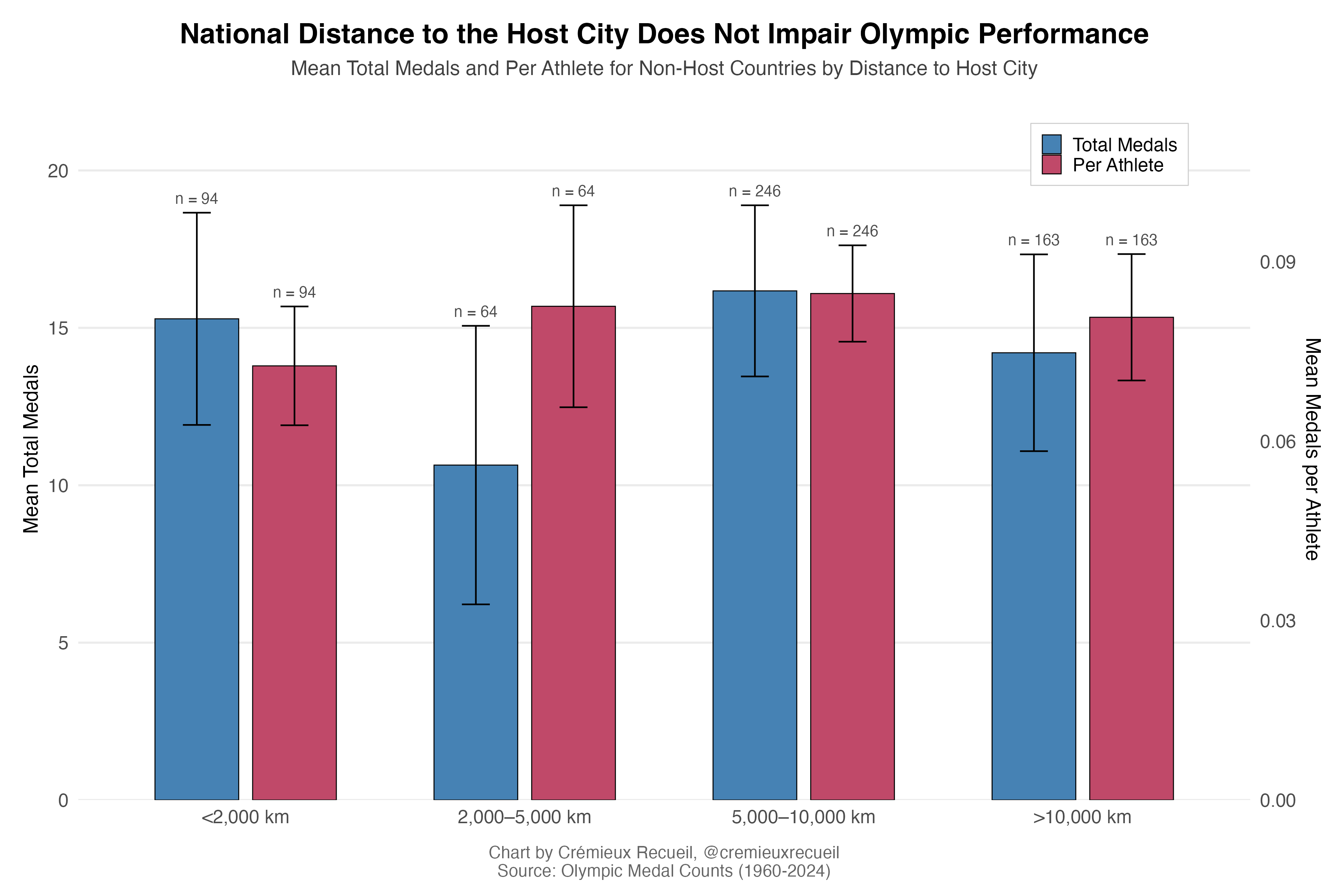
So, is that it? Possibly, but I think we can go deeper. For one, we need to address other possibilities. For example, what about jet lag and climactic effects? To proxy both, we can just look at the distance to the host city that sending countries are and see how the medal counts and per capita medal counts are. As it turns out, distance isn’t meaningful in any case: overall (shown) or as latitude and longitude (not shown).
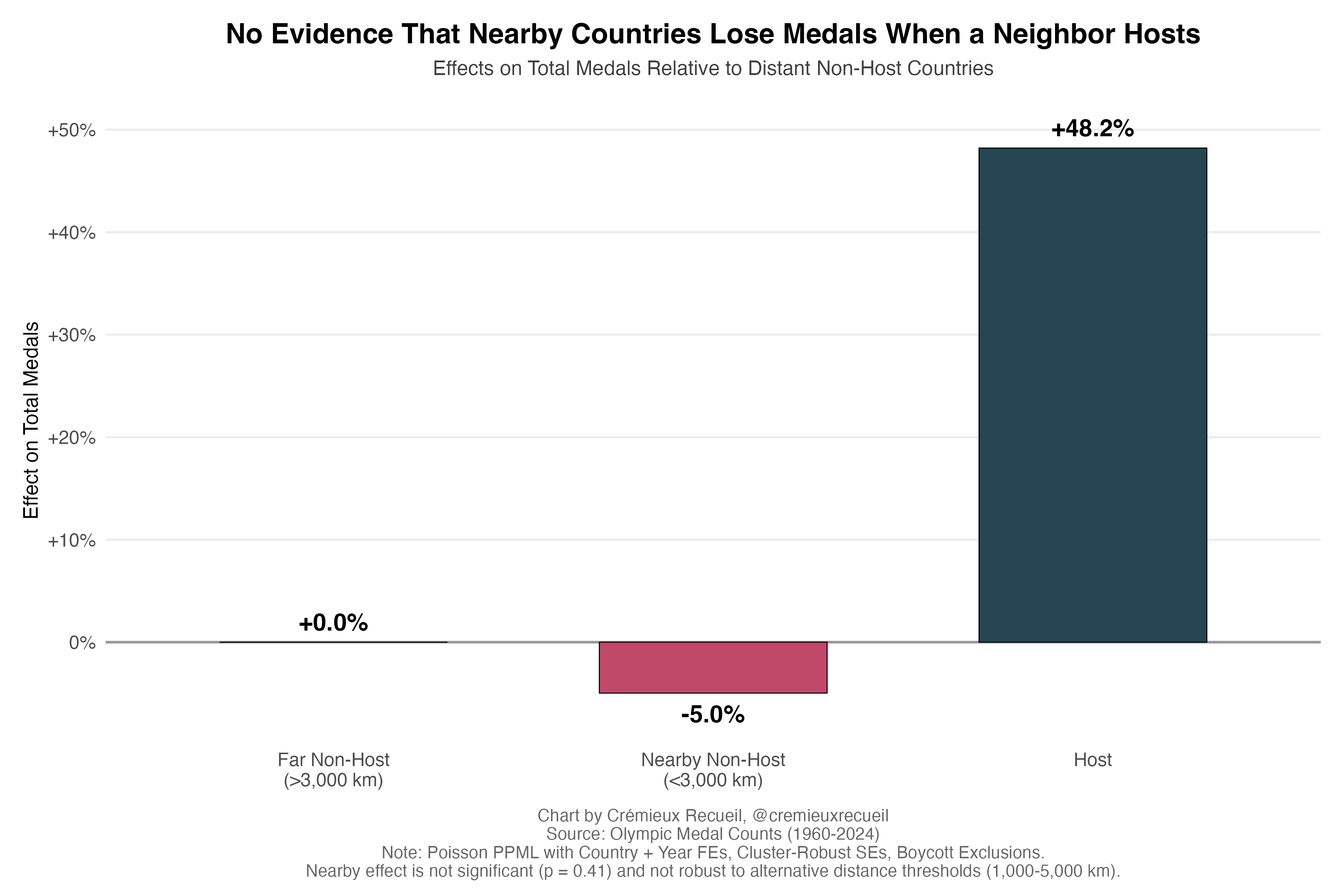
There’s also not some sort of distance-related cultural spillover effect, where nearby countries who host draw medals from countries that near them that might practice in similar sets of sports.
The real kicker for the Olympic host effect has to do with judging. The host, as it turns out, exerts considerable influence over two things that impact judging: for one, the judges themselves! For two, the crowds, as hosting countries get more seats for their countrymen at the events, and this might matter because there’s evidence home field advantages have to do with influencing people like referees.
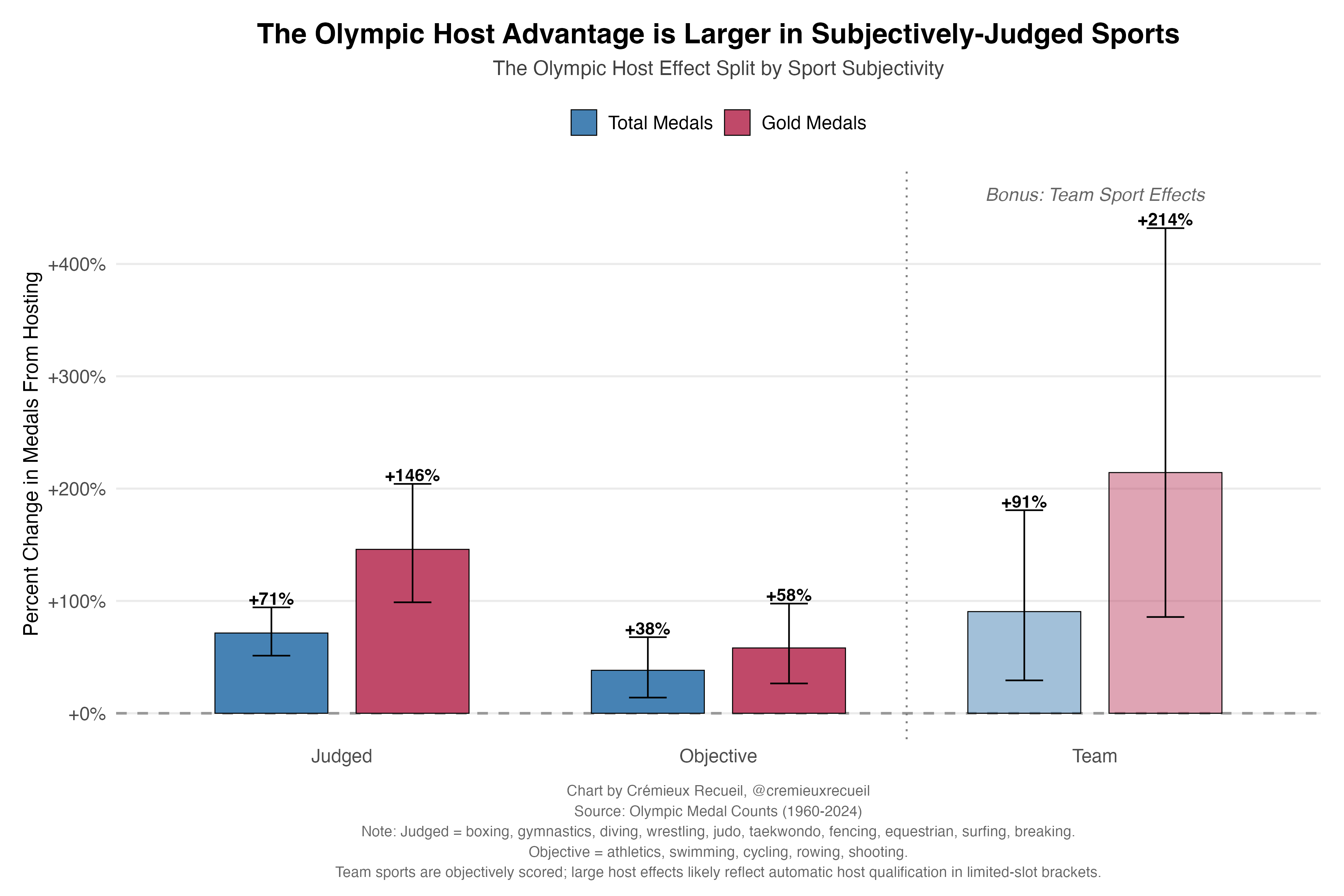
When we look at the Olympic host bonus, after we control for delegation size, there is no bonus. However, there is a significant interaction by medal type: the host may not gain significantly in terms of total medals beyond delegation effects,7 but they still earn more gold medals. That effect is only significant for events with subjective judging criteria:
A final concern could be that the host advantage reflects that hosts can select to add new events, and they’d be likely to select new events that favor them. Fortunately, this is only recent and we know which events have been added, and that they benefitted Japan and France, but not by enough to significantly alter any of our results so far. But while we’re on the subject of Japan, let’s focus on it a little more.
When Japan recently hosted the Olympics, COVID precautions made it so there were virtually no crowds. They had a normal-sized overall host advantage (p = 0.94 for total medals and p = 0.38 with a delegation size control), but no crowds. Given the lack of a crowd, the crowd size influence channel on judging should have been eliminated. We can thus leverage this natural experiment to figure out if it’s the crowds swaying judges or if it’s the judges being biased in home countries for some other reason.
As it turns out, the answer has nothing to do with crowd size. The subjective-only boost Japan received—even net of its choice to add skateboarding and karate as events—was completely normal!8 Japan's delegation-residualized judged-sport bonus at the fanless Tokyo Games was statistically indistinguishable from the typical host's (p = 0.59), and the overall judged-sport residual remains highly significant (p < 0.001) even with Tokyo excluded.9 Whatever mechanism drives the subjective scoring advantage, it operates with or without a home-based crowd.
Why Do Hosts Do Better?
Let’s go through things that we now know do not explain why Olympic hosts do better:
Being wealthier
Coming from bigger countries
Spillovers with neighbors
Being able to propose events10
Jet lag
Climate familiarity
Higher athlete quality via additional funding, training, etc.
Favorable crowds11
And now let’s talk about the pathways that really matter:
Being able to send more delegates is the primary mediator of the host advantage
Being able to influence judges is the primary mediator of residual host advantage in earning gold medals
The reason Olympic hosts earn more medals at the Olympics is overwhelmingly because they send more athletes. The reason they earn more gold medals above and beyond sending more athletes is because they influence judges.12
Note: my analysis only concerns the Summer Olympics, and only modern years (c. 1960-2024), with the boycott countries excluded.
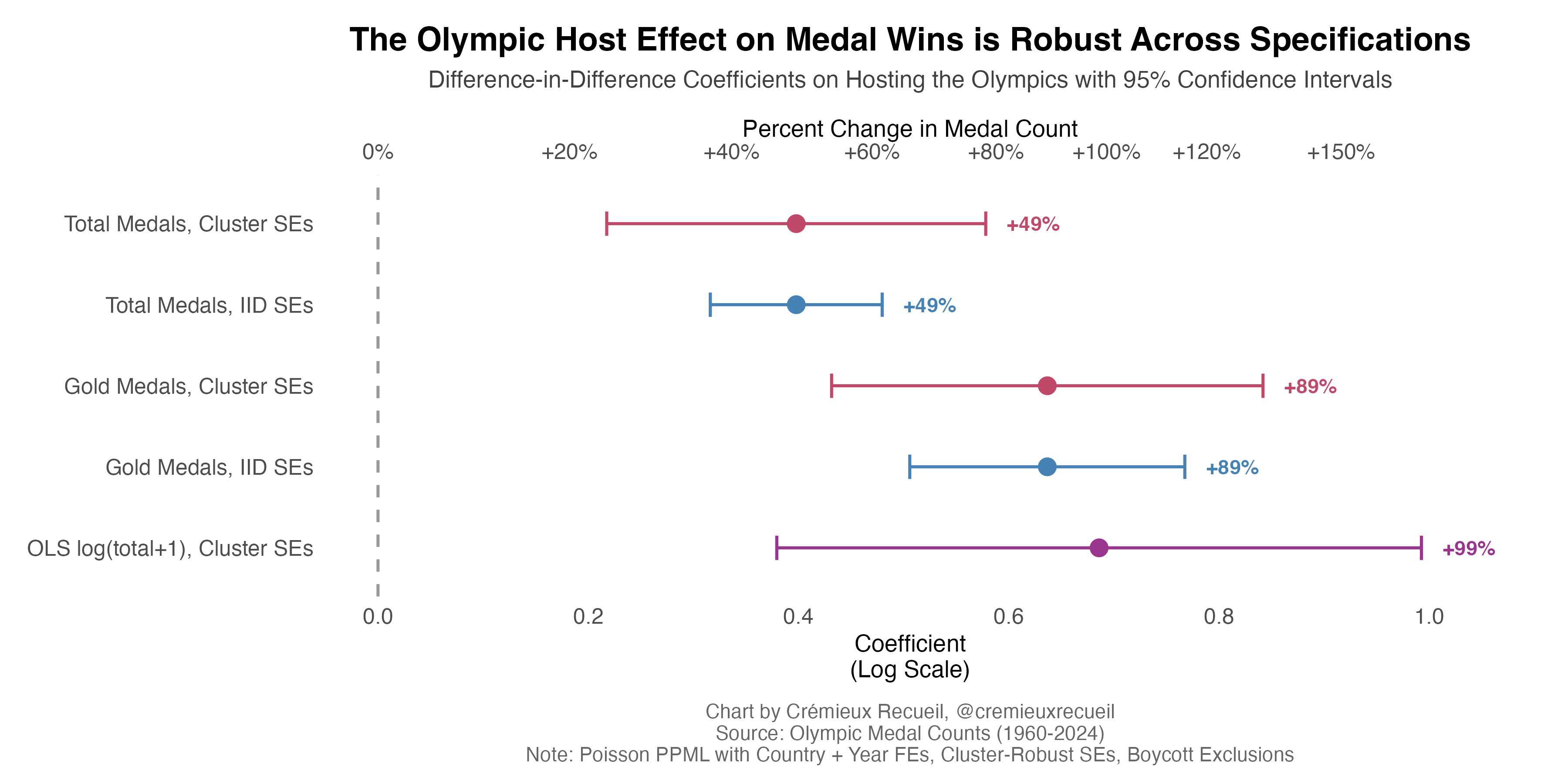
Alternative specifications listed below:
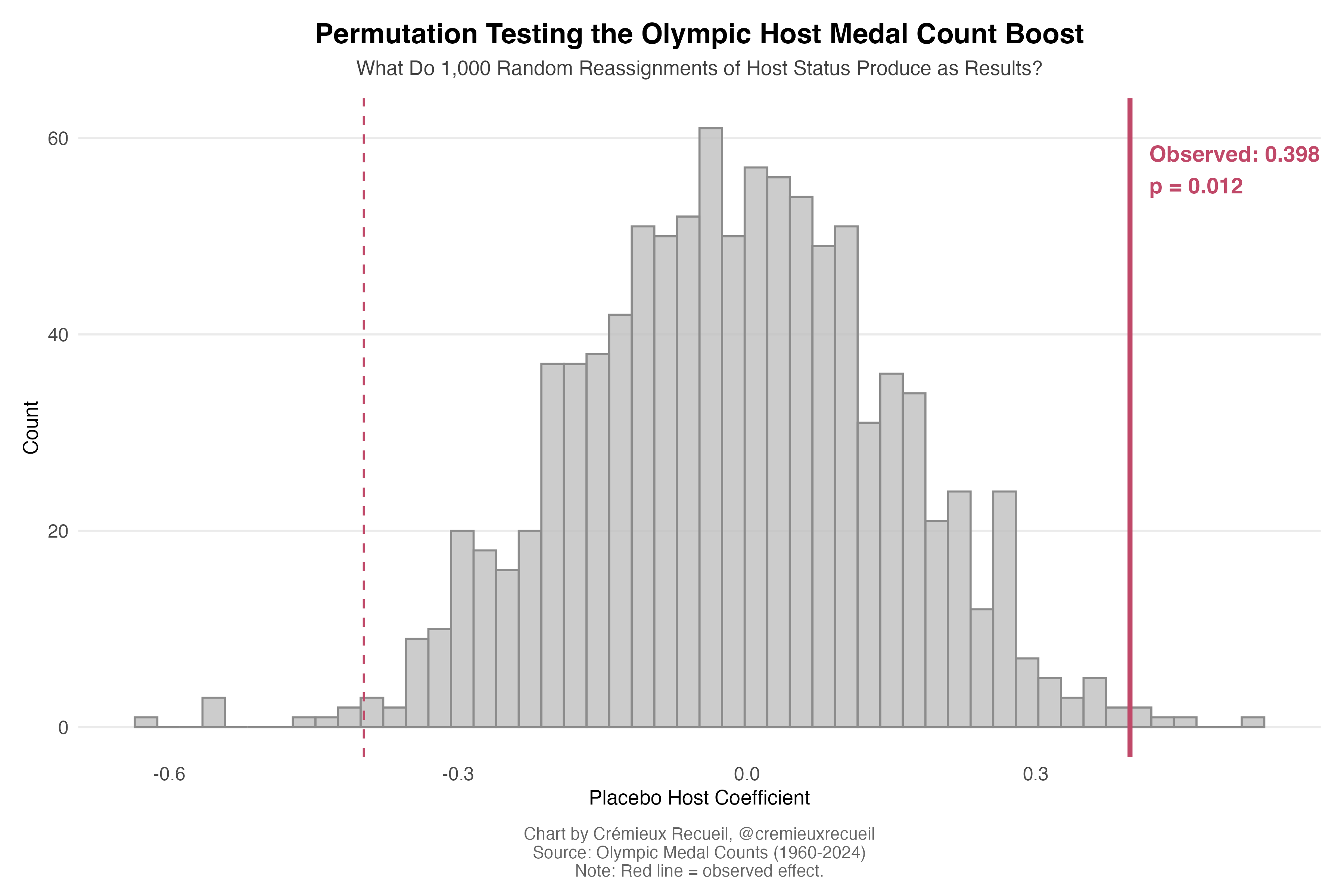
We can also subject the effect to a permutation test and see that it holds up, but this isn’t saying much since that’s practically just repeating the p-value:
Here’s another visualization method:
I lacked PPPs for the whole period, but the country and year fixed effects should fill that role anyway. The impact of not using PPPs is limited.
This is also robust across different specifications:
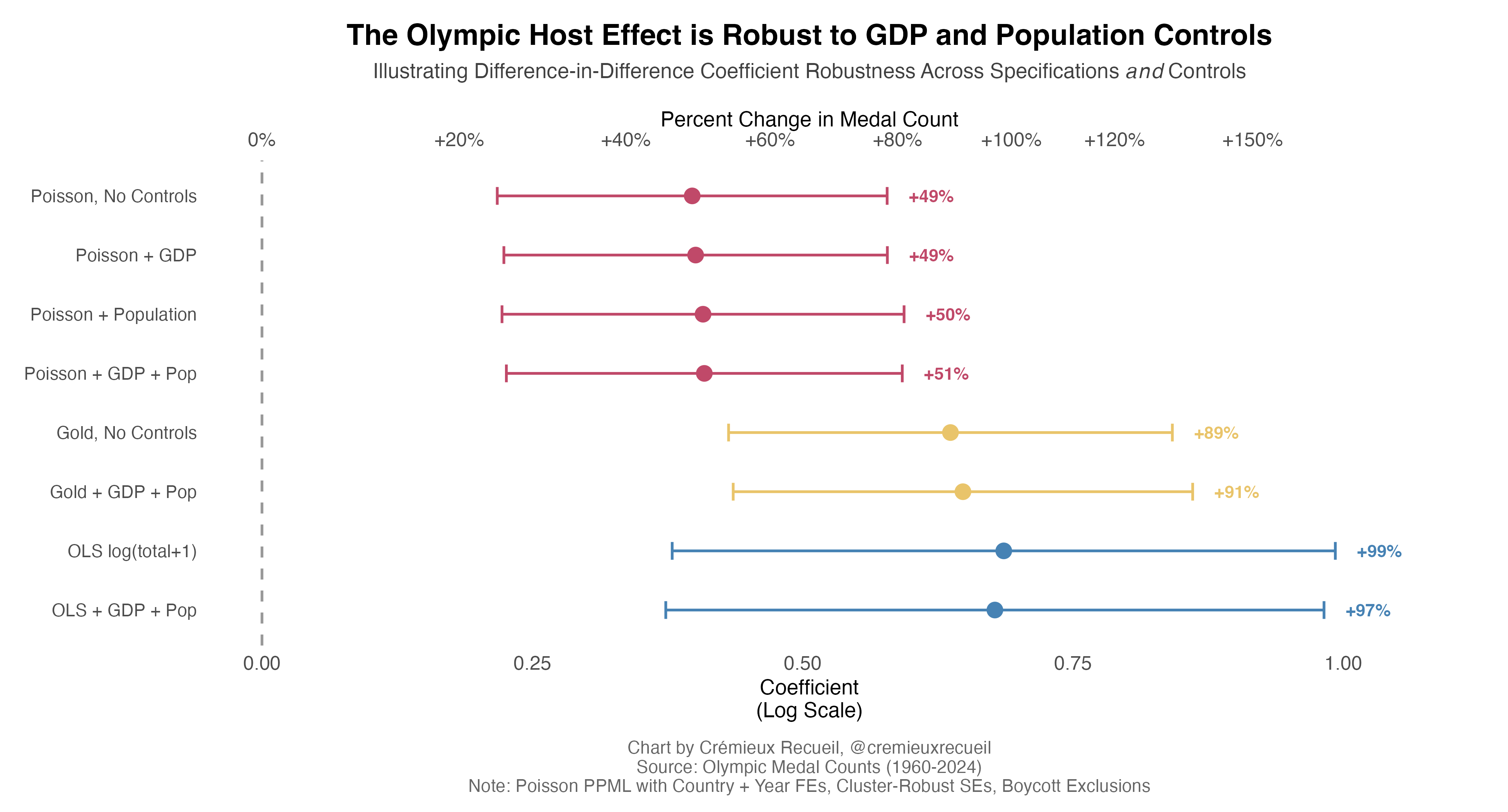
The coefficient on this appears smaller than the coefficient from the earlier figures only because of the difference in comparison. This figure shows a static difference-in-differences result against a dummy in the hosting year itself.
You can see this illustrated like so, and also take note: the extra delegation size effect is not just mediated by hosting countries being more likely to take part in sports involving large teams, which tend to have fewer medals per Olympian. There is a host effect across all competition types. And yes, I am aware there are some subjective team sports, I just didn’t want these figures to have captions that were too bulky.
Although this difference was not statistically significant.
And they had no significant gold advantage in objective sports net of delegation size.
Although this increases the host advantage and if it’s kept as a feature, will make it larger going forward.
This is probable, but let’s not say it’s definitive just yet, because Japan might be culturally unique in some way that isn’t apparent in our data. A better way to analyze this would be to obtain data on variation in ticket provisioning in different events, to people from different countries. But this data is unavailable, unfortunately, so we can’t do that.
As a sort of postscript, allow me to say this:
There’s a lot more juice to squeeze in athletics. Countries like Norway and Australia—with their more extensive funding and athlete searches and concomitant outperformance—show that. This is unrelated to host advantages and more to the choice to fund athletics and talent searching. Countries that do that will consistently outperform, because we are nowhere near having an Olympics peopled by the best of the best in any population. Instead, the current Olympic crop is a select sample that’s good or maybe great depending on the event, but is far from as good as it can be. Countries that search make that very clear.
One more thing: I think that host countries were typically allowed to get away with a little more PEDS juicing in the past, although the IOC cracked down on Russia after the 2014 Sochi winter games when Russia made itself unpopular by seizing Crimea.
The Spanish won a number of prestigious medals in 1992 in Barcelona that they didn't have much of a history in those events before. In retrospect, it looks like EPO was already big in Southern Europe in the early 1990s before getting to East Africa in 1995.
To get ready for the 2000 Sydney games, the Australians hired a lot of disgraced East German ex-coaches.
Canada notoriously underperformed at the 1976 Montreal Olympics and 1988 Calgary Olympics, so when they got the 2010 Vancouver Whistler Olympics they made damn sure that wouldn’t happen again. And finally they won a gold on home soil!
Of course, the Olympics have expanded a lot, both in number of sports and women’s events. It’s pretty easy to game the Olympics by racking up medals in the least popular events. You can also invest in the sports that issue the most medals.
I would also point out a training advantage. Your athletes can train on the actual luge track, ski jump, etc. You can also adjust conditions a bit to suit your home athletes.