

This was a timed post. The way these work is that if it takes me more than an hour to complete the post, an applet that I made deletes everything I’ve written so far and I abandon the post. You can find my previous timed post here.
I don’t like the term ‘ultraprocessed food’. It’s vague, and the vagueness might even be intentional. The inventors of the most popular food processing classification scheme—NOVA—have failed to provide a detailed breakdown of which foods count as processed, unprocessed, or ultraprocessed. Despite that, it’s currently all the rage to talk about how bad ultraprocessed food is for health.
Take a peanut in a shell. That’s an unprocessed food (Group 1), but when you crack it open, that’s a minimally-processed food (Group 2). If you want to get dangerous, crush it up into a paste, add some salt, and now you’ve got peanut butter, a processed food (Group 3). If you add some sugar on top and put in a dab of vegetable oil to stop the oil from separating, you now have ultraprocessed peanut butter! (Group 4)
By today’s received wisdom, you went from something benign and safe to something whose consumption is dangerous and liable to promote all manner of health ills, from heart attacks to diabetes to cancer. But in that example, there’s little nutritional change going from Group 1 to Group 4, and that example isn’t particularly unusual. Per NUPENS—the creators of NOVA—if you slice a potato and bake it, it’s unprocessed, just like a peanut in a shell. But, if you take that potato and fry it, it jumps right into Group 4 and becomes an ultraprocessed food. Shake it off and dry it out and there’s no nutritional difference for your body to detect, so who cares that it jumped groups?
If you add a teaspoon of honey to plain yogurt at a factory, it goes straight from Group 1 to Group 4. If a factory grinds roasted peanuts into peanut butter, they go from Group 1 to either Group 3 or 4—it’s not completely clear. Bread baked at home slots into Group 3, but an identical recipe baked in a factory with a single preservative goes in Group 4.
When you see examples like fortified breakfast cereal (Group 4) being classified worse than white rice (Group 1) even though it’s substantially healthier, it can make the system look useless. But that’s how it is:
Fruit is minimally processed and fruit in sugar syrup is processed;
Applesauce with added sweetener can be minimally processed or just processed, but if you sweeten it with high-fructose corn syrup, it’s ultraprocessed;
Beer, cider and wine are merely processed whereas distilled spirits are ultraprocessed;
Margarine and spreads are ultraprocessed while butter is a culinary ingredient;
Powdered milk is objectively processed but it’s listed as minimally processed, while almond milk just requires soaking, grinding, filtering, adding water, homogenizing, and pasteurizing—steps that have no nutritional impact whatsoever—and as a result, it’s listed as either processed or ultraprocessed.1 Compare this to normal cow’s milk, which retains minimally processed status after homogenization and pasteurization.
After you’ve familiarized yourself with NOVA, it becomes apparent that the classification scheme is capturing something about ‘naturalness’ and industrial context rather than nutrition. All food processing classification methods are attempts to provide scientific-sounding language that makes industrial-scale food production sound dubious. They fill a niche for health and wellness influencers who want to moralize about food and nutrition but know that if they just said ‘added sugar is bad’, their complaints would be obvious and their disdain would be morally unsatisfying.2
But moralizing catches on. There’s demand for ways to praise and celebrate the aesthetics of basic cooking and to attack complex food preparation, just as there’s demand for ways to attack modern lifestyles in general. But demand doesn’t substitute for nutrition guidance: good guidance still needs nutritional facts, not expressions of anxiety about modernity.
Empirically-Speaking
I used the NHANES dataset to look into the question of what ultraprocessed food intake was even correlated with. I checked basic correlations, moved up to extensive matching exercises, and took the analysis plausibly causal by checking if ultraprocessed food consumption mattered within households. I found that the picture is unclear. For starters, read this:
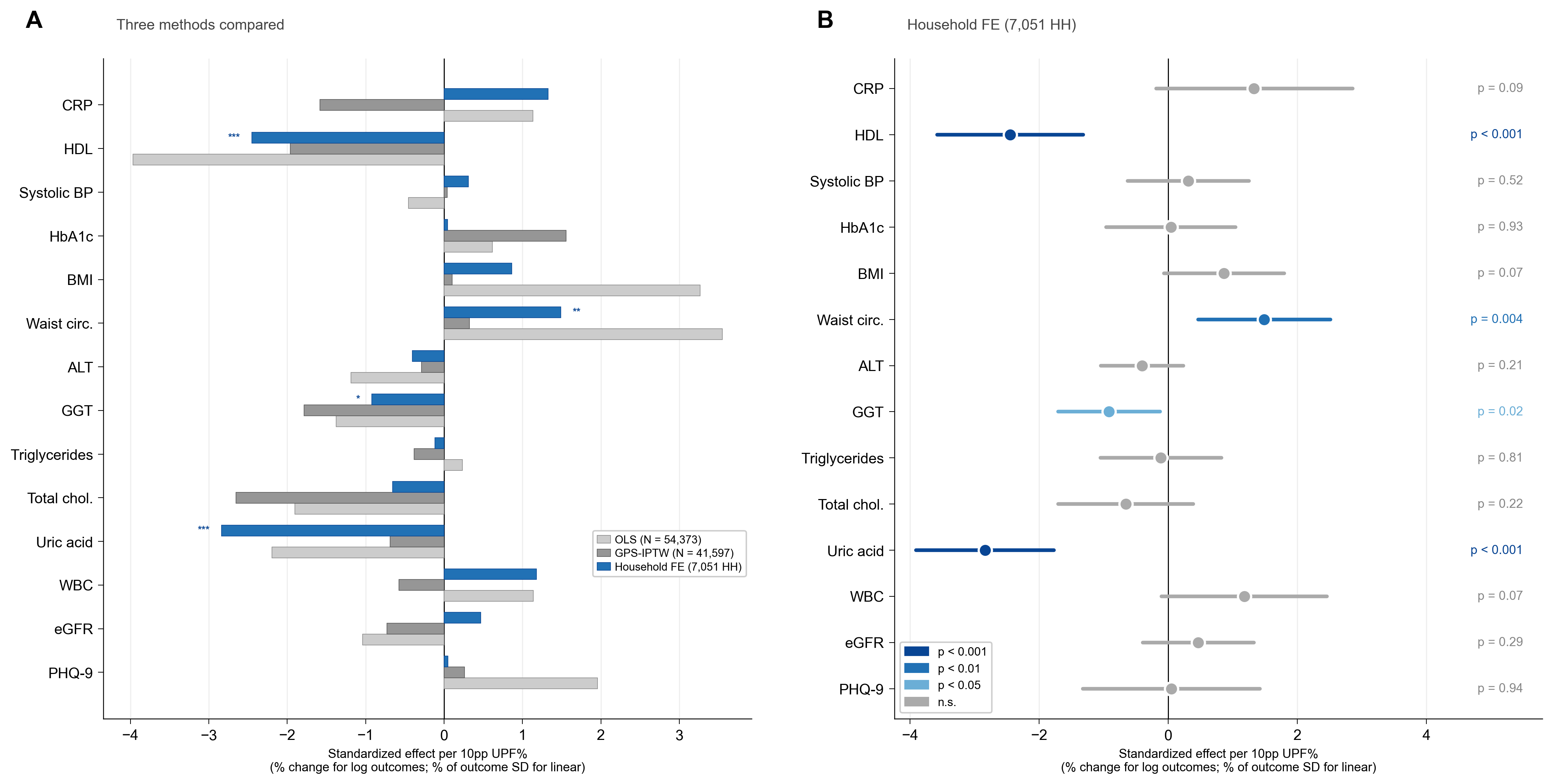
With basic ordinary least squares (OLS) regressions, ultraprocessed food intake is correlated with higher white blood cell count, lower HDL, lower blood pressure—wait what? These correlations aren’t even consistently bad, they’re all over the place. Then, if we switch to the plausibly-causal household-level analysis, only four results remain significant, and only two do so in a way that’s robust to multiple comparisons correction remain significant: lower HDL (bad) and lower uric acid (good).
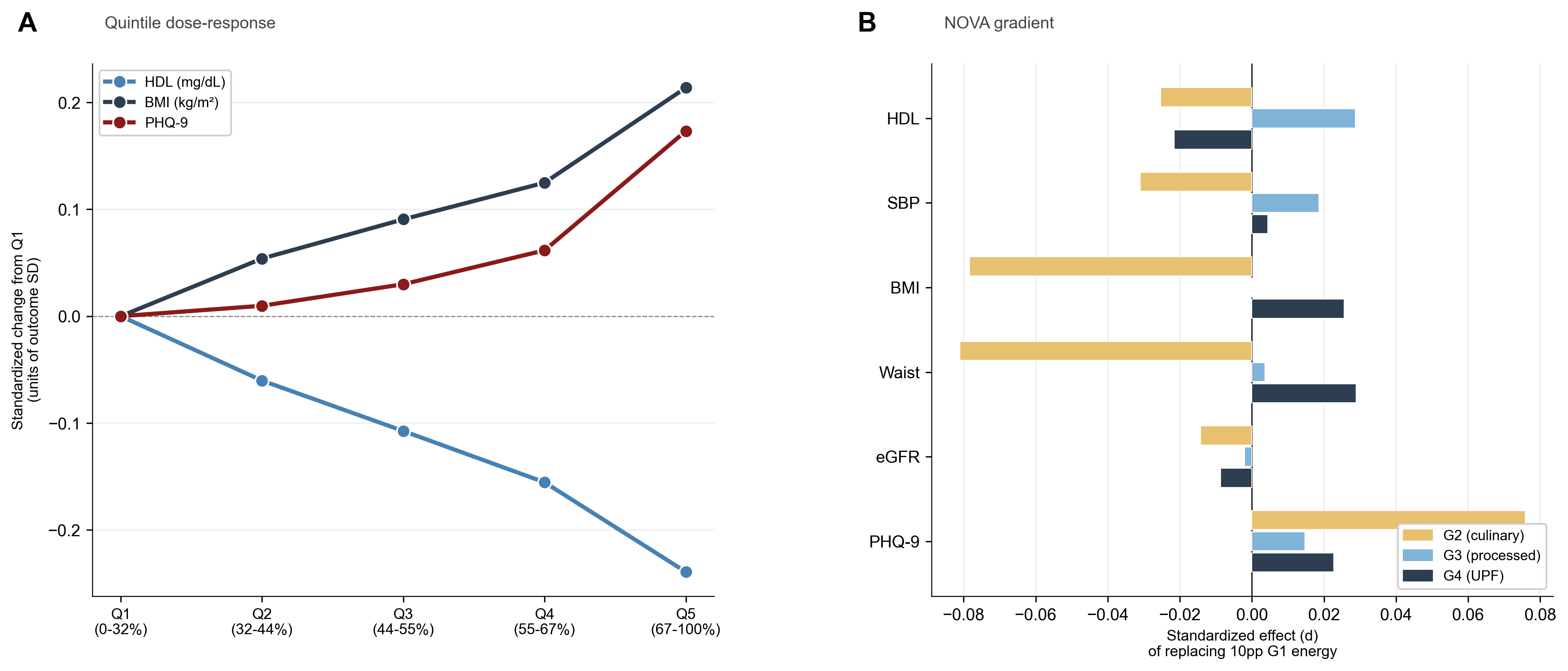
This is a bizarre set of relationships that only gets worse when you look at the gradient of effects across NOVA categories. For some reason, you can see different signs of effects for processed and ultraprocessed foods at times. How odd!
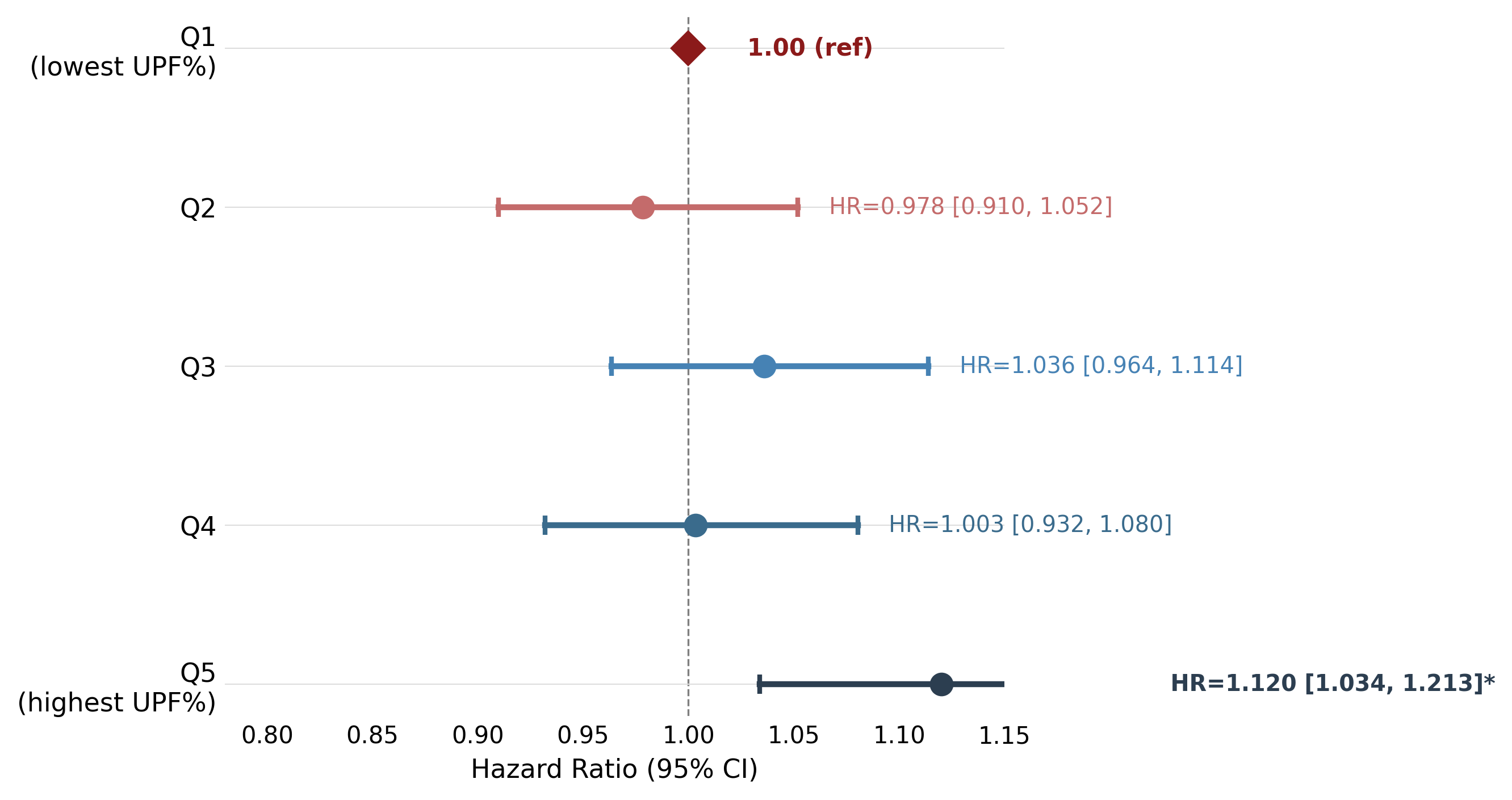
If we change up our dose-response analysis and look at all-cause mortality—the hardest of hard outcomes—then the results just don’t look that bad: it seems to only be the most extreme ultraprocessed food eaters who are at risk, and they’re not at much risk in any case.
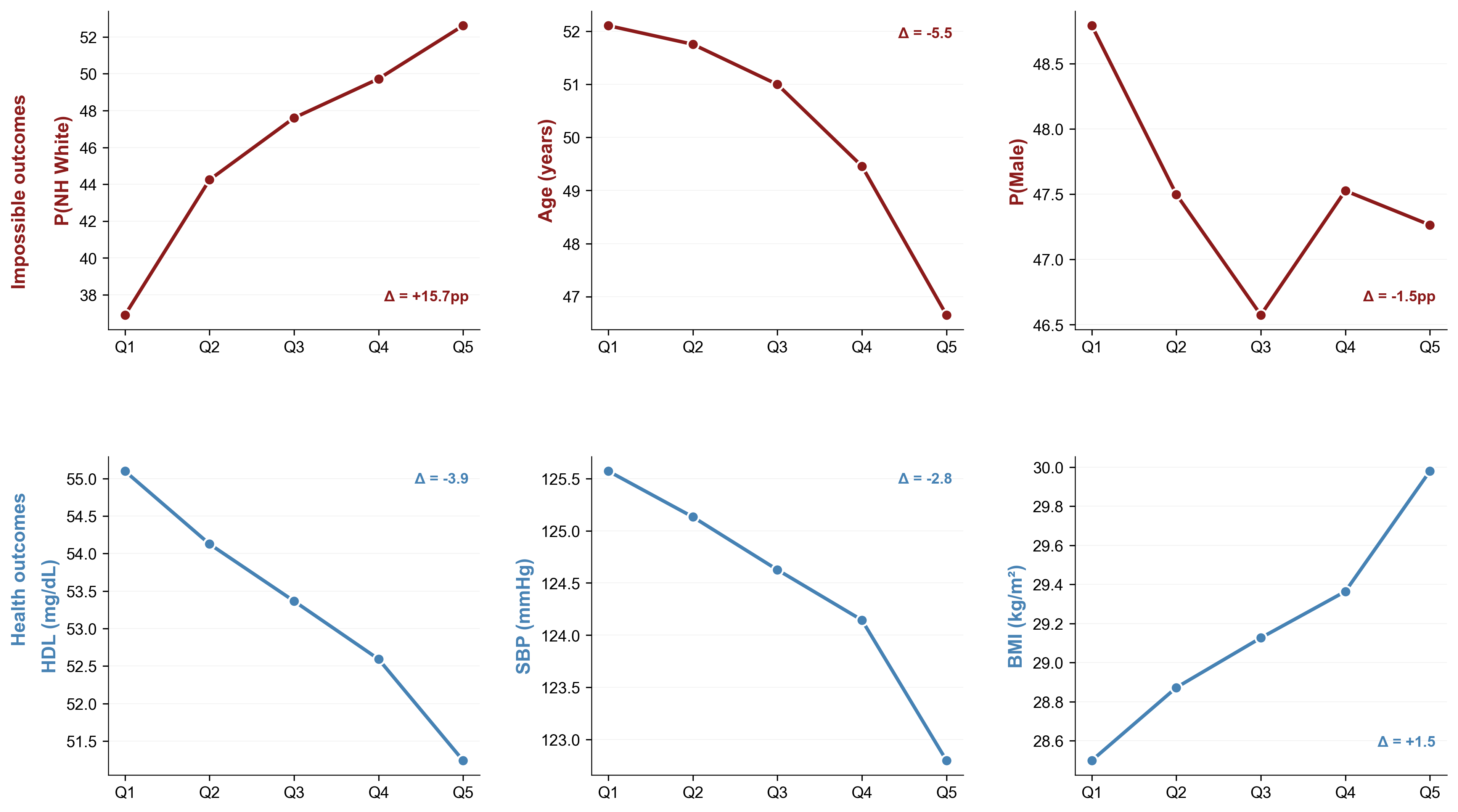
What I suspect is that food processing is a noisy concept, so it’s bound to produce noisy results. But this concern should be moderated because ultraprocessed food consumption is consistently related to a few things—things it can’t possibly affect.
There are stronger and more monotonic relationships between ultraprocessed food consumption and obvious confounders like the probability of being White or the age of the study participant. We also get awkwardly non-monotonic relationships for some variables that can’t be affected, like being male. If we benchmark our statistical findings based on these impossible ones, then there’s nothing left for ultraprocessed food harms: nothing bad is very strongly related to it.
What we end up finding is that ultraprocessed food consumption is not a good variable to correlate with anything else because it is, to a considerable degree, a mirror-image of whole food intake (r = -0.64).3
Getting your calories from whole foods has been standard dietary advice since at least 1980 when the Dietary Guidelines for Americans began recommending it. When government and professional organization recommend something, the people who follow those recommendations tend to be better-off and healthier, regardless of diet, making it so that in the future, the associations between what those guidelines recommend and all manner of good outcomes are confounded.


In other words, because ‘we know’ the inverse of ultraprocessed food—whole food—is good, we’ll tend to find that ultraprocessed food is bad or neutral, even if it is, in fact, good. And, because it’s such a poorly defined concept, we’ll also find that it produces plenty of noise. Accordingly, most epidemiological research on ultraprocessed foods is liable to be worthless—even more so than nutrition research generally.
The truth of all of this also makes for an interesting conclusion: it’s incredible that ultraprocessed food can look so neutral given how bad it ought to look. It might not be so bad after all!
