

Today’s post is brought to you by my sponsor, Mechanize. They’re hiring junior software engineers at $300K/year base salary.
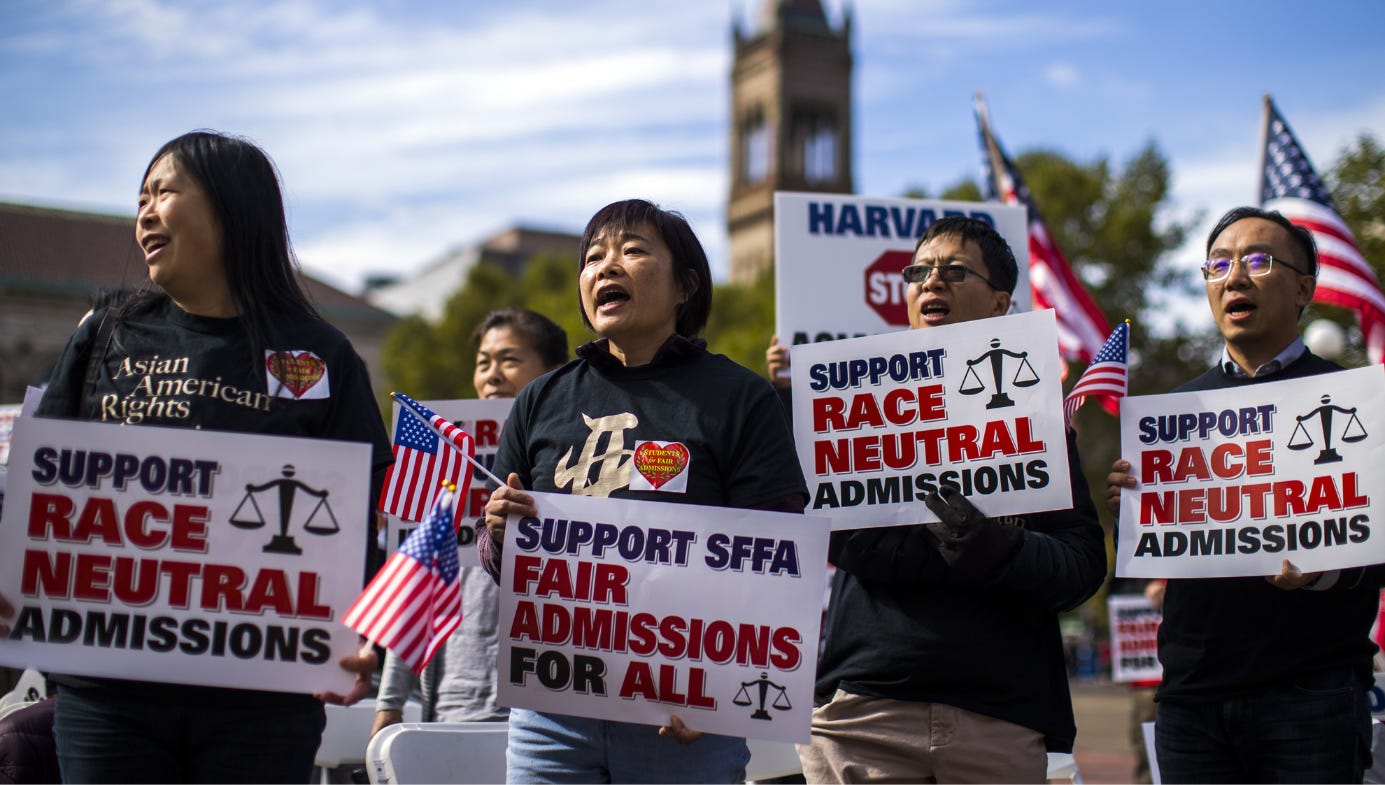
On June 29, 2023, the Supreme Court declared by a 6-2 vote that American universities that accept federal funds were no longer allowed to racially discriminate when making admissions decisions. The case—SFFA v. Harvard—concerned the fact that Harvard was making decisions using students’ race as a variable in admissions.
Advocates on the side of Harvard argued that racial discrimination was necessary practice to preserve diversity. Opponents argued that racial discrimination was wrong and illegal. The opponents are best described as ‘correct’; but the advocates do also have a point, albeit one that should only be responded to with ‘So what?’: racially-fair admissions should undermine diversity, because certain groups—namely, Asians and Whites relative to Blacks and Hispanics in the U.S.—tend to have higher levels of academic achievement.
So, three years on, has the verdict in SFFA v. Harvard resulted in universities becoming less ‘diverse’ and more reflective of what a fairly-admitted student body would look like? The answer is ‘partly’, not entirely. A recent article in Econ Journal Watch looked into this and reached just that conclusion. But why? From the changes or lack thereof alone it’s hard to tell. But the most likely possibility is that universities are still discriminating even though the Supreme Court has declared doing that to be illegal.
The Department of Justice has been looking into this issue using the methods I outlined when I showed that Columbia and NYU were still discriminating. They’ve recently opened cases against UCLA’s medical school, Yale’s medical school, UC Davis’ medical school, UC San Diego’s medical school, Duke Law School, George Washington’s medical school, UC Berkeley Law School, UC San Francisco’s medical school, and UCLA Law School. They’ve also sued Harvard for withholding race-related admissions documents, run broader compliance reviews at Stanford, Berkeley, UCLA, and UC Irvine, and began a broader investigation into fifteen medical schools.
Every university the DOJ has opened an investigation into so far is almost-certainly discriminating. We know this because each of the universities shows a considerably higher odds of admissions for students from favored racial groups—Blacks and Hispanics—as opposed to the ones that universities have historically wanted to discriminate against—Whites and Asians:
Berkeley gives Blacks ~6-times higher odds of admissions at the same LSAT and undergraduate GPA (UGPA) levels.
UCLA Law gives Blacks 7-times higher odds of admission and Hispanics 2-times higher odds of admission than Whites.
Duke gives Blacks 3.5-times higher odds of admission than Asians at the same LSAT and UGPA levels.
Yale invites Blacks as much as 29-times more often for interviews than it invites similarly qualified Asians.
UCSF is 12.6- and 4.6-time as likely to admit Blacks and Hispanics, respectively, as it is to admit Whites with comparable MCAT scores, UGPAs, and socioeconomic characteristics.
UC San Diego was nearly 3-times as likely to admit Blacks as Whites.
UCLA Medicine admits much less qualified Blacks and Hispanics than Whites and Asians.
George Washington Medicine admitted less qualified Black and Hispanic applicants than applying Whites and Asians.
There are only two ways to obtain these patterns of results:
Discrimination; or,
There are compensatory factors that make less academically qualified Blacks and Hispanics as worthy of admissions as their more academically qualified White and Asian peers.
Proponents of racial discrimination frequently argue in favor of the latter idea. But it’s absurd. For one, they’re forced to argue for an incredible coincidence: that admissions departments are making the same sorts of decisions without explicitly using race that they made when we know they explicitly used race. People are free to argue that, but it’s obviously unlikely given that there are no such factors that reliably proxy race in the way they’d need. They also don’t have any room to stand on the idea that there are compensatory factors generally. The reason for this is simple: admissions departments don’t collect information about factors that are plausibly compensatory.
A valid non-discrimination explanation for universities continuing to admit student populations that look demographically like their pre-SFFA ones requires a few things:
It needs to use variables that are available to admissions departments: whatever admissions decisions are based on must be collected and available before the admissions decision;
Variables need to be acceptably measured: they should be assessed consistently across races, without functioning as a racial preference or identity substitute;
They need to show the necessary racial disparity: they should favor the group receiving higher admissions odds, conditional on tests, grades, and other academic achievement-related controls;
They need to be strong enough: the conditional advantage the variables provide should, when combined with their actual admissions weight, explain the gap.
And though this isn’t required, to be considered valuable:
They need incremental predictive value: they should predict relevant outcomes like student GPAs, course completion, in-class behavior, etc. beyond the purely academic criteria they’re being weighted against.
Every college the DOJ is investigating is an open-and-shut case because none of them has an admissions department that gathered data on variables fitting these criteria. We know what they collect because it’s public; we know how the differences in what they collect tend to vary across groups; and we know how much predictive value they have in the general population. There’s no explanation besides discrimination.
Take Berkeley Law as an example. Their admissions department collects 2-4 letters of recommendation, a personal statement, a résumé, and they don’t have a general interview to speak of. Each of these things tends to favor White and Asian students, which means that if they were used, they would actually make it harder for Berkeley to make its case unless they were an outlier school in terms of how these things correlate with grades, test scores, and demographics. To make things worse, most of what Berkeley Law collects data on is unreliable. In Kuncel et al.’s meta-analysis of letters of recommendation, for example, they found that to achieve a reliability of 0.80—roughly the bare-minimum for how reliable something should be—students would need to submit six letters, but Berkeley Law collects at most 4 per student
Unlike test scores, the variables Berkeley Law collects are also usually racially biased, and in any case, they can be easily used to infer student race even if admissions departments never explicitly ask for students to report their race. For good measure, the Supreme Court ruled that sort of proxying illegal, but—and this is part of the evidence—Berkeley Law has decided to engage in this practice anyway.
In the case of Berkeley Law, the DOJ noted that the school’s dean Erwin Chemerinsky explicitly and publicly discussed replacing explicit racial preferences with proxies and presenting such a policy with race-neutral justifications in order to keep discriminating. Communications within the admissions department were uncovered and they explicitly called for maintaining diversity despite litigation risk. Application questions created by these people and their coworkers also expressly invite students to disclose their race. Finally, to make things clearer with some contextual evidence, Chemerinsky explicitly discussed concealing racial considerations in faculty hiring, suggesting that he wants racial discrimination in multiple areas, not just admissions.
Evidence like this was present in every case the DOJ has opened so far, from Duke Law to George Washington’s medical school. The DOJ is not resting on the strong statistical evidence that universities are discriminating; they’re also showing that we know what they’re doing. And the truth is, they know that we know what they’re doing, too. They discuss it openly! The fact that we know that they know that we know what they’re doing should make these cases easy to prosecute1, but only time will tell.
It’s clear now that the universities cannot be trusted. The documentation from the universities themselves indicates beyond any reasonable doubt that they have continued engaging in racial discrimination. In several cases, they’ve been caught planning to do so, admitting to were doing so, hinting at it, and so on. In each case, it’s clear: making racial discrimination illegal was insufficient. We must go further.
Universities must be compelled to affirmatively justify their admissions decisions. They need to publicly provide the data and the model used to select students, and they need to tell us how it works—explicitly—and then show us—verifiably—that they used only the information provided on students’ applications, without proxying race. If they find that to be a too great a burden, then we only have one course of action: defund them. Ban their researchers from grants, ban their students from public loans, take away their tax benefits and accreditations and confiscate their endowments until they become compliant or voluntarily cut themselves off from the public teat. The universities will only learn if it hurts.
This was a timed post. The way these work is that if it takes me more than an hour to complete the post, an applet that I made deletes everything I’ve written so far and I abandon the post. You can find my previous timed post here.
A message from my sponsor, Mechanize:
We’re hiring software engineers to build environments and evals that frontier AI labs use to train coding agents.
To get a better sense of the work we do, you can check out GBA Eval, where we had models build Game Boy Advance emulators from scratch and scored their performance.
Base pay starts at $300K/year for junior software engineers, with more for senior roles, plus equity and performance bonuses. Apply here.
Because of the evidence people leave out in the open that leads to this knowledge of one another’s motives.
These universities are basically doing the same jury nullification thing as in the OJ Simpson trial. They know that they're breaking the law, but they think the law is unjust. The worst thing is that they're so dishonest about it, fooling naive outsiders into thinking that these skewed admissions result are actually based on merit. I don't care if some universities treat certain ethnic groups or athletes or children of influential people with favoritism, as long as they honestly and transparently show all their selection criteria that produced those results.
Why do you think Asian students have been outperforming White students in the West during the last half-century, whereas Whites led the pack civilizationally and intellectually for several centuries before that (since the renaissance or certainly the enlightenment)? Usually modern circumstances can be predicted looking at the past, but this is surprising to me. If a genetic advantage propelled Europeans to the front in the last half millennium, what explains our relative underperformance in the last 50 years? And if one claims environmental or cultural factors make the difference, then where did the more innovative Western culture come from in the first place if not the Western collective personality? Moreover, what are the odds that someone else would be better than you in navigating your own culture and institutions? I wish there were more in-depth research into this topic, but of course it is wishful thinking given the thorniness of the subject.