

Today’s post is brought to you by my sponsor, Mechanize. They’re hiring junior software engineers at $300K/year base salary.

I’ve been asked about fifty times in the last few weeks if taking {Viagra or Cialis}1 every day will make people live longer. The bull case for these drugs is simple: both drugs are PDE5 inhibitors, which raise cGMP signaling, downstream of nitric oxide, improving vasodilation and vascular smooth muscle relaxation. This is why they give people erections and how they help with pulmonary arterial hypertension. It’s also plausible that this benefits endothelial function, lowers vascular tone, improves perfusion, and reduces rates of ischemic injury, explaining their known benefits.
Or even simpler: they’re good for your heart, and your heart is often the organ that ends up killing you, so if you take the boner pills, you’ll live longer. Right?
There is some evidence these drugs might help. For example, one study found that men with erectile dysfunction (ED) were 90% more likely to have a cardiovascular event. A review of cohort studies found that people who took these drugs had a 30% lower risk of dying over the follow-up period. Another review even found that Cialis was associated with 32% lower risk of dementia, with Viagra trailing it somewhat, with a still-considerable 25% risk reduction.
But is that convincing evidence to anyone? Is ‘guys with ED get more heart attacks’ sufficient to conclude ‘If we treated their ED with Viagra, they would therefore have fewer heart attacks’? Is ‘people who take Viagra die less often’ enough to infer that ‘If we gave more people Viagra, then they would die less often’? Is ‘people who take Viagra are less likely to develop dementia’ really what you’d conclude from that association, or would you think ‘Guys who are still having sex with their wives are probably a group that’s less likely to become demented, regardless’?
Selection issues in this domain are absolutely enormous. The people using Viagra are mostly guys who are seeking it so that they can have sex. They also have enough wherewithal to pursue treatment and fill a prescription, and they’re physically healthy enough to withstand a vasodilator. They are not random people; the facts that they live longer, look healthier, and seem to be less demented are not surprising even if Viagra doesn’t help them one bit.
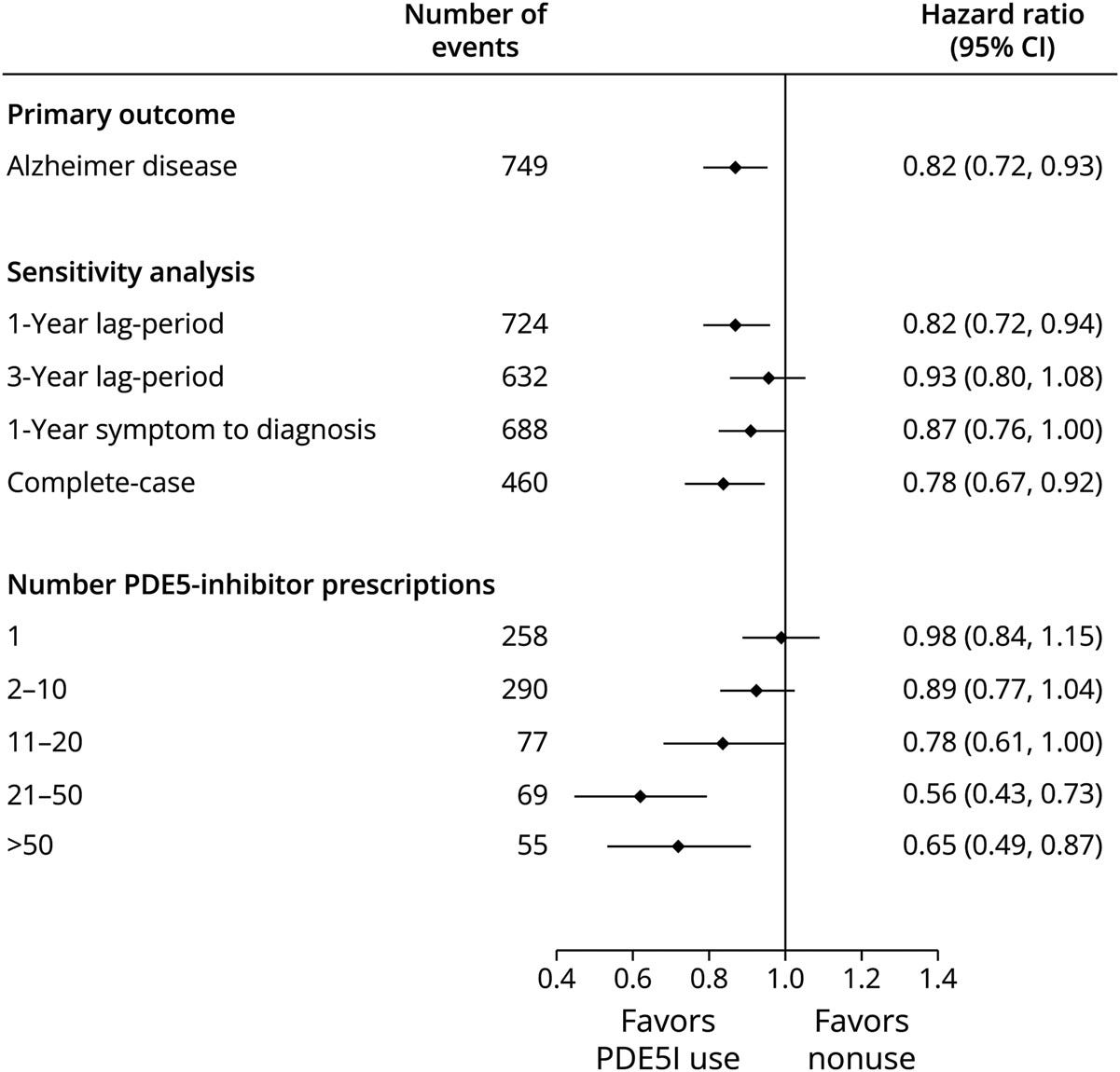
Researchers are not unaware of this issue; their studies frequently do include attempts to address it, but mostly in ways that are far from sufficient. One of the better examples comes from a cohort study of Alzheimer’s dementia where the researchers included a three-year lag to account for protopathic bias, meaning that they tried to account for the fact that people in the early stages of Alzheimer’s are still symptomatic in ways that might make them less likely to go and seek out Viagra.
In their lagged model, the initially significant ‘protective’ effect, whereby taking Viagra seemed to reduce Alzheimer’s risk by 18%, became a statistically nonsignificant 7% reduction.2 There may be room for protection, but I’m still doubtful: given that the preclinical and prodromal—meaning early, pre-diagnosis—period for Alzheimer’s is more than three years3, this lag certainly doesn’t go far enough.
The gold standard test that would answer the question of whether Viagra is life-extending is a large, long-term randomized, controlled trial (RCT). The only problem is that there aren’t any of those and the outcomes that have been assessed in RCTs so far aren’t the outcomes we want.
For dementia, we have two trials: OxHARP and ETLAS-2. These trials didn’t look at dementia per se, but they did look upstream, to cerebral vasculature—the blood vessels in the brain. They found that patients with cerebral small vessel disease—a condition characterized by reduced blood flow to the cerebrum—there was some suggestive evidence of improved perfusion in one of the trials, but there was nothing for cognition. In another small trial, there was some evidence of blood flow improvement, but all of this is very indirect and besides the point. There’s not a lot of good evidence for Alzheimer’s and dementia.
For cardiovascular outcomes, we have several trials, but their results are very indication-specific. For pulmonary arterial hypertension, these drugs are clearly beneficial. For heart failure, there don’t seem to be improvements or harms. In some cases, there’s even evidence for harms, like for patients with persistent pulmonary hypertension after corrected valvular heart disease or for another type of heart failure patient. For more normal people, like men with suspected coronary artery disease, Viagra at least appears to be safe, but it doesn’t seem to be helpful.
For life extension itself, this is where the RCT evidence is weakest. There’s practically nothing out there for all-cause mortality. The best evidence we have is in this review of Viagra for ED and diabetes, where there appeared to be a 65% mortality reduction, but despite such a massive effect, it was nonsignificant. The combination of a huge effect and statistical nonsignificance suggests this literature is just too imprecise to infer anything from.
The only other trial-based evidence we have on life extension is only tangentially relevant. In this trial, people with pulmonary arterial hypertension who were prescribed higher Viagra doses lived longer: over 32 months, 26.4% died in the 5mg group, 19.5% died in the 20mg group, and 14.8% died in the 80mg group. It’s hard to generalize from a group with this high a death rate, especially given the condition they needed to be in to enter the trial and that fact that there was no placebo group. The PASSION trial for heart failure patients was also uninformative, because in it, they had to stop early due to a medication supply problem. At the end of the trial, all-cause mortality was five-times higher in the treated group, but the confidence intervals were very wide, so the result isn’t useful (p = 0.04).
That’s the gold-standard evidence and it’s bad! It’s certainly not enough to actively recommend everyone start popping boner pills like we’ve been seeing a lot of podcasters tell their audiences recently. But we shouldn’t stop there. We technically don’t need RCT-based causally informative evidence to figure out if these pills are likely to be good. We can also update by leveraging causal-ish evidence.
For example, we have a large-scale active comparator study to go off of. An active comparator study means that we’re observing people with the same conditions being prescribed different drugs, one of which is the drug we’re interested in. After some additional matching on observables, these groups should, in theory, be comparable, allowing us to make causal inferences about the drugs. Alas, among patients with pulmonary hypertension, there’s no protection against dementia for patients prescribed Viagra versus those prescribed endothelin receptor antagonists—drugs that do not help with ED, while still helping with blood flow.
The causal-ish evidence that’s informative and well-conducted almost singularly points to null effects, and the causal-ish evidence that’s poorly conducted and obviously open to massive residual confounding just can’t be taken seriously. But we’re not out of evidence yet. There’s one more method to use: Mendelian randomization.
As it turns out, some people are born with genes that basically make it so they’re living life on Viagra. Much like how there are people who basically live life on statins and there are people who basically live life on GLP-1RAs due to the genes they were born with, these people are just lucky. But we’re also lucky, because we get to look at them and see how they’re doing.
If people with genetically-proxied Viagra are doing well, that provides us some positive indication that the drugs, taken over a very long period of time, will also make the people taking them better off too. So, how are they doing? Great!4 Look:
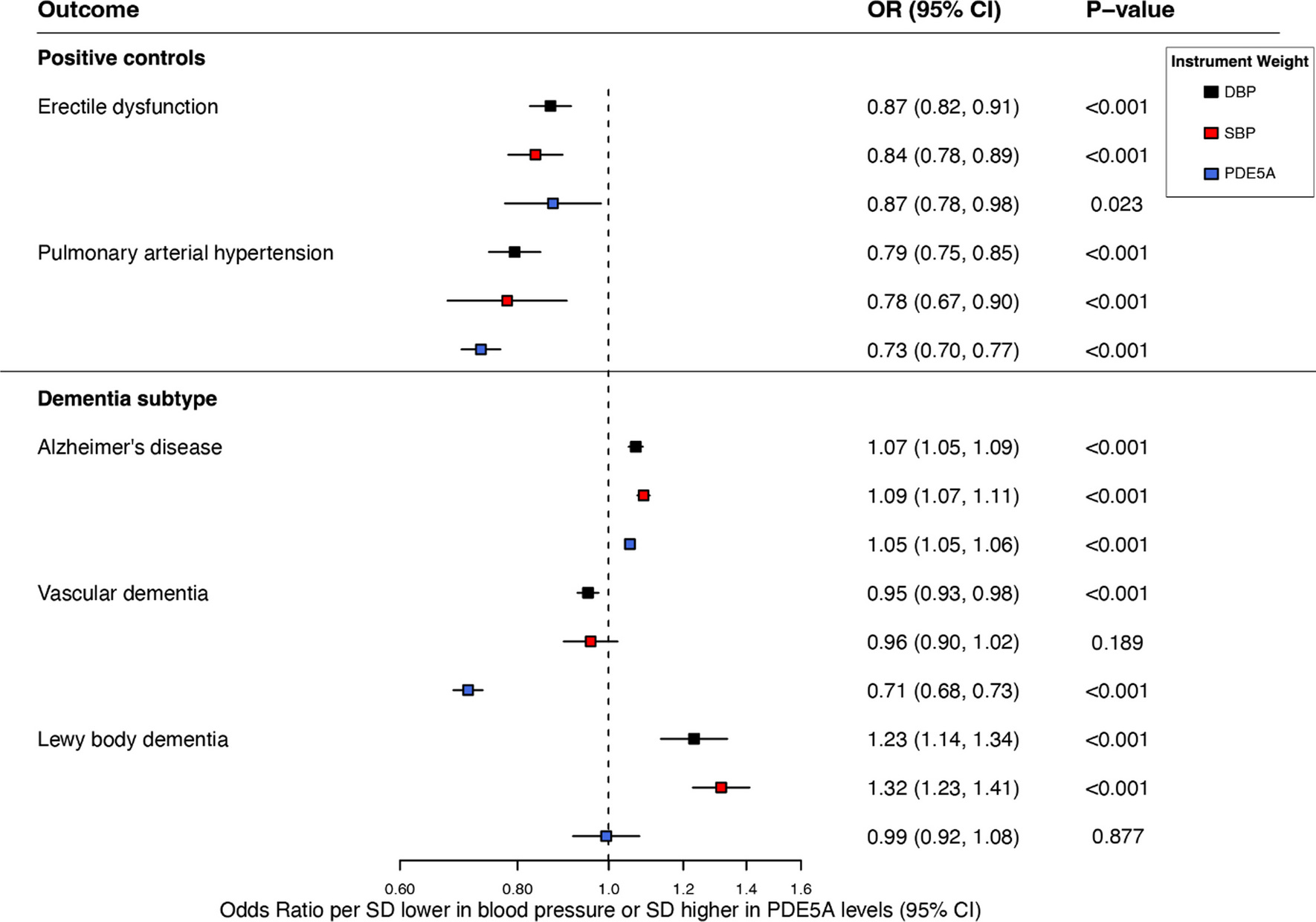
People who have basically been on dosing Viagra every day since birth have lower risk of erectile dysfunction and much lower risk of pulmonary arterial hypertension, both of which the drugs are used to treat. This constitutes positive control evidence that the genetic proxy works as expected.
Looking down further, we get to the juicier dementia outcomes: considerably lower risk of vascular dementia—as expected given its cardiovascular origin—and no increase in the risk of Lewy body dementia. However, there is a warning sign that contradicts some of the cohort evidence. It looks like these people have very slightly increased risk of Alzheimer’s dementia. But we’re lucky because that signal does not withstand scrutiny and the other signals do hold up, among men and women.5
My verdict, if I had to guess, is that {Viagra or Cialis} is good for cardiovascular health quite broadly and mildly, and if you’re at high risk of bad cardiovascular outcomes, then it will probably help you to live longer and to live healthier. Moreover, it’s good to take anyway for the treatment and prevention of ED if you’re a man.
But the key question for this post isn’t about a few particular risks. The question we really want an answer to is if preventing vascular and Lewy body dementia and slightly lowering the risk of cardiovascular problems translates to greater life expectancy.6 Unfortunately, I don’t think so. The mechanism behind these drugs does not tend to show up as a target for life extension.7 When we explicitly test if it helps with lifespans like I did in this earlier article,8 we also get a disappointing result:
Lifespan, overall: +0.20 years (p = 0.576)
Men: +0.38 (p = 0.412)
Women: -0.08 (p = 0.881)
Parental lifespan: -0.11 (p = 0.540)
Healthspan: HR = 0.988 (p = 0.623)
90ᵗʰ-percentile longevity: OR = 0.824 (p = 0.043; marginally significant harm)
Both parents 90ᵗʰ-percentile longevity: OR = 1.004 (p = 0.668)
Viagra has many benefits, but it does not seem like the drug that will extend lifespans.
A message from my sponsor, Mechanize:
We’re hiring software engineers to build environments and evals that frontier AI labs use to train coding agents.
To get a better sense of the work we do, you can check out GBA Eval, where we had models build Game Boy Advance emulators from scratch and scored their performance.
Base pay starts at $300K/year for junior software engineers, with more for senior roles, plus equity and performance bonuses. Apply here.
I use “Viagra”, “boner pills”, etc. as generic terms.
It should be noted that this estimate was not itself significantly different from the initial estimate. It’s highly likely that a full accounting for prodromal disease with a longer lag would reduce the estimate further, but with this dataset, there’s not enough power to make strong determinations. Even if the estimate became a perfect null of 1, if it had the imprecision of the other estimates—say, ranging from 0.87 to 1.13—then the p-value for the difference from the initial estimate would only be about 0.04—marginally significant at best.
Note: it is possible to predict Alzheimer’s far ahead of time:


And if you’re being generous about the word ‘predict’, it’s trivially easy to predict Alzheimer’s development from birth with one genotype alone. This isn’t good for prediction per se, because in predicting like this, you’ll miss most of the cases with other genotypes.


Further, there are subtle cognitive downsides far ahead of the point where diagnosis is happens. At the ASHG conference in 2019, I saw a presentation that spoke to this: people who filled out biobank intake forms more slowly were more likely to go on to develop Alzheimer’s! The closest thing I’ve found to a publication on this topic since then is a replication. This study found that (1) in the U.K. Biobank, people who completed the cognitive test more slowly were at significantly greater risk of developing Alzheimer’s, and (2) in the Wisconsin Registry for Alzheimer’s Prevention, initially dementia-free middle-aged adults who took longer to complete the cognitive battery had lower executive function and greater rates of mild cognitive impairment.
People born unlucky, with genes that do the opposite, also seem to do worse. They have worse cardiovascular health, with greater risk of coronary heart disease and heart attacks.
The sex-stratified results holding up signals that this is not likely to be due to people with lower risk of ED simply being more fit due to having sex more often, unless that effect also transfers to women in some other way. It might; there are people who believe it does. But I doubt such an outcome has as much influence for women as ED does for men, so it’s still an important piece of evidence to reason with.
It might also lower the risks of colorectal and gastric cancer.
Mendelian randomization also correctly predicted that GLP-1RAs would not help with Alzheimer’s dementia in RCTs.
The PDE5A instrument is rs58583086 cis pQTL from GCST90162352. It has an F-stat of 61.1 and effects are in terms of 1 SD lower genetically-predicted PDE5A protein.
Adding rs9997186 for additional power doesn’t change any results except for the marginal 90ᵗʰ-percentile longevity result, which it nullifies (OR = 0.857, p = 0.073). Running a 5-SNP relaxed position-spaced stress test, I got the same result, but it’s not a proper IVW instrument because my QC found residual correlation (max r² = 0.844). Nothing to see here.
Great article, thanks! One typo: "no increase in the risk of Lewy body dementia", whereas Brennan and Tinworth 2025 found "higher odds of [...] Lewy body dementia (OR 1.32, 95% CI 1.23–1.41)". That's a lot!
Aside from the selection effects, there's also the possibility that having sex is good for you. If viagra makes people have better/more sex, it wouldn't be a huge surprise for that to show up as improved outcomes in weird places.
Honestly if these drugs improve people's sex lives, and they're well-tolerated, that's a good reason to use them anyway. There's no need to be squeamish about it or come up with some convoluted explanation about how it's "for Alzheimer's" - take the drugs that make your sex life better.