

Today’s post is brought to you by my sponsor, Mechanize. They’re hiring junior software engineers at $300K/year base salary.
Do you see the chart Trump is gesturing at on his Joe Rogan Show appearance?


It is perhaps the most misleading chart in modern health discussions: it’s widely circulated and it makes people think that America lags in life expectancy because it has a bad healthcare system. Here’s a better view of the chart:
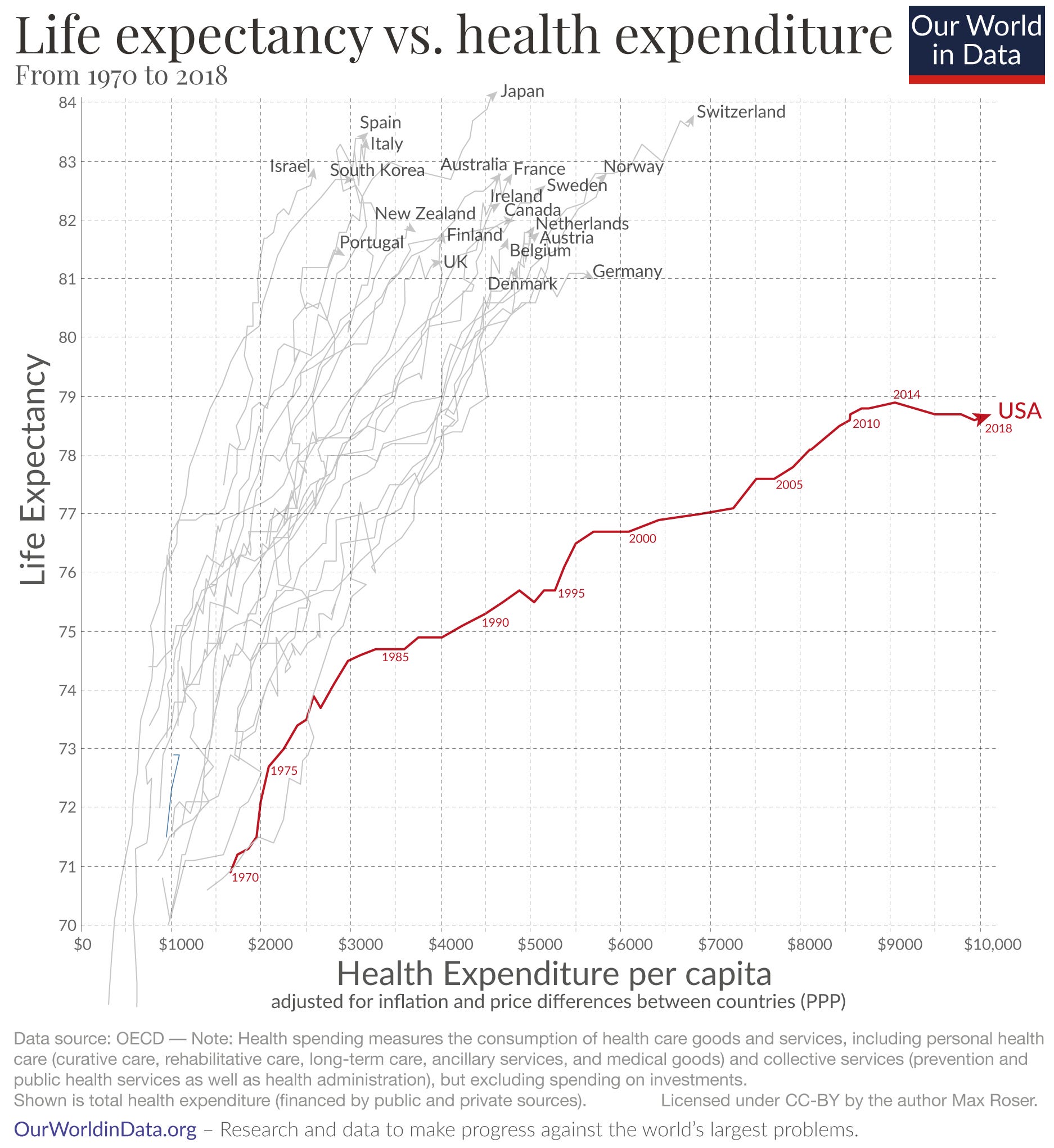
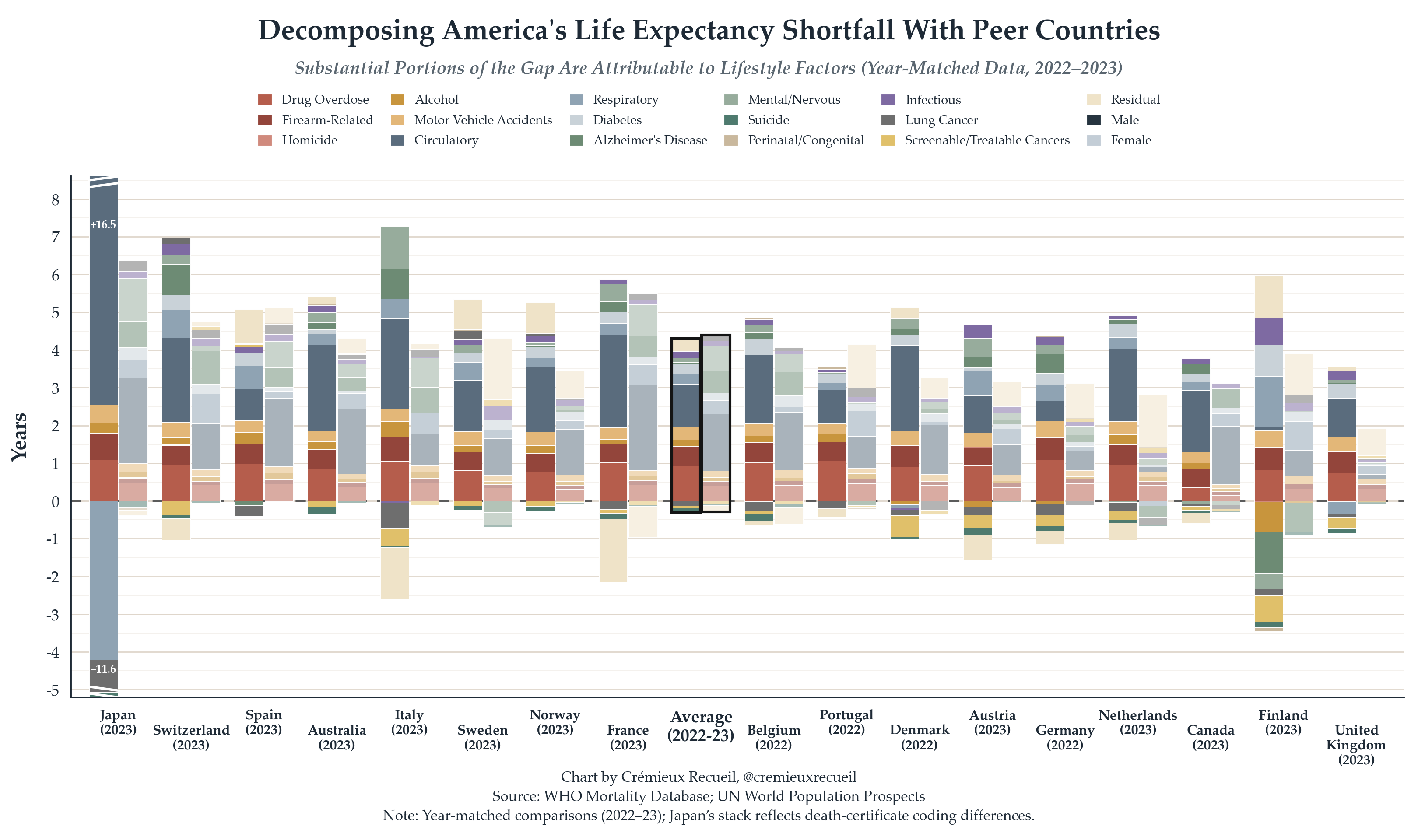
The reasons Americans live shorter lives despite being much richer than their peers are well-understood at this point. The biggest contributor is that obesity is very bad for health, as countries get richer their citizens tend to get fatter, and America is the richest country. We can break this down explicitly by using methods developed here.1
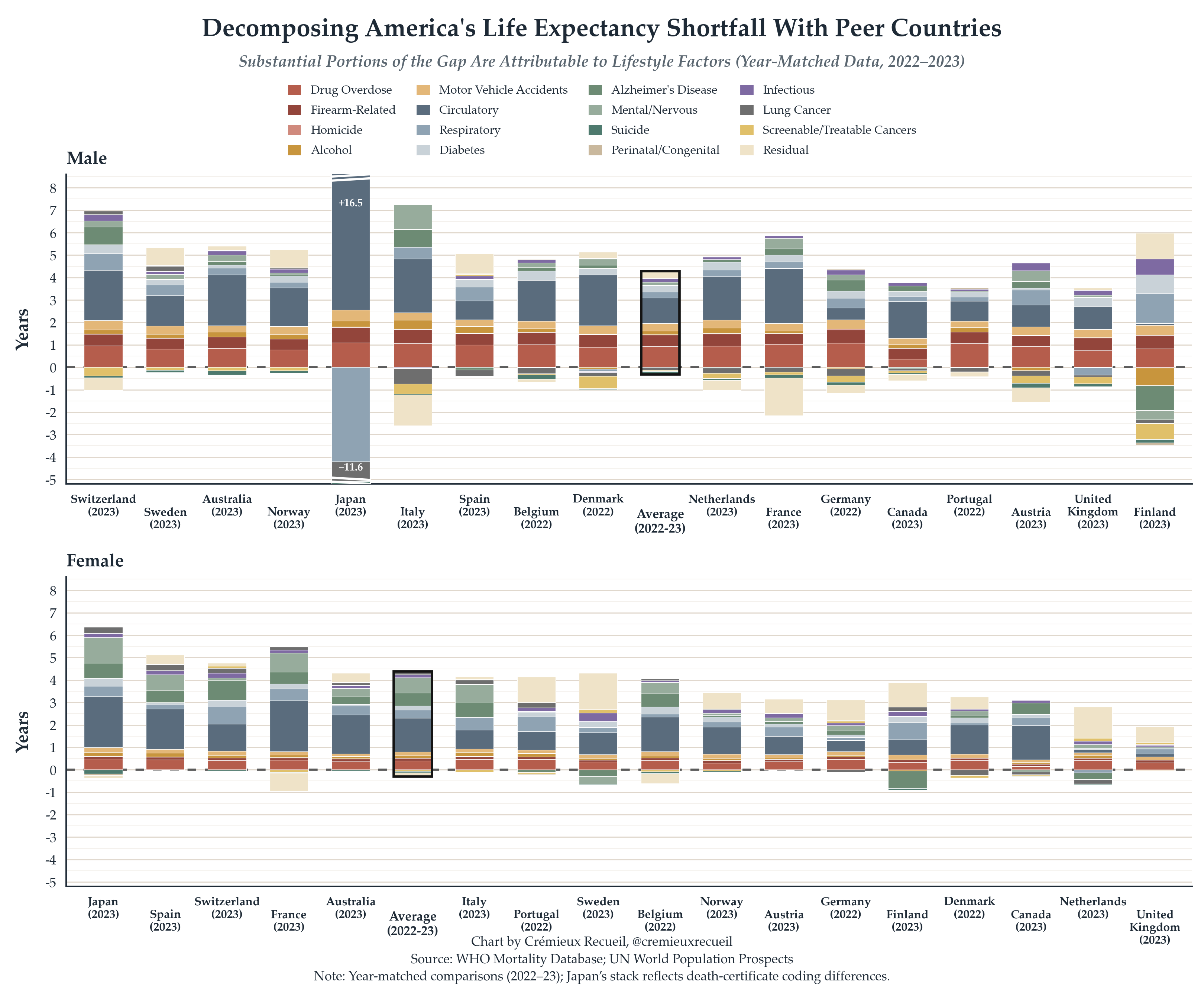
Notice how the American life expectancy gap varies by the choice of comparison country not just in terms of the size of the gap, but also in terms of the causes and magnitudes of death that it can be attributed to. Notice too that the causes of the gap vary considerably by sex. I think we expect this. For example, consider automobile accident and homicide mortality. Those are attributable largely to extreme males, whereas women are generally less extreme in their behavior, and this is true globally, so we should see smaller gaps attributable to those causes. We also see that there’s not a difference in the cleanly health care-attributable share2 for men and women, which is odd if you put a lot of onus on that, given that women have more interactions with the health care system and they’re more reliable in their interactions with them (e.g., they take their medicines more consistently, make it to their appointments, etc.).
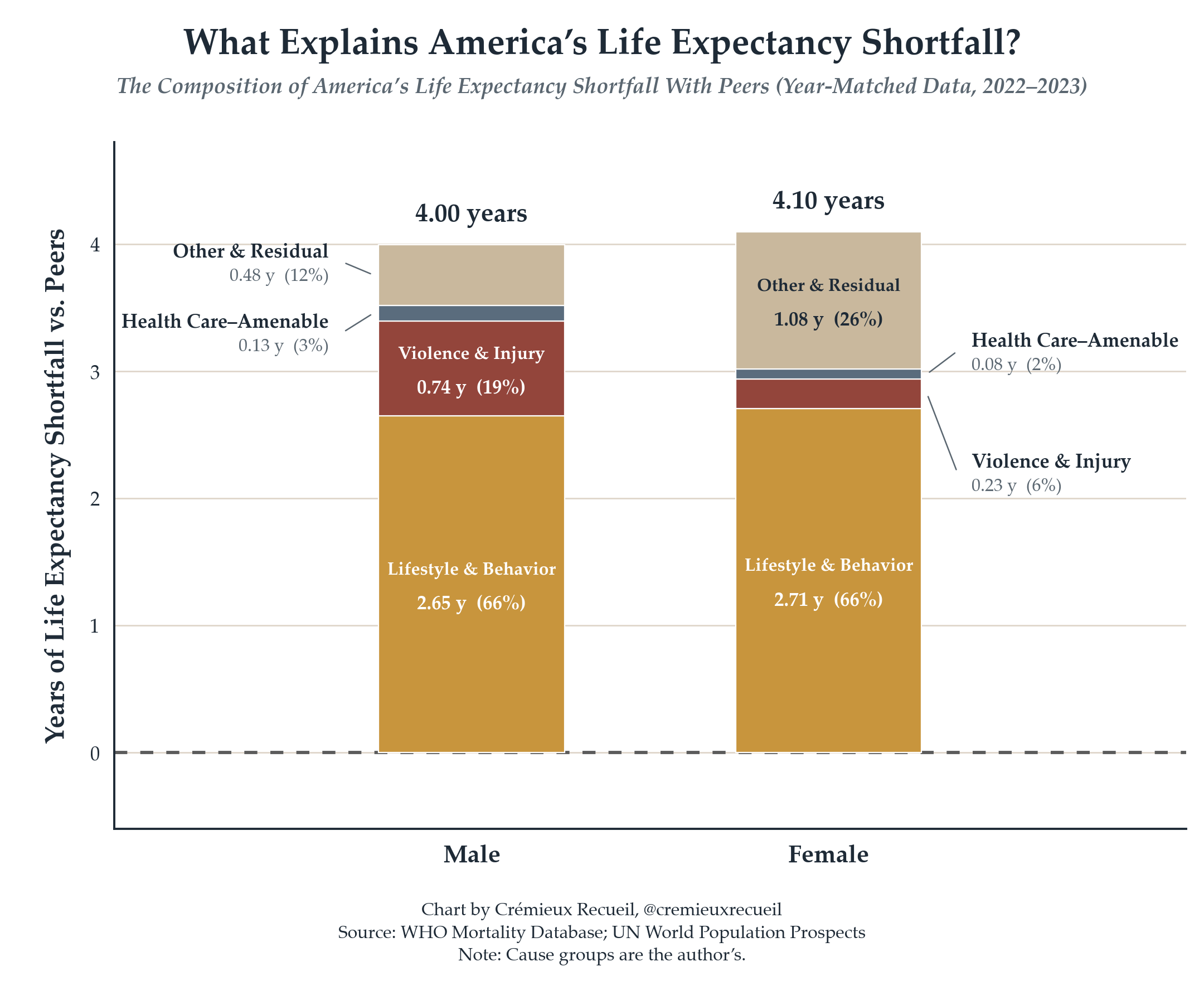
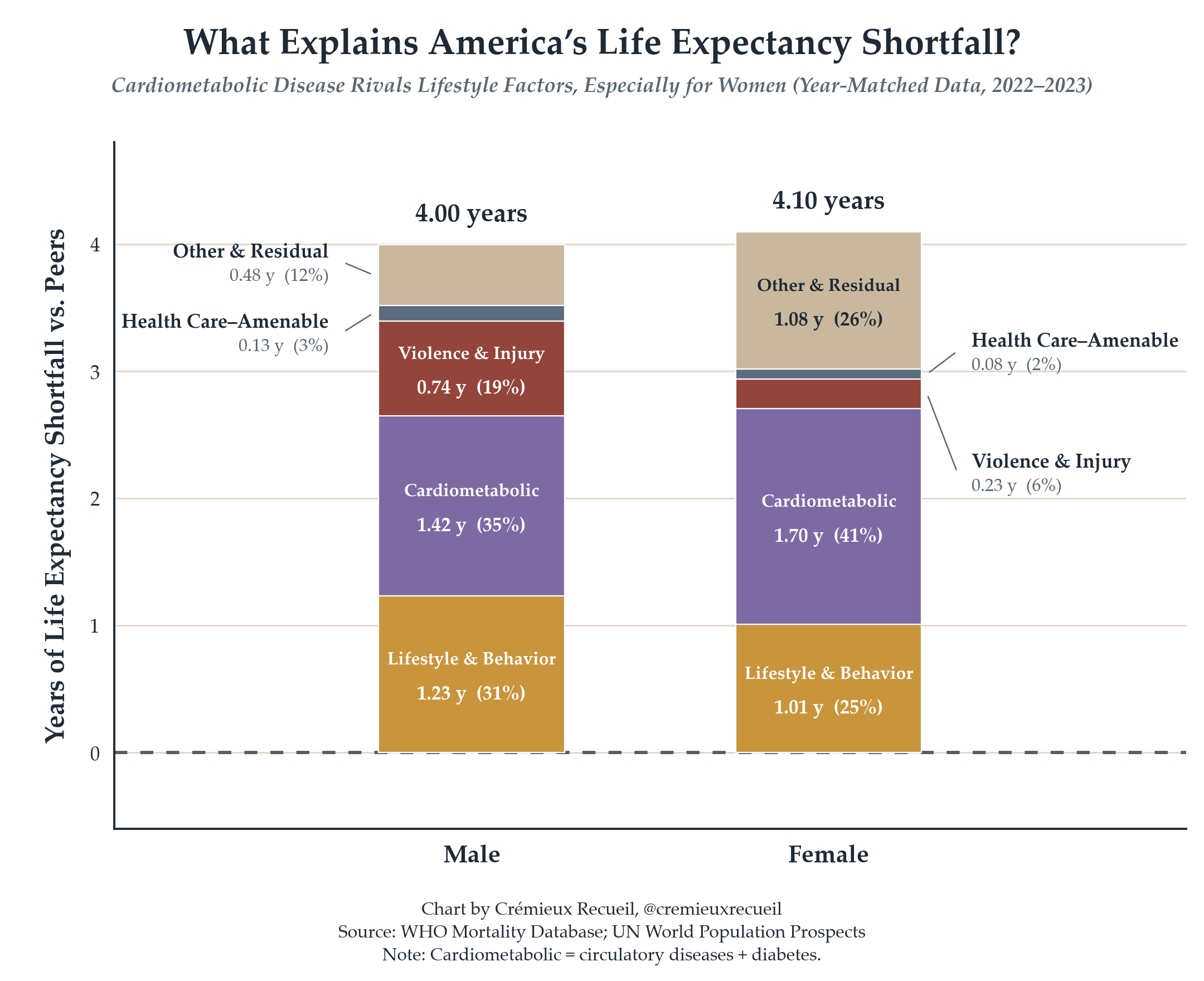
Take a look at the broader causes of the life expectancy gap:
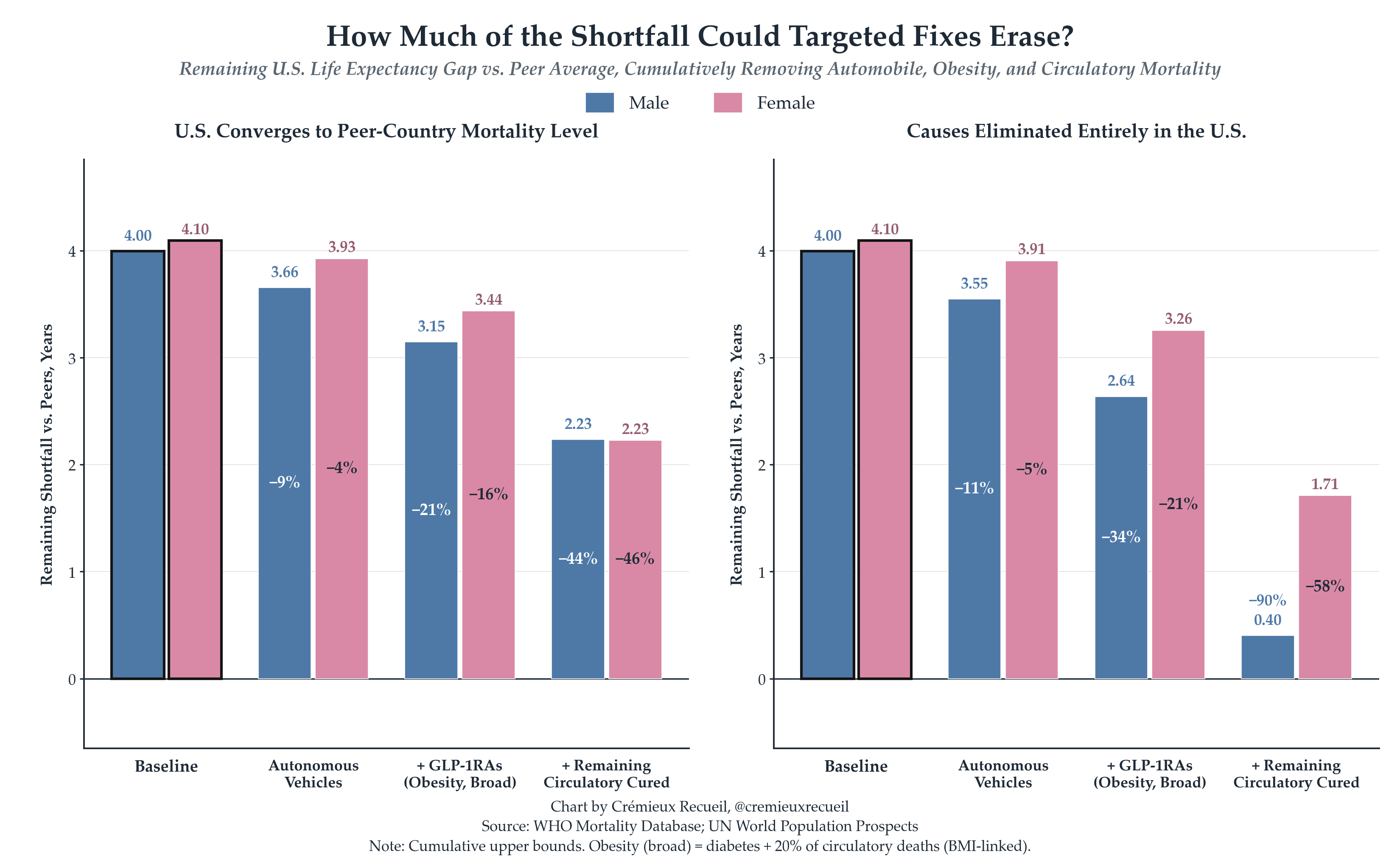
One thing that’s interesting about this is that it will change over time. Two very critical ways that these things will change are that some things will shift towards being amenable to intervention by the health care system (e.g., we will one day be able to clear arterial plaques, reversing atherosclerosis, but we can’t yet), and some of these gaps will be reduced or reversed by technological innovation. Consider the recent advents of self-driving cars, GLP-1RAs (which you can acquire cheaply at this link), and gene therapies to permanently reduce cholesterol levels. What if we fixed just the gaps in automobile accidents, obesity, and heart disease? The impact would be huge:
To make the point that America’s gap is not about its health care system clearer, consider one of the most key—and controversial—explanatory variables that separates America from these peer countries: race. Take a look at those gaps. They’re really something:
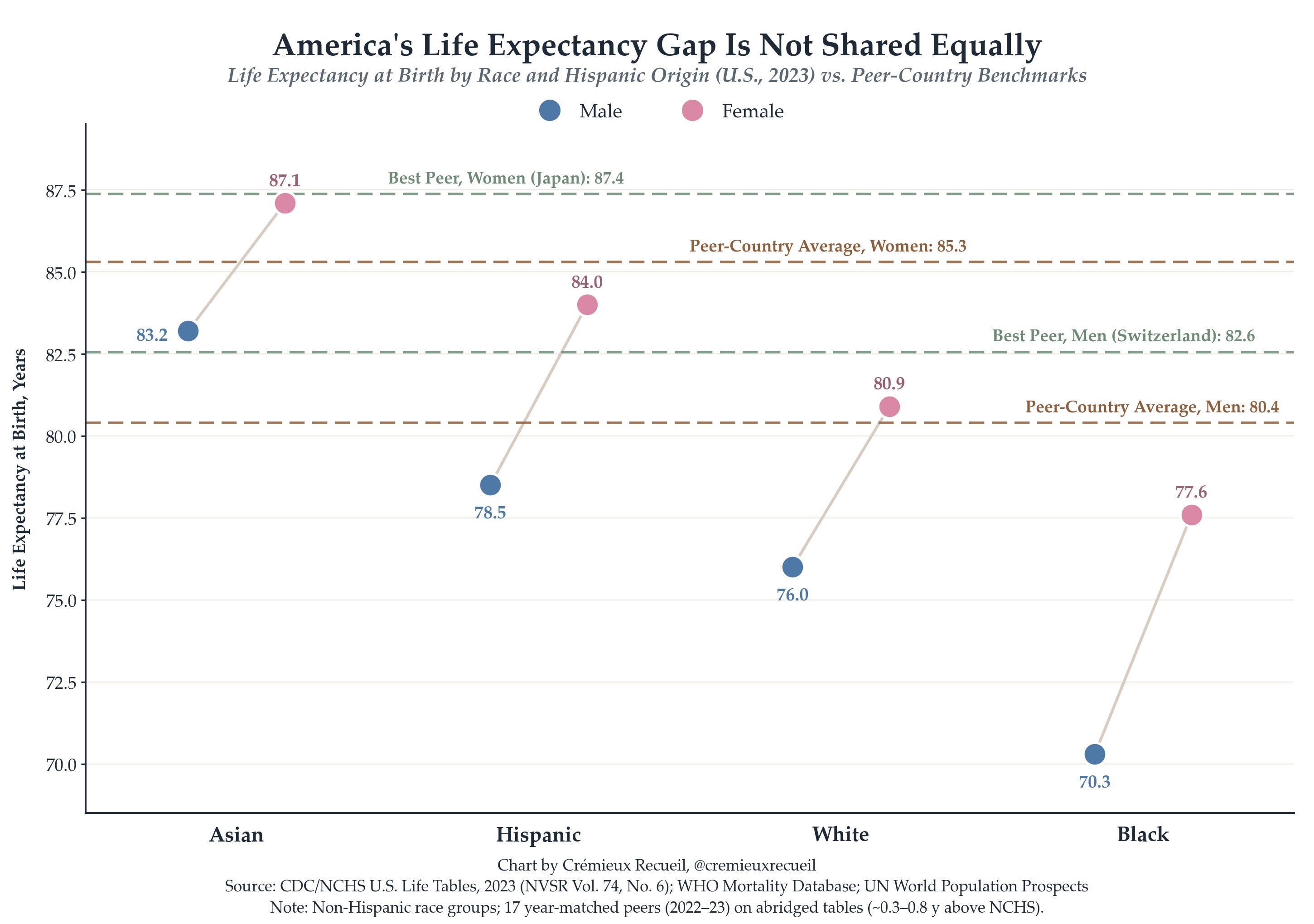
All Americans regardless of race are, in principle, exposed to a health care system of the same quality understood broadly3, although there are gaps in access4, but those access gaps don’t fit the order of the longevity gaps—as a close proxy, in 2024, the insurance rates go Asian > White > Black > Hispanic. These race results and the sex ones combine to produce a picture that cannot be explained by a simple health care-centric story. In fact, when it comes to things the health care system can plausibly intervene on, America is usually the highest-performing country—at least cross-sectionally—or it’s very nearly so. When it comes to lifespan and America’s lag despite its riches, look elsewhere than health care.
This was a timed post. The way these work is that if it takes me more than an hour to complete the post, an applet that I made deletes everything I’ve written so far and I abandon the post. You can find my previous timed post here.
A message from my sponsor, Mechanize:
We’re hiring software engineers to build environments and evals that frontier AI labs use to train coding agents.
To get a better sense of the work we do, you can check out GBA Eval, where we had models build Game Boy Advance emulators from scratch and scored their performance.
Base pay starts at $300K/year for junior software engineers, with more for senior roles, plus equity and performance bonuses. Apply here.
The data used is the latest years of available data, matched to America in that year. Some of this is substantially impacted by COVID, unfortunately. Moreover, cause-of-death attribution like this is an accounting exercise as I’ve done it here, not dynamically modeled. So, for example, if you reduced heart disease deaths, a larger portion of the population would likely instead die from cancer (similar ideas hold for group comparisons). Keep the observational nature of the attributions here in mind. Also keep in mind incomparability in coding across countries, like that which explains what’s going on with Japan’s data.
For a combined instead of sex-split version, here you go:
Drug overdose, alcohol, lung cancer, diabetes, respiratory illness, and circulatory problems were grouped into Lifestyle & Behavior. Firearm-related, homicide, motor vehicle accidents, and suicide were grouped into Violence & Injury. Screenable/Treatable Cancers, Infectious Disease, and Perinatal/Congenital complications were grouped into Health Care-Amenable. Alzheimer’s Disease, Mental/Nervous, and Residual were grouped into Other & Residual.
Notice that in some cases—such as Perinatal/Congenital in Health Care-Amenable—the causes are not truly Health Care-Amenable in enough cases, that the allocation almost-certainly over-attributes American’s life expectancy gap to its health care system. This is because large portions of congenital issues are not remediable and large portions of all fatal perinatal issues have to do with things like maternal obesity. Classification also plays a role. (See this and this, too.)
Here’s an alternative view:
Yes, there are regional differences, insurance-related differences, culturally-affected usage-related differences, and more, but that is not what I’m referring to.
Which is itself not very important.
Several other factors impacting life expectancy in the United States: (AI responses)
The United States has the highest rate of drug overdose deaths among high-income nations, averaging 3.5 times higher than peer wealthy countries. This severe crisis disproportionately kills young and working-age adults, directly accounting for roughly 8% to 12% of the overall life expectancy gap between the U.S. and other wealthy countries.
This phenomenon is known in public health as the "Hispanic Paradox" or "Hispanic Health Paradox". Research consistently shows that Hispanic individuals in the U.S.—particularly first-generation immigrants—tend to live longer than non-Hispanic white Americans, despite lower average incomes, higher rates of uninsured status, and less engagement with the formal healthcare system.
If America spends a lot of healthcare, they should do really well in the Health Care-Amenable category. This seems accurate, as America does really well in treatable cancers according to the chart. And as you said, the Perinatal/Congenital category has other factors, so it might not be affected by increased healthcare spending. But what is the cause behind the lackluster performance on Infectious diseases, which seems to be in the Health Care-Amenable category, yet our ginormous healthcare spending didn't affect it? My guess is that is has something to with the underlying risk level of the population, but I would be interested to hear your thoughts.