

Today’s post is brought to you by my sponsor, Mechanize. They’re hiring junior software engineers at $300K/year base salary.

Coffee causes cancer. Or at least, we used to think it did.
Back in 1981, MacMahon et al. observed that there was a strong dose-response relationship between coffee consumption and pancreatic cancer. This association survived controls for cigarette use and appeared internally robust, but in the wider literature, the association collapsed almost immediately due to a textbook problem: the control group was drawn from patients of physicians who diagnosed cases, and those patients had been advised to cut down on coffee intake.1
Substantive and direct replication failures started rolling out and large-scale meta-analytic data failed to confirm any link among cohorts of people who’d never smoked before.
Shortly after the idea of coffee harms was crushed, the literature flipped to the idea that coffee is not just not associated with cancer, but instead, that it’s actually protective against it. (You would think the null results would temper expectations; alas, no.)
In 2012, Freedman et al. found a ~10-15% all-cause mortality reduction for people who drank two or more cups of coffee a day. In fact, coffee seemed to be protective for most things, save for cancer. Gunter et al. then reported that more coffee drinking was associated with lower mortality, with particular benefits for digestive and circulatory diseases. An umbrella review by Poole et al. corroborated these findings.
But protective findings were based on the same sorts of problems the initial harmful ones were: they built on confounding artefacts, whereby sick people quit drinking coffee and healthy people opted into drinking coffee. To get around this sort of problem researchers would have to do be a bit more clever. To that end, they used Mendelian Randomization!2
Leveraging the fact that there are genetically controlled differences in caffeine metabolism—and thus in the reason to even drink coffee in the first place—researchers were able to show that coffee consumption does not seem to cause any risk elevation or reduction for mortality, cancers, etc. And to close the loop, it doesn’t seem to cause pancreatic cancer.
Coffee was viewed as harmful, then it was considered helpful, and now it’s just nice to drink. This is a story that’s been repeated many times. There’s a mountain of proposed food items, drinks, habits, and supplements that have been proposed to hurt or help in broad ways but which have later been found to have essentially null effects outside of the areas we know they definitely help in: Coffee is great for energy thanks to the caffeine; it doesn’t make you live longer. Viagra is great for erectile dysfunction; it doesn’t make you live longer. Statins are great for preventing heart disease; they don’t cause dementia.
One proposed target for study is “hot drinks”—tea, coffee, maté, etc. Several recent papers have claimed that consumption of drinks like these, above a certain temperature, causes cancer. One of the proposed mechanisms is thermal injury: every time you drink something hot, you burn the mucosal lining of the esophagus and what gets built back is more likely to be something with an error that leads to cancer.
The strongest evidence for this theory comes out of Iran, and specifically from the Golestan Cohort Study.
The Golestan Cohort Study shows that the consumption of drinks at 60°C or greater is associated with a ~40% greater risk of esophageal cancer. Consumption of ‘hot tea’ is associated with a 60% greater risk of esophageal cancer, and in another permutation of the analysis, a 107% greater risk, with ‘very hot’ tea being associated with 716% higher risk of esophageal cancer.
So, are hot drinks bad? I wouldn’t say that on the basis of the Golestan Cohort Study.
There are a lot of issues with this study. To get to the meat of the matter, hot drink consumption is heavily confounded with factors like sex, age, drug consumption3, and so on, and virtually everyone in this cohort drinks a lot of tea every day. If you believe the results of this study, you can’t just believe them piecemeal: the result that says hot drinks have a large effect also says that cigarette smoking has no effect! As it turns out, in Golestan, those things are heavily confounded, so the obviously cancer-causing effects of cigarettes can’t be distinguished from the effects of hot drinks.
Cigarettes obviously cause cancer, so we cannot accept the conclusions of this study unless we qualify them in a really convoluted and odd way. But why do that? There’s not even a consistent dose-response effect to temperature, as you’d expect under the thermal damage theory. I say it’s better to move on. To that end, I recommend looking at this with the National Health and Nutrition Examination Survey (NHANES), which I’ve used for several other blogposts.
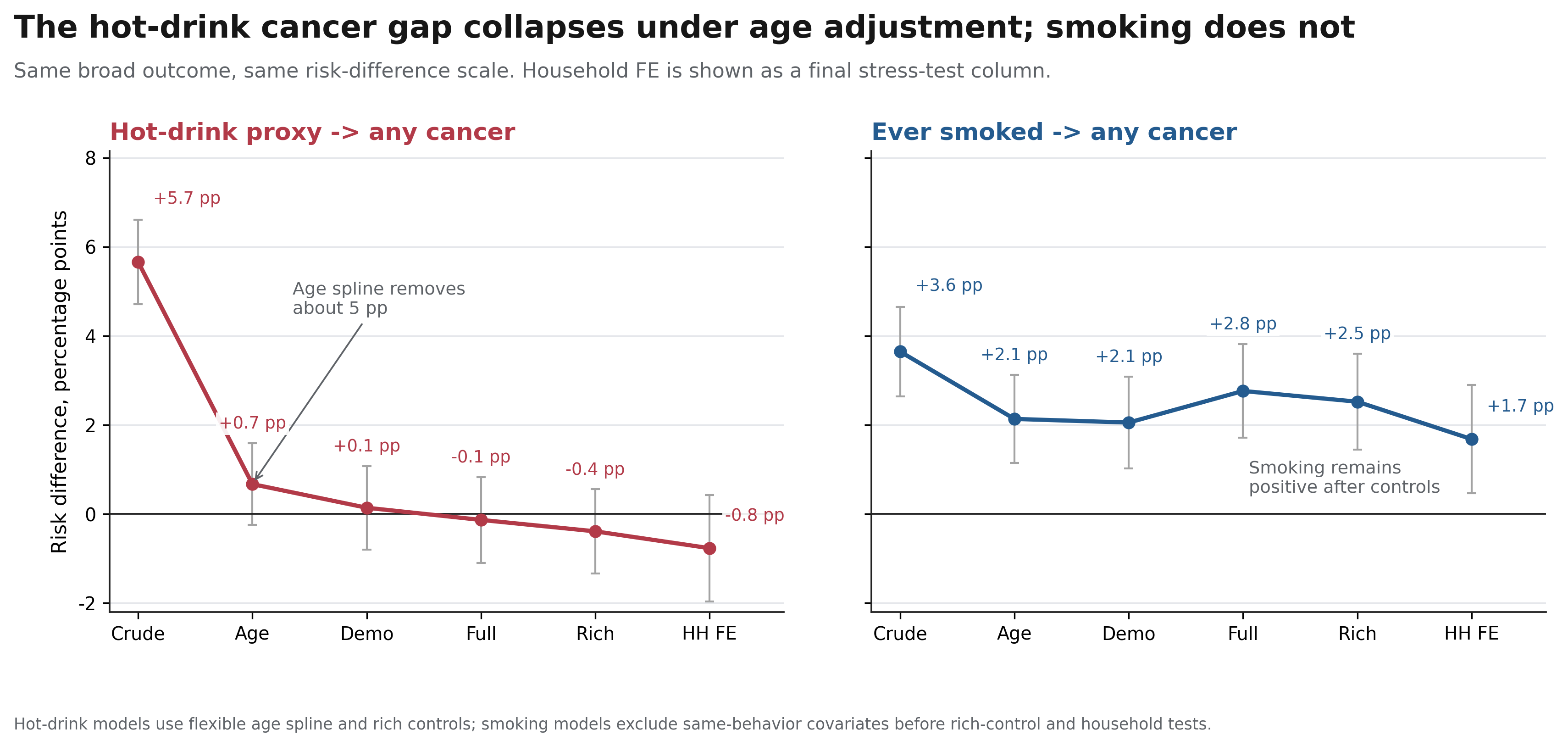
The first thing I did was I looked to see if hot drink consumption being linked to cancer replicated in the NHANES4. It did. But, even using basic controls eliminated any signal. As a positive control, this was not true for smoking. As it turns out, the hot drink → cancer link in the U.S. looks to reflect the fact that older people drink more hot drinks and also get more cancer, whereas smoking just seems bad.
We can verify this confounding signal by scrutinizing the specific types of cancer that hot drinks seem to ‘increase’. Several cancers cannot be increased by hot drink consumption because there’s no way for there to be thermal damage effects and the substances in coffee and tea are not carcinogenic in their own right. Even switching around the comparison group materially changes the results. For example, comparing hot drinkers to non-drinkers, lung cancer seems elevated for the drinkers, but looking among hot drinkers, consumption is robustly linked to lower risk of lung cancer!
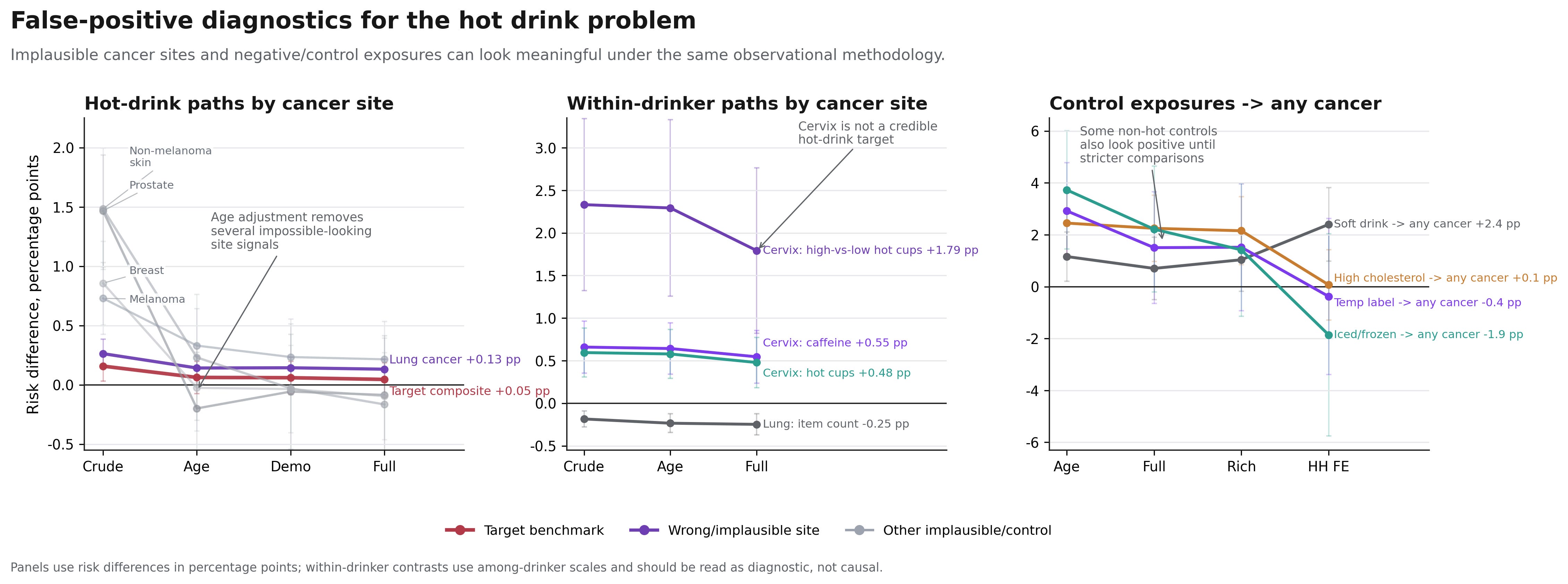
If you look on the right-hand panel, you’ll see that some things even look to be carcinogenic in some analyses, when we know from causal analyses that they are not, providing us with more assurance that the pattern observed for hot drinks in some cohorts can arise even without causality being present.
To be sure, I’m not the first person to notice these sorts of odd findings. Some people have been motivated to look into oddities around the claim that maté causes cancer. For example, Bates et al. found that it was related to cancer among ever-smokers, but not never-smokers, and that the cancer in question didn’t make sense, as it was bladder cancer. De Stefani et al. also conceded that temperature couldn’t explain a bladder cancer risk bump and Weng et al. failed to affirm the link with tea, with largely culturally disjoint samples—a likelier explanatory factor.
It’s unlikely that hot drinks cause cancer. Where we have causally informative evidence for a particular type of hot drink, there’s nothing to see.5 Where the evidence is more limited, suspect, and seems to be wholly dubious, there looks like there’s something, but it’s clearly confounded to such an extreme extent that if we accept the results, we have to also accept ideas like that smoking doesn’t cause cancer. Where the quality of non-causal evidence is very good, we can make out that the signal is clearly confounding-driven and it disappears with adequate controls.
Frankly, I think we can just put this idea to bed and say that hot drinks probably don’t cause cancer. To the extent they do, it has to be limited, below the level detectable with samples reaching into the tens of thousands.
This was a timed post. The way these work is that if it takes me more than one hour to complete the post, an applet that I made deletes everything I’ve written so far and I abandon the post. You can find my previous timed post here. I wrote this because a friend wanted me to assess whether hot drinks were likely to cause some of his health problems.
A message from my sponsor, Mechanize:
We’re hiring software engineers to build environments and evals that frontier AI labs use to train coding agents.
To get a better sense of the work we do, you can check out GBA Eval, where we had models build Game Boy Advance emulators from scratch and scored their performance.
Base pay starts at $300K/year for junior software engineers, with more for senior roles, plus equity and performance bonuses. Apply here.
Accordingly, their intake was artificially low, making coffee look especially risky.
This is unlikely to be strongly valid if they’re using data from a behavioral trait like ‘cups of coffee consumed per day’, but it’s valid the way people have tended to do it. Some studies, however, have used the behavioral trait GWAS for coffee, and I’m not a fan of it, but it produces consilient results with other methods, so it’s likely fine.
Notably measured with error!
I used the same analytic methods and covariate sets from my previous analyses, dropping things related to the independent variables as needed.
The hot drink proxy is constructed based on the consumption of hot coffee, coffee substitute, and tea. This excludes cold and frozen versions of coffee and tea that’s not labeled hot. This matches the construction of the independent variable in much of the rest of the literature including some of the Golestan papers, making it appropriate.
And lack of consumption of coffee doesn’t seem to cause a corresponding bump in the consumption of other hot drinks, so this is a strong point to make.
if you're interested in the theological justification for the prohibition against hot drinks. As it states in the very beginning of the Revelation that talks about " in consequence of evil designs that do and will exist in the heart of men in the last days, I give you this.... word of wisdom"
It's not really a health claim at all. It doesn't even say that the practices themselves are uniquely, evil, but more the instruments to be used by "evil designs and conspiring men." that is the reason for the prohibition.
If any of your Mormon friends tell you otherwise. I'm sorry they're wrong